Into thin air – how high can you go before rider, motorcycle and mountain reach their limits?
I was sitting at my desk in the museum, deep in the daily swamp of emails and meetings, when AMCN editor Greg called. “There’s a spot on a Royal Enfield ride through Ladakh in a few weeks. You ride it, then write the story. Interested?” My quick response was yes. Then a few moments later I realised there is always a small, dangerous gap between accepting an adventure and understanding what you’ve agreed to.
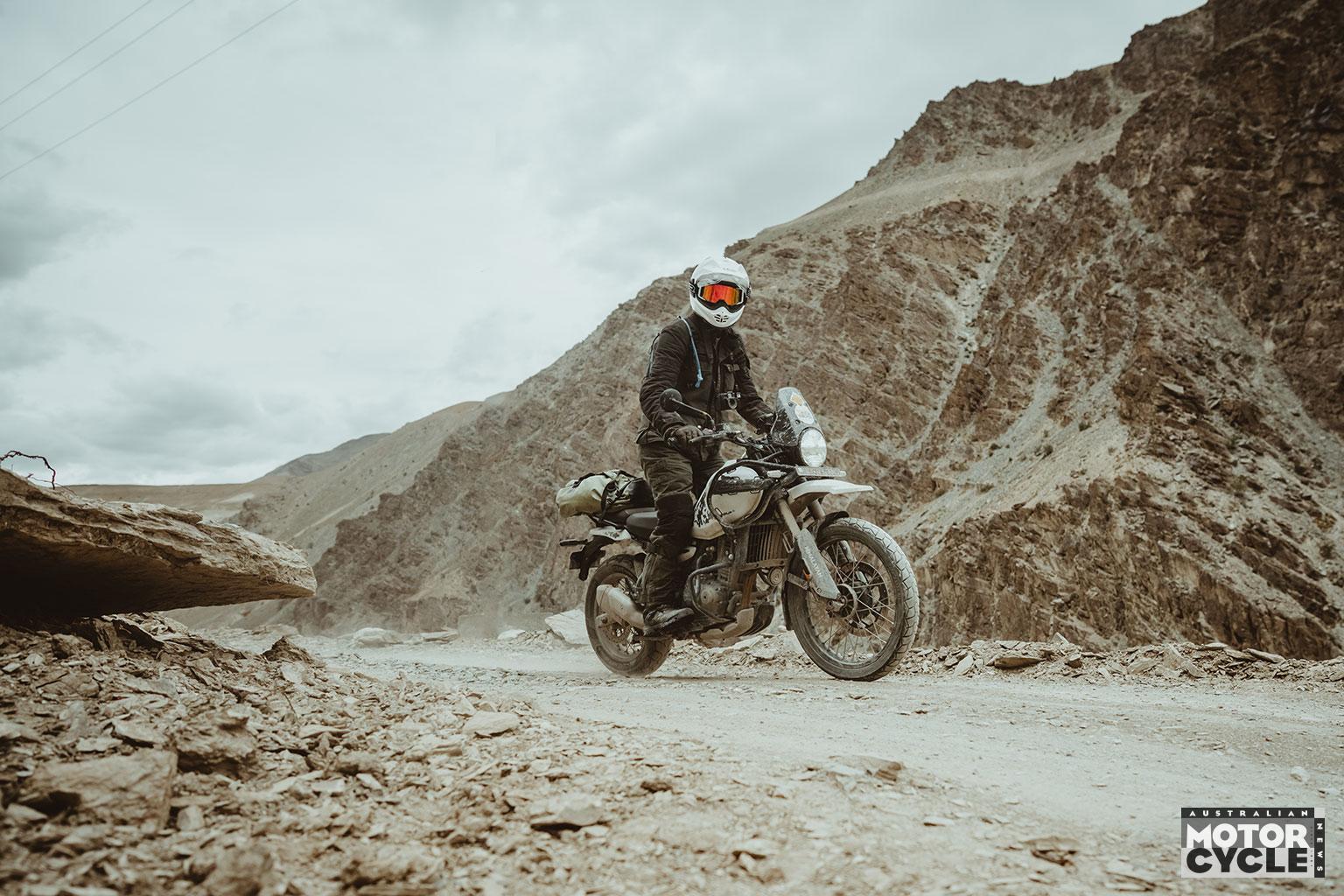
Since 2018, Moto Himalaya has taken small groups deep into Ladakh, India’s northern frontier, across broken tracks, river crossings and some of the highest roads on Earth. We’d spend 10 days riding through mountains before eventually reaching Umling La, higher than Everest Base Camp, where the air is thin, the guardrails are scarce and the nearest office meeting is a very long way away.
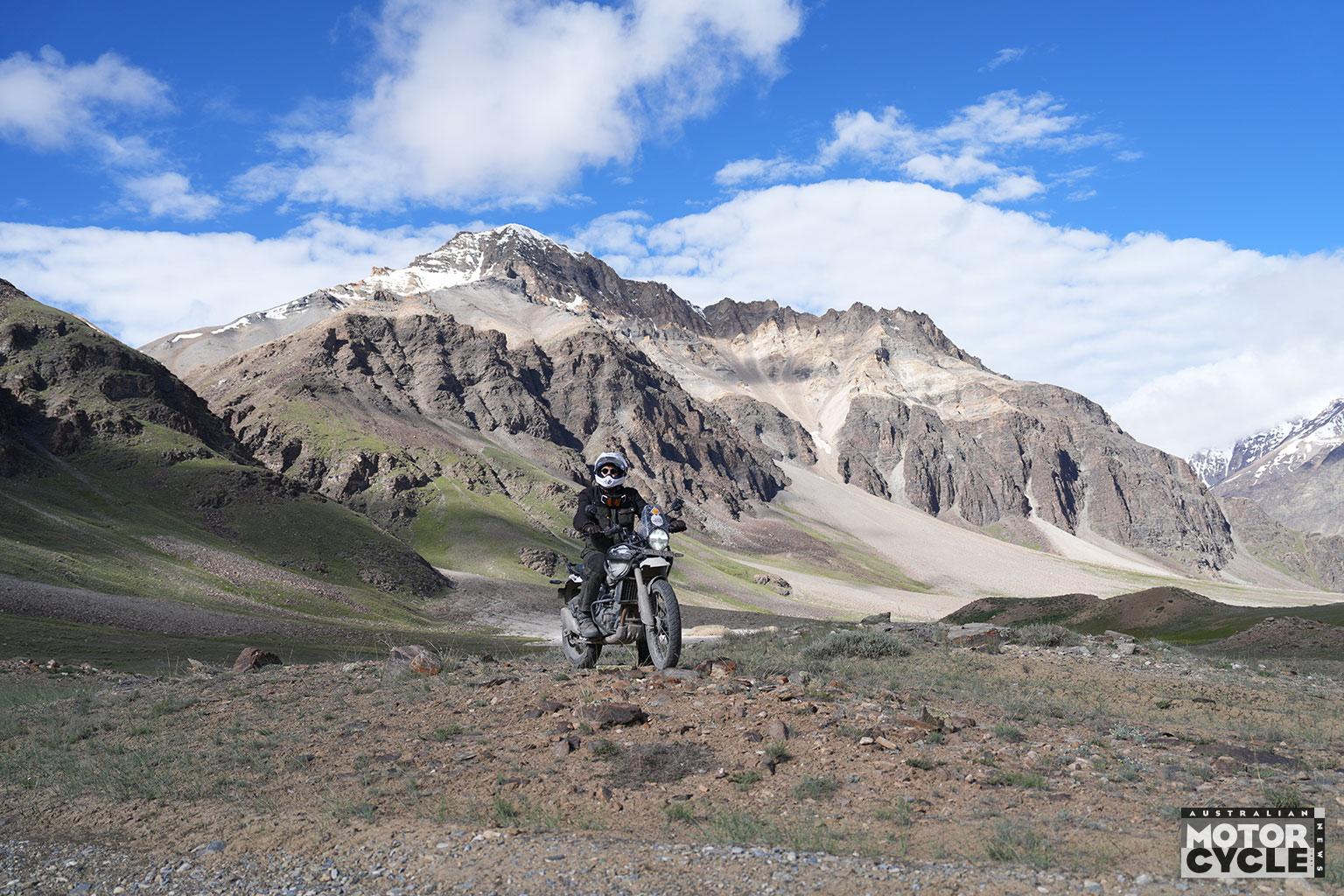
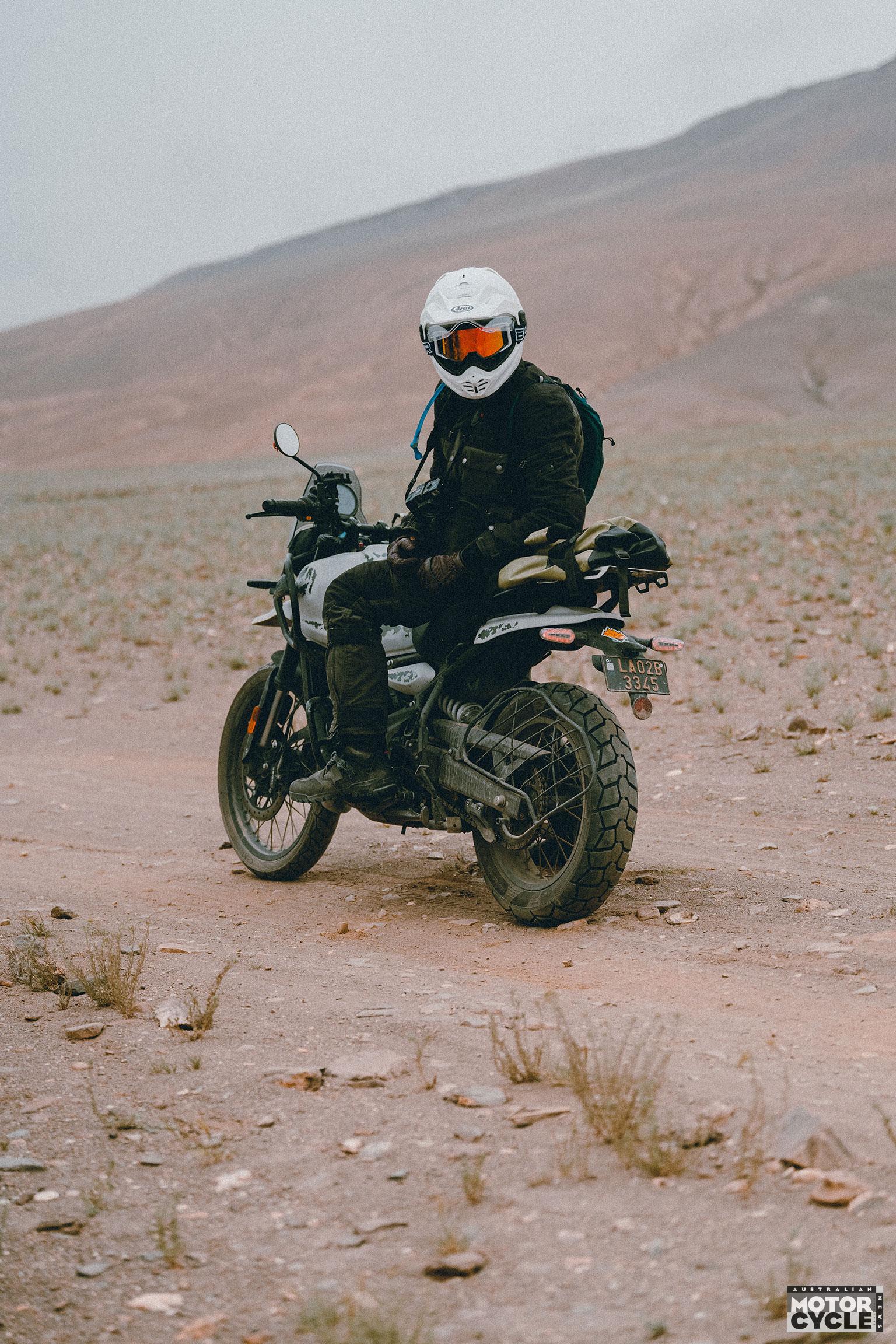
The bike was Royal Enfield’s new Himalayan 450, a motorcycle developed in these mountains for exactly this kind of riding. One cylinder. One mechanical heartbeat. One job, repeated at altitude, a hundred kilometres from anywhere.
It felt like a once-in-a-lifetime opportunity.
THE BIKE
Royal Enfield has been building motorcycles since 1901, making it the oldest motorcycle brand still in continuous production. While the original British company disappeared decades ago, the Indian operation survived, evolved and ultimately inherited the name. Today, more than a million Royal Enfields roll out of factories around Chennai each year.
The Himalayan is perhaps the purest expression of its modern history. It first arrived in 2016; inexpensive, uncomplicated and built less for speed than endurance. It became the motorcycle riders trusted to disappear into the Himalayas – and, more importantly, return.
The 450, introduced in late 2023, brought liquid cooling, a substantial jump in power and modern electronics without changing the philosophy. Strip away the TFT display and Google Maps and it remains a remarkably simple motorcycle designed for places where simplicity still matters.
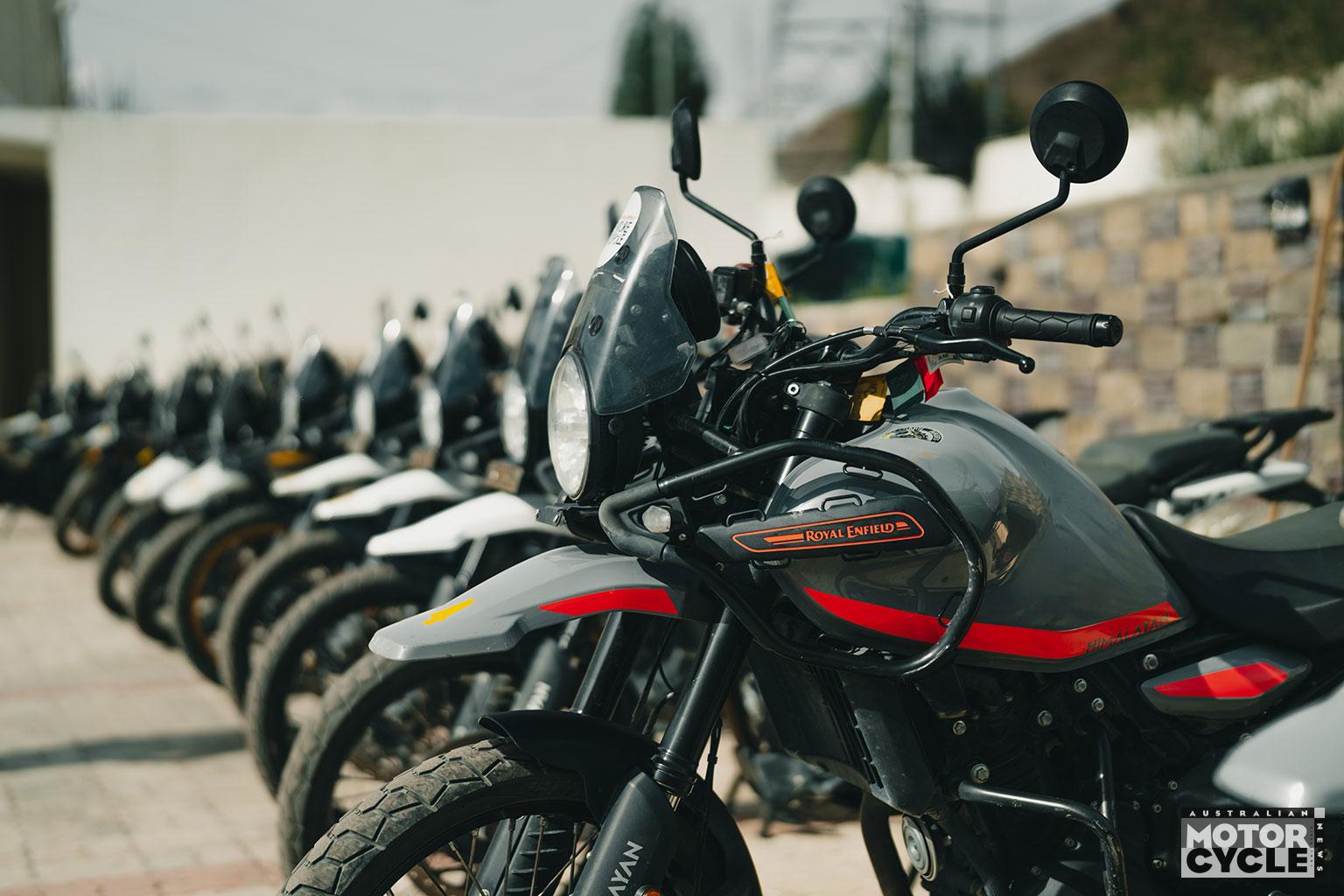
The trip was put together by Royal Enfield, with the Australian participants ably assisted by David Song from Moto Machine, Royal Enfield’s largest Sydney dealership. In Ladakh, David arrived wearing a one-off Kabuto and Deus Ex Machina helmet stamped with the coordinates of this year’s expedition before we’d even ridden them.
It set the tone perfectly.
ARRIVING THERE
Our flight cuts north out of Delhi towards Leh. We drop through cloud and emerge surrounded by mountains, the aircraft threading its way between them. Dry, dust-coloured ridges stretch towards snow-capped peaks on the horizon, while rivers carve through the valleys below like the ribs of some enormous fossil.
I raise my camera towards the window. “No photography,” the flight attendant says. Leh airport doesn’t do touristy welcomes; it does military salutes. It’s the highest altitude airport in India, built for fighter jets, flanked by bunkers dug into the landscape. Outside it’s a mess of taxis, soldiers and bewildered tourists looking exactly how I feel.
The air has already made up its mind about me; one flight of stairs to the taxi and I’m breathing hard.
A new terminal is under construction, India’s first geothermal-solar hybrid airport, designed for visitor numbers that barely existed a decade ago. Ladakh has become one of India’s fastest-growing destinations, offering relief from the furnace-like summers farther south while opening up a landscape that had remained largely inaccessible to outsiders for generations. Everywhere you look, change is arriving.
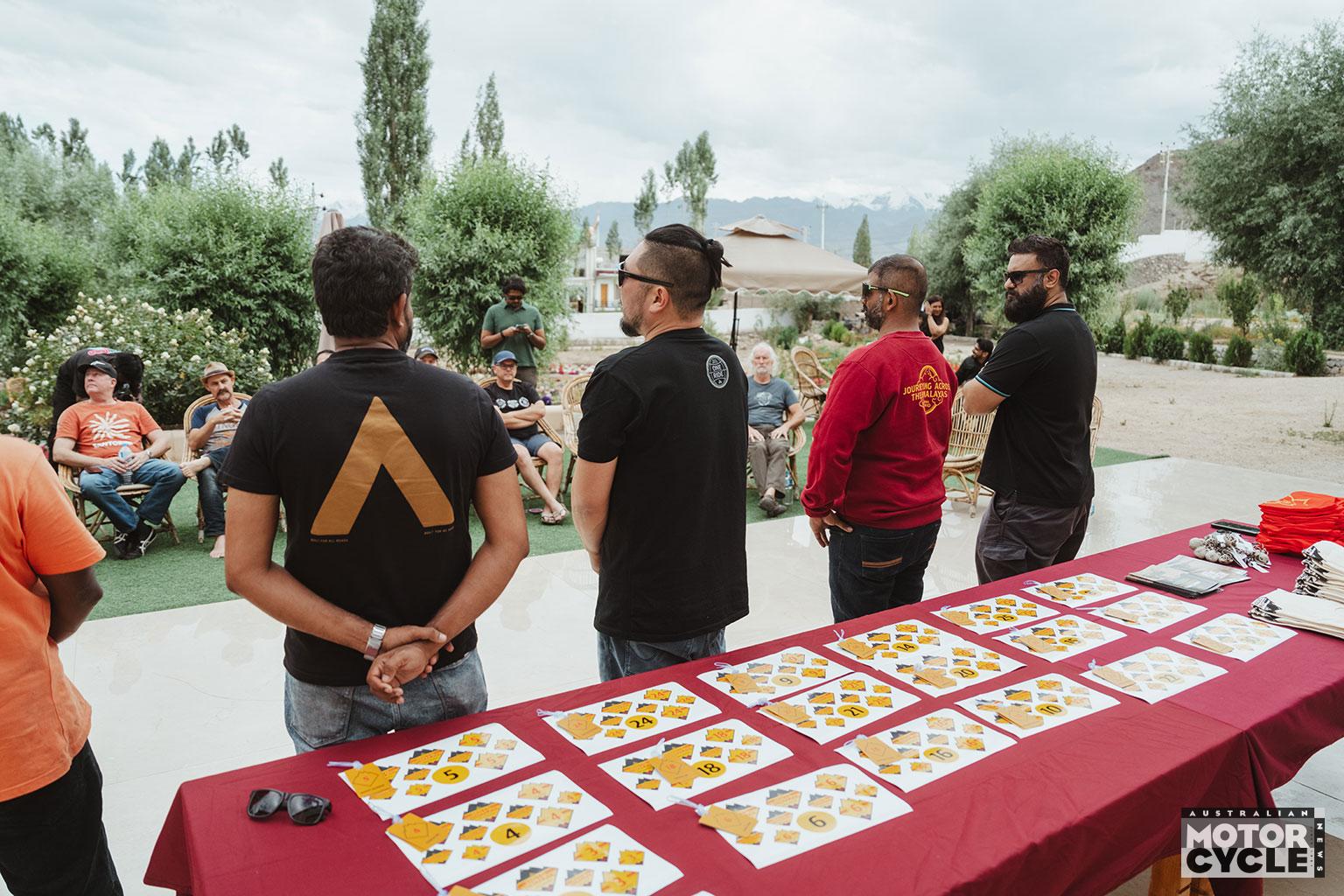
At the hotel we meet Ricky, Kegan and VJ, Royal Enfield’s guides, men who have run this loop enough times to have stopped pretending it’s casual. “Take it slow,” they warn us of coping with the altitude. “Not slow. Very, very, very slow.”
From the outset we’re warned that not everyone will make it to the end. Each year, at least two riders fail to complete the journey. The mountains usually collect a few names through altitude sickness, stomach trouble, exhaustion, an accident after one bad decision made at speed. Dr Sam will travel with us the entire way, checking oxygen levels and pulses. If he sees a risk he will make a call. When that happens, nothing will be optional.
We’re given two full days to do almost nothing, which sounds like luxury until you realise it’s really triage. They used to allow riders only one day to acclimatise, until enough people got sick that they doubled it.
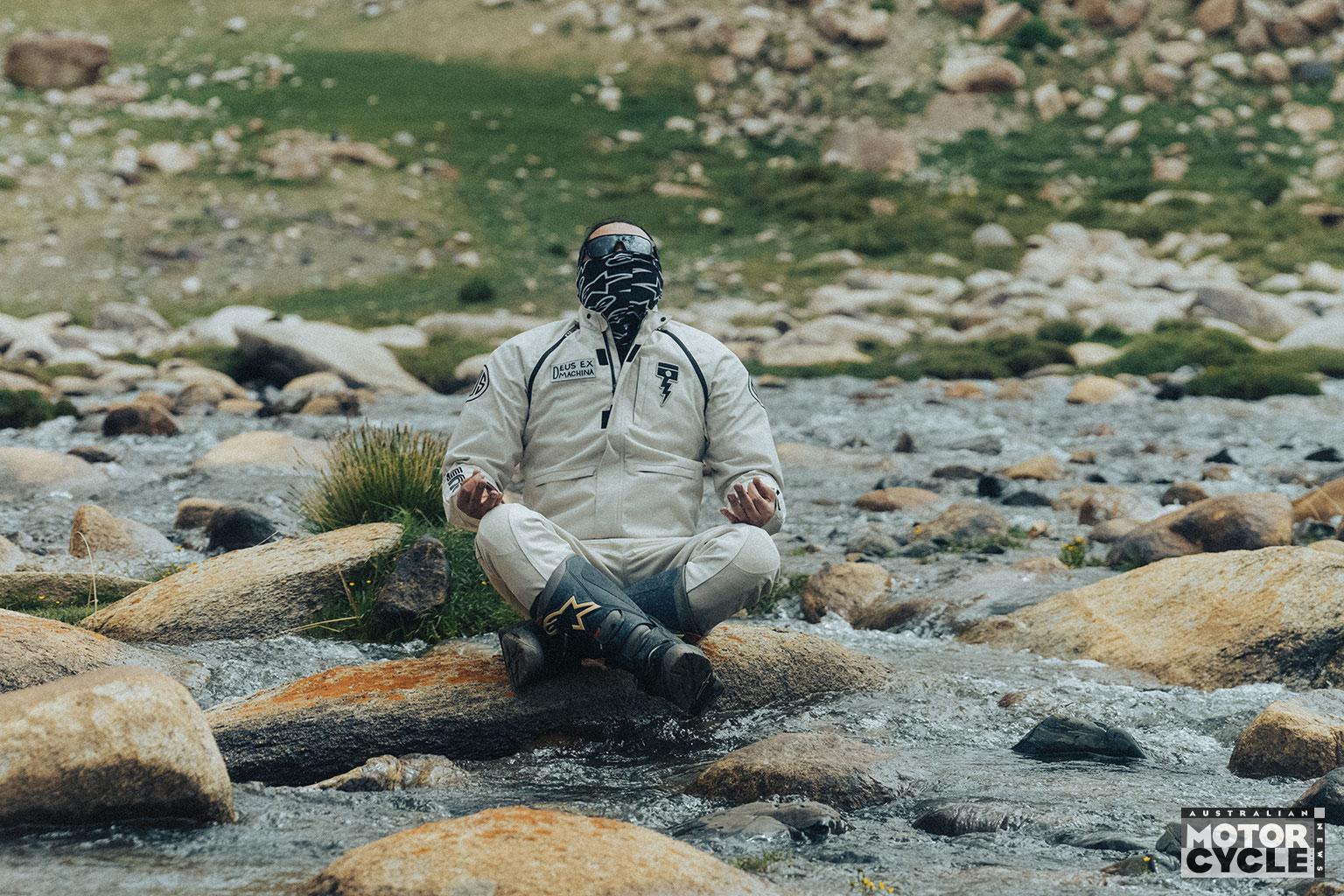
Altitude sickness begins innocently enough with headaches, nausea, breathlessness. Ignore it and it can become life-threatening. The cruel part is that fitness offers no guarantees. A chain-smoker might sail through untouched while an elite athlete ends up in hospital. Up here, knowing when to stop can matter as much as knowing how to ride.
Before leaving Australia, I’d tried to stack the odds in my favour. For several weeks I trained inside Sydney’s Rozelle Combine Air gym, where oxygen levels are reduced to simulate altitude. My trainer, Sam Cubbin, built a program around long periods standing on the pegs, strengthening my core and legs to cope with days of riding rough terrain.
The first session left me with a 12-hour headache. By the fourth, my body had stopped complaining.
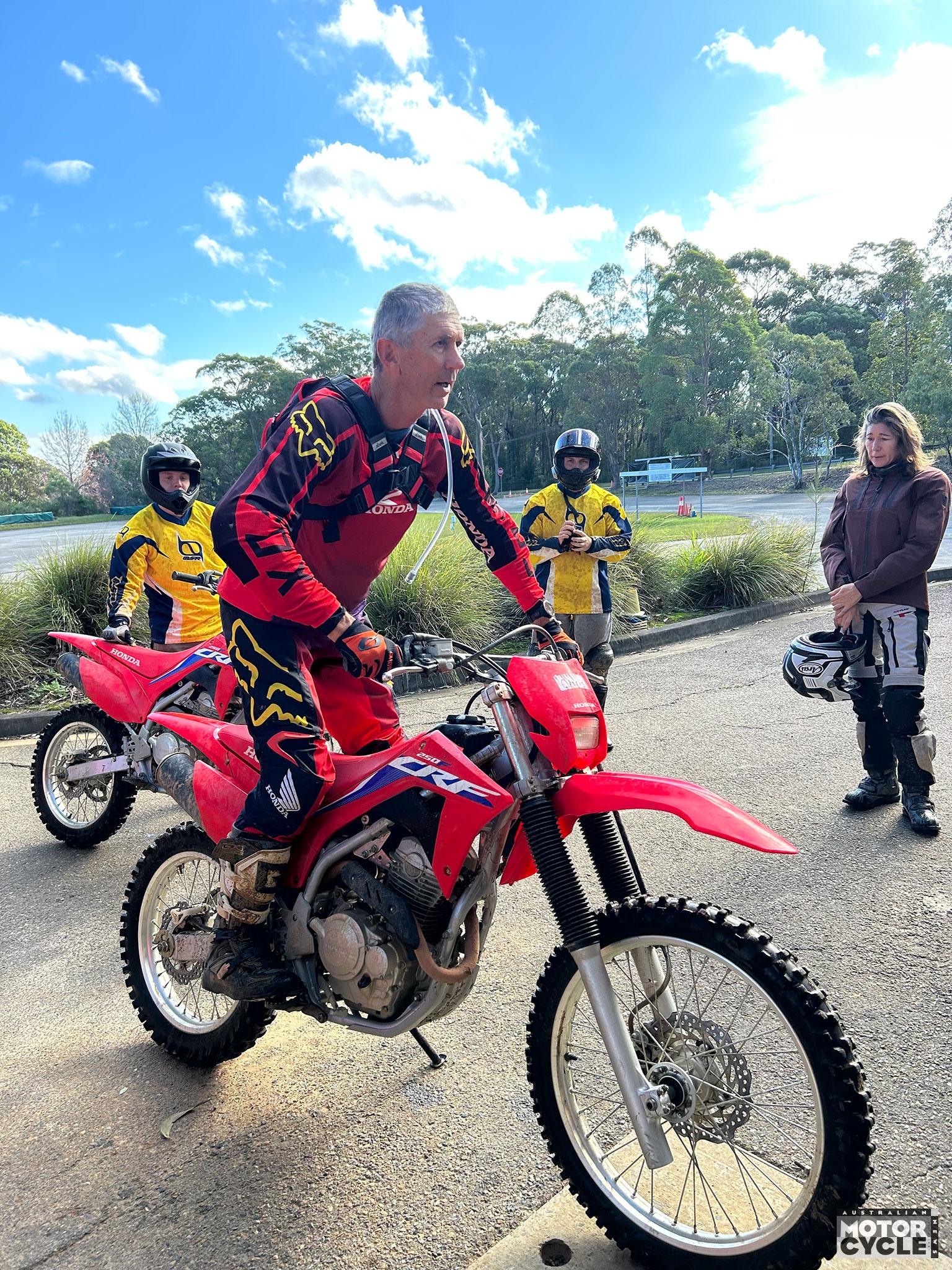
I also booked a dirt refresher with HART. Years of road riding had left me with habits that don’t translate particularly well off-road, especially standing posture, weight distribution and allowing the bike to move beneath me instead of fighting it.
Before departure I visited a travel doctor rather than my regular GP, collected a small pharmacy of medication, updated my vaccinations and navigated India’s surprisingly involved visa process. Fortunately, David Song had already assembled a comprehensive briefing pack for the group. Small thing, but it’s the kind of small thing that tells you who you’re about to spend 10 days trusting in India.
Even so, none of it prepared me for climbing half a flight of stairs at the hotel in Leh. I stopped halfway to catch my breath. The mountains had won the first round.
DAY THREE – FINDING OUR FEET
Two days of sitting still, then, after the mandatory morning medical check, they let us onto the bikes. Not for the expedition itself. Just a 60km out-and-back to acclimatise to the Himalayan 450, the altitude and each other, in that order.
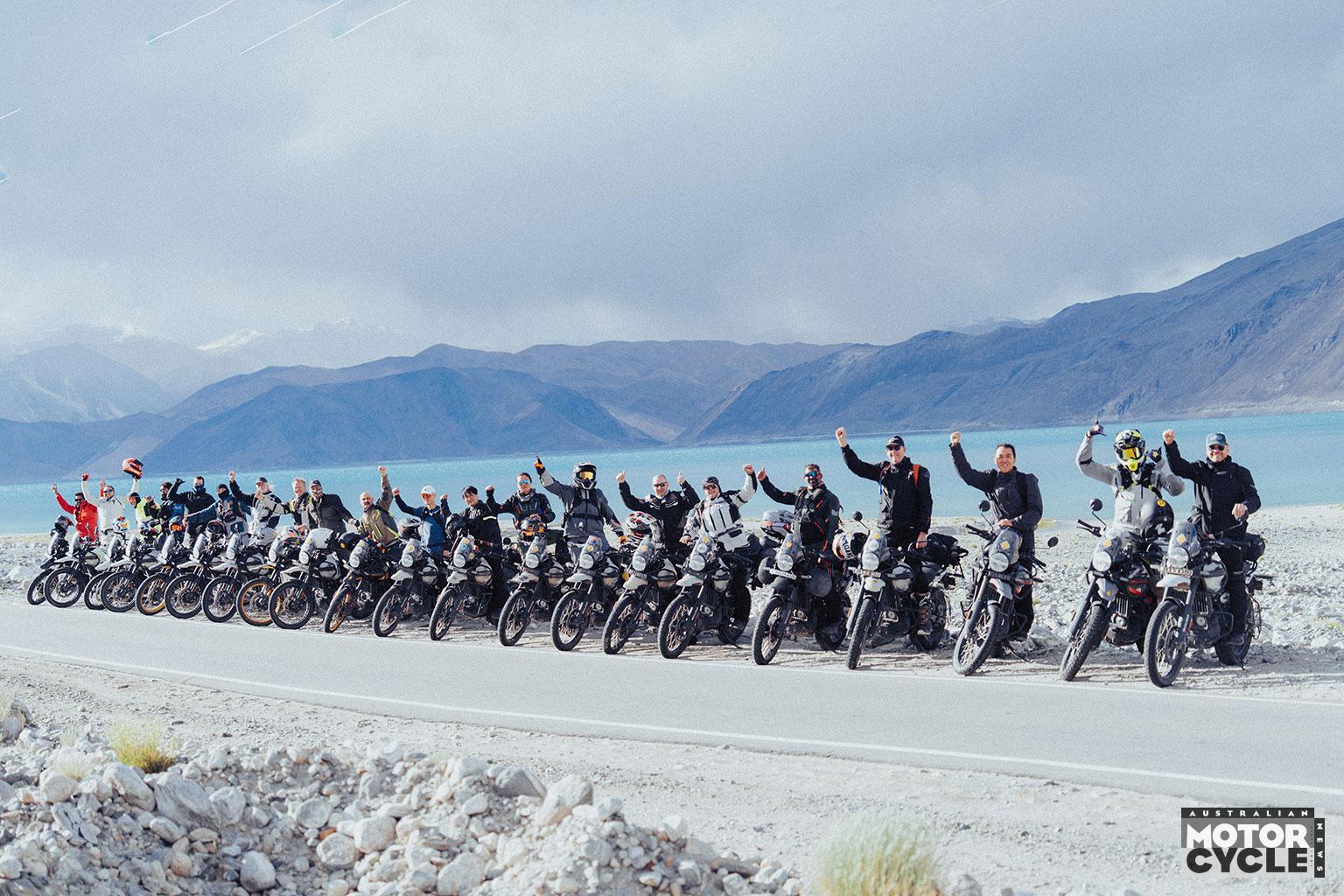
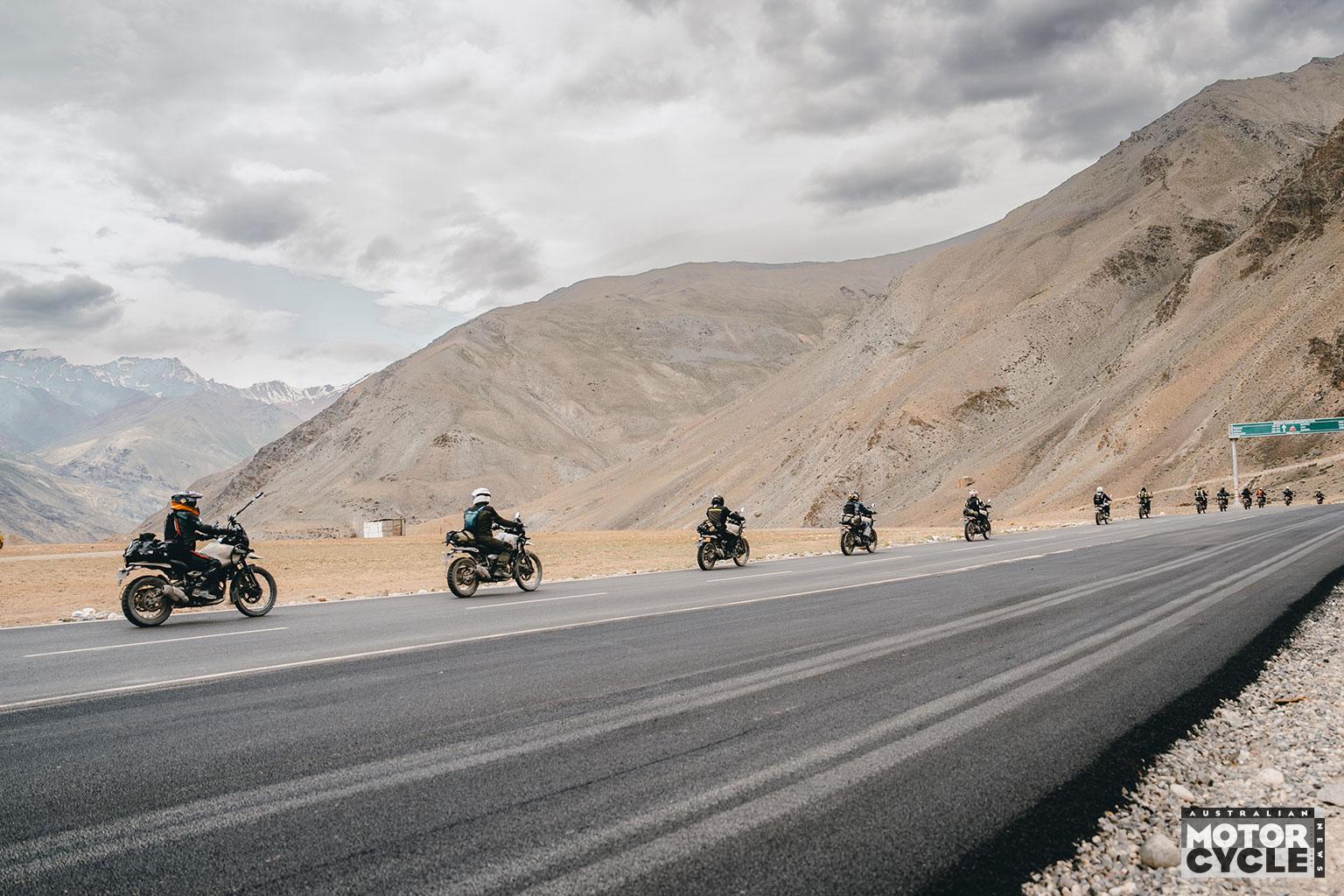
There are 17 riders in our group – Australians, South Koreans, a Brit and a German. Our Himalayans have been supplied by a local rental rather than the factory, part of Royal Enfield’s commitment to supporting regional businesses.
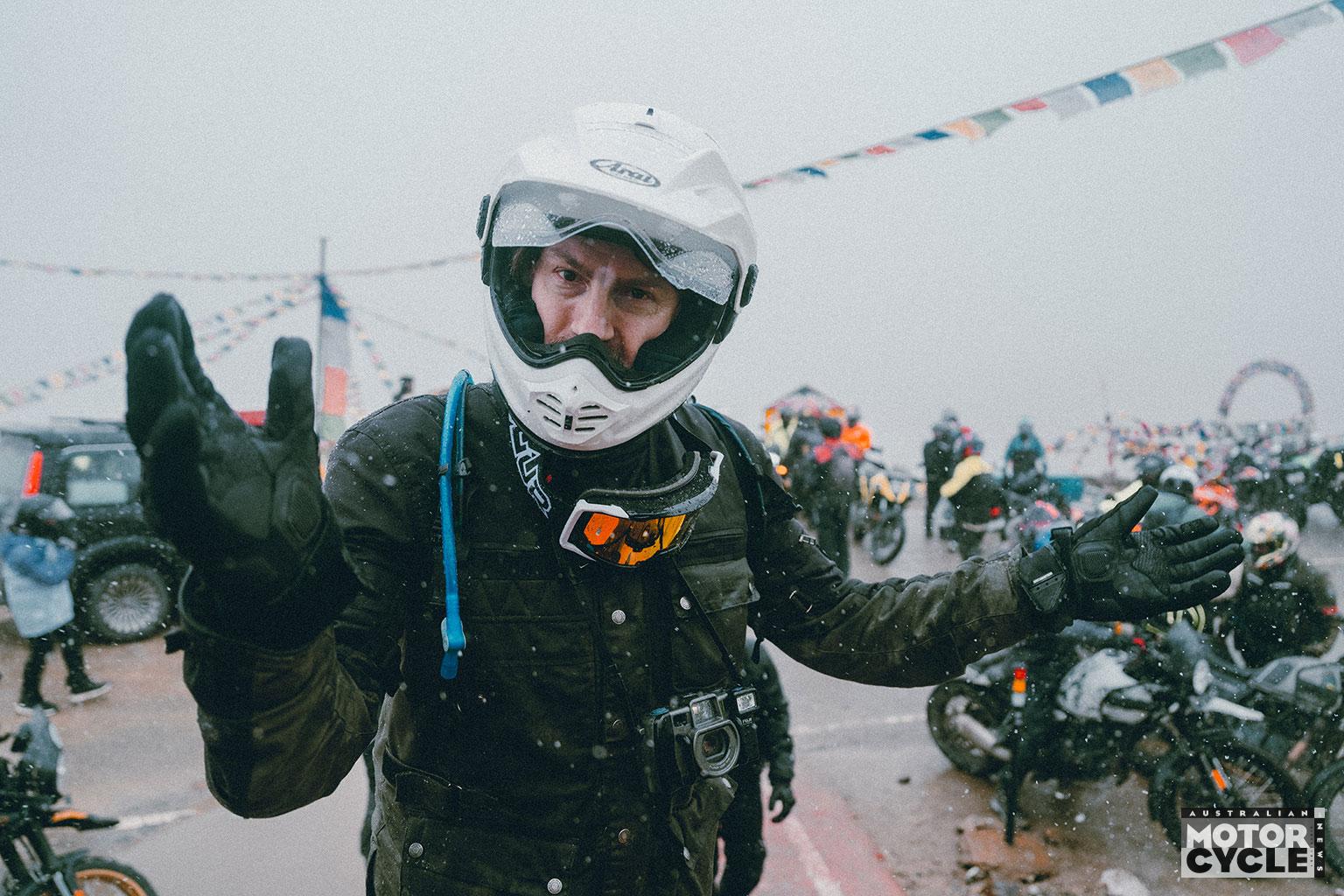
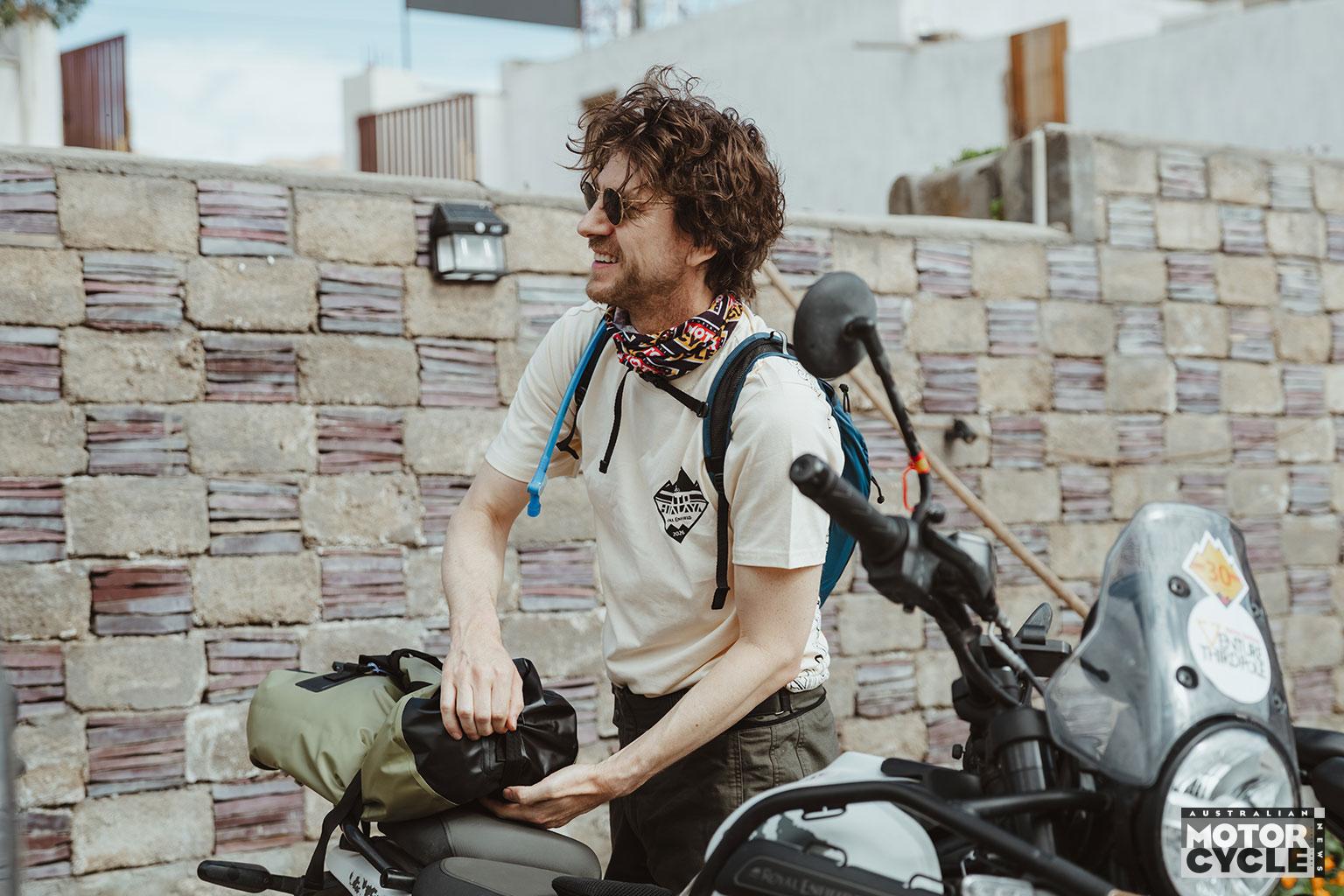
The temperature catches most of us by surprise. I’d packed for mountain cold and arrived in the middle of a high-altitude summer. My Merlin Mahala Explorer jacket and pants, complete with D3O armour and Maverick Explorer boots, were faultless for protection but considerably warmer than I’d imagined needing.
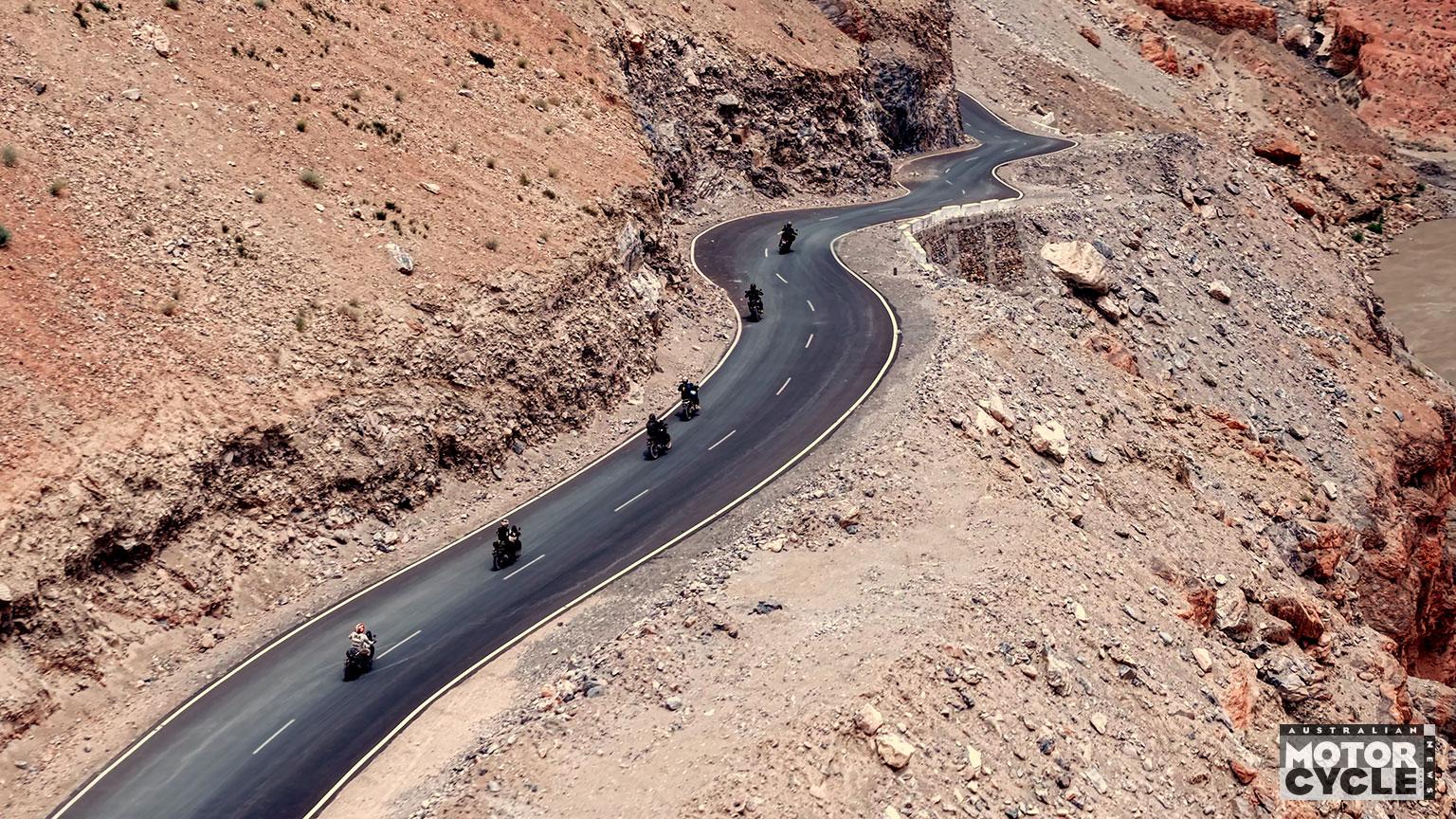
The roads leaving Leh are smoother than many around Sydney, although the traffic quickly teaches me that road rules here are more suggestion than law. After half an hour we leave the town behind and begin threading our way through valleys carved into sheer cliff faces.
This is our first chance to see how everyone rides. The South Koreans move almost as one, instinctively closing ranks whenever someone drops behind. The Australians are looser, each rider settling into their own rhythm. Two different approaches to the same road.
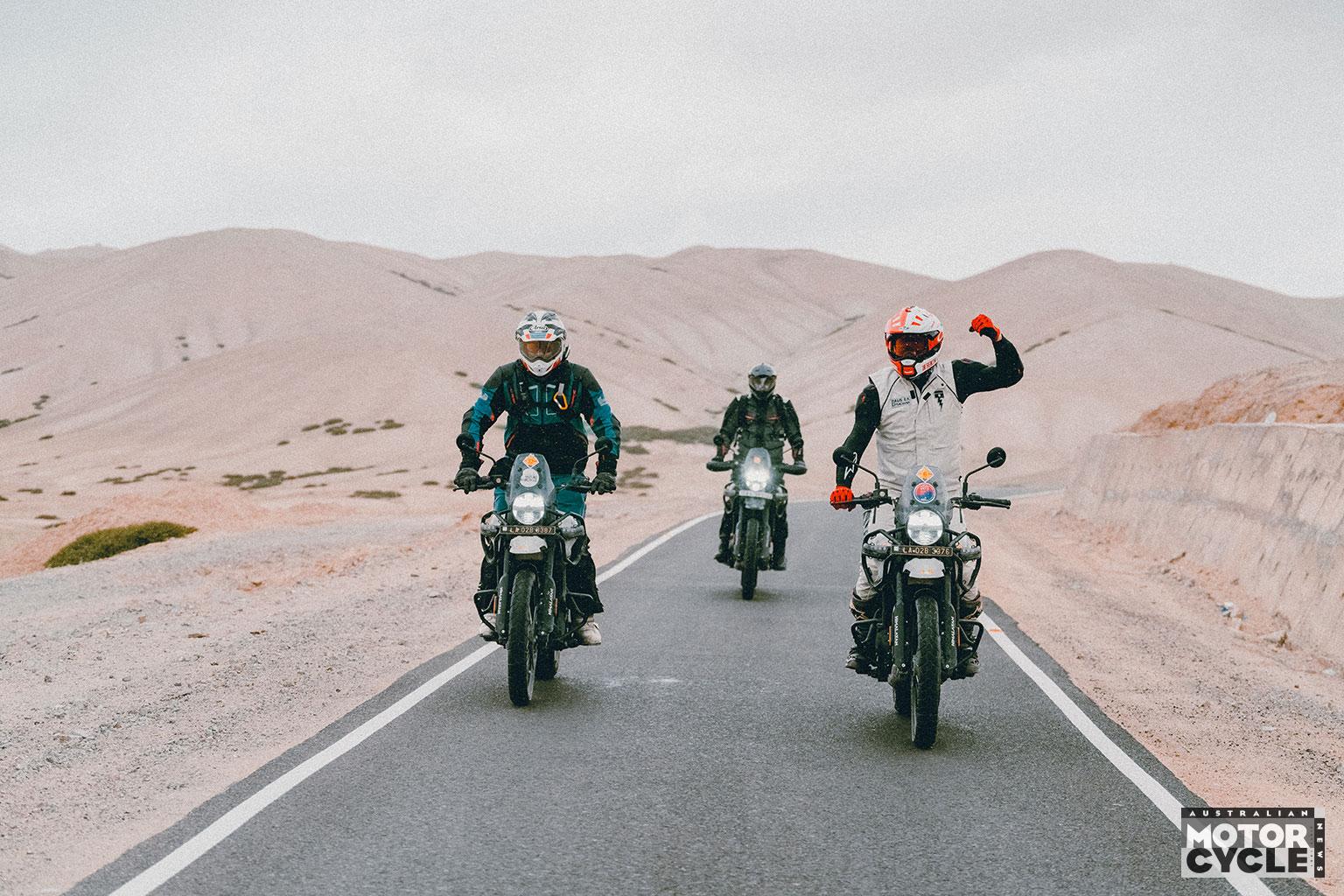
The plateau gives out, the road folding into a valley cut straight into the cliff face. As the road starts to wind down, it’s blind corners after blind corners. My confidence for Indian roads over the past 40 minutes is built then immediately reset. A broken-down truck across the lane of a blind corner, a gasp, but traffic in both directions giving space around it with predictable logic.
The scenery grows steadily larger until the mountains begin swallowing perspective altogether. At Sangam Point we stop where the Indus and Zanskar rivers meet beneath the road. Right now it’s simply another spectacular stop. It won’t be until the final day that I realise we’ve just ridden to the finish line before we’ve even started.
On the way back, the engine light flickers and the power drops twice, once while I’m overtaking. I turn the bike off and back on, the oldest trick in the IT department and apparently just as effective in the Himalayas. But for the rest of this ride I leave more room and take things slower.
I do not get an explanation until we return to the hotel. My theory is E20. The ethanol may have loosened debris inside the tank and carried it into the fuel filter. The mechanics replace filters on a couple of the bikes, which make the theory feel less imaginary, although hardly conclusive.
E20 had been planned years before Trump’s Gulf conflict with Iran, part of India’s long campaign to burn less imported oil. The conflict merely added urgency. The country was already moving towards E85 for specially built flex-fuel machines. Progress, apparently, comes with increasingly alcoholic petrol.
Maybe that was it. Maybe not. Either way, the warm-up ride had done its job: find out what breaks two hours from a hotel, not 200km from anywhere.
DAY FOUR – LEH TO PANGONG TSO
We leave Leh at 9am into traffic that should not exist at this altitude. Coloured flags hang above the streets and the whole town is out for the Dalai Lama’s 91st birthday. He’s speaking live somewhere nearby apparently, though all I can see are cars, trucks, bikes and people; obstacles moving in every available direction.
Lane splitting here means trusting a gap before you’re entirely sure it exists. Ahead, the traffic forms a whirlpool, every vehicle maintaining speed while bending around something moving slowly through the centre of the road. A cow.
In India’s hierarchy, the cow outranks everything and knows it.
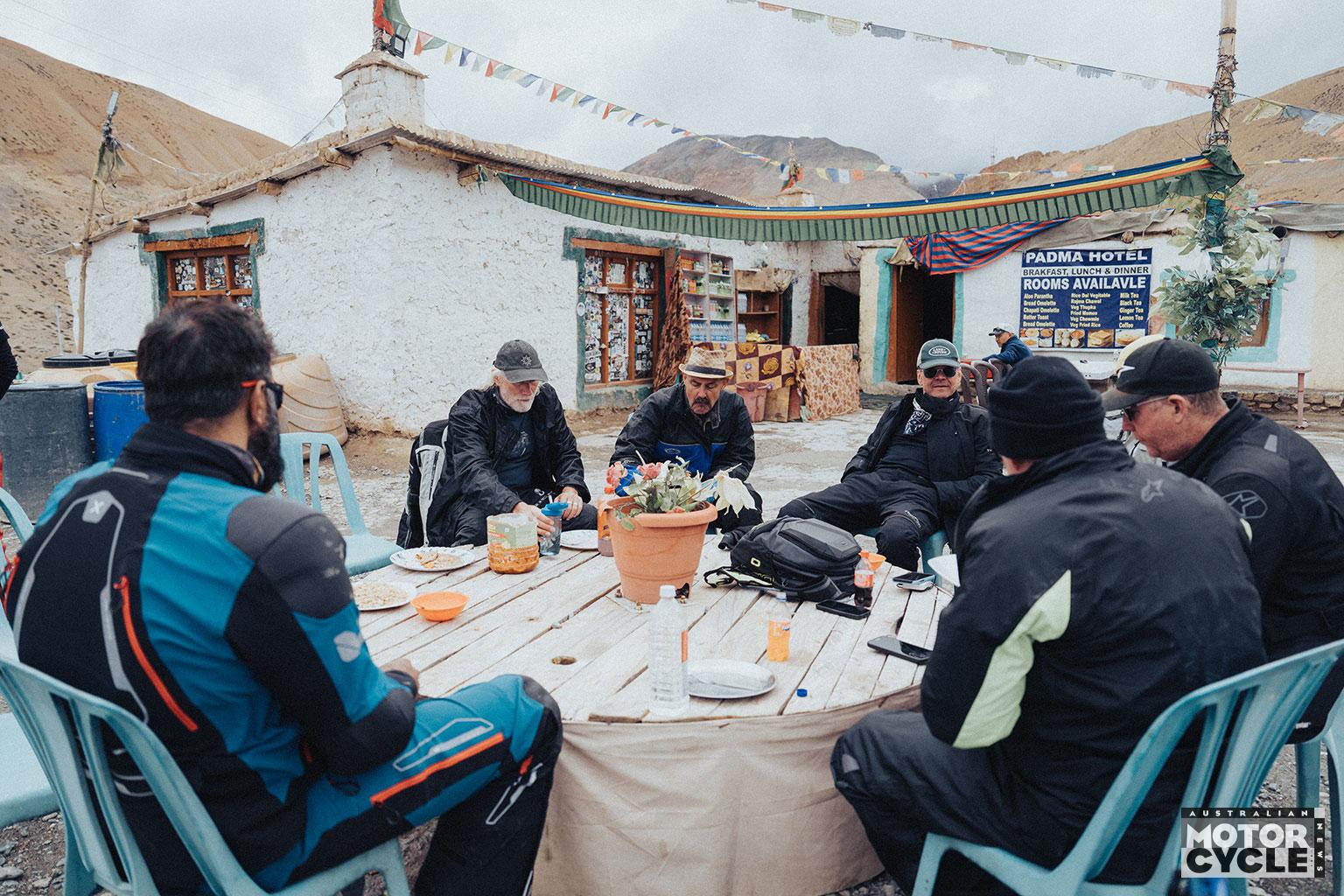
Our first stop is Kari, a small cafe operated by local women through one of Royal Enfield’s community programs. Fresh bread, momos and apricot jam disappear quickly. It’ll be one of the last leisurely meals we enjoy for a while.
As we remount, the sky splits cleanly in two. Blue and clear on one side. Grey and carrying real weight on the other. We climb into it rather than at it, weaving through the valley instead of meeting the cloud head on. By the time we reach the base of the ascent the argument between blue and grey is already decided. We layer up. We stop pretending this is casual.
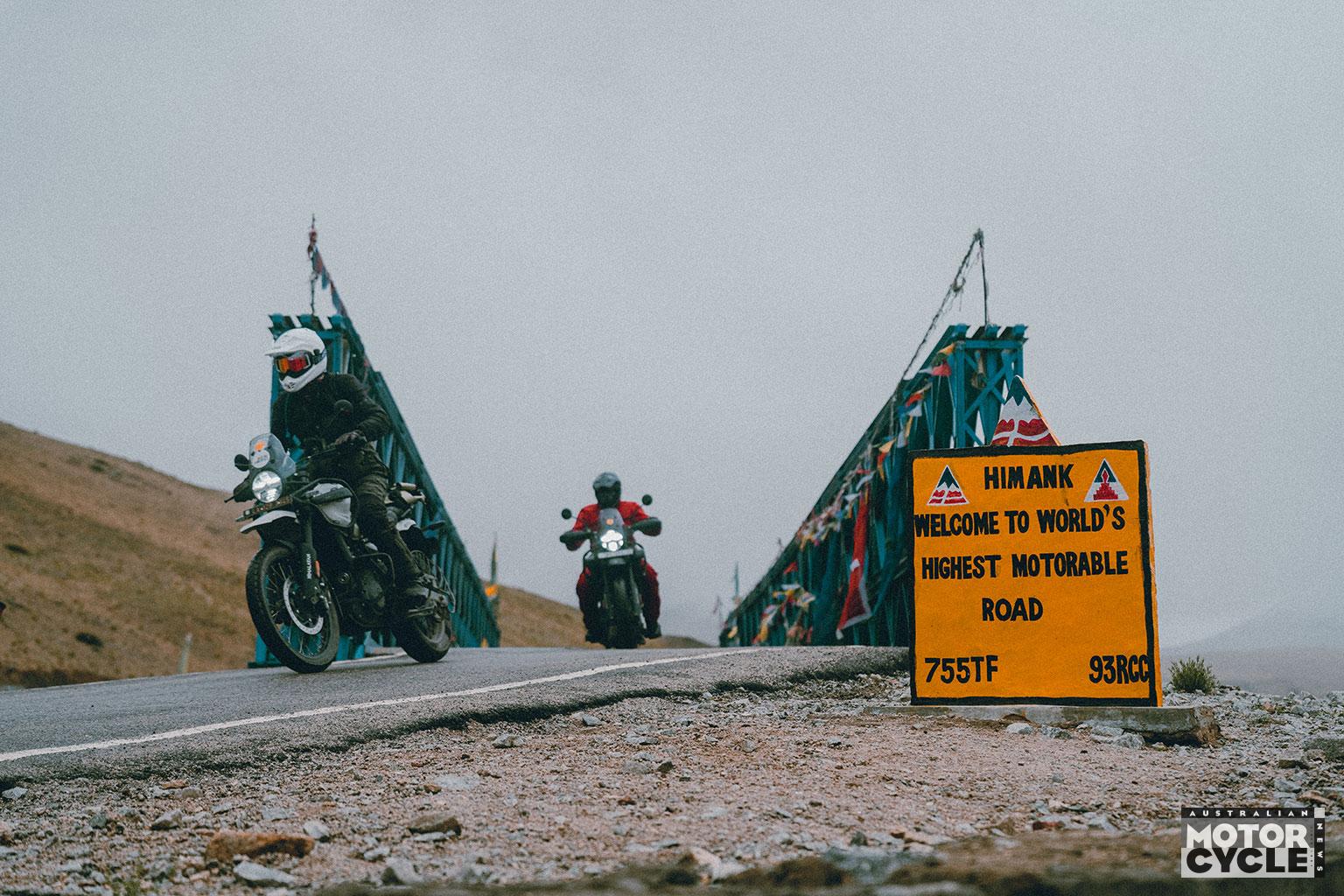
The road narrows as we climb Chang La, one of the world’s highest motorable passes. Hairpins stack one above another. The drop beside the road grows steeper with every corner while the guardrails become increasingly optional. Then, around a blind bend, I meet a backhoe loader coming the other way down the single lane. I move left. Then farther left. Then I’m out of road.
My front brake locks slightly as my left boot searches for ground that no longer exists. My right knee brushes the machine as it rumbles past, leaving me balanced on the edge of a very long drop.
The vehicles following the loader have seen everything. Without hesitation they edge away from the edge, silently handing me enough road to continue. The rest of the climb receives my complete attention.
At 17,590 feet we stop briefly at Chang La, roughly the height of Everest Base Camp; 15 minutes, no longer. Stay too long and altitude sickness can begin and that would put you out for the rest of the trip.
The descent transforms almost immediately. Snow gives way to green valleys, streams and Buddhist monks picnicking beside the roadside. Just three years ago this crossing could take six hours. We complete it in 45 minutes.
Everywhere we ride, Ladakh is changing beneath our wheels. My fuel problem, however, isn’t interested in progress. The warning light returns, power disappears and the group vanishes into the distance. At one intersection I have no idea which road to take until VJ, riding sweep, catches up and points me towards Pangong Tso.
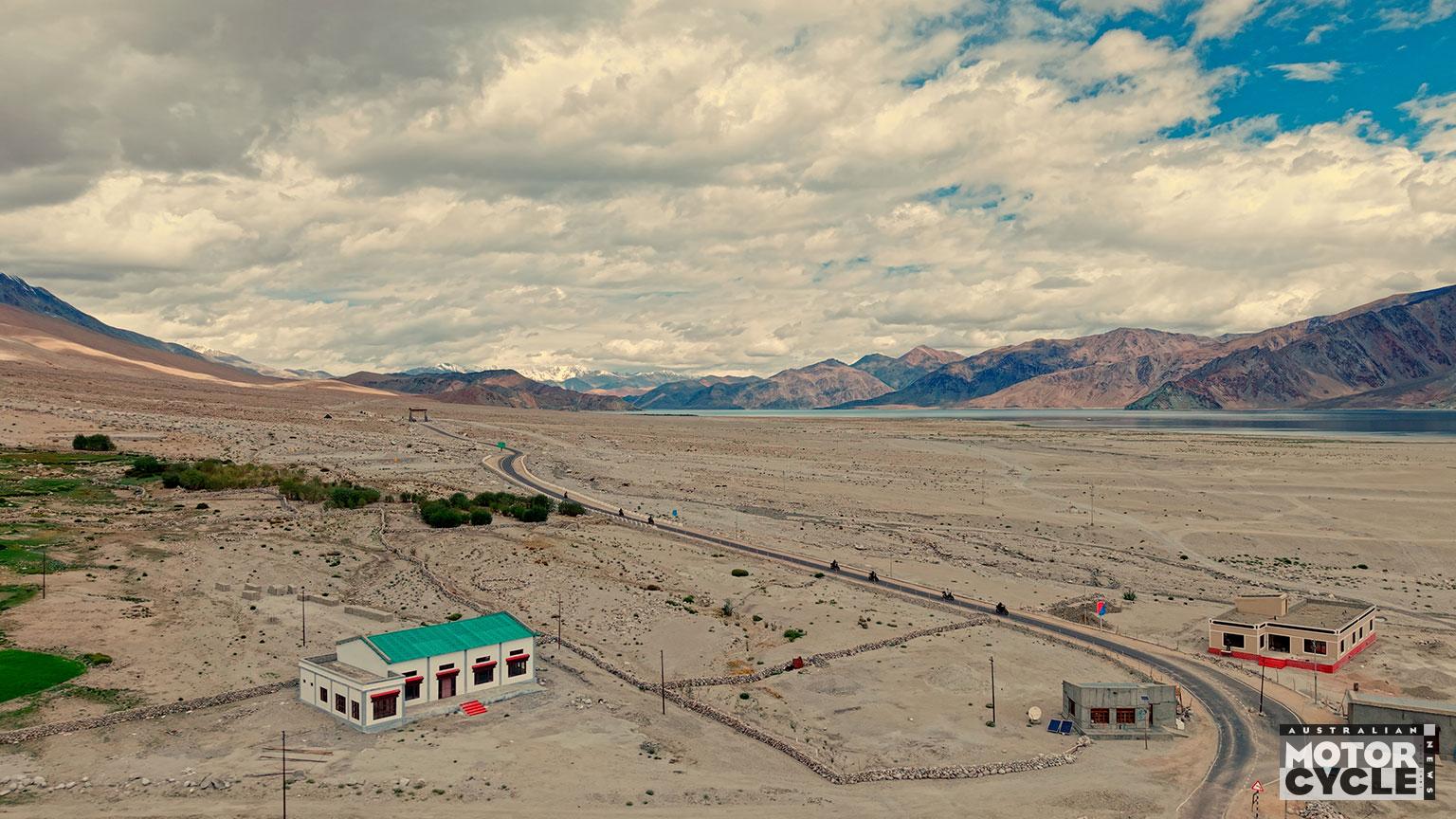
The lake appears slowly, an immense sheet of brackish water changing colour with the light. More than 15 years ago, it appeared in the final scene of a Bollywood film and the shoreline changed almost overnight from remote military territory (this area forms the border of three nuclear powers) into a place of national pilgrimage.
Tourism here still comes with rules; 12 guests to a homestay, no exceptions. Some structures are taken apart each winter to reduce the impact on the reserve, then rebuilt when the roads reopen.
I share a homestay with several of the Korean riders. That evening they produce carefully packed supplies from home – soju, kimchi and fish soup – insurance against 10 days without familiar food. This is not culinary arrogance. It’s about seeking the benefit of familiarity after a challenging ride.
Once the cold settles in, we gather around a bonfire, drinking, eating and talking over one another about the day. The loader grows larger with every telling. The cliff becomes steeper. Everyone was closer to death than everyone else. By night’s end, we’ve all survived several different versions of exactly the same journey.
DAY FIVE – PANGONG TSO TO HANLE
Morning arrives with Pangong Tso stretched beyond the window, blue, cold and absurdly beautiful. The kind of view that makes you forget you have to get back on a bike and continue tempting geography unknown in Australia.
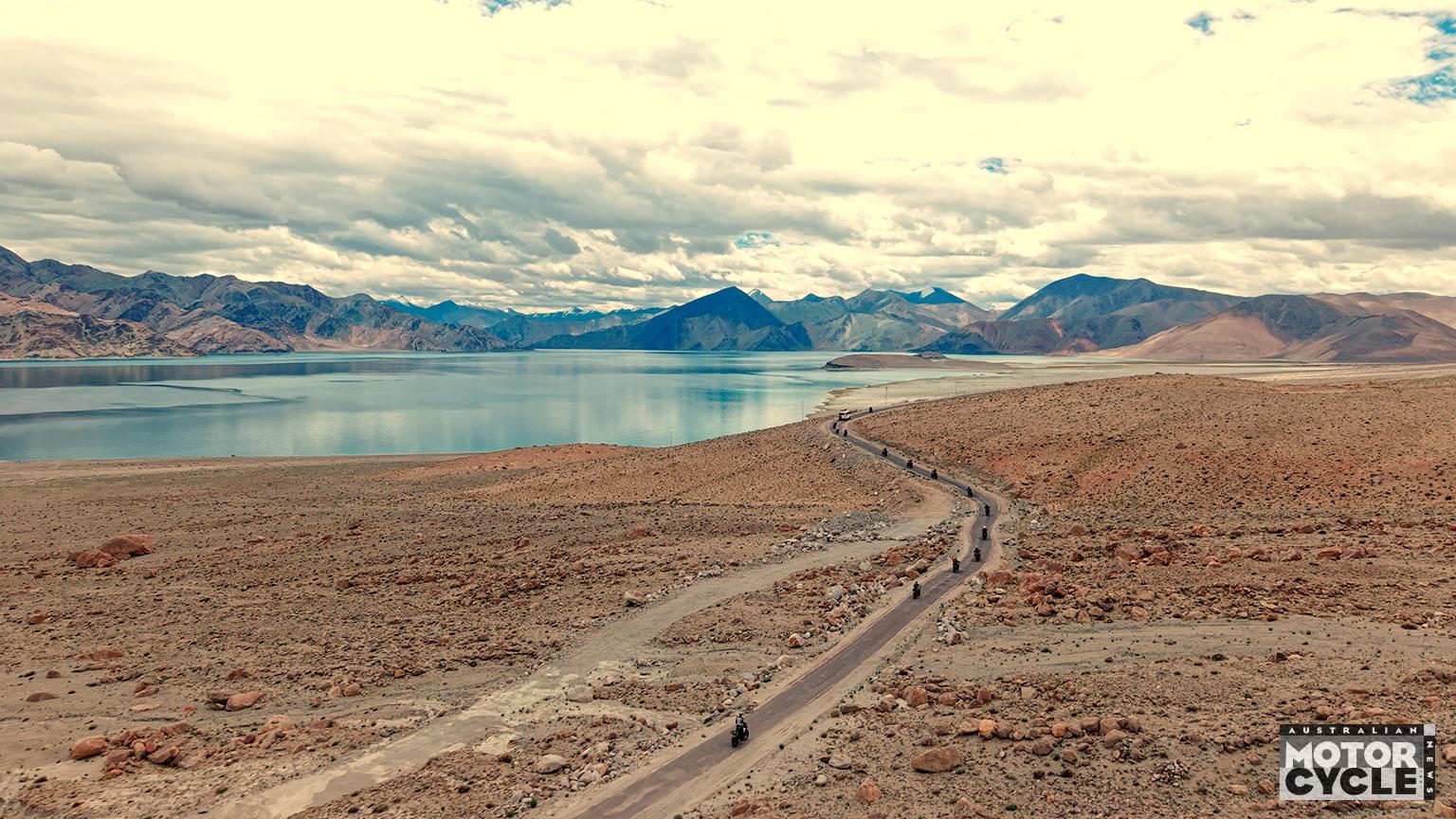
Traffic fades as we leave the lake behind until it’s mostly military trucks, motorcycles and enormous stretches of empty country. At one junction a rough track disappears towards Mig La, part of a new military road that will soon become the highest in the world. For now, it’s closed to civilians. The army gets the road first. Tourists can wait.
Instead we cross broad, empty plains where wild horses graze beside nomadic camps. China lies beyond the mountains to our left. To the right, Indian bunkers watch the valley. This isn’t simply adventure riding; it’s one of the most heavily militarised landscapes I’ve ever visited – although somehow also one of the quietest. Nothing announces itself. The soldiers are there, the bunkers are there, but most of it stays tucked into the hillside, out of sight until you know to look for it.
We stop at the Rezang La War Memorial, commemorating 114 Indian soldiers killed defending the valley during the 1962 conflict with China. Several riders in our group have military backgrounds. The South Koreans listen attentively; every one of them has completed mandatory national service. One of the smallest, quietest and most stylish riders turns out to be a tank driver, trading his 55-tonne war machine for a 200kg bike (fully fuelled) for the week. His cautious riding style is perhaps a reflection of his reduction in armour.
At lunch a few riders seem to be struggling with the altitude. The medic moves through the group checking oxygen levels, pulses and faces.
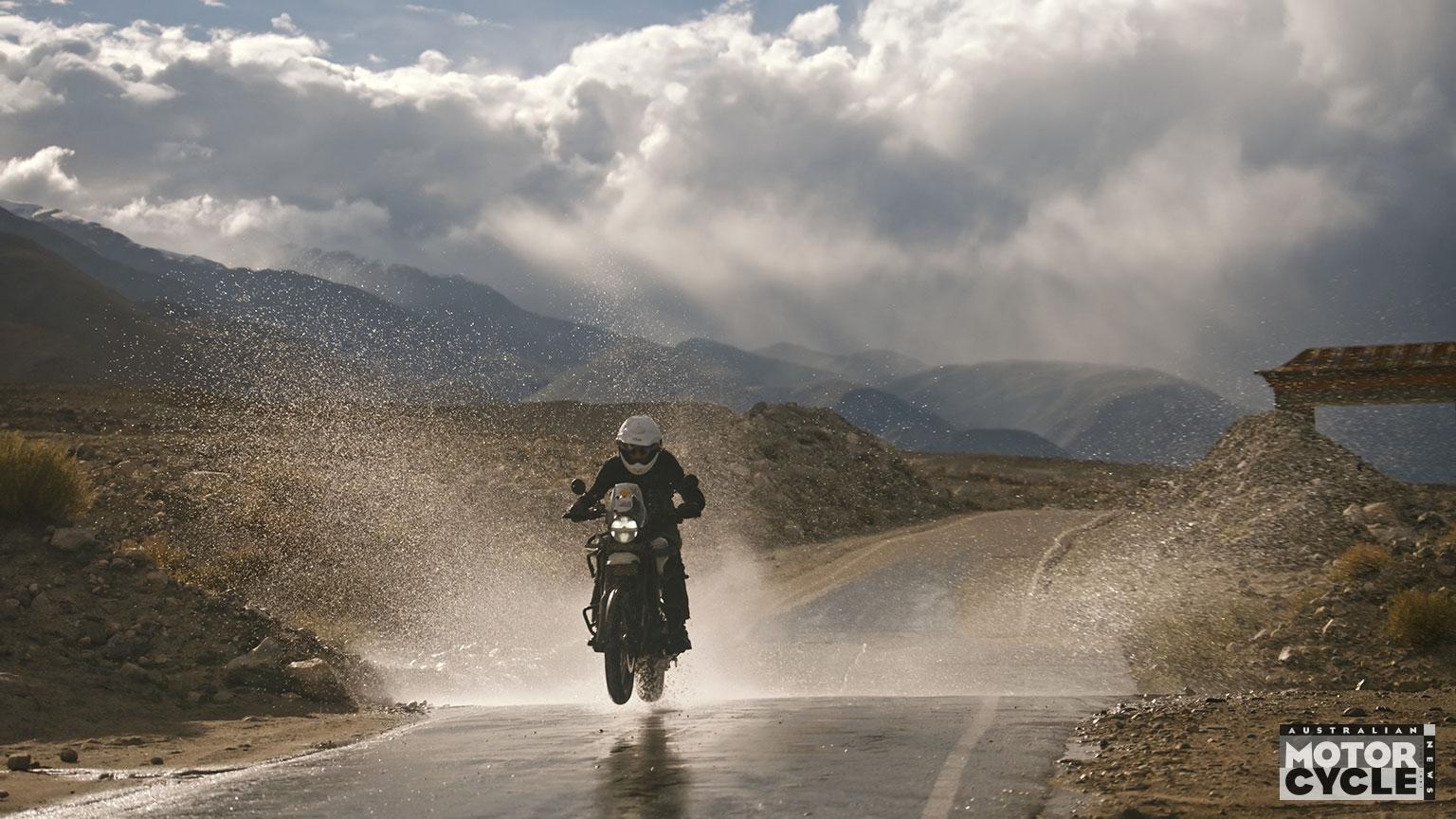
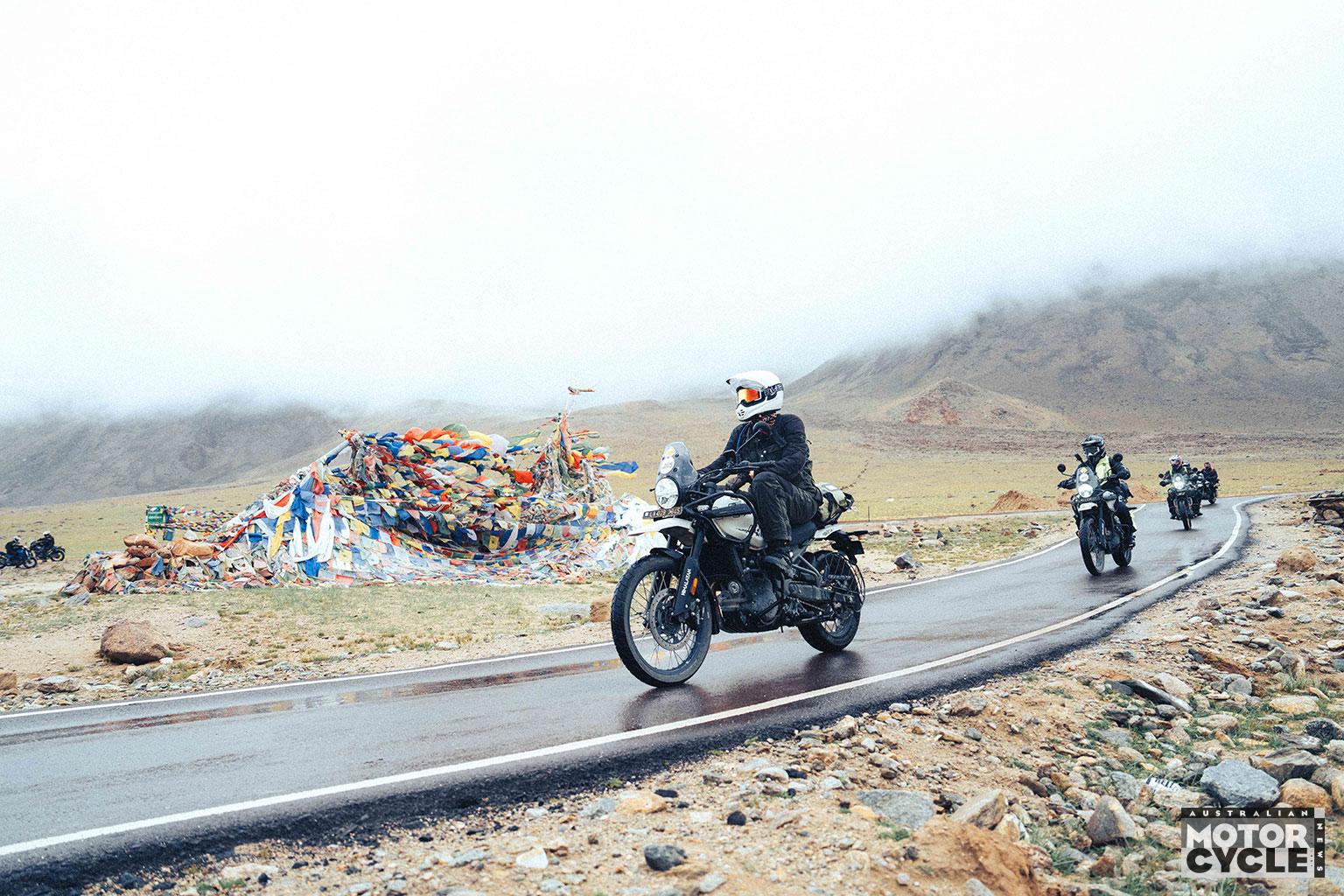
The weather catches us again as we leave. Rain spatters across my visor before turning into something halfway between sleet and snow. Diesel trucks labouring at altitude leave lethally slick rainbows across the tarmac, forcing us to pick our way carefully around corners.
We pull over to change into full wet-weather gear. I’m one of the few who doesn’t need to change thanks to my Merlin get-up. Ricky is watching the dark sky. “If it’s raining here,” he says, “it’ll be snowing on Umling La tomorrow.”
That changes the mood. If the army closes the checkpoint because of snow, the highest point of the expedition simply disappears from the itinerary. No appeals. No disappointed tourists waving paperwork. The mountain belongs to them.
A little later, the road splits. Fresh black tarmac on one side, raw gravel on the other. I stop to photograph the seam, then chase the group across 15km of graded dirt. Some explore a shortcut and end up lying in the sand.
Back on the tarmac, the landscape becomes drier and more fortified. Good visibility, bunkers sit in the hills, I up my speed. Confidence soars, as confidence often does, moments before it becomes a problem…
Two military trucks blast around a bend, shooting out plumes of charcoal soot like a covert smokescreen. No room to spare on the road, I drop a gear and accelerate off onto the dusty shoulder at speed. Except the shoulder is not solid. It’s deep, soft sand, the bike violently swimming beneath me. My right boot pounds along the tarmac for stability as both trucks wash past in a green blur, close enough that my foot skates between tyres.
Eventually the road catches up with me again.
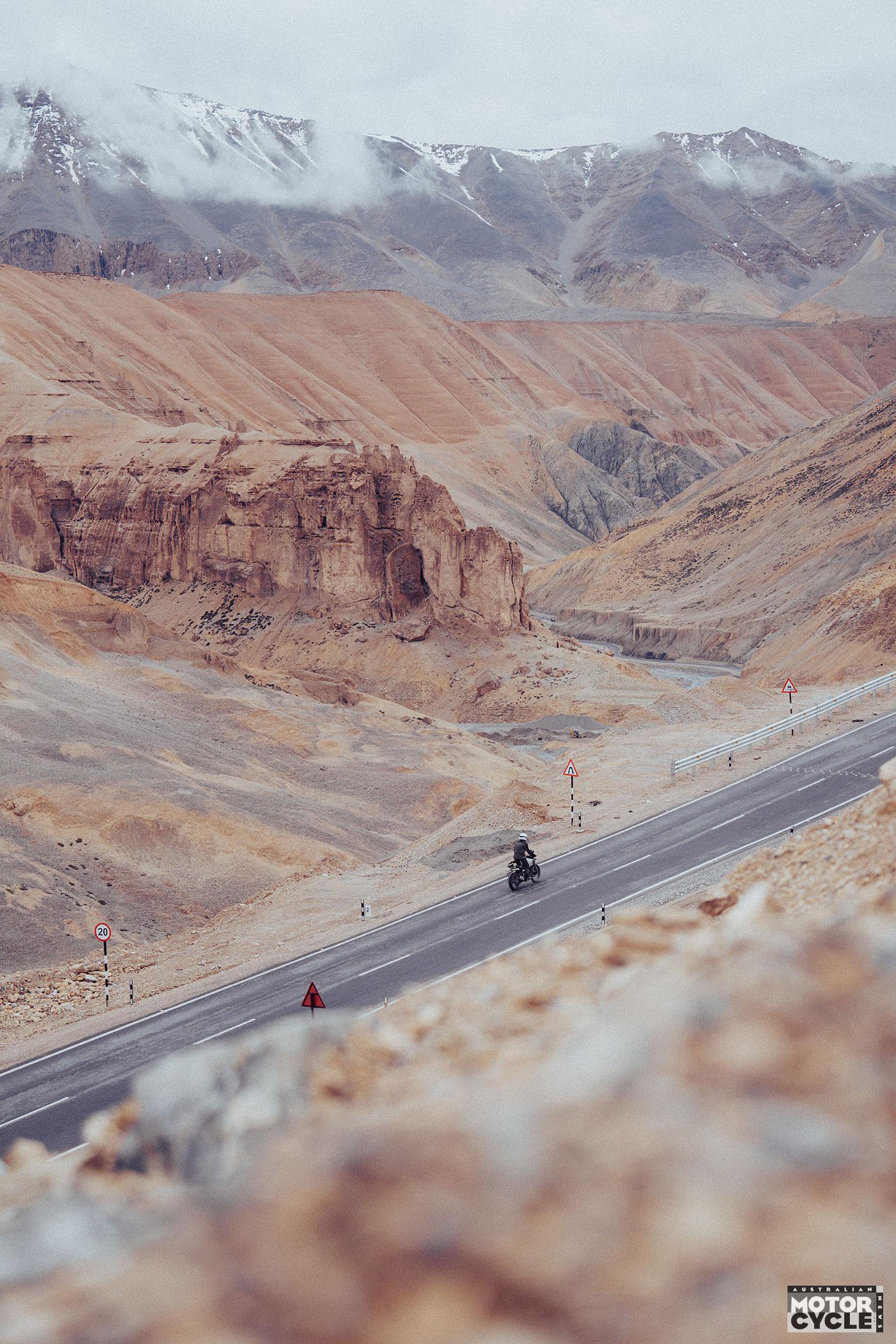
Hindsight always brings clarity: 20cm of tarmac laid straight over open desert, the whole landscape underneath just soft dunes, invisible until you’re standing on it wrong. Only a few years ago, there was no road here in any meaningful sense. Riders followed tyre marks through sand for three or four hours. Now a tarmac ribbon reduces the desert crossing to 40 minutes. Progress is wonderful, provided you stay precisely on top of it. Another lesson learnt.
We roll into Hanle beneath grey skies, cameras switched off through the nearby military zone. Above the village sits an ancient monastery. Below it, our homestay serves what quickly becomes the best meal of the trip.
After dinner I watch our host’s son of about five leave carrying a small suitcase, his father driving him towards the monastery school. In some families, one son enters monastic life. He receives an education, joins the monastery and visits home rather than the other way around. From outside, it can look like sacrifice. Here, in a place where families were nomadic until very recently and choices remain practical, it looks more like an old bargain that still works.
DAY SIX – HANLE TO UMLING LA
I wake to military vehicles already moving beyond the village while a small dust devil spins slowly across the valley outside. It’s raining. Nobody knows yet whether we’re actually going to Umling La.
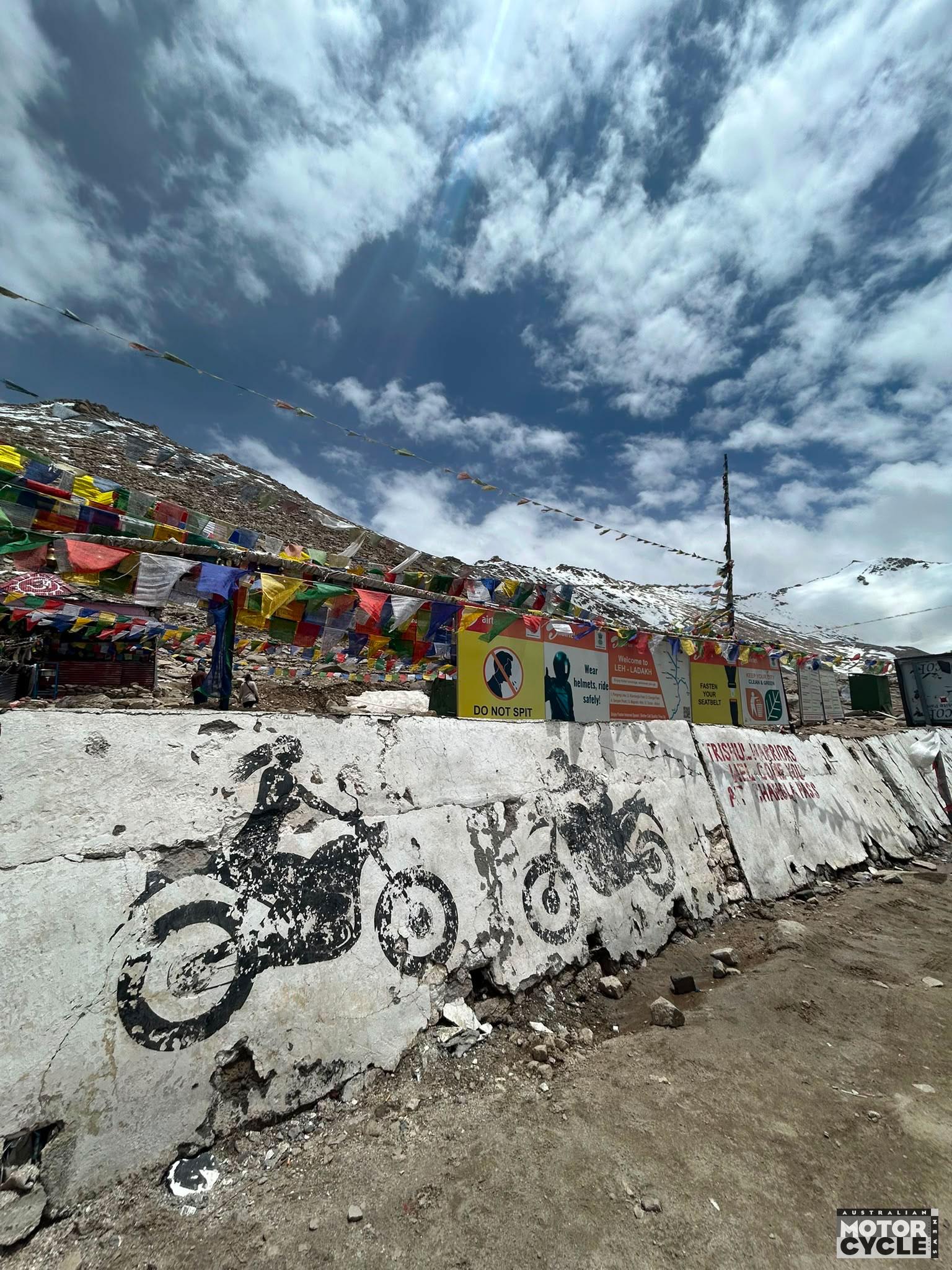
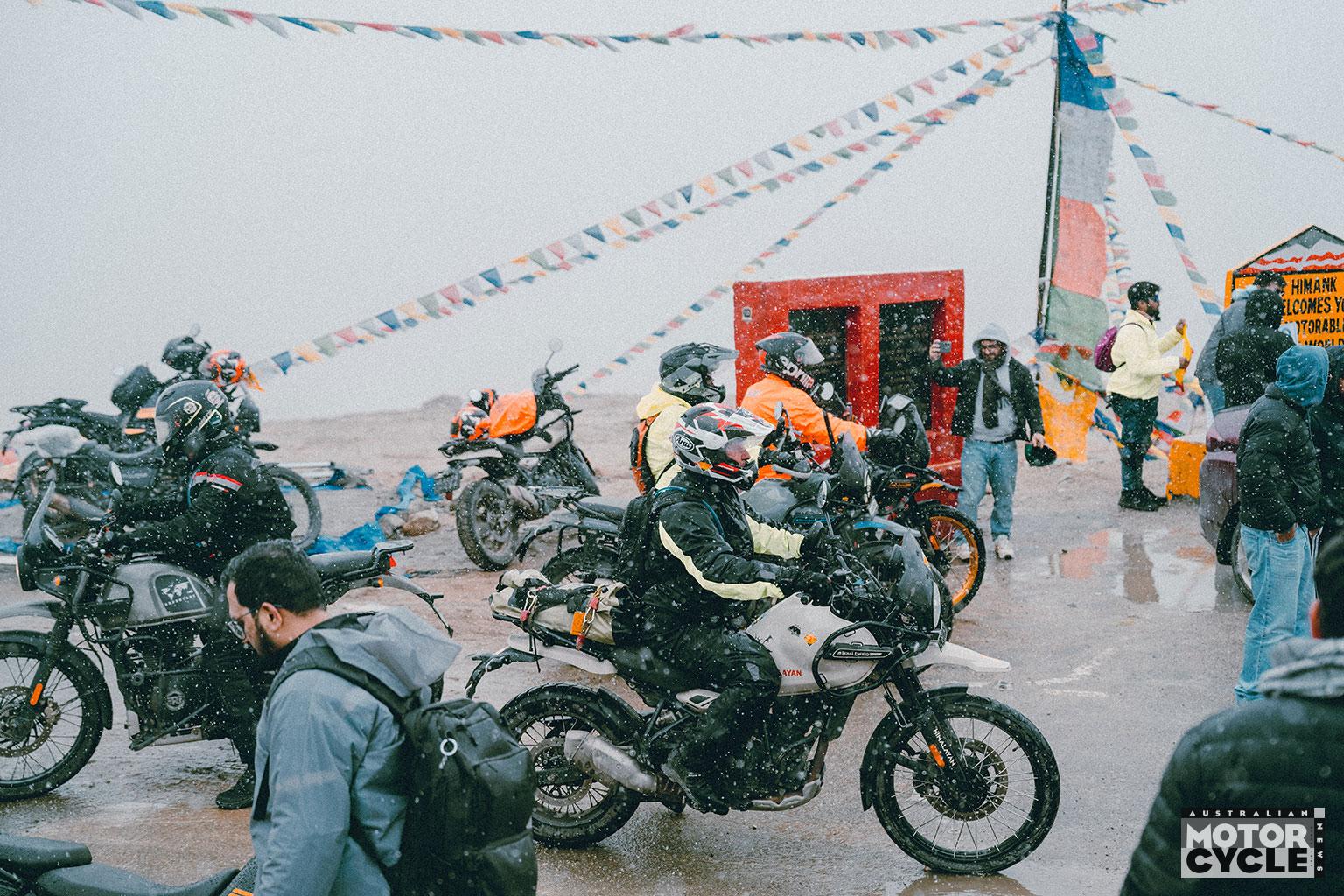
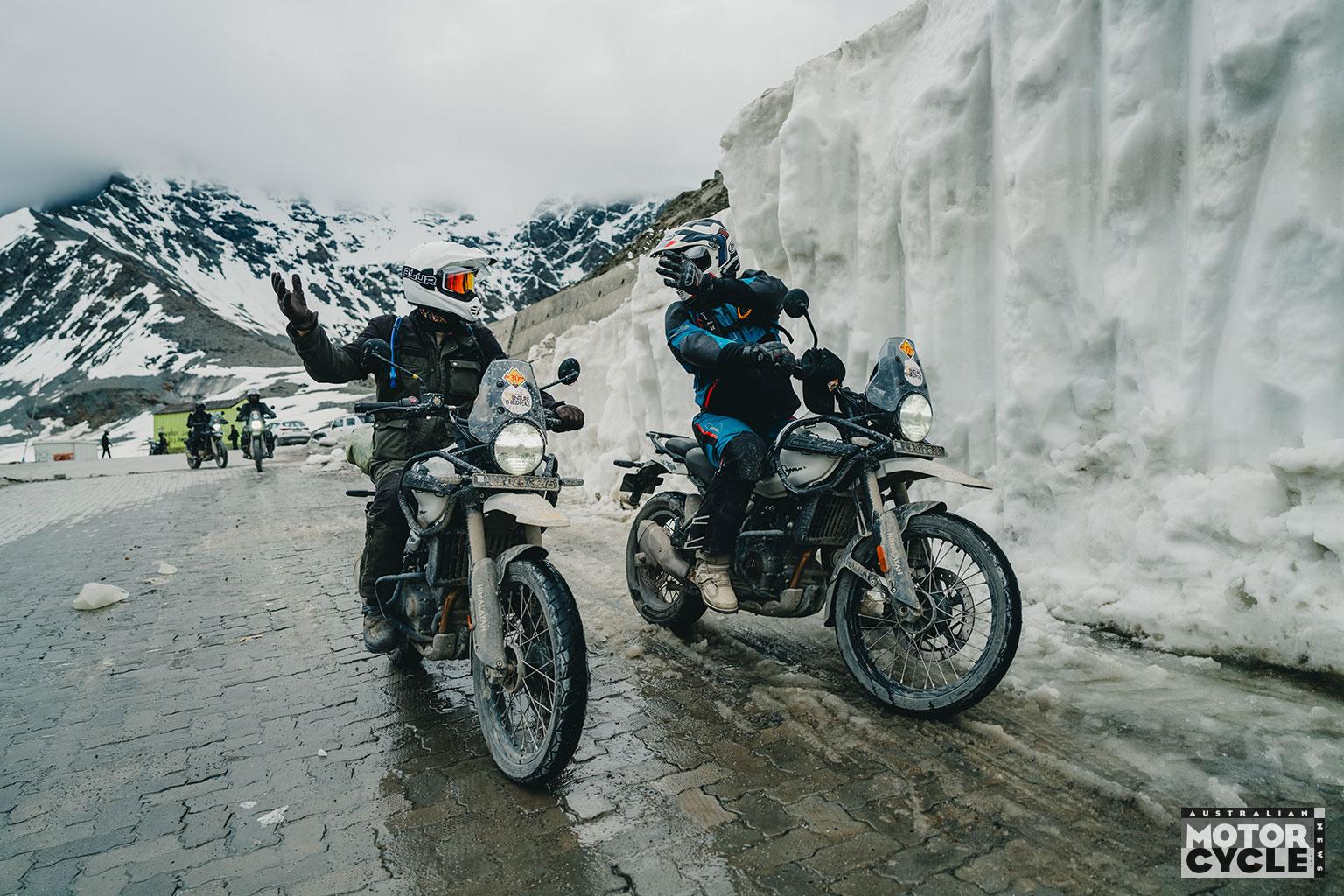
Royal Enfield first ran this route in 2021, when it was a rumour of a road rather than an actual one. Today construction creeps through the outskirts before giving up to crop farms, and the tarmac gives up not long after; 30km of dirt and dust that feels like a Mongolian plain, sand-filled holes disguised by wind. A wall of bikes and the occasional 4WD barrelling through, some sinking, some launching over undulations they didn’t see coming. Then the climb begins. Rain becomes sleet, sleet becomes snow, visibility shrinks to little more than the next corner. My Himalayan’s power drops as the altitude climbs, slipping into first gear for corners that would normally take second, snow defeating every attempt to steal extra air through an open visor now covered in ice.
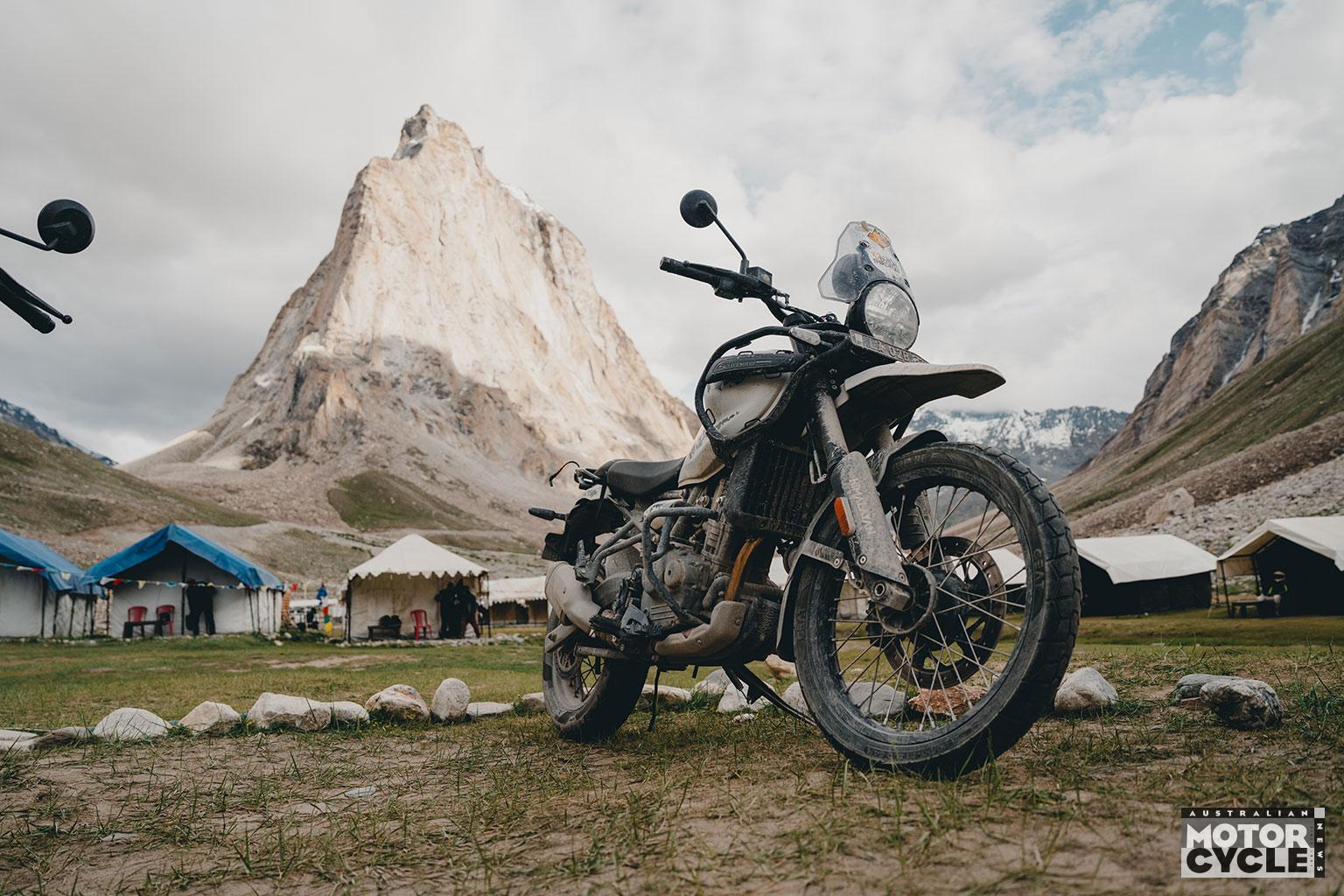
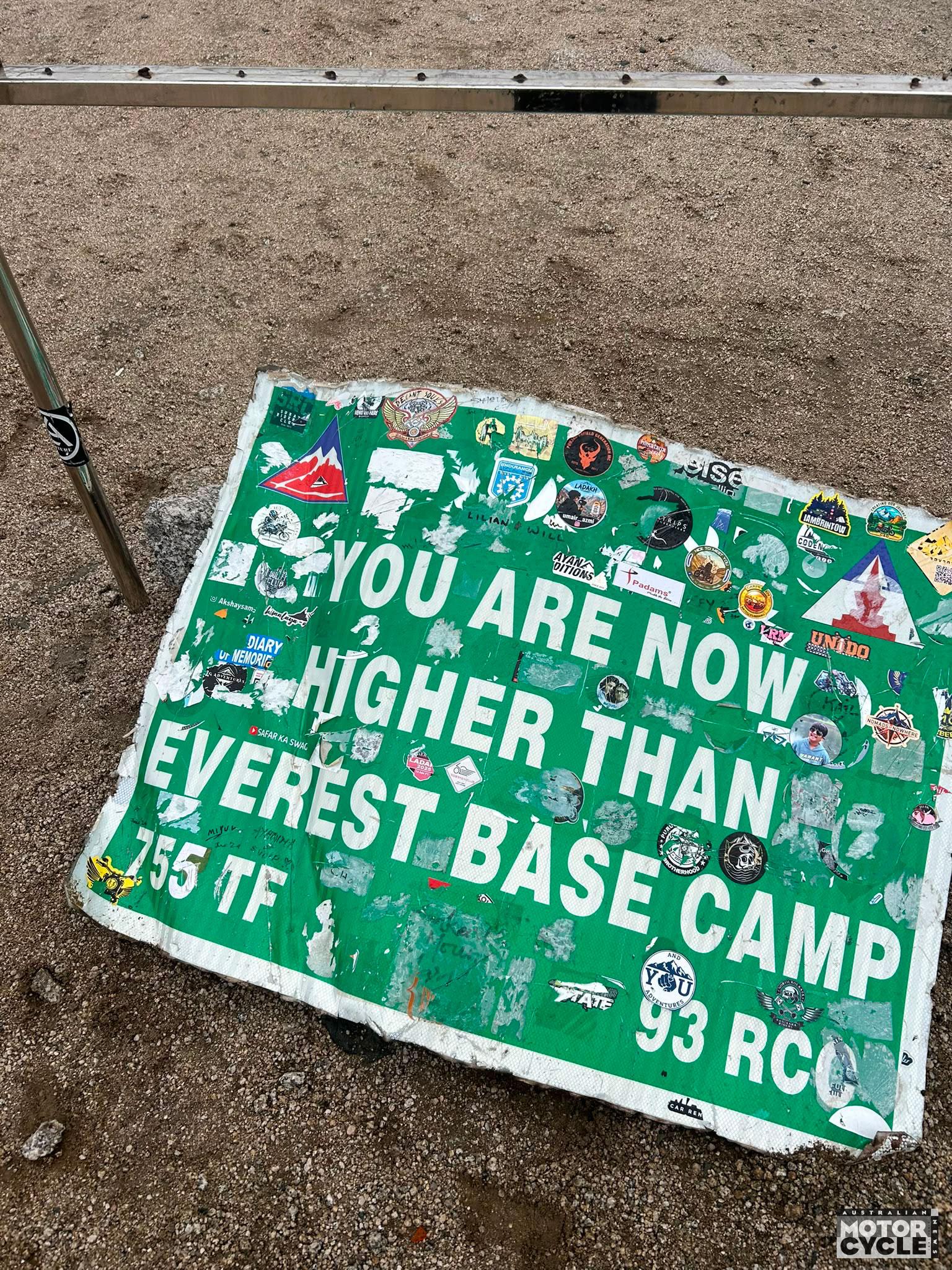
Halfway up, a sign, half buried: “You are now higher than Everest Base Camp”. No indication we’re near the top. Traffic coming downhill moves with the urgency of people who know what altitude sickness feels like. One 4WD is parked at an angle that isn’t really parked, the driver bent over vomiting into the road.
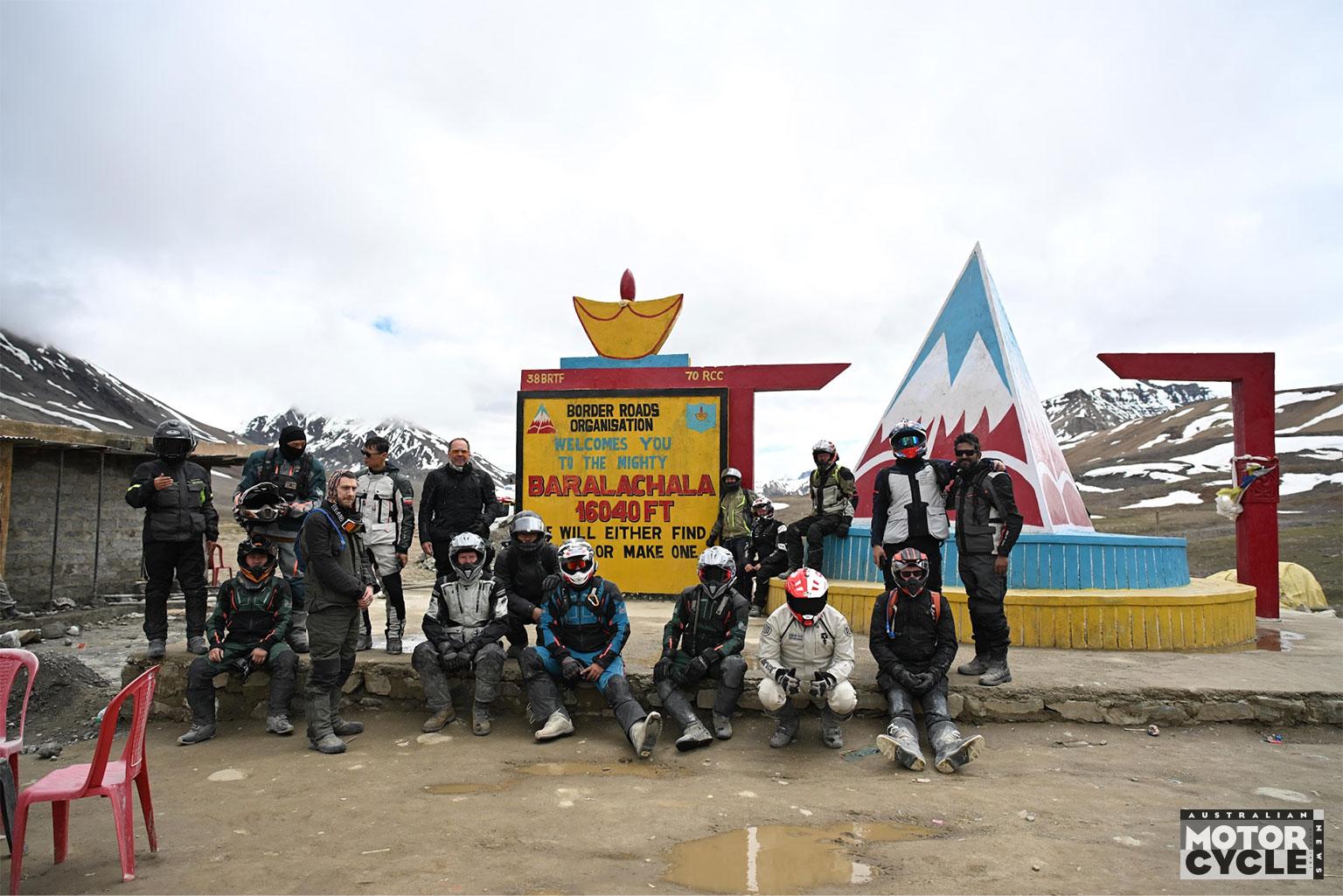
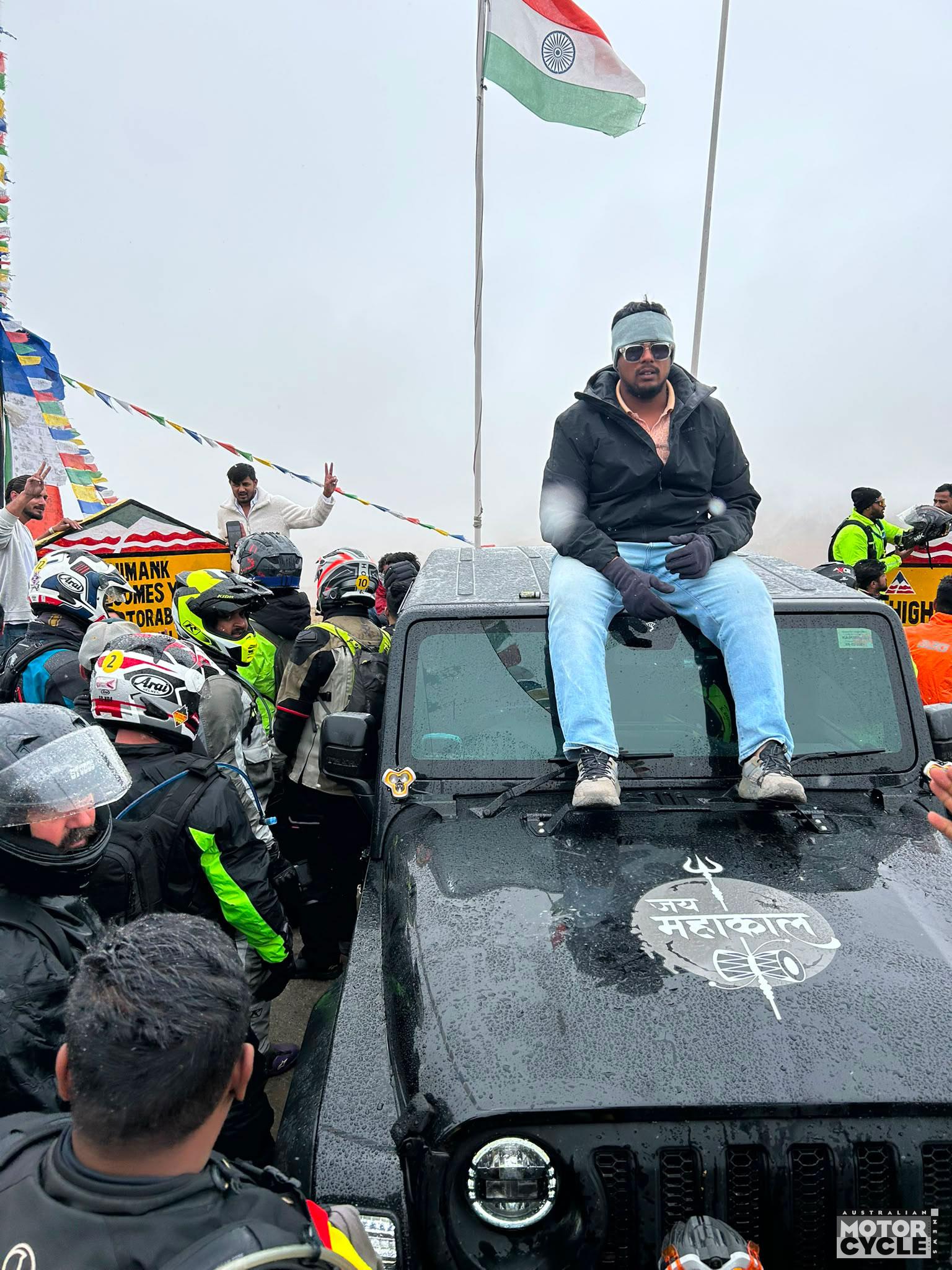
The summit just appears, unannounced. I could have ridden straight past it into China without the crowd, bikes, 4WDs and phones up everywhere, everyone shouting for the shot before their 15 minutes runs out.
As we’re organising a group photo, a Mahindra reverses directly in front of the sign so its owner can climb onto the roof for his own photo, earning a very specific kind of abuse from a crowd that just fought its way up here without a heated seat.
Walking back, I notice we’ve parked under another hand-painted sign: “Highest carpark in the world”. We descend carefully, icy hairpin after icy hairpin, a headache building until we drop below the cloud and both my lungs and the bike remember how to breathe.
That was the literal high point of the trip, though it isn’t really my high point. The journey for me has always been the accumulation, not the summit, and I suspect that’s true for most people who end up loving something like this rather than just surviving it. But I understand exactly why Umling La gets the attention it does. Saying you’ve ridden higher than Everest Base Camp neatly summarises the holiday over coffee back home.
For me though, it’s one day out of 10, not the whole story.
DAY SEVEN – HANLE TO SARCHU
Celebrating the previous night’s ride to Umling La with Old Monk rum had seemed like an excellent idea. Altitude disagreed. I wake with a headache that could be hangover, altitude or both. Either way, today is the longest riding day of the trip – close to nine hours.
Even the flatter sections hover around 14,000 feet. The weather refuses to settle. One valley is dry and dusty, the next cold enough for rain. Military convoys become more frequent, truck after truck climbing steadily towards the frontier.
The road itself can’t decide what it wants to be either. Fresh tarmac rises and falls like waves, one sign warning of a bumpy ride ahead, the understatement of the trip.
Then, completely without warning, we round a corner to find a full cricket match in progress. Proper pitch, boundary flags, spectators. The 20th Malash Rumlig Trophy – the kind of tournament no cricket website will ever list but matters enormously to everyone here. Grown men sprinting between wickets at an altitude where jogging feels like an act of defiance.
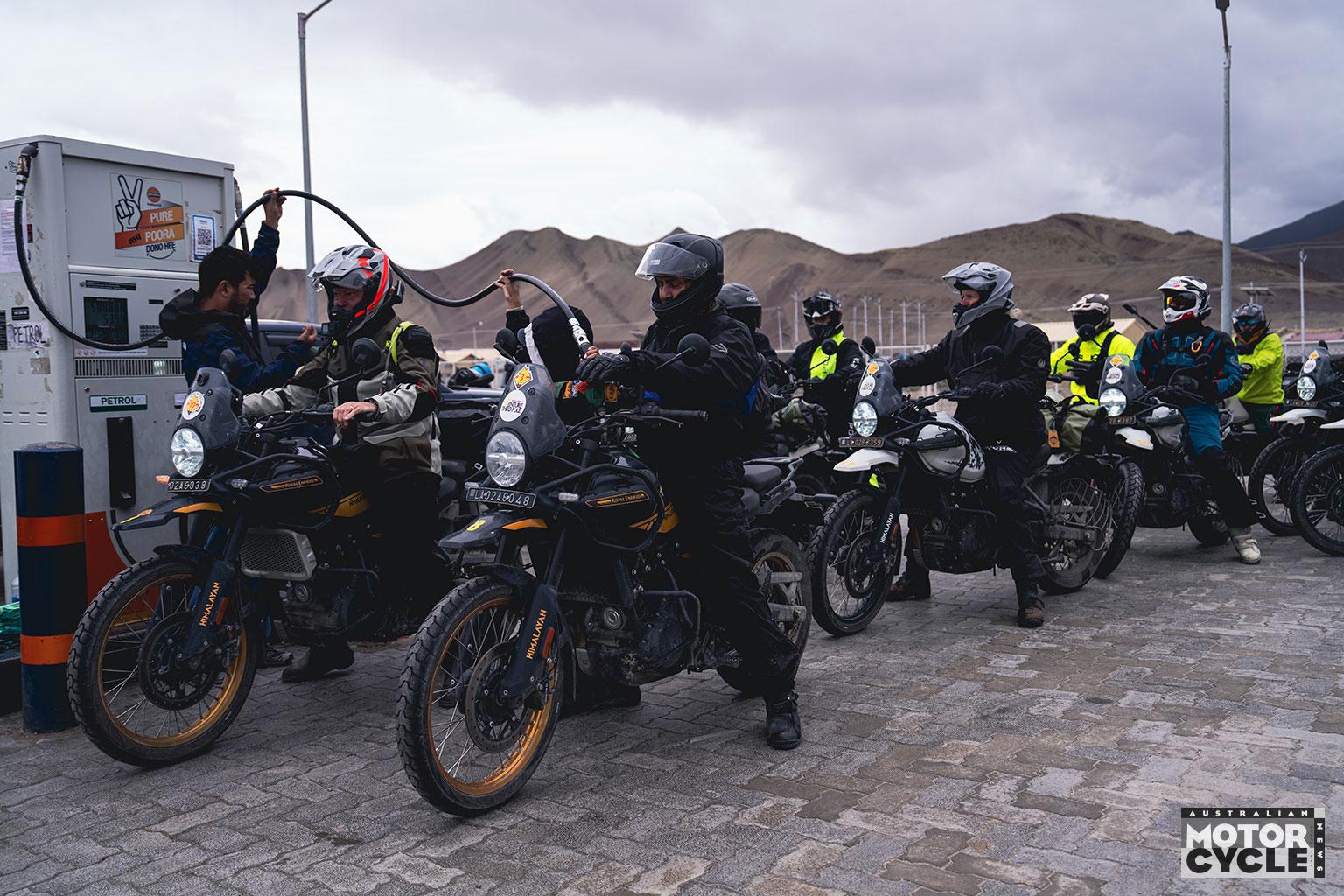
The petrol station not long after is the last reliable one for hours, and it’s packed, our 17 bikes turning what should be a two-minute stop into a genuine jam, trucks and cars spilling out into the street.
Before lunch we descend into a rocky valley where scale stops making sense: a mountain poised what looks like a comfortable distance away turns out, one corner later, to be a sheer cliff face directly beside the road. No transition, just a sudden correction of everything my eyes had assumed. I’m slightly disoriented by it, more than the terrain alone accounts for, and silently note that tonight probably calls for a little less Old Monk.
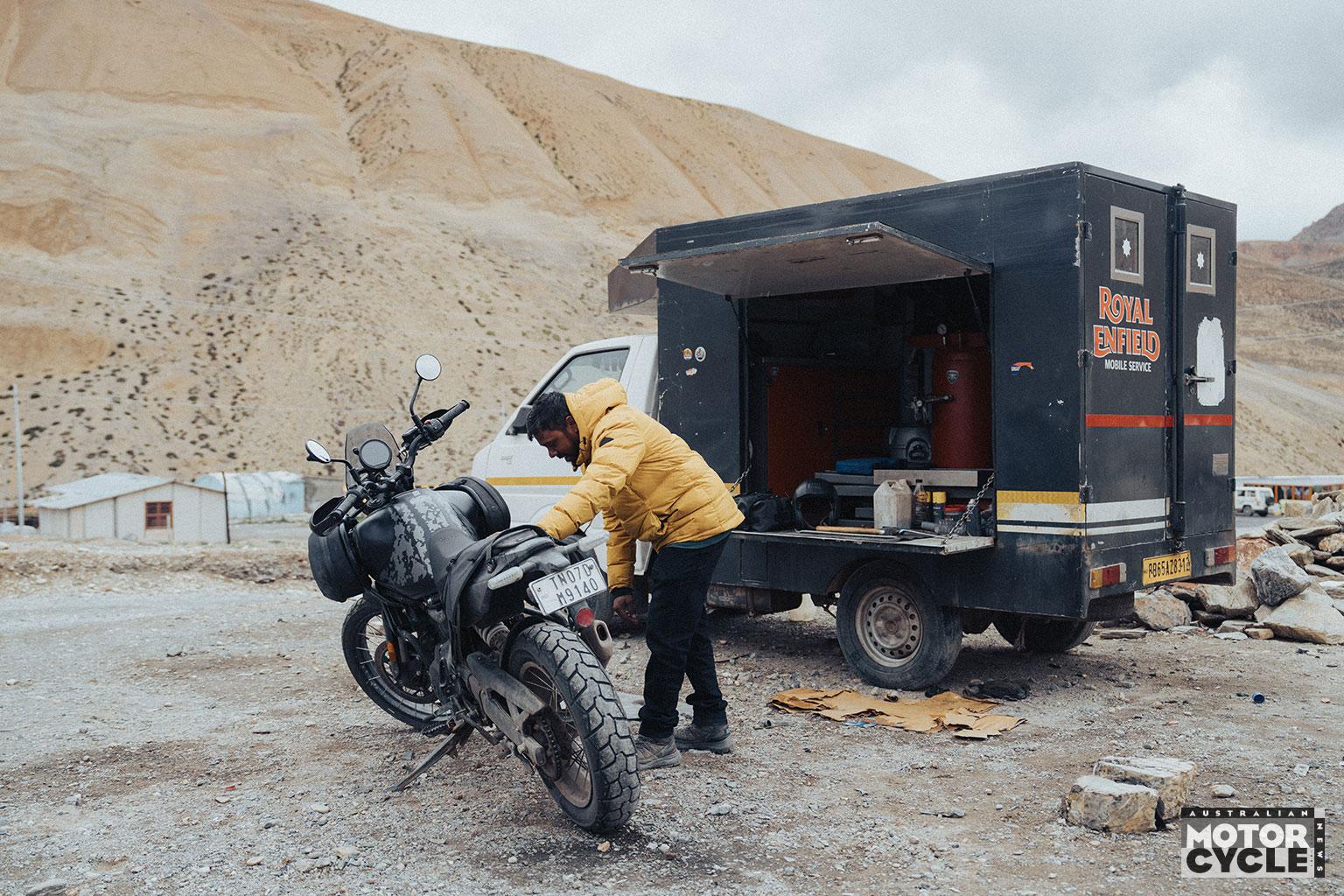
Lunch brings another visit from Royal Enfield’s travelling mechanics. My bike’s intermittent fuel issue is still lurking in the background. Working from a small support truck are two young mechanics, both barely out of school, servicing any two-wheeled vehicle that shows up, Enfield or not. It’s part of Royal Enfield’s 100 Himalayan Communities initiative, deliberately investing in local skills rather than bringing in factory technicians from elsewhere.
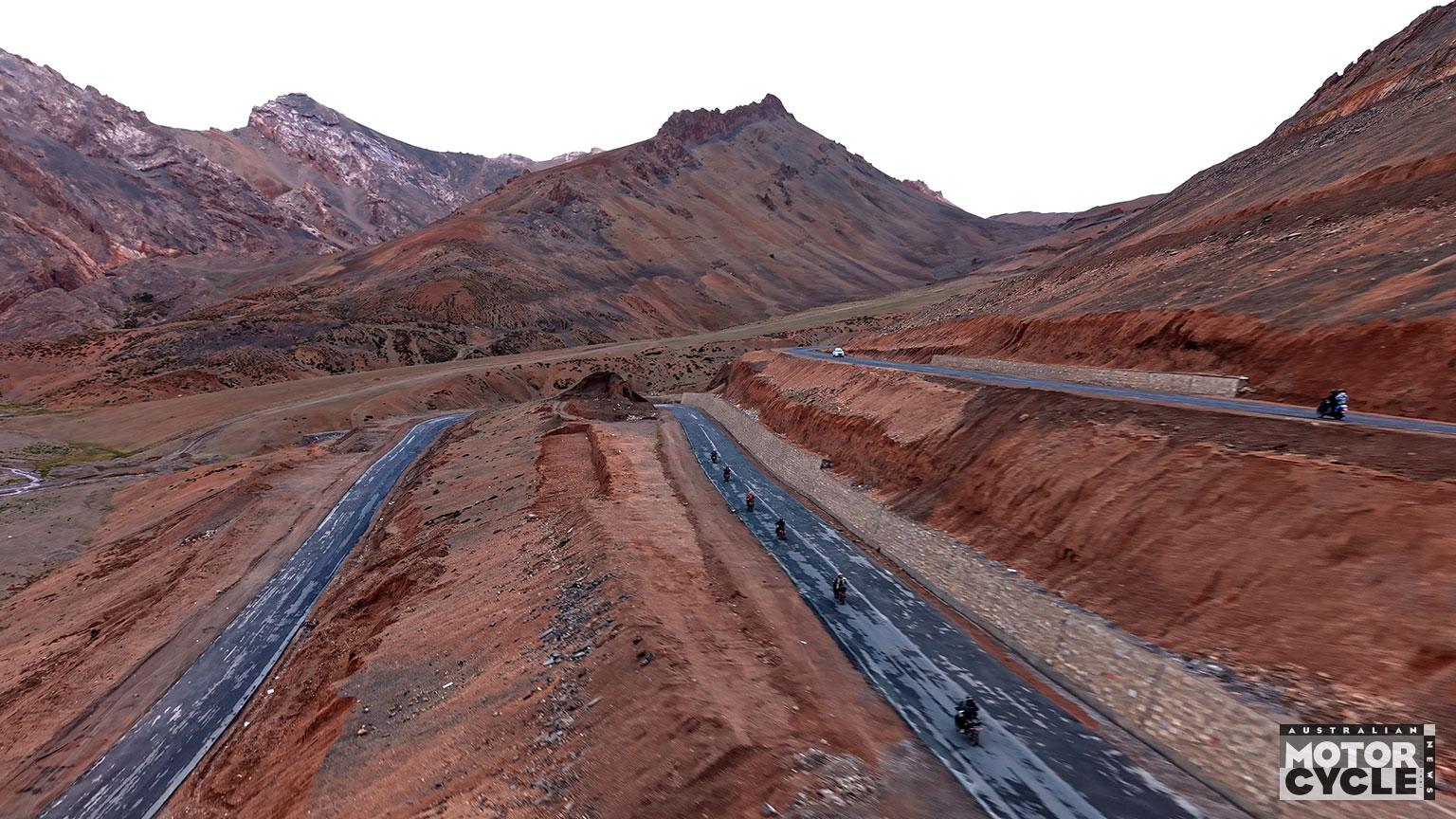
Back on the road, we climb towards Lachung La before the surface dissolves into mud, puddles and broken rock. One abandoned truck lies hundreds of metres below the road, slowly disappearing into the mountain that rejected it.
Farther on come the Gata Loops, switchbacks stacked so tight you can watch the group above and below you on the same mountain at different points in time (and altitudes). Slightly dizzy, I drift toward the edge, chasing a view that’s stopped being scenery and started being hypnosis. I’m at the back of the group. From above the road reads like a stitched seam, 21 hairpins zigzagging down the face. But I see a shortcut that ignores all that, a raw scar of clay cutting straight through, the kind of line only the guides know exists – so I follow one onto it.
Rain’s turned the clay slick, engine braking barely holding the bike on tyres never built for this, moderately dangerous, genuinely fun, and I go from back of the pack to the front in four minutes. Then it runs out, too steep, too loose, and we’re back on the main track – just in time for us to meet another obstacle.
Two trucks interlocked, one a fuel tanker centimetres from the cliff, one wedged against rock, preventing it from going anywhere. People yelling at each other; it’s hard to tell if this has just happened or if it’s been like this for hours. Either way, there’s no room even for a bike as small as the Himalayan 450 to slide through.
Drivers shout instructions. Workers wedge rocks beneath wheels. Eventually the tanker inches forward just enough to free itself. The bikes get waved through first, and there’s a small, unearned pride in that, proof that the smallest thing on the mountain sometimes has the advantage. The road opens and for a stretch it’s just full throttle, gear after gear.
My dad has an argument that a slow bike ridden flat out is more honest than a fast one ridden at 70 per cent. A superbike spends most of its life being restrained; 40hp doesn’t leave room for that. You’re at full throttle constantly, working every gear through every corner. Actually present, rather than managing something bored with you. More than one rider said the same thing: that it reminded them of the bike they learned on, that got them into biking.
It isn’t just about restraint. It’s about range. This same engine flat out on tarmac now was in first gear crawling down a steep, slippery track just hours earlier. An adventure bike earns the name by refusing to specialise.
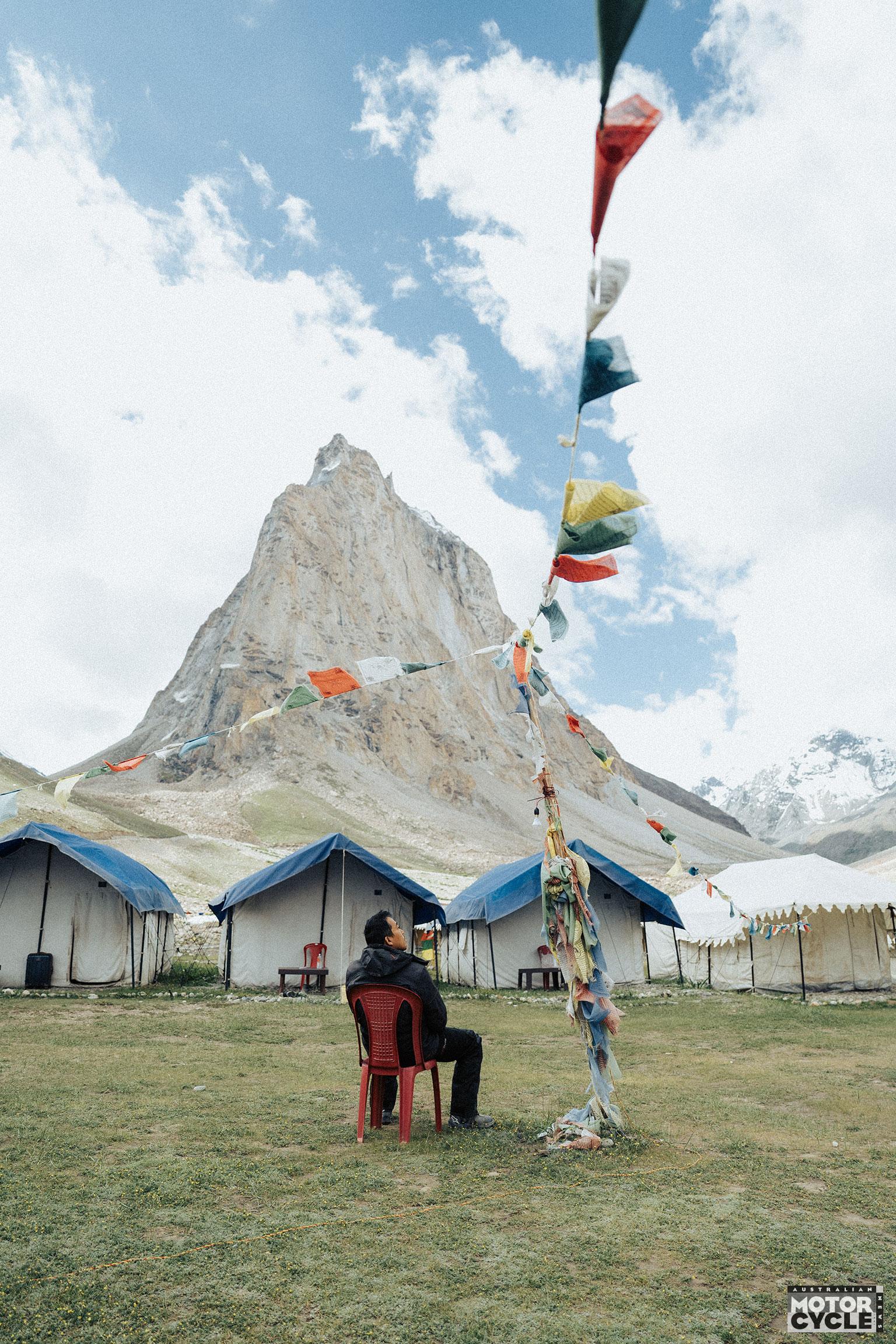
That afternoon we roll onto the Sarchu plains and into camp. For centuries nomads crossed this valley with yaks, sheep and pashmina goats, following water and pasture across one of the harshest landscapes imaginable, a vast open bowl where the wind has been known to gather great speed with nothing to stop it. Tonight, it’s home.
DAY EIGHT – SARCHU TO GUMBOK RANGJAN
I wake before sunrise and climb a small ridge above camp. Far below, a solitary figure sits quietly facing the morning sun, not in a monk’s robes but a blue hoodie and black tracksuit pants. It’s Robo, one of our riders.
As we set out, so do a herd of 50 or so goats. We ride slowly amongst them for a while and then pull into the wind. The morning passes in something of a blur, my stomach having other plans, and I ride through most of it half present, tracking the road on instinct while the rest of my attention stays somewhere else entirely.
Military convoys pass in the opposite direction before we climb over Baralacha La and begin descending another seemingly endless series of hairpin turns.
At morning tea my attention finally returns to the landscape. Across the valley sits a cliff face I’d clocked as scenery and nothing more, until someone points out the goats. A hundred of them, maybe more, speckled up the rock like static, and it’s only once you can measure the face against something small and countable that you realise it’s 2km high, the herder somewhere among them invisible until you know where to look.
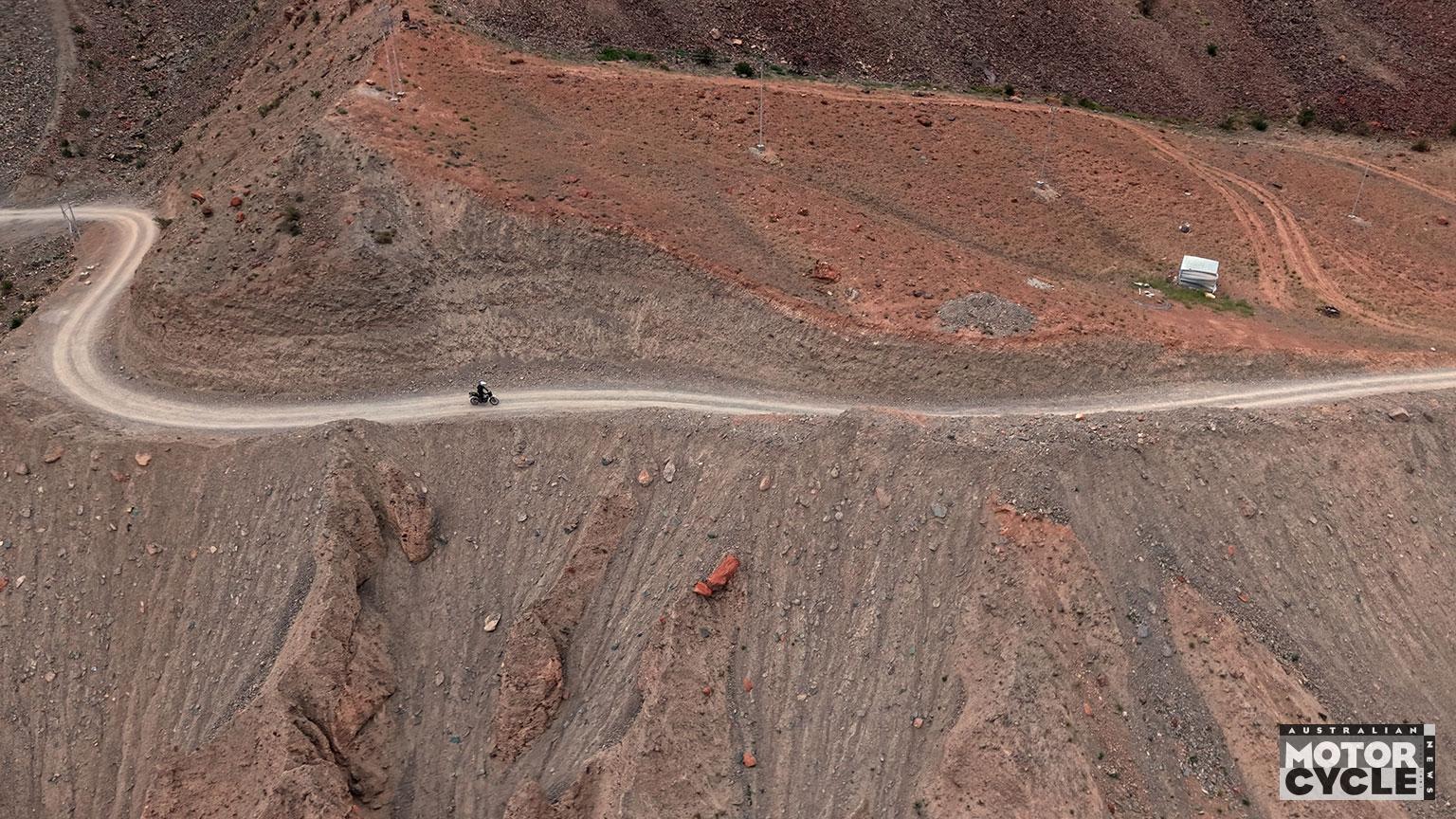
Back on the bikes we ride through villages growing spinach and carrots in places that somehow support both glaciers and farming. Road crews work by hand. Some labour with babies strapped to their backs while excavators carve fresh routes through rock only metres away. In 2021 much of this route barely existed. Now the road pushes farther into the mountains as every season passes.
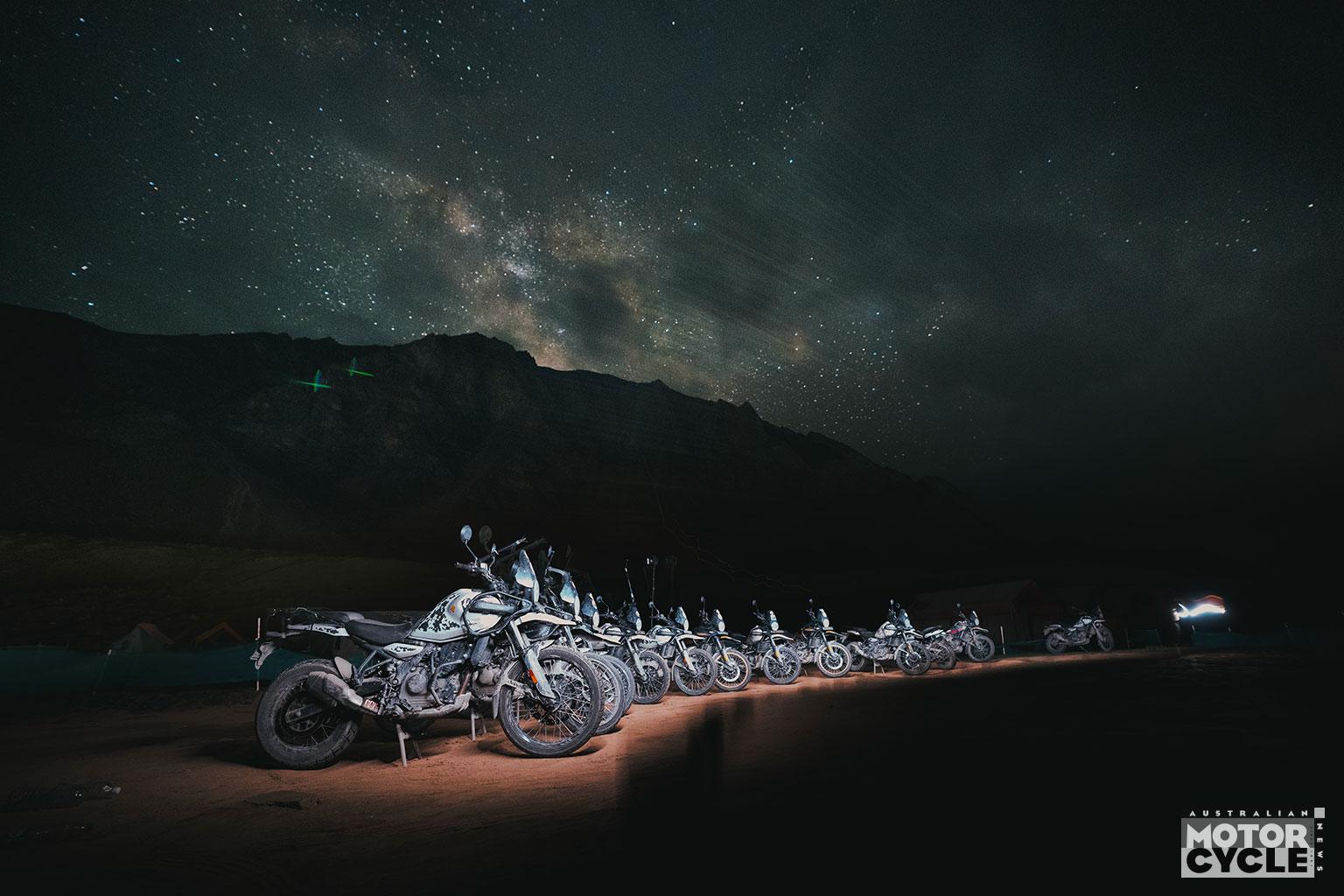
We arrive at Gumbok Rangjan late in the afternoon. Unlike the surrounding ranges, this mountain stands almost alone, a giant monument rising from the valley. To local Buddhists it’s sacred – the throne of Gonbo. As darkness falls, the summit remains pale against the night sky while everything around it disappears into shadow.
It’s one of the quietest evenings of the trip. Tomorrow, we begin turning for home.
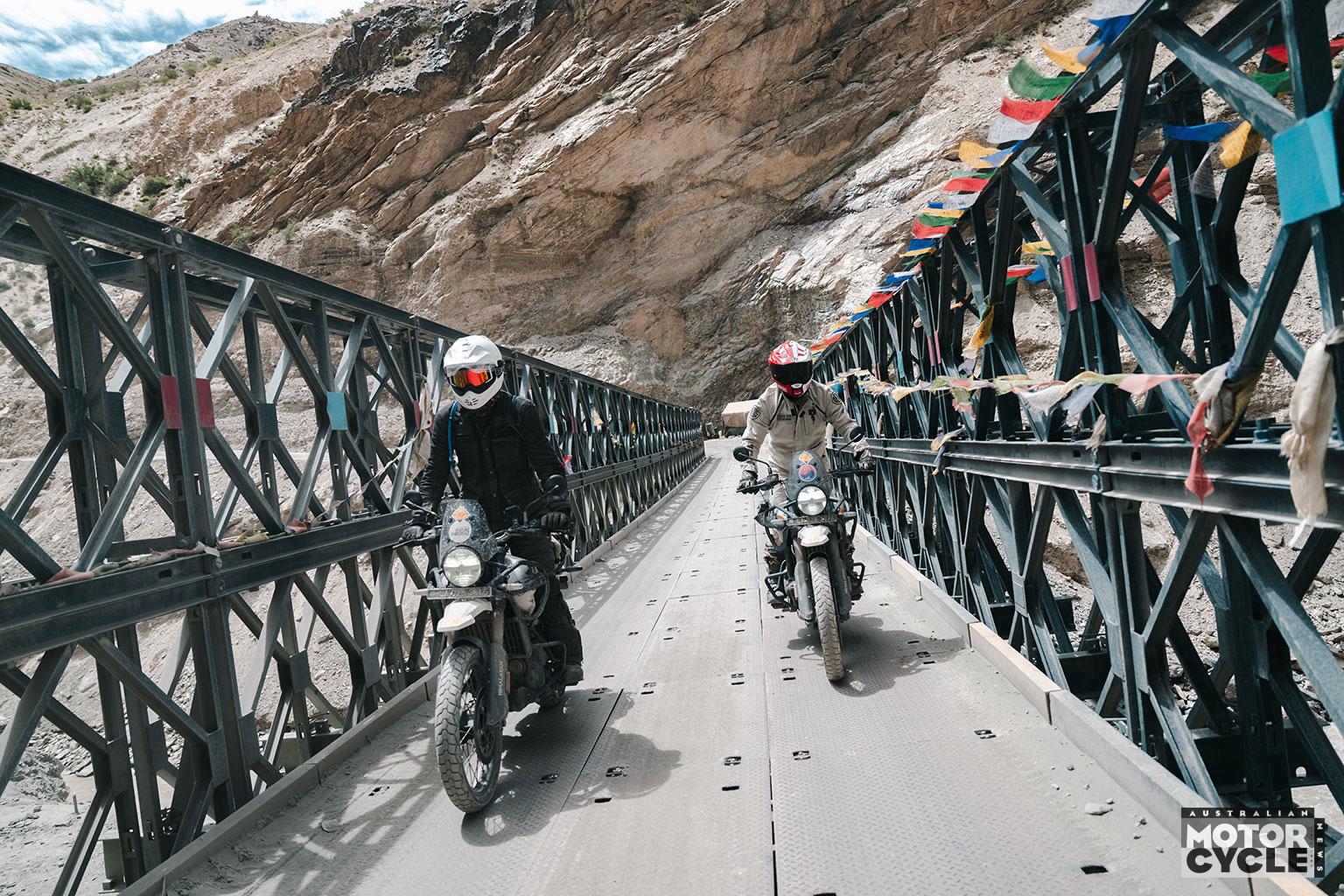
DAY NINE – GUMBOK RANGJAN TO PADUM
We’re running late before the day even begins. Entirely my fault. I’d talked everyone into stopping early for photos, not just of the riders but of the support crew, the people doing the work nobody tends to point a camera at.
The second it was over, everyone bolted; 16 riders suddenly very interested in recovering the time I’d wasted. I stood there packing away a camera as the sound of little engines disappeared up the valley.
It was worth it. Trips like this are often remembered as a small pack of riders charging through spectacular scenery, congratulating themselves for surviving it. But almost as many people are working behind the scenes to make that possible.
Ricky, Kegan and VJ lead the ride, sweep the group and quietly solve problems before most of us even notice them.
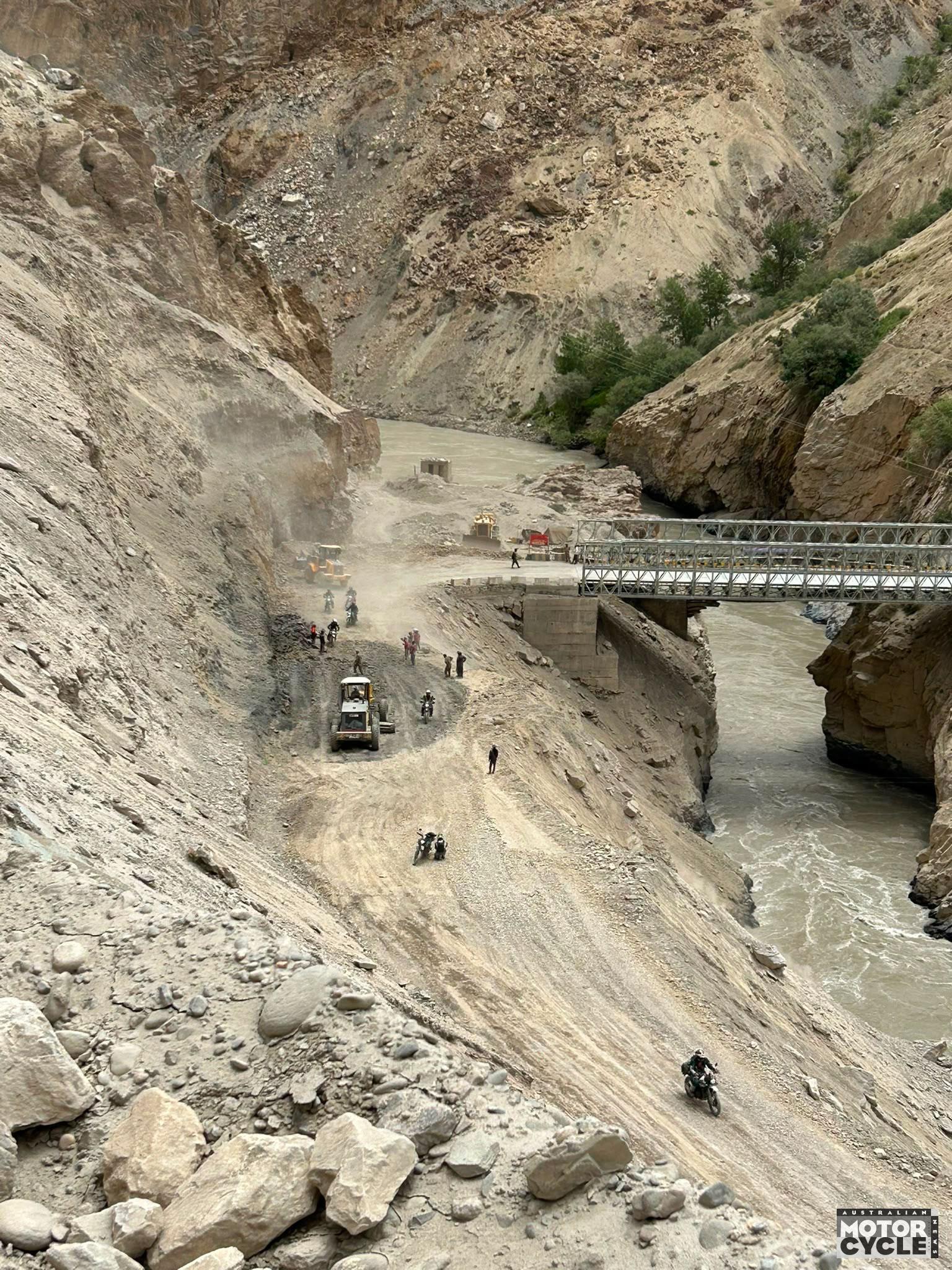
Then there’s Pushkar and his crew from Broken Asphalt, contracted by Royal Enfield to film the expedition. Their day is considerably harder than ours. Race ahead, find a location, film 17 motorcycles riding through it, overtake everyone, do it again. All day.
Behind them is a support crew of five mechanics, drivers and fixers. They carry the luggage and spare parts, handle every checkpoint and breakdown, and run our passports ahead so we barely slow down.
We arrive at each checkpoint, ride past crowds still waiting to get processed, and someone drops the chain to wave us straight through. From the saddle it all feels effortless but I’m sure for the crew it isn’t.
The road narrows as we follow the Lungnak Valley towards Phugtal Monastery, perched on a rocky outcrop, centuries old, reachable until recently only on foot, which makes arriving on a motorcycle feel like a small betrayal of the place.
What would have taken two full days a couple of years ago is done in an afternoon now, the refrain of the entire trip, less a fact by this point than a warning about how fast this place is changing beneath us.
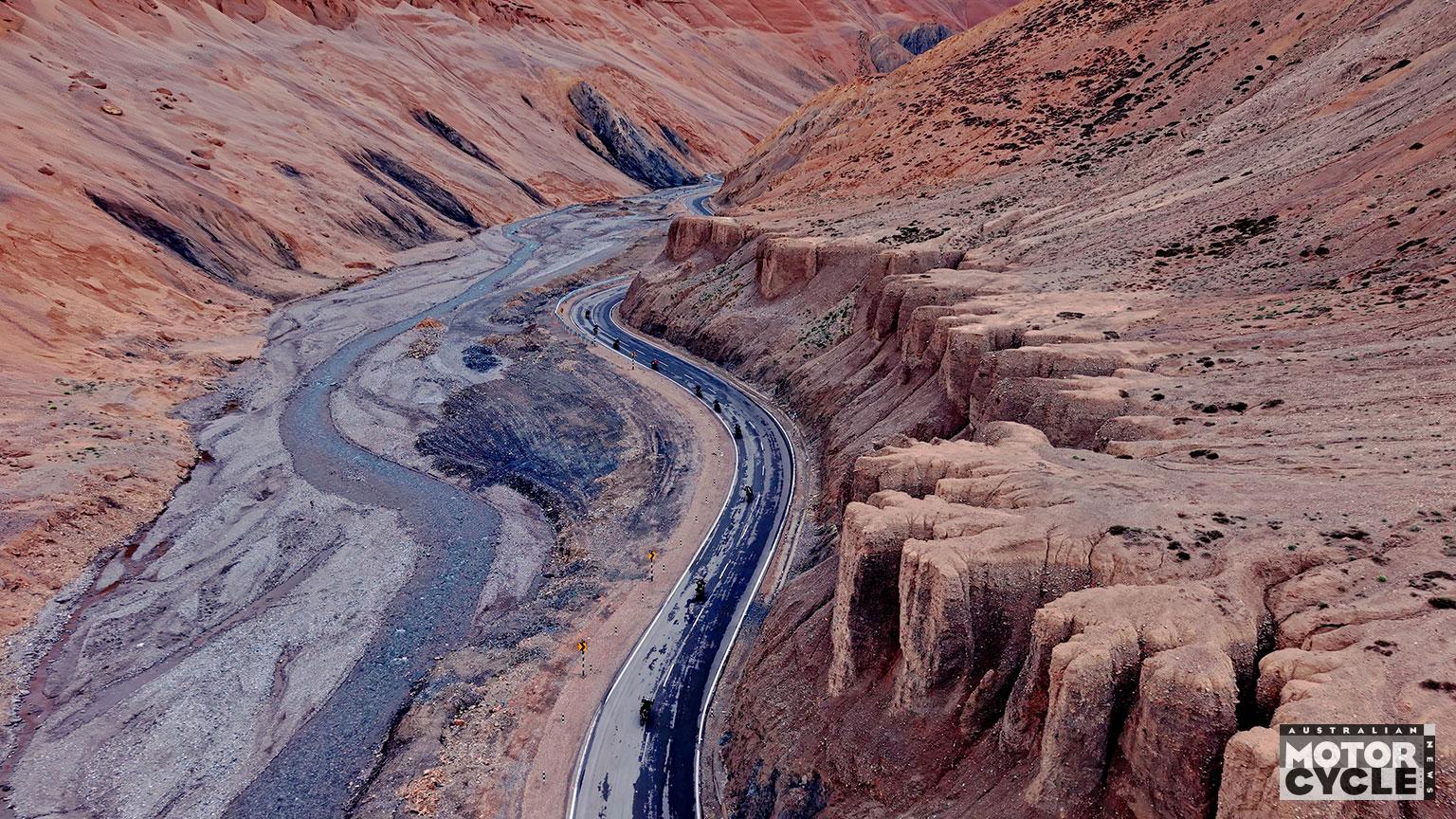
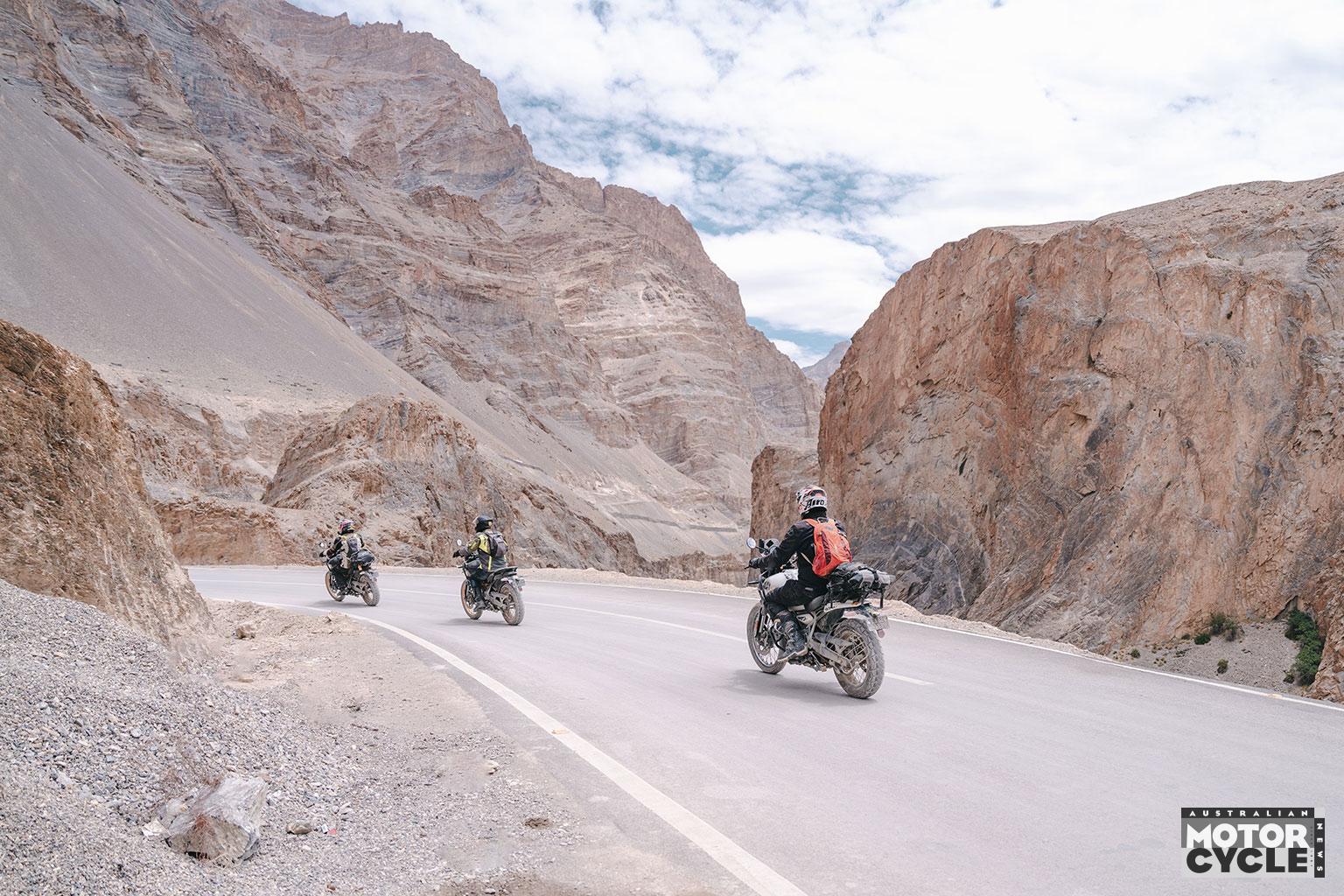
Landslide warning signs become actual landslides. Fresh tarmac disappears beneath fallen rock. A rusting excavator lies abandoned far below the road; the mountain is already taking it back. Blind corners demand constant attention. What’s waiting on the other side? A truck overtaking another truck, a herd of goats, a patch of deep sand?
A 4WD carrying slightly too much speed… or simply a view so vast you forget to watch the road at all.
We roll into Pandum in the late afternoon. After dumping the bikes and enjoying a pleasantly reviving hot shower, we walk into town.
It’s getting dark as we wander through backstreets, past Yak Bothers Bike Repair Shop – “Ride on worry free!” – behind a sawmill, over what are unmistakably open sewers, eventually arriving, against all odds, at Za Pizza. A tiny outdoor place, sheltered under an Indian military parachute, that serves genuinely great pizza and cold beer to go with it.
DAY TEN – PADUM TO LEH
The direct route back is closed for blasting. Instead of six hours we’re looking at closer to nine. For the first time all trip, the weather is warm enough that everyone starts peeling off layers.
An hour into the day, David gives me two enthusiastic thumbs-up as we pass. An hour after that, a shard of metal ends his optimism. His rear tyre is finished. But the beauty of travelling like this is that someone is always coming, and within half an hour the support crew have him rolling again.
The road follows the Zanskar River while construction crews continue carving fresh sections into the cliffs. Some work with heavy machinery, others still rely on little more than ropes, shovels and determination. The smell of fresh tar fills the air. Elsewhere rocks tumble down slopes that seem permanently undecided about whether roads belong here at all. Next year, maybe the year after, this stretch will be sealed and smooth and unremarkable, and whoever rides it then will have no idea any of this happened underneath their wheels. We caught it at the one moment that won’t come around again.
A checkpoint holds us for an hour; word of a possible blasting window that could save three hours on the shortcut, so we wait outside a half-built row of shops at Nerak, a place that looks like it wandered out of a spaghetti western. Across the ravine a cliff face rises what must be 1000m, looking like a landslide that hasn’t finished happening yet.
North of Nerak the gorge tightens before finally opening near Chilling and then, again without much ceremony, the muddy churn of the Zanskar meets the clear green of the Indus – the same convergence we rode out to on day three, except we’re arriving from the opposite direction now, nine days the long way around to a spot 30km from where we started.
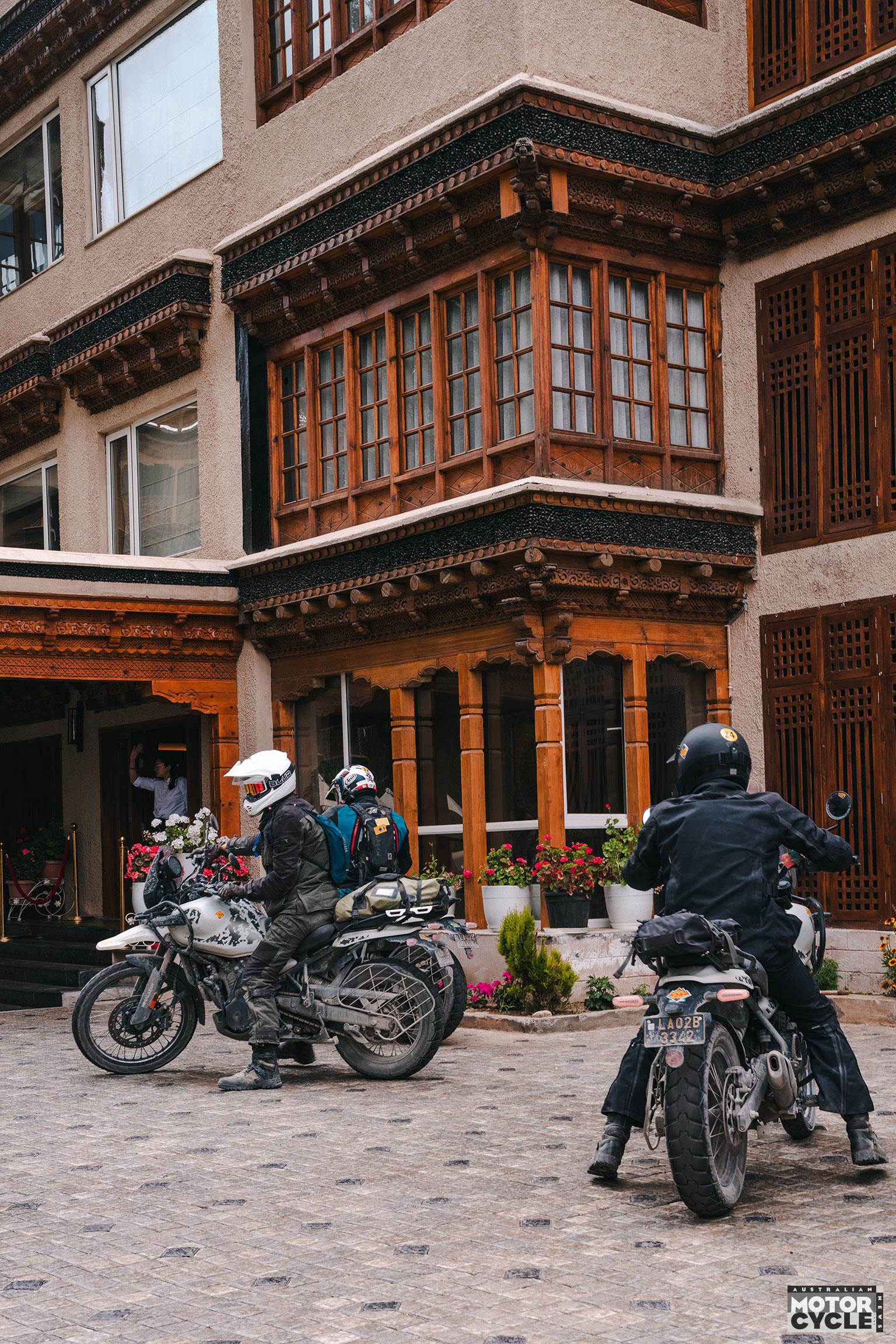
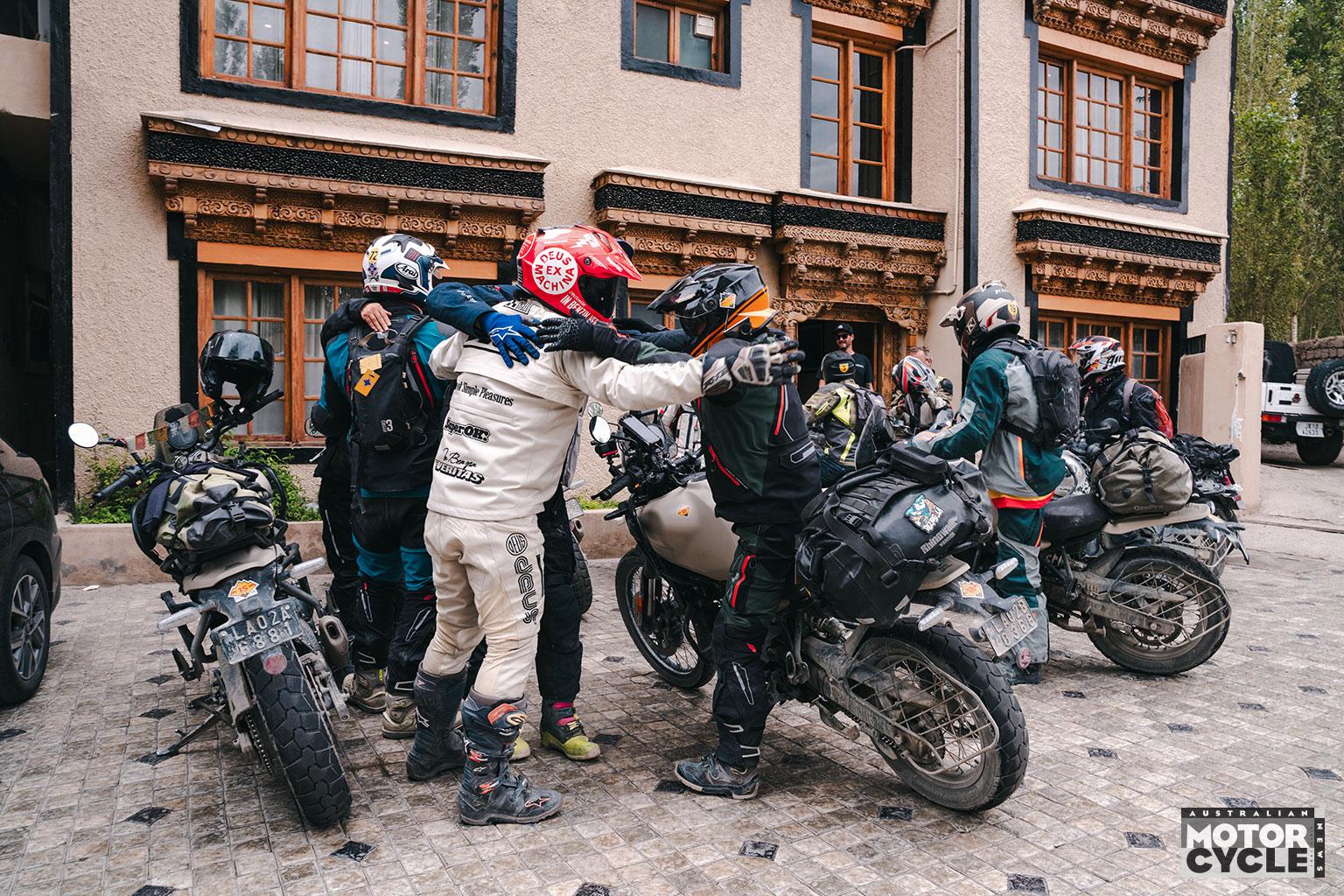
Sangam. Nobody says much. We just ride on, back into Leh, closing a loop none of us fully understood we were riding until it closed. We pull into a different hotel, one of the oldest in town, built in the mid 1970s, around the same years Ladakh itself first opened. Hugs everywhere, the relief of people who rode the same trip alone and together at once. No accidents. Everyone standing.
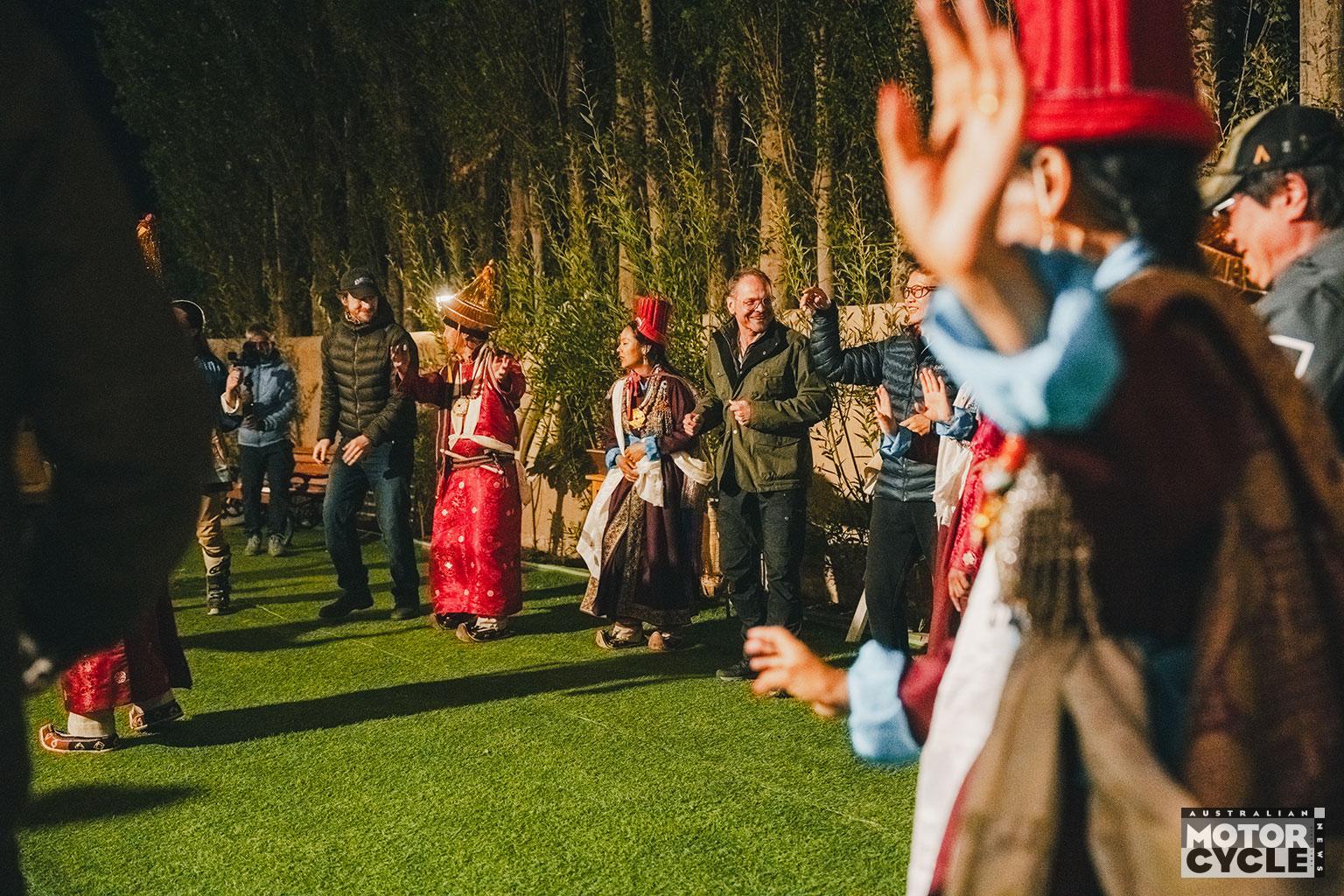
That evening, Royal Enfield hosts a farewell dinner complete with Ladakhi dancers, speeches and certificates. One speech, from a Korean rider, written in a language that isn’t his first but read anyway, speaks of the scale of what we’d taken on, and of how he is humbled to have even attempted something this raw, before thanking the group for getting each other through it. It lands harder than anything scripted has a right to.
Ten days earlier I couldn’t make it up one flight of stairs. Now acclimatised, lungs finally working, I’m dancing with a folk troupe in a hotel that’s been standing since before any of the roads, the tourists, any of it, existed at all.
Coming down
Ten days isn’t enough to understand a place like this and it was never supposed to be. What it’s enough for is to get hit by it. The headache at 19,000 feet when pilots must have oxygen available at 14,000, a foot skating over a drop, a cow standing dead centre on a blind corner like it owns the road.
We rode through every condition the Himalayas had to offer. In between we watched a road get built in real time under our front wheels and started to realise that everything we thought was ancient and permanent – the passes, the villages, the idea of Ladakh as some untouched Shangri La – is actually under enormous change, held together with fresh tarmac and a Border Roads Organisation slogan painted on a rock.
Nothing here held still long enough to be photographed the way the postcards promise. The mountains didn’t care that we were there. The cow didn’t care. The trucks pumping black smoke into thin air, the excavator I nearly went off a cliff to avoid, the family sending their five-year-old off to become a monk, none of it was performed for us. It just happened to be happening while we rode through it, which is the closest thing to authenticity you’re going to get anywhere. It’s not comfortable and it shouldn’t be.
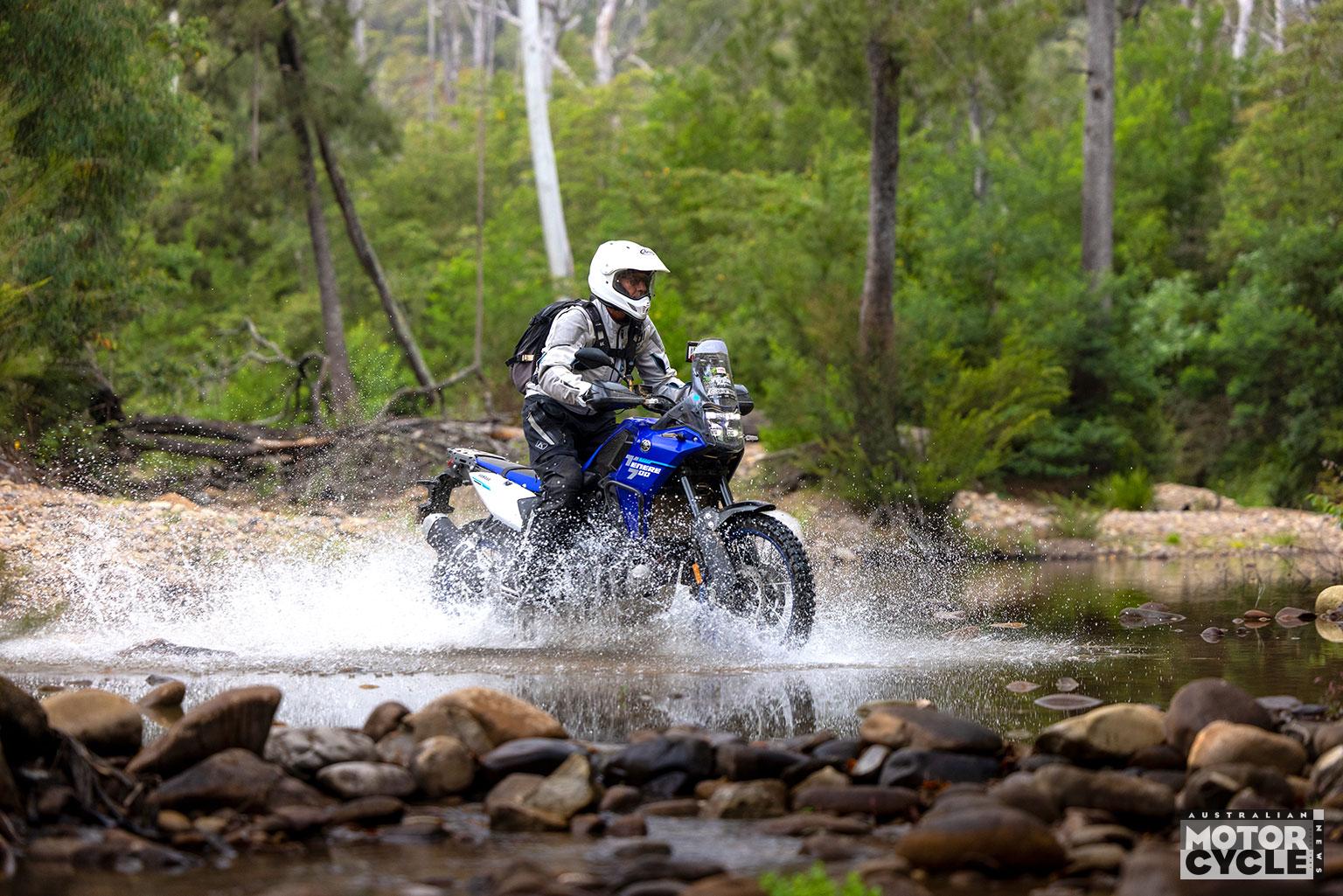
The bike had a lot to do with how that landed. The Himalayan 450 isn’t fast, 40 odd horsepower, and at 19,000 feet we were lucky to feel two thirds of it. It won’t win you anything. What it does instead is refuse to complain. Liquid cooled for the first time in the model’s life, an upside-down fork swallowing washboard gravel and hidden creek rocks without ever threatening to throw me off, switchable ABS that let me kill rear brake intervention the instant tarmac became dirt. In my worst moments, the emergency swerves and sudden stops, it was forgiving and light enough that none of it felt like a catastrophe. Just the bike doing its job, which was never to be impressive. It was to be trusted. A mule, built for roads that don’t forgive ambition, with just enough power to get you there and just enough simplicity that a teenager with a socket set could put it back together on the side of a mountain. It matched a place that felt the same way; long history, unfinished, unpretentious.
Near the end of the trip, I passed one of the Border Roads Organisation’s hand-painted signs: “Better to see something once than hear about it a thousand times”. I believed it the way you believe any cliche until you’ve tested it against a mountain that didn’t have a road four years ago, and a group of strangers who didn’t know each other on day one.
By day nine they were pulling each other out of sand traps and sharing soju around a fire like it was owed. So go now. Not because it’s ancient. Because it isn’t. And it won’t stay this new for long either.
Who is Callum?
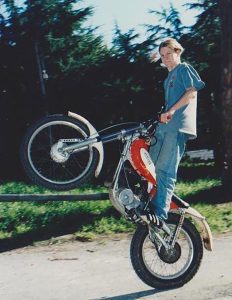
Australian Creative Director Callum Cooper is an award-winning small-film maker who, after working in London, undertook a fellowship at MIT in the US then led teams developing digital experiences such as the Empire State Building’s $165m interactive Observatory Experience. Now he is Head of Digital at Sydney’s Powerhouse Museum. Callum started riding on a Yamaha TY175 as a teenager. His Sydney ride is a 2001 Triumph ‘street tracker’.
Viewfinder changed to black and white
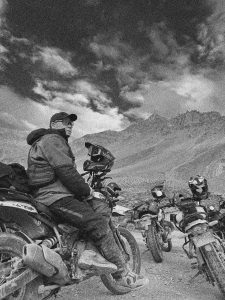
My mum Helen travelled close to this area in the mid-1970s going overland from Canberra to London. Only five photographs survive; hard to imagine now with travel built around capturing every second, edited and posted on the day. To honour the old days of travel I brought a cheap Fuji Work Record camera, used on Japanese construction sites in the 1990s. Weatherproof, shockproof, bumper guards around the lens. I wore it around my neck the whole ride; no need to take gloves off to shoot. Two rolls of black-and-white film. The gallery is up on AMCN’s website.