Laverton ’76 headlined big names and bigger promises, only to unravel in a collapse that stunned the sport here and overseas.
Fifty years ago, the largest-ever influx of international motorcycle stars descended on Melbourne for what promised to be the race meeting that set Australia on the map: the 1976 Australian TT. It was touted as history in the making, but what transpired was not just history, but sheer horror for investors, a Federal Government investigation, and a near-riot in Italy. Nonetheless, the on-track action was like nothing seen in this country before.
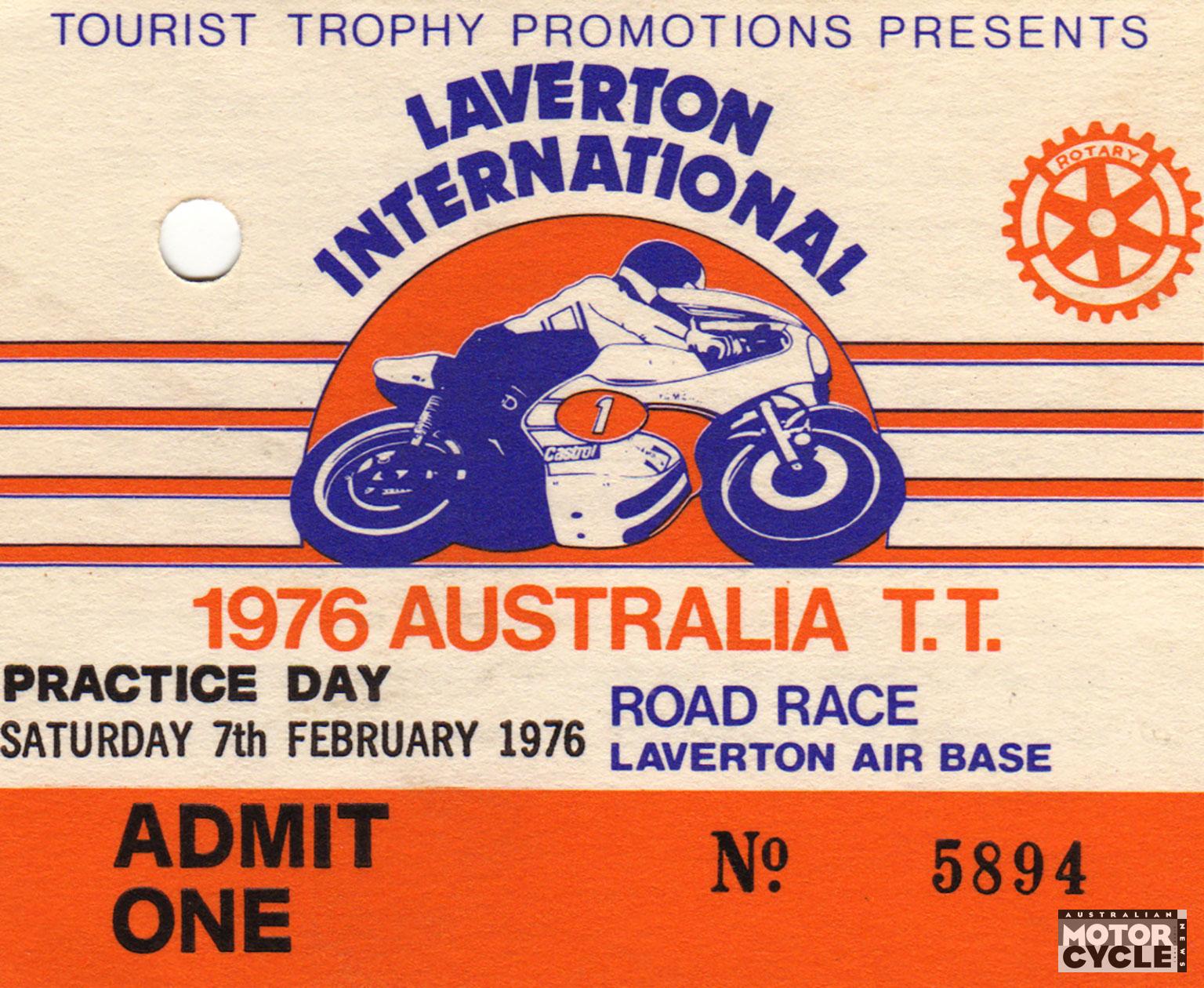
First held in 1914, the Australian TT (Tourist Trophy) was our oldest and most prestigious event. Sanctioned thereafter by the Auto Cycle Council of Australia, the TT became the official Australian championship, rotating annually between states. In 1973, however, the ACCA instituted a new six-round Australian Grand Prix series to take over as the national championship – with five classes for solos and two for sidecars. It left the Australian TT high and dry. Although it continued as a standalone event in various states from 1973, it was no longer important. For 1976 it looked like the TT, which was due to be held in Victoria, would not take place at all, until the date was quietly allocated to the only applicant.
In the lead-up to the 1976 Australian TT, the news broadcast by the promoters, a mysterious company called Besa Pty Ltd, just got bigger and bigger. Trading as TT Promotions, the company announced in October 1975 that it had signed contracts confirming the appearance of eight topline GP riders, including Giacomo Agostini, who had clinched his 15th world title only one month before. Others included World 350cc champion Johnny Cecotto, World 125cc champion Paolo Pileri, and 250cc title holder Walter Villa.
Hartwell MCC president Murray Nankervis, who was also a director of Besa, told the media that TT Promotions would be running the Australian TT at the ramshackle Phillip Island circuit on 7-8 February, 1976. Hartwell MCC was named as organiser of the meeting, with the backing of Rotary International, of which Mr Nankervis was also a member. Rotary District 280, which comprised 54 Rotary clubs in the Melbourne area, funded a trip to Italy by a representative of the promotion to negotiate with riders and managers.
“Obviously, Rotary will be getting a percentage of the gross gate receipts, but one of our ambitions is to show the FIM that Australia can host a major international meeting,” said Nankervis. “Ultimately, we want to see the Australian Grand Prix revert to a one-meeting affair instead of a six-round series, so that meeting can become a round of the world championships.”
The announcement coincided with two major events in the GP arena: Yamaha’s threatened withdrawal from entering official teams in the world road racing and motocross championships, and the release of the new square-four RG500 Suzuki. The RG500 had first appeared for the works Suzuki team in 1974, with a production version slated for the following year. The ‘customer’ RG500 made its debut at the Indonesian GP in November, with Australian Bill Horsman, Kiwis Stuart Avant and John Boote, and local Bambang Soedarsono the four riders chosen to launch the exciting newcomer.
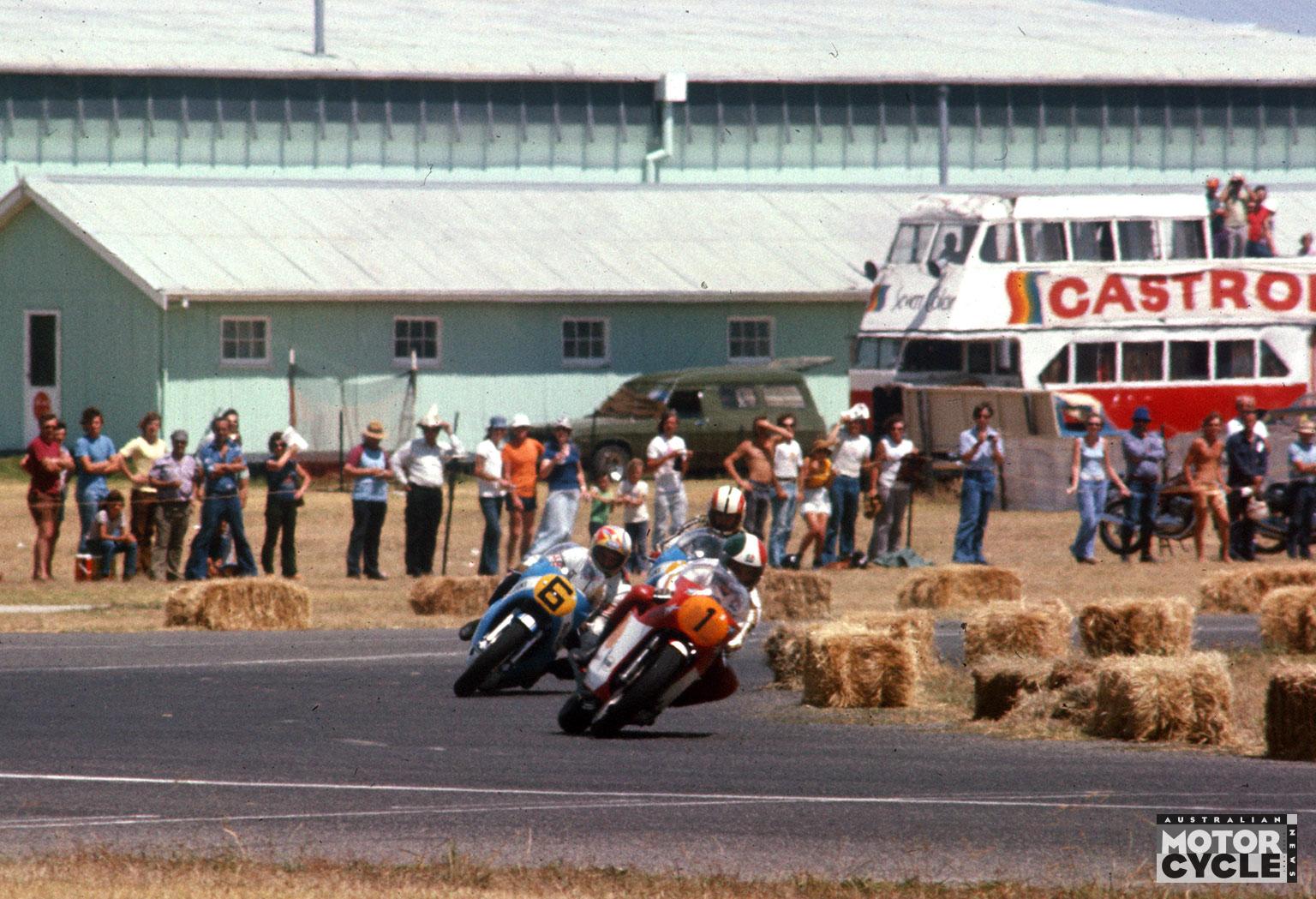
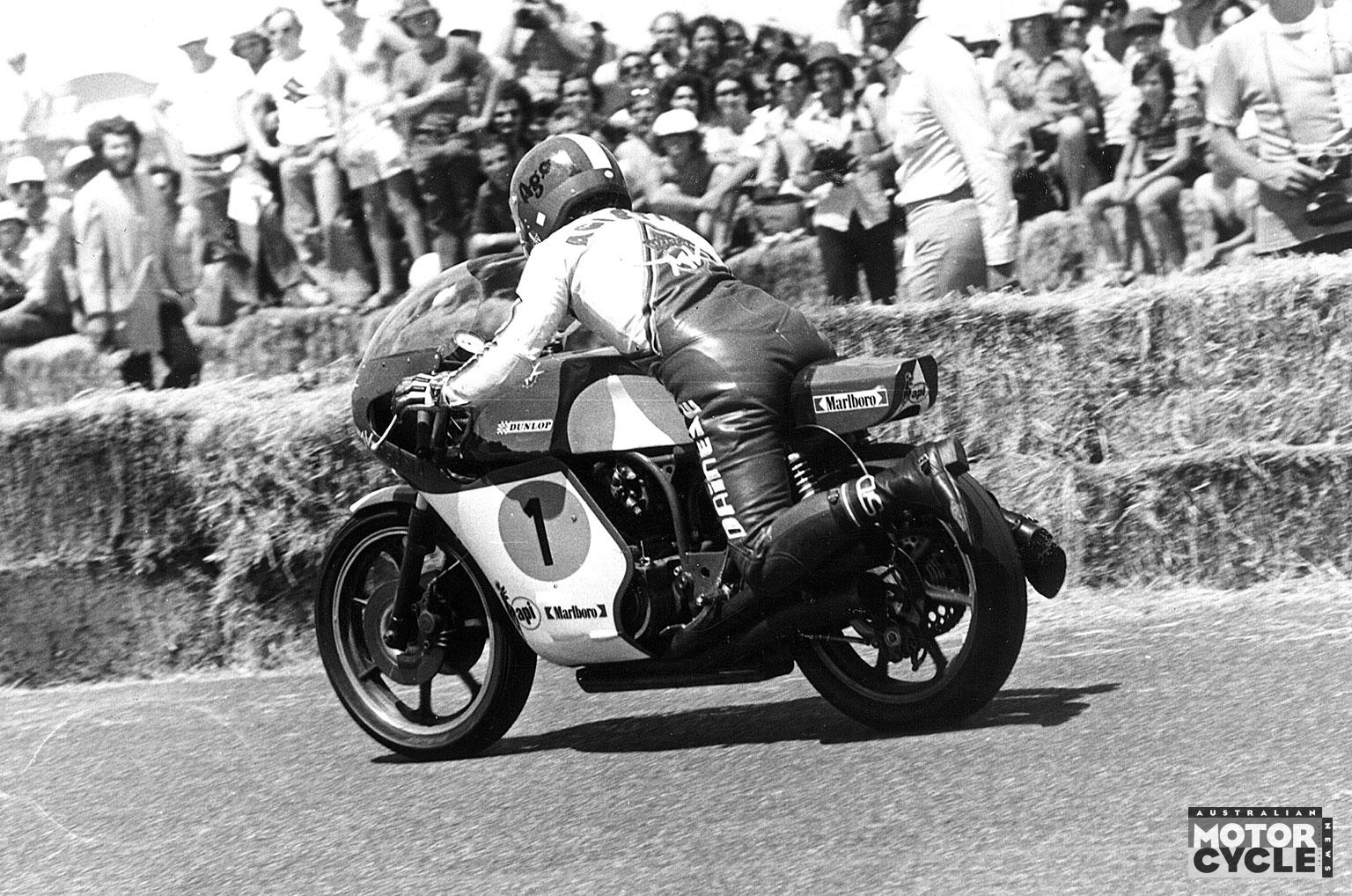
With his Yamaha contract gone, Agostini announced he was off with his number one plate, back to his spiritual home at MV Agusta. This was to be a ‘private’ team using works bikes, but his mount at Laverton was a well-used 1974 500/4.
Meanwhile, Phillip Island was quietly dumped as the venue, to be replaced by an as-yet unseen 5.3km circuit at Laverton Air Base, 22km west of Melbourne. In August 1975, the RAAF hosted an air show there that drew 164,000 spectators, many of whom arrived by special trains. Shifting the TT to the air base was supposedly a strategic move to tap into Melbourne’s large Italian population, much of which was concentrated in this region.
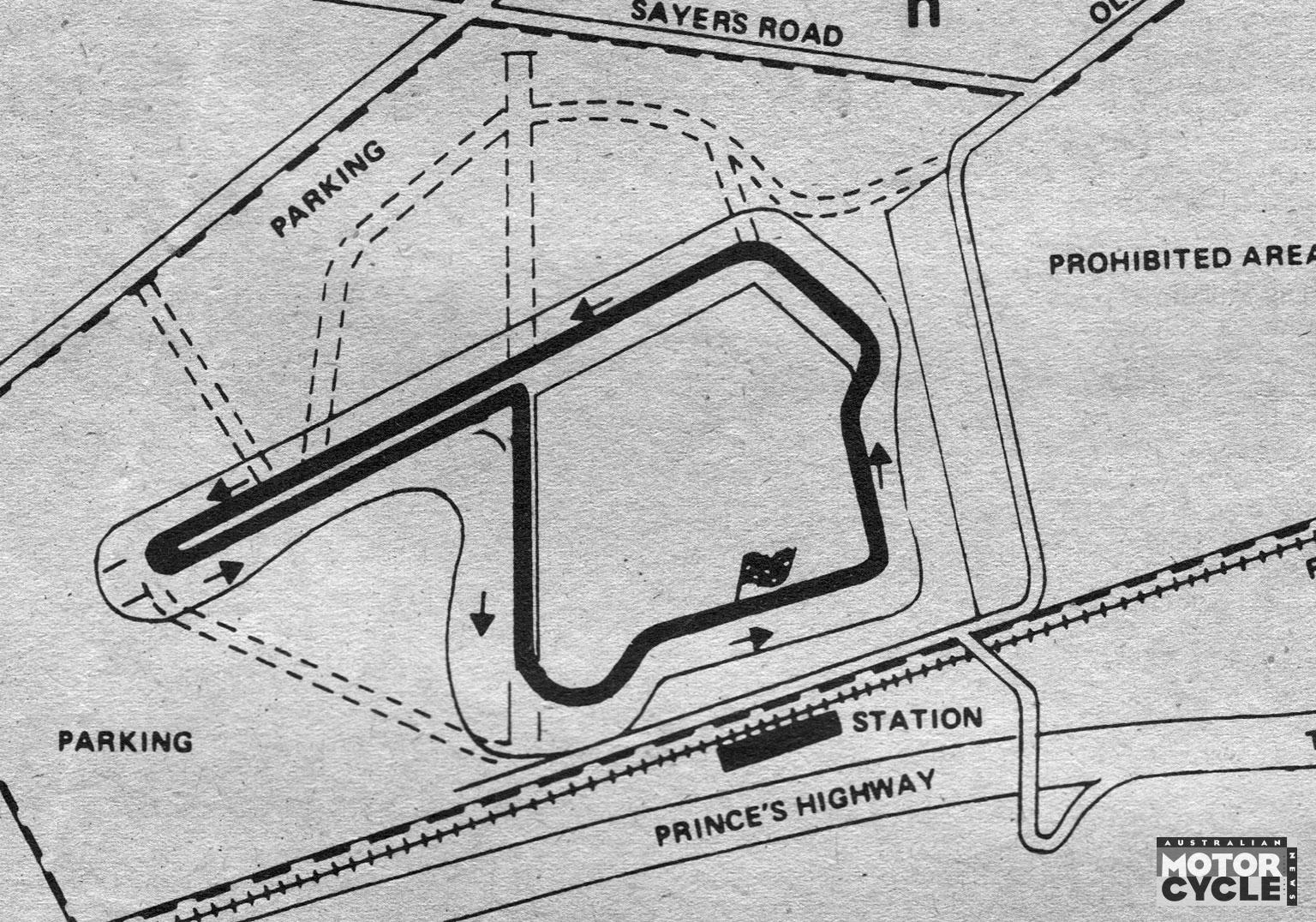
Victorian champion Bob Rosenthal inspected the proposed layout with his new TZ750 Yamaha, declaring the machine under-geared despite reaching 290km/h. The surface – which had been sealed with hot-mix bitumen less than a year before – was described by the promoter as “like a billiard table”. The layout incorporated the main east-west runway, with a roughly square section of mainly left-hand corners at the western end.
Nankervis said: “This will be the first time Laverton has been used for a motorcycle meeting, and if everything goes well it won’t be the last. The RAAF has already said that depending on how things go in February, the base will be available for perhaps one meeting a year, providing it is run for some form of charity.”
Over the Christmas period, Cecotto pulled out due to problems with the ankle he had broken in the final round of the world championships, and was replaced by Aermacchi Harley-Davidson rider Gianfranco Bonera. Adding to the international line-up was the Dieme-Yamaha squad of Giovanni Proni, Otello Busherini and Attilio Riondato, Pierpaolo Bianchi on a 125 Morbidelli, Japanese stars Sadeo Asami and Yamachan Yamasaki, American Pat Hennen and Giacomo’s younger brother Felice Agostini on a 250 Yamaha. New Zealanders Stuart Avant, John Boote and John Woodley all had the latest RG500 Suzukis. As well as the international brigade, it seemed like every top rider in Australia was entered.
It was certainly going to be by far the biggest influx of world talent to Australia, but little by little, organisational issues crept into the equation. The security organisation contracted for the event was sacked, their $3000 fee being deemed excessive, and was replaced by private individuals, whose task it was to collect gate receipts. There were sceptics who maintained that the TT would not happen, and this did little to help the nerves of those who recalled the previous large-scale international invasion, the ill-fated Moto Crosse (sic) series of 1972, when the promoter went bankrupt the day after the last race.
Christmas came and went, preparations proceeded apace, and with a week to go even the sceptics had gone quiet.
The Rotary connection worked well in the right places. No less than Australia’s PM, Malcolm Fraser, would be there as guest of honour along with his Employment Minister, former race rider and sponsor Tony Street. Special Melbourne-Geelong trains were deployed to handle the anticipated massive crowd, stopping at a station within the air base.
Gates open, wide open…
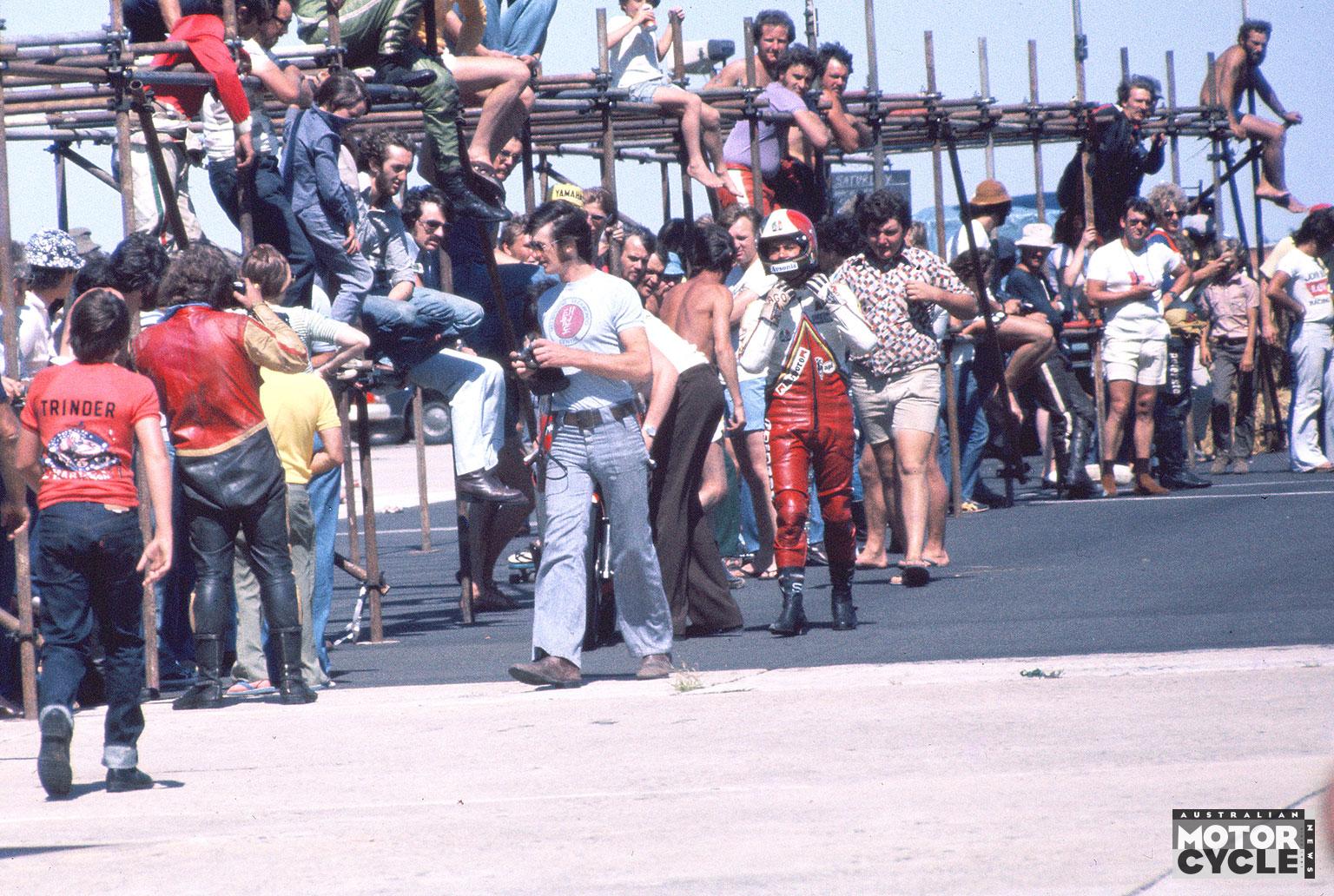
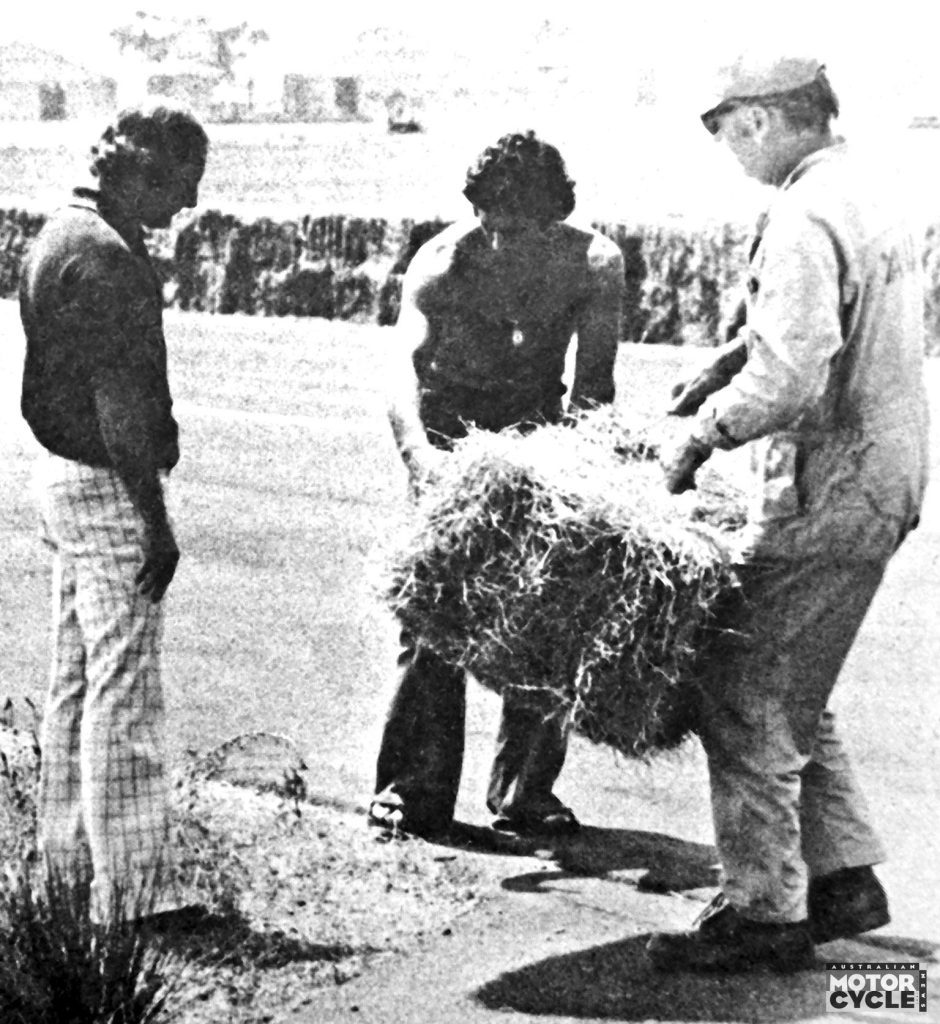
Impressive as the crowd was, just how impressive it was would remain a key question in the events that followed the meeting. But there’s no disputing that what the spectators saw that weekend was a feast of brilliant sport, with one performance in particular going down in local racing legend. There is also no disputing that the circuit itself was a major factor in its success. Fast and fairly smooth, the track permitted speeds usually only associated with Conrod Straight at Bathurst, while the section linking the airfield with its twin straights also proved to be testing and spectacular. By and large, the internationals praised the track. Much discussion went into the positioning of straw bales, and Agostini himself took charge, removing his shirt and dragging them into position.
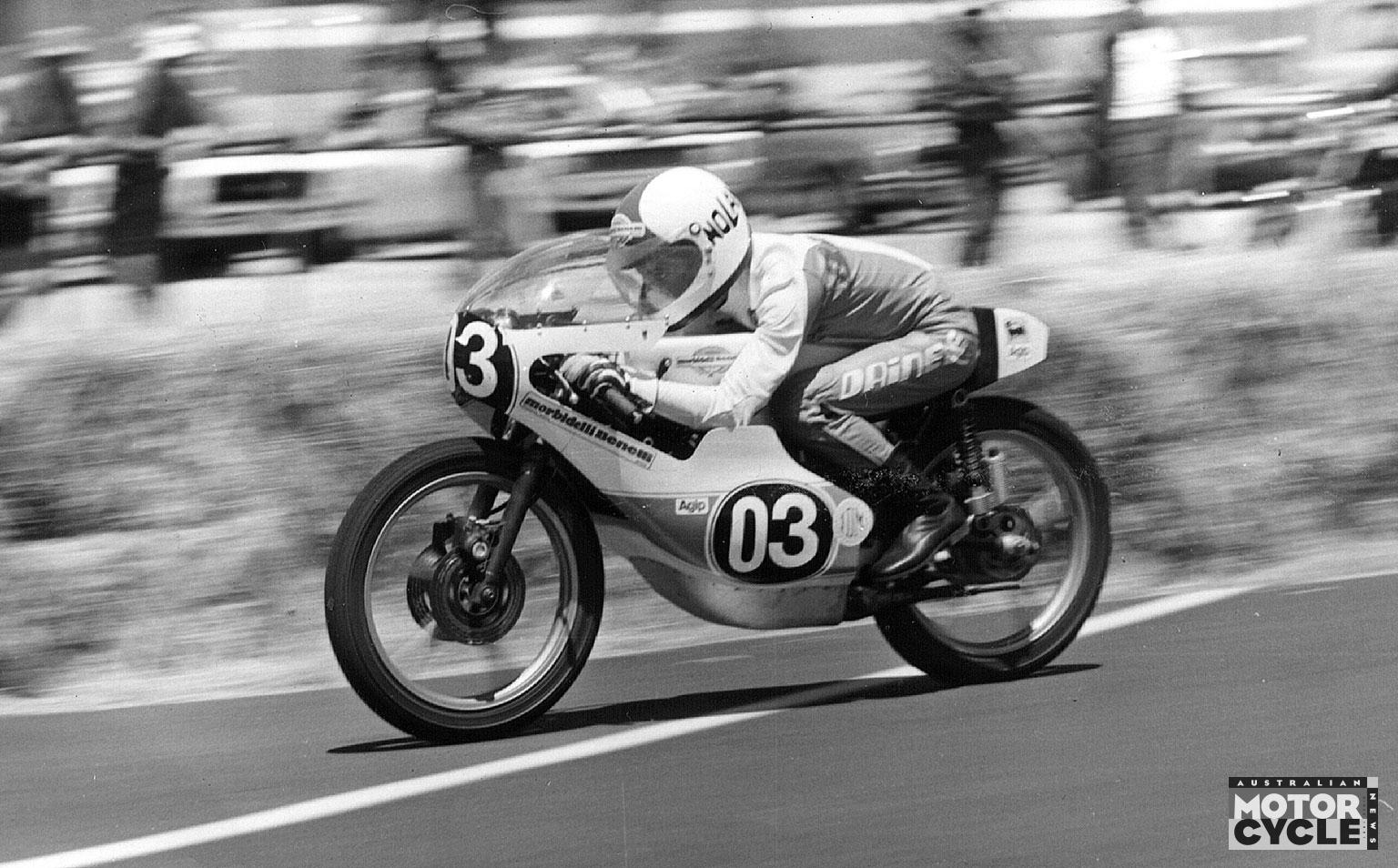
A typically stifling summer’s day dawned, creating very uncomfortable conditions for spectators. The meeting began with the 125cc TT, and the works Morbidellis were clearly going to make minced meat of the field after qualifying eight seconds ahead of the best local. During a test session at Calder, the two little blue and white twins had equalled the existing 250cc lap record!
From the start, Ray Quincey, on Clem Daniel’s home-brewed CSD, made the running, but on the first run down the straight, Pileri steamed past, followed soon after by his teammate Bianchi. The locals were finding the switch from the normal diet of alcohol fuel to the petrol required (the fuel for the meeting was supplied by the RAAF) under the FIM permit to be a disaster, with reigning Australian champion Geoff Sim and quick qualifier Dave Burgess (Kawasaki) both falling victim to engine gremlins. At the flag it was Pileri, 38 seconds ahead of Bianchi with Quincey, best of the locals, almost a minute farther back.
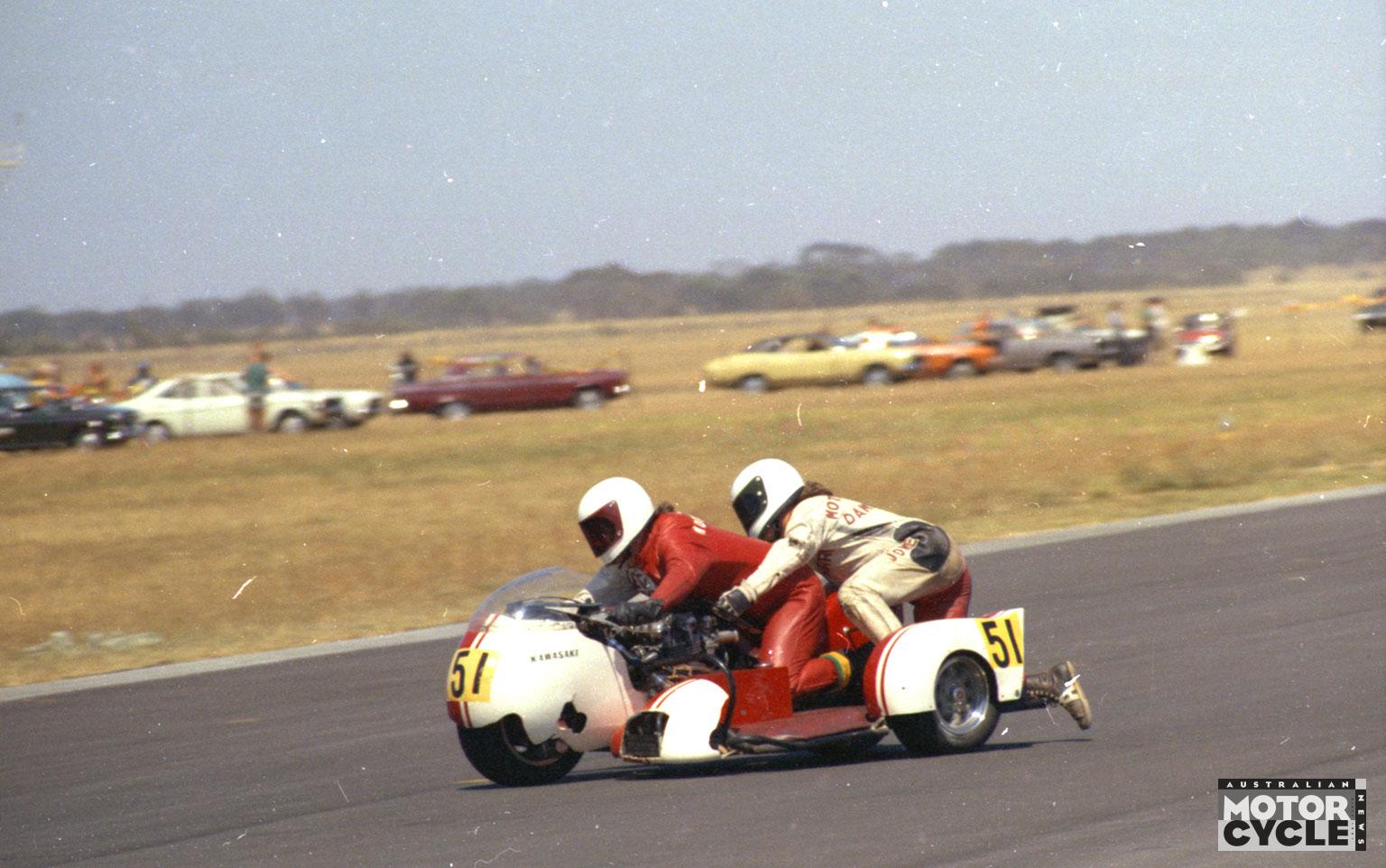
The following Junior Sidecar was another drawn out affair, with South Australian Alex Campbell, partnered by Tim Pearson, winning with ease. The pair had finished an excellent seventh in the Isle of Man 500cc Sidecar TT, the experience clearly polishing an already sharp act. Veterans Bob Salter/Trevor Luck were second, comfortably ahead of another NSW pairing, John Macklin/John Lloyd.
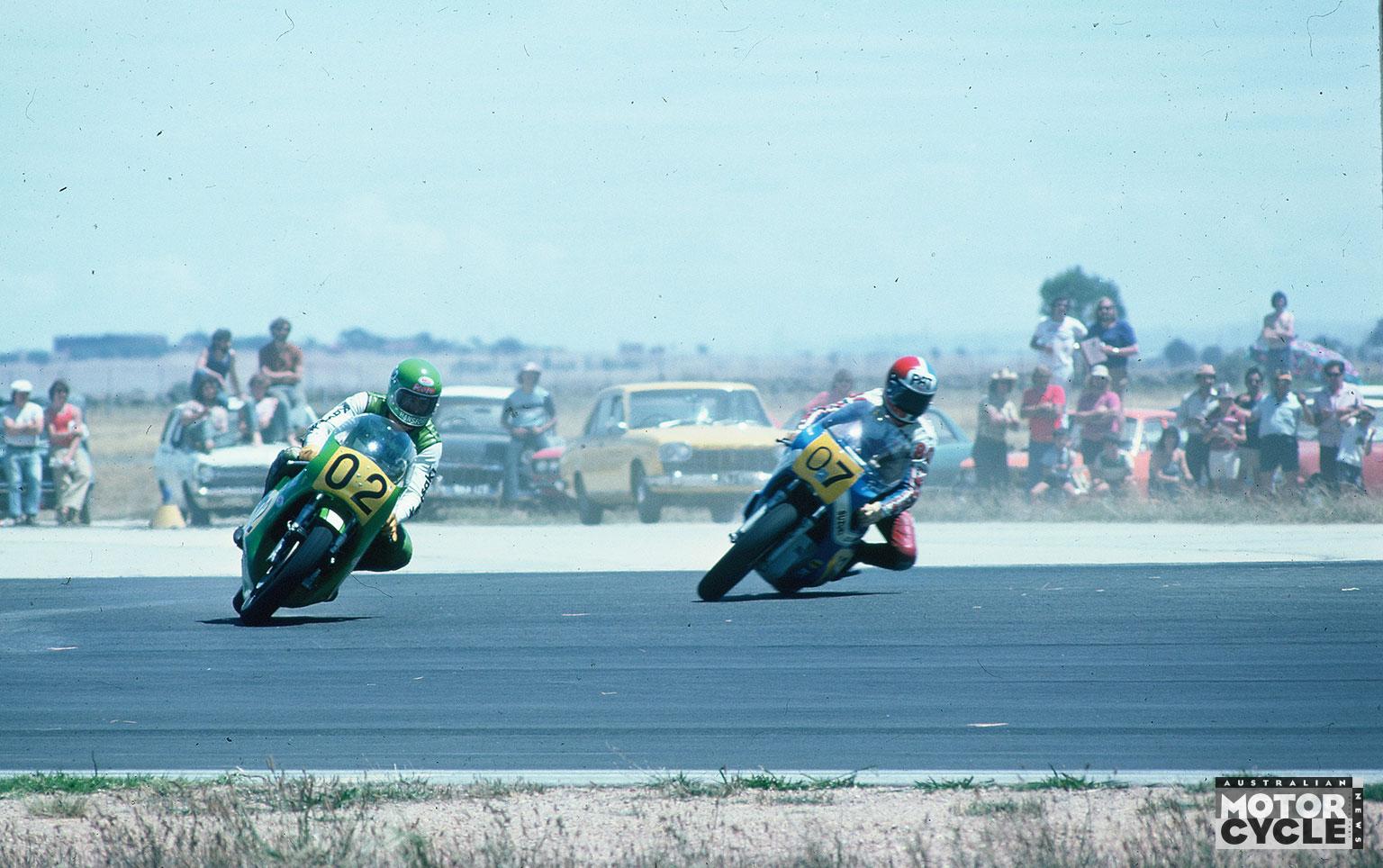
Although the 500cc Senior TT was being touted as the day’s main event, the 15-lap Unlimited (750cc) TT held big interest for the crowd, being another episode in the brilliant contests between Gregg Hansford and Warren Willing that had been going on since the memorable 1974 TT at Bathurst. But it was American Pat Hennen and his Daytona-spec TR750 Suzuki who took the fight to the blond Queenslander, despite giving away around 20km/h in top speed to the new water-cooled Kawasaki.
The lead changed on every one of the 15 laps, the pair crossing the line constantly shoulder to shoulder. But just when a photo finish looked on the cards, the Suzuki’s clutch began to slip, forcing Hennen to settle for second. A long way back came a rather subdued Willing, who admitted he just didn’t feel on form with his new mono-shock TZ750. Queenslander Stephen Klein got the better of Ken Blake for fourth place.
During the lunch break, Minister Tony Street hopped aboard the 250cc Honda-4 that had been ridden to many victories by Kel Carruthers, and did a lap of the track. Kel himself had been flown in from his base in the US to act in an advisory role on the design of the circuit. Course Marshal Kevin Donnellan was happy to oblige Malcolm Fraser’s request for a few laps in his Porsche Turbo, although the PM’s minder, a large man, insisted on squeezing sideways into the miniscule rear seat. After a circuit at moderate pace, Mr Fraser requested a few more revs and was reportedly delighted as the Porsche slithered through the bends. It wore out a new set of tyres during the course of the weekend.
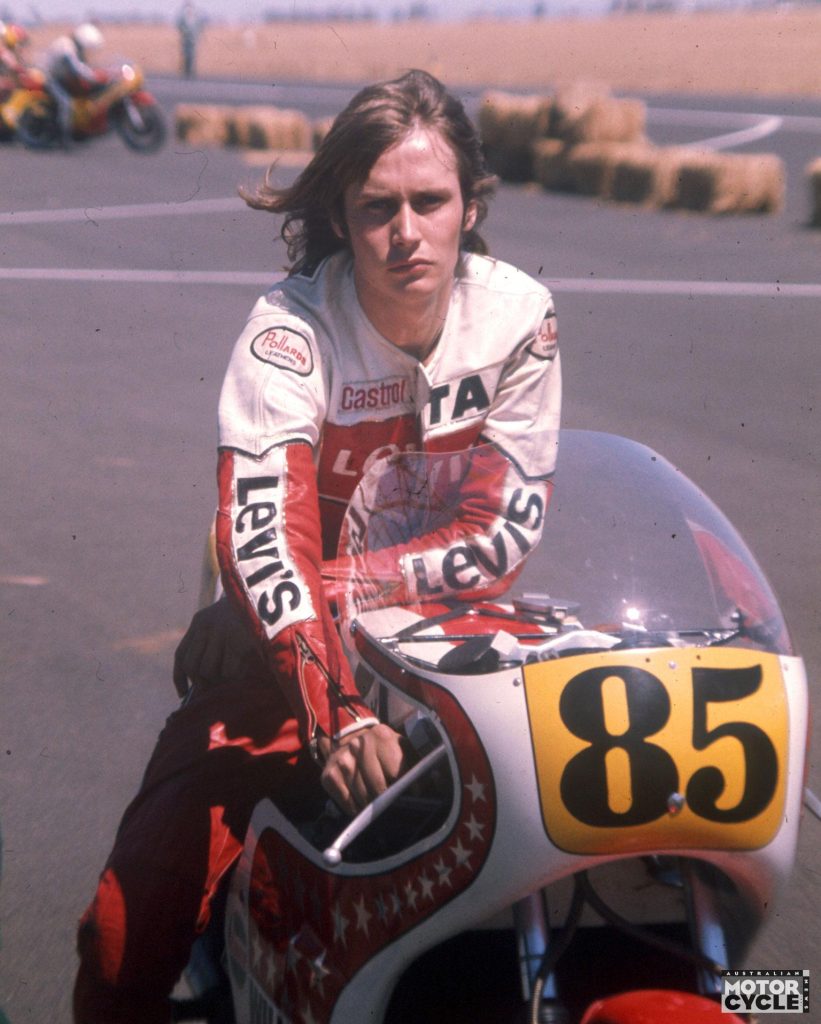
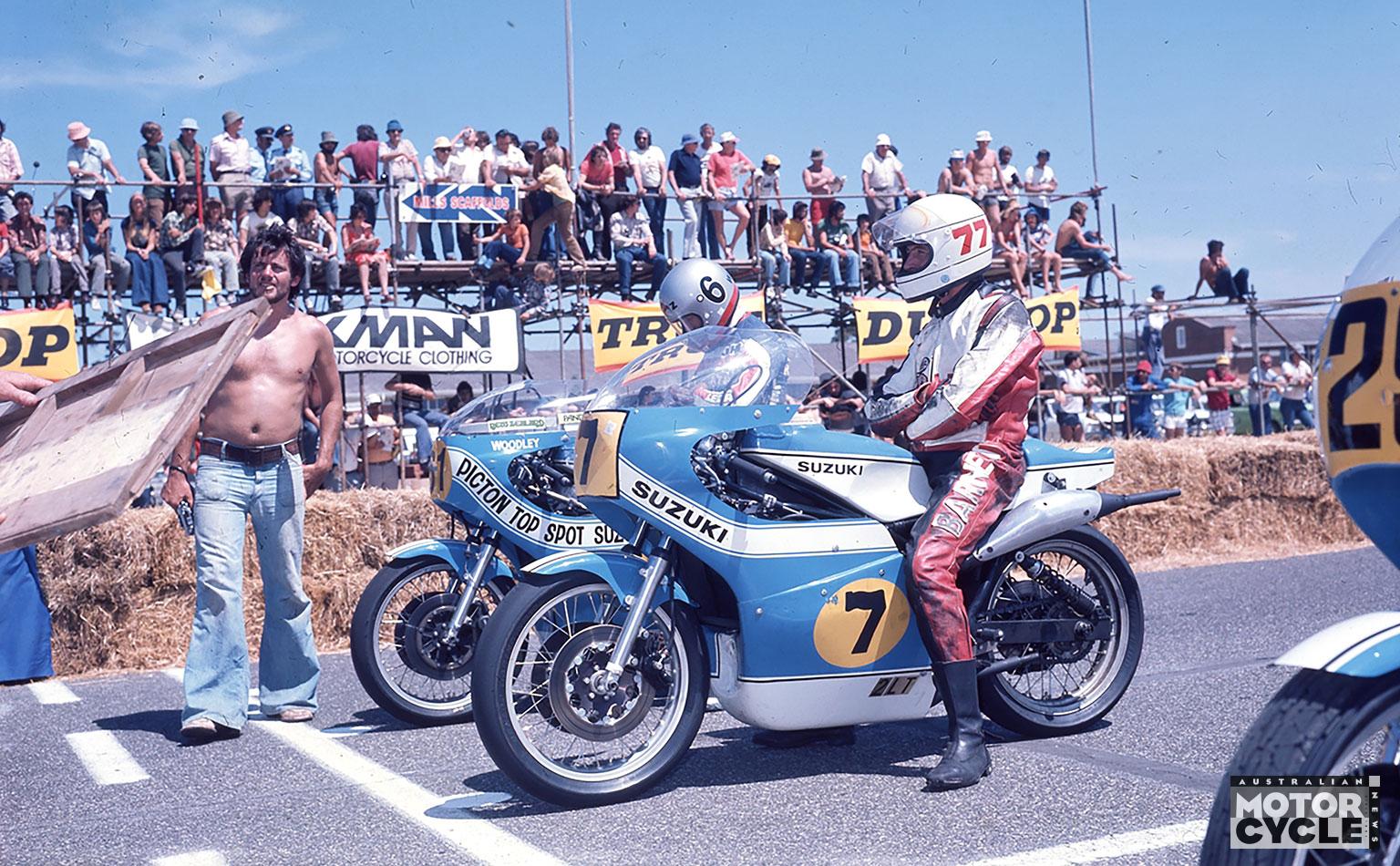
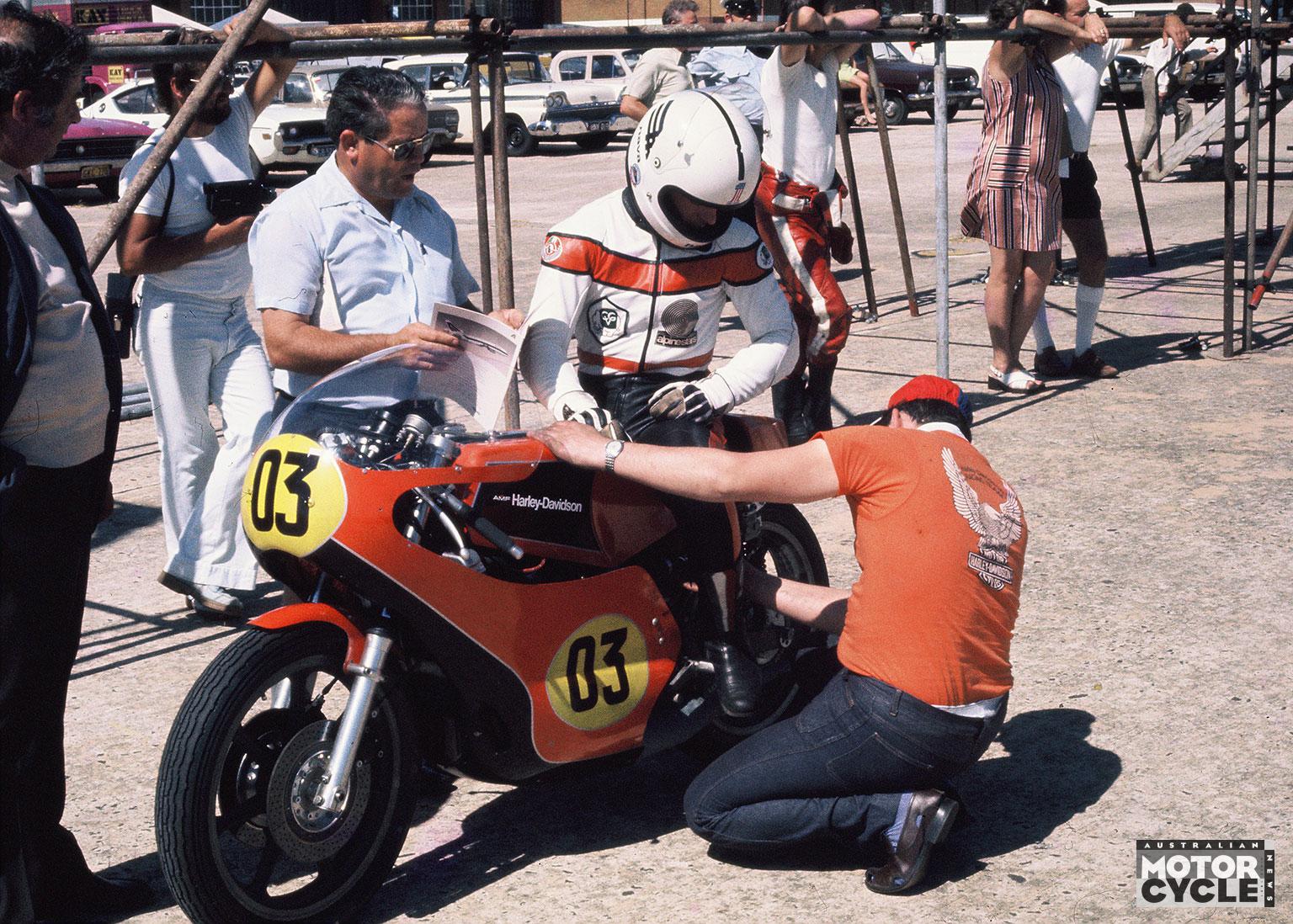
With the lunch break over, it was time for the blue riband class, the Senior, which had also attracted the smallest field. Nevertheless, on the grid were no fewer than eight Suzuki RG500s, Agostini’s MV, Bonera’s vicious H-D twin, and a host of Suzuki 500 and 350 Yamaha twins.
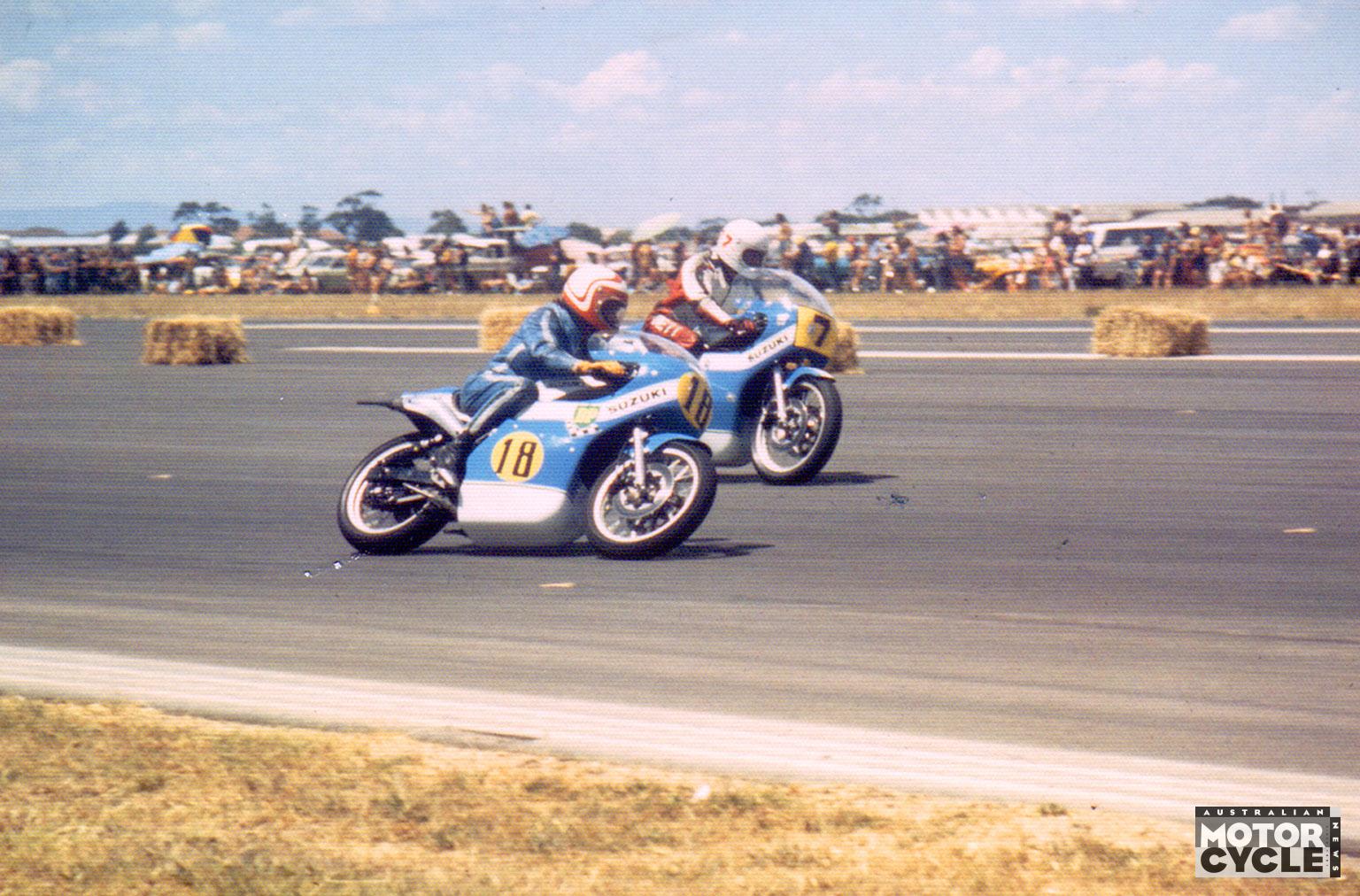
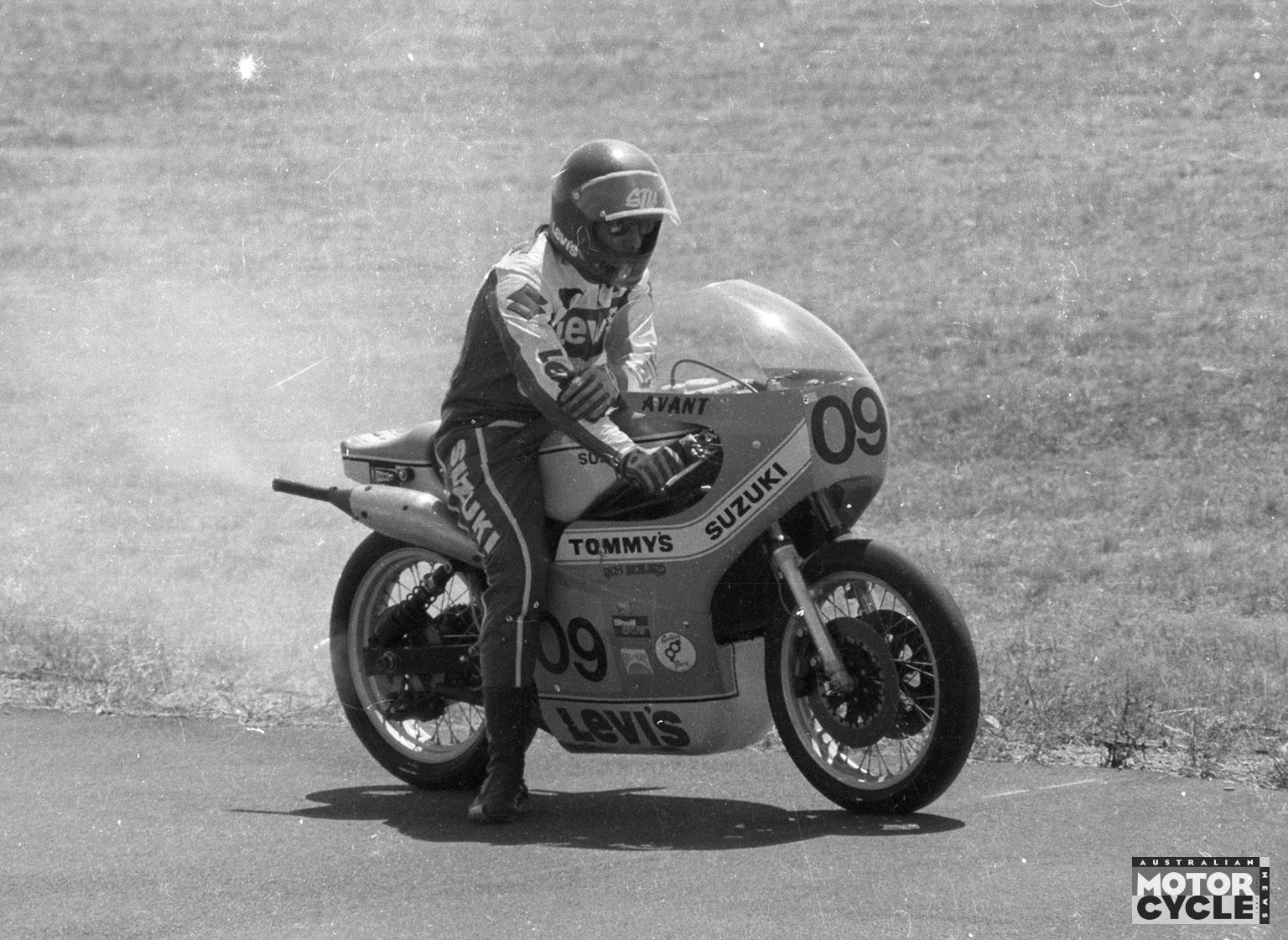
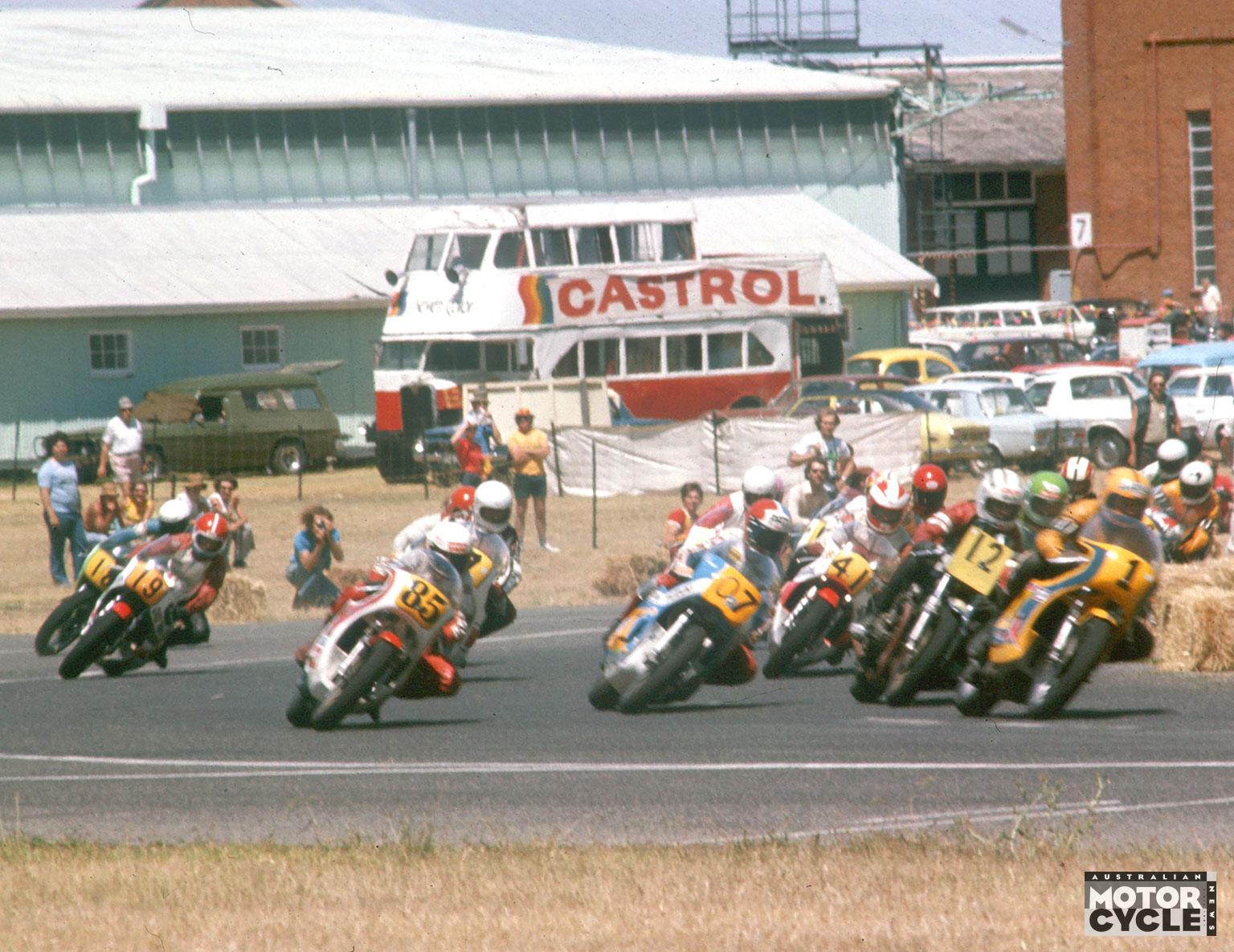
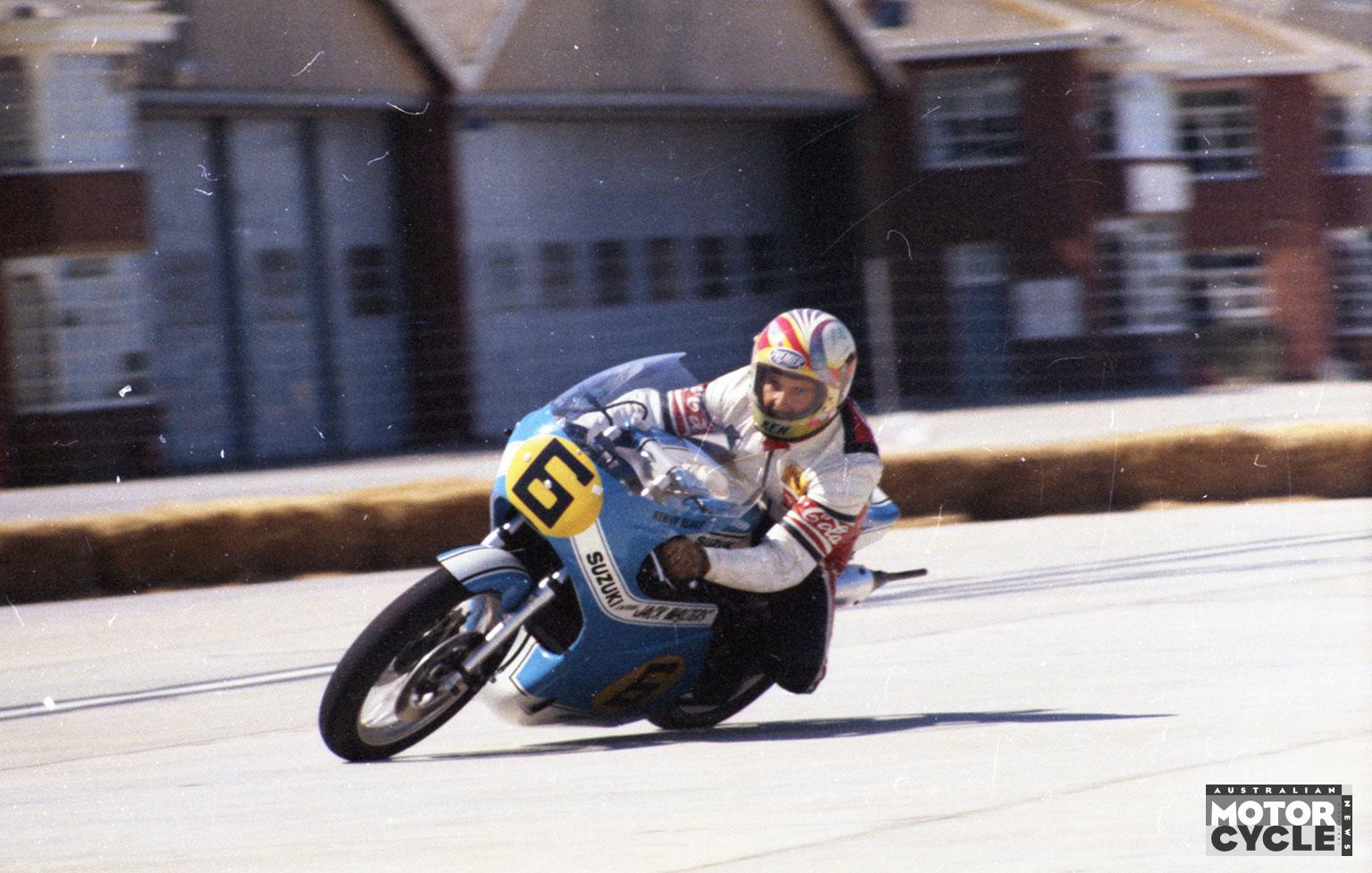
The MV fired instantly from the push start and Agostini was away while the two-strokes struggled into life, the lone four-stroke wailing its way around the flat circuit. Behind, Woodley and Boote were early retirements with engine failures, but fellow Kiwi Avant was really in his stride, and on the second lap passed the Italian on the outside through the section called Carousel. Behind came the remaining Suzuki fours of Blake, Greg Johnson, Laurie Barnett Peter Jones and Bill Horsman, the latter off colour after a recent big crash at Mount Gambier.
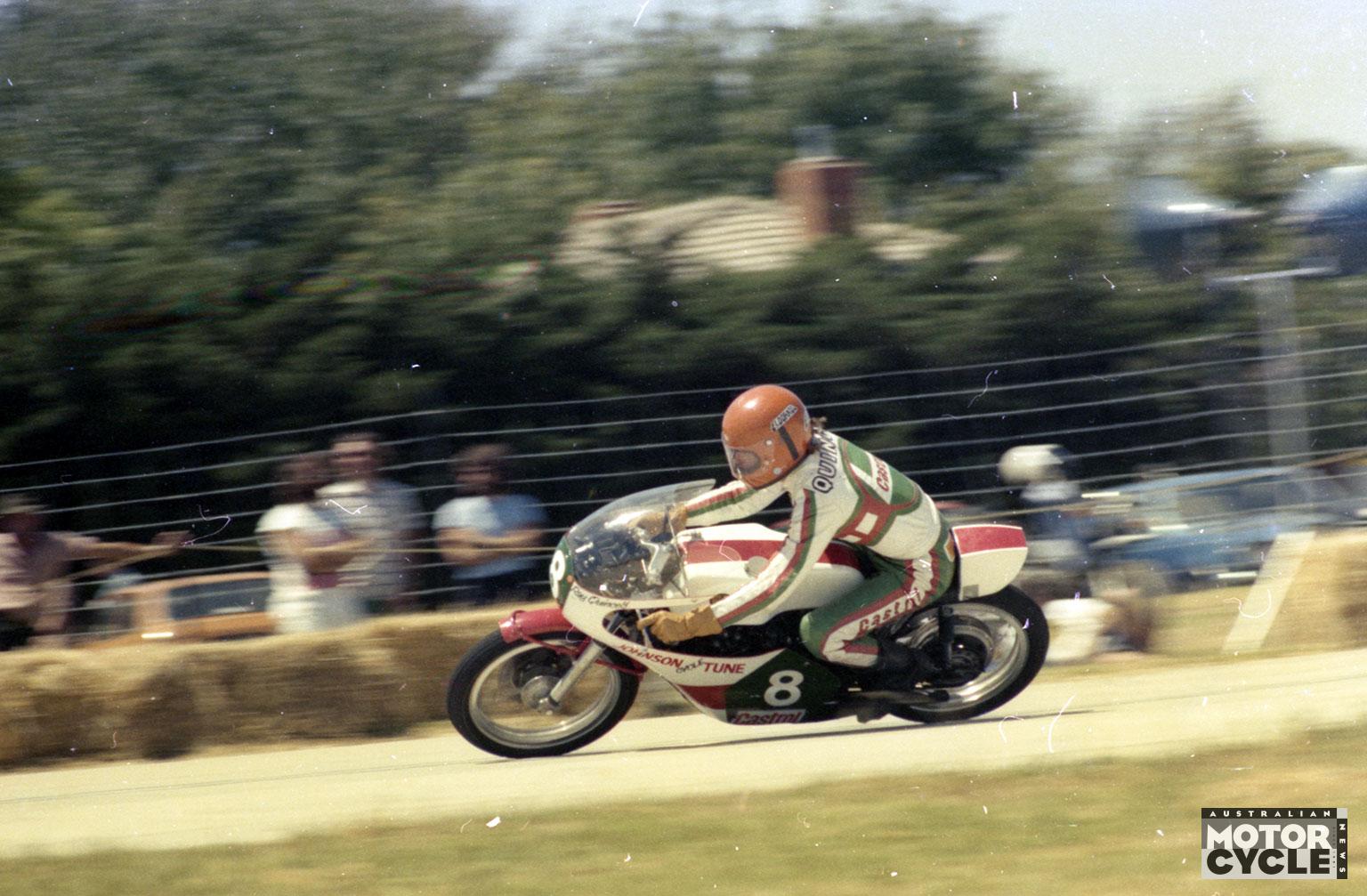
As Avant cruised away in front, Agostini soon had another aggressor to contend with, and on lap eight Blake passed the Italian on the Western Straight. It looked like this would be the finishing order as the gaps between the leading three stabilised, but then came heartbreak for Avant as his Suzuki seized at the hairpin, casting him unceremoniously down the road.
Blake accepted the gift and, to thunderous applause from the crowd, blasted home on the Jack Walters Suzuki to claim the most important win of his career. Behind Agostini came the Suzukis of Johnson and Jones.
It took some time to restore order to allow the 250cc TT to get underway, and when it did, reigning world champ Walter Villa took charge to head home Buscherini and Proni, with Felice Agostini fourth and Ray Quincey pipping Steve Trinder on the line to again claim the best performance by a local.
The Senior Sidecar began with chaos when Dennis Skinner lost passenger Adrian Hanson, and was won at a canter by Alex Campbell from Geoff Taylor/Barry Frazer and Gavin Porteous/Barry Jones. The meeting concluded with the 350cc TT, easily won by Villa.
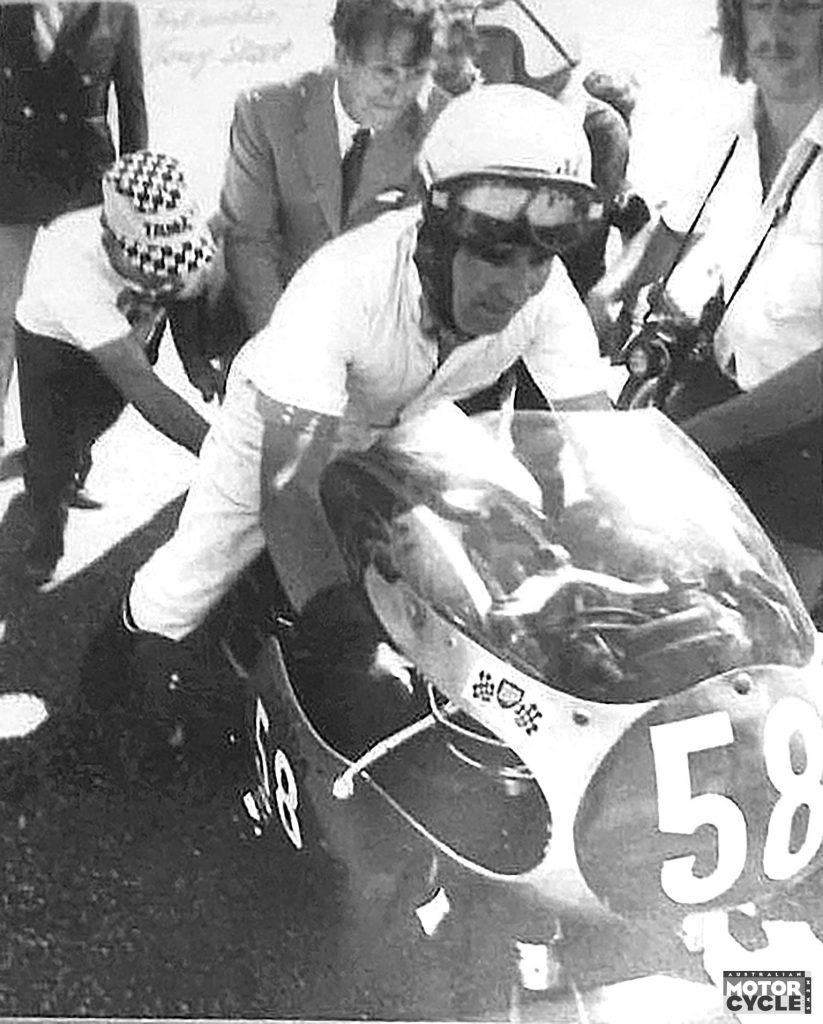
As sun-burned fans began the task of getting out of the place, the grumbling was almost as loud as the now-silent exhausts had been. Chief among the gripes was the almost total lack of staff, from security, ticket checkers to trackside officials. As the day wore on, fans wandered freely, including onto the track itself, with no restraint. The merciless heat and the almost total absence of shade and toilets was not just uncomfortable but a health hazard. With virtually no public address system operating, most were at a complete loss as to the race results. The programme contained just seven events, with around half an hour of no activity between them.
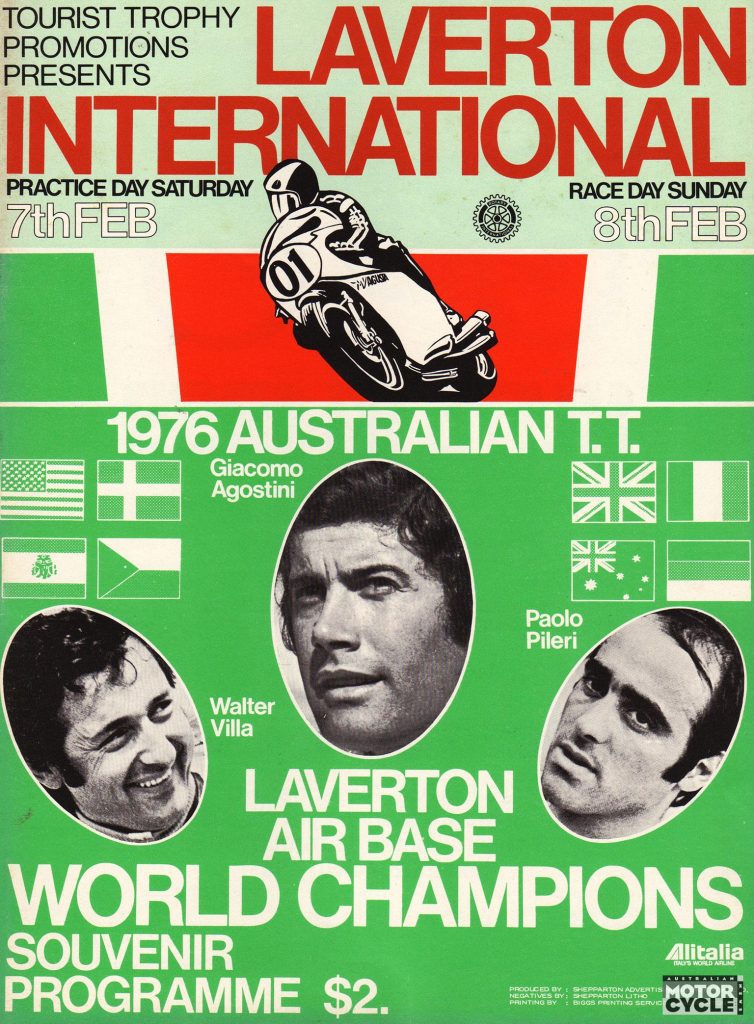
Il scandolo grande!
It had been a day of high drama, but the real excitement was just beginning. The day after the meeting Besa Pty Ltd went into receivership, with reputed debts of $80,000 incurred at the TT. In the Italian camp there was pandemonium, with riders and mechanics missing their scheduled flights and their machinery impounded pending the overdue payment of air freight charges from Italy to Melbourne. Despite unofficial crowd estimates of between 30-50,000, organisers claimed only 13,600 paying spectators. This figure would appear to be for pre-paid tickets, because on race day most of the entry gates were unattended – people just rode, drove or walked in.
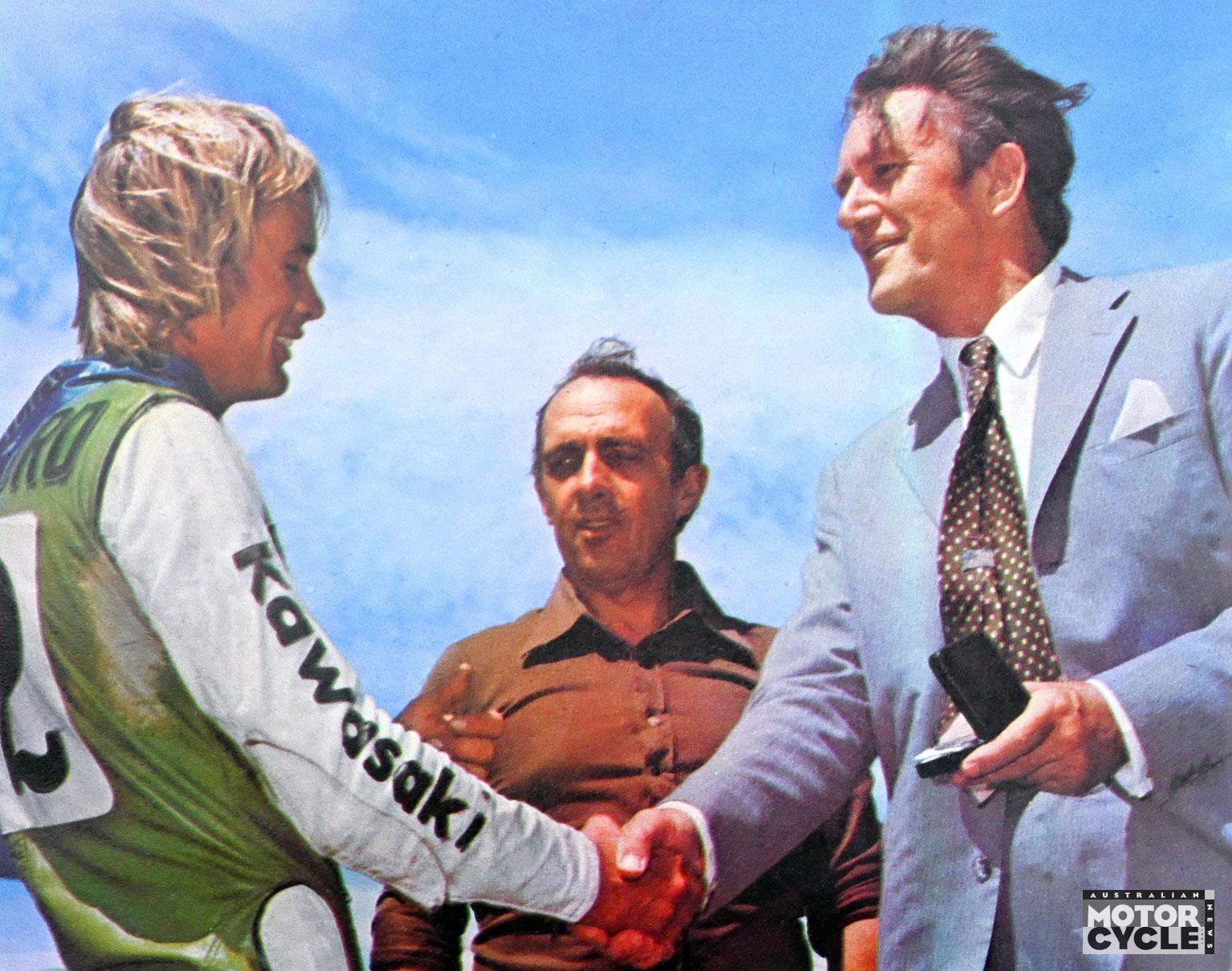
Prize money had been lodged with the ACCA and was not in dispute, but the appearance fees promised to the Italian riders was either not paid or only partially so. Understandably, the Italian press went ballistic, labelling the meeting ‘Il Scandolo Grande’. As panic set in, it was feared the works bikes may not make it back to Europe in time for the 1976 world championship’s opening round.
Damien Cook of the BMW Club of Victoria has clear memories of the aftermath: “My late father, John Cook, was a senior solicitor with the Victorian Government. Although not a motorcycle enthusiast, he came to the (Laverton) meeting with us and after the races we had a drink in the Tarmac Hotel. We got home late and about 11pm dad received a phone call which sounded quite urgent and important. He made a call to my uncle in Canberra then dashed out, and the next day was very busy trying to sort out a problem with Customs and the returning of the bikes to Italy.”
As the bills rolled in, the extent of the company’s demise became clearer. Air freight firm Pandair was owed $29,000 and with the European season looming, an agreement was finally struck whereby the machinery was returned, then held at Milan until the freight bill was met by the owners. As the creditors argued their individual cases, Federal Minister of Defence, Mr Killen announced that there would be a government inquiry into the TT. This came about after the Leader of the Opposition, Gough Whitlam, questioned the running of the meeting on a defence establishment and with “exalted patronage” – referring to the presence of the PM.
Hartwell MCC Honorary Secretary Wes Brown issued a statement on behalf of the club, stating that its only involvement had been the conduct of the practice and races, and it had no involvement in the collection of entry fees or the payment of prize money, and that the club itself was a creditor of the collapsed TT Promotions. The statement also said Nankervis was no longer the president, or on the committee of the Hartwell club.
“Murray didn’t set out to rob anyone,” Brown recalls, “but he was a loaded gun, full of big ideas but didn’t think anything through. He was like a bull at a gate. When he first got the idea, he pleaded with me to be on the board of Besa, but I declined – it was unthinkable that the president and secretary of Hartwell clubs should be involved like that. We had meetings with the authorities out at Laverton – police, council people and so on – and they kept asking him questions like, ‘where are all these people going to stay?, what about toilet facilities?’. His answer was ‘they can camp in that paddock and there are toilets at the pub and the railway station!’. The day after the meeting my wife Joyce and I were at Laverton, cleaning up, and the Italians were driving around the place in a rented van looking for Murray; they were furious. But he was nowhere to be seen, he knew he was in big trouble.”
LONG AFTER THE FLAG
Despite the excellent racing, there were numerous complaints from spectators, from the $5 admission charge plus $2 for a program, to the restricted viewing due to the flat nature of the circuit, poor toilet facilities and lack of a proper PA system – the latter partially due to RAAF radar interference. Skirmishes broke out in the temporary grandstand when people who had paid an extra $7.50 found their seats already occupied.
The meeting that had promised to put Australia on the world map merely succeeded in branding the country (at least in the eyes of the FIM) as a bunch of colonial bandits. The projected world championship Australian GP would have to wait another 13 years before it eventuated, at the 1989 Australian GP, which – in a supreme touch of irony – was to be held at Phillip Island, the original choice for the 1976 meeting. That one claimed its scalps as well.