The 2026 Speedway season opened with a debut win shaped by family history. This bike comes from a different lineage – built in a workshop, not passed down, but no less connected to the past
Purpose Built Moto founder Tom Gilroy remembers the initial conversation clearly. A customer, Jake Tobin, was a huge speedway fan and had a vision of owning a vintage speedway bike he could ride on the road. Something that captured the stripped-back, single-minded aggression of a solo, but made usable beyond the shale circuit.
“A few emails and phone conversations ended with me saying ‘we can make it happen, but go buy a motor, find a pre-unit gearbox and get some details on a speedway frame we can work with’,” he says.
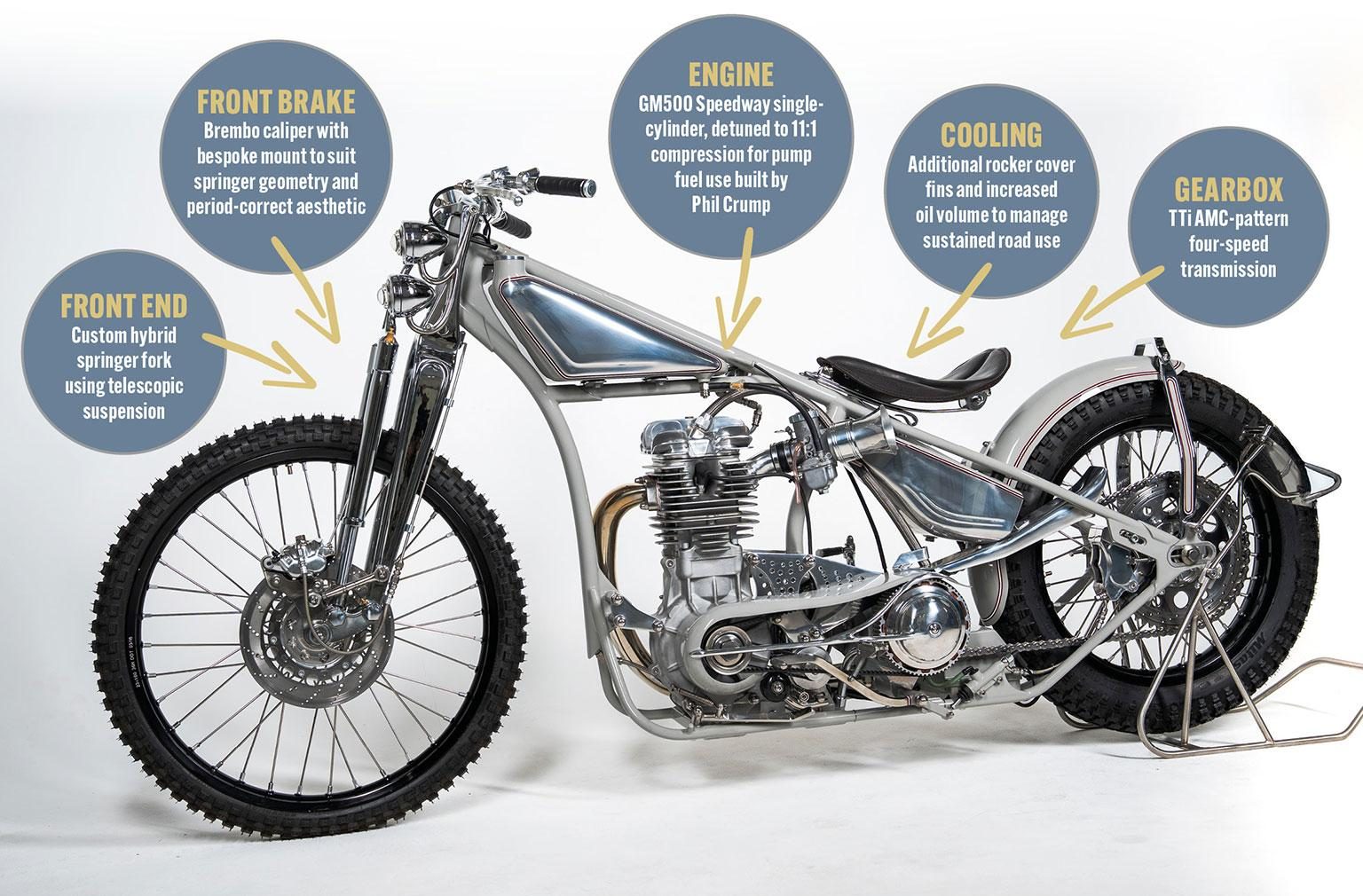
Three years later, Jake rang back to advise Tom he’d sourced the parts in the form of a GM500 upright speedway engine – a must if it was going to have any hallmarks of a vintage speedway machine – although in a state of tune that wasn’t full noise on race fuel for half-a-dozen laps. He’d also sourced a Mikuni VM carburettor to match and a TT Industries AMC-style four-speed gearbox.
“The engine came to us already built, but after a few test runs we noticed some significant oil leaks and a few things that needed to be addressed,” says Tom. “Let’s just say that ‘racetrack good’, and ‘street bike…’ or should I say ‘PBM good’ are two different things. So we spent some time repairing, machining and bringing the engine up to spec.”
More than just another custom bike, the so-called Speedway Commission is the first ground-up creation Tom and his PBM crew have embarked on and it’s fair to say they didn’t start with something simple.
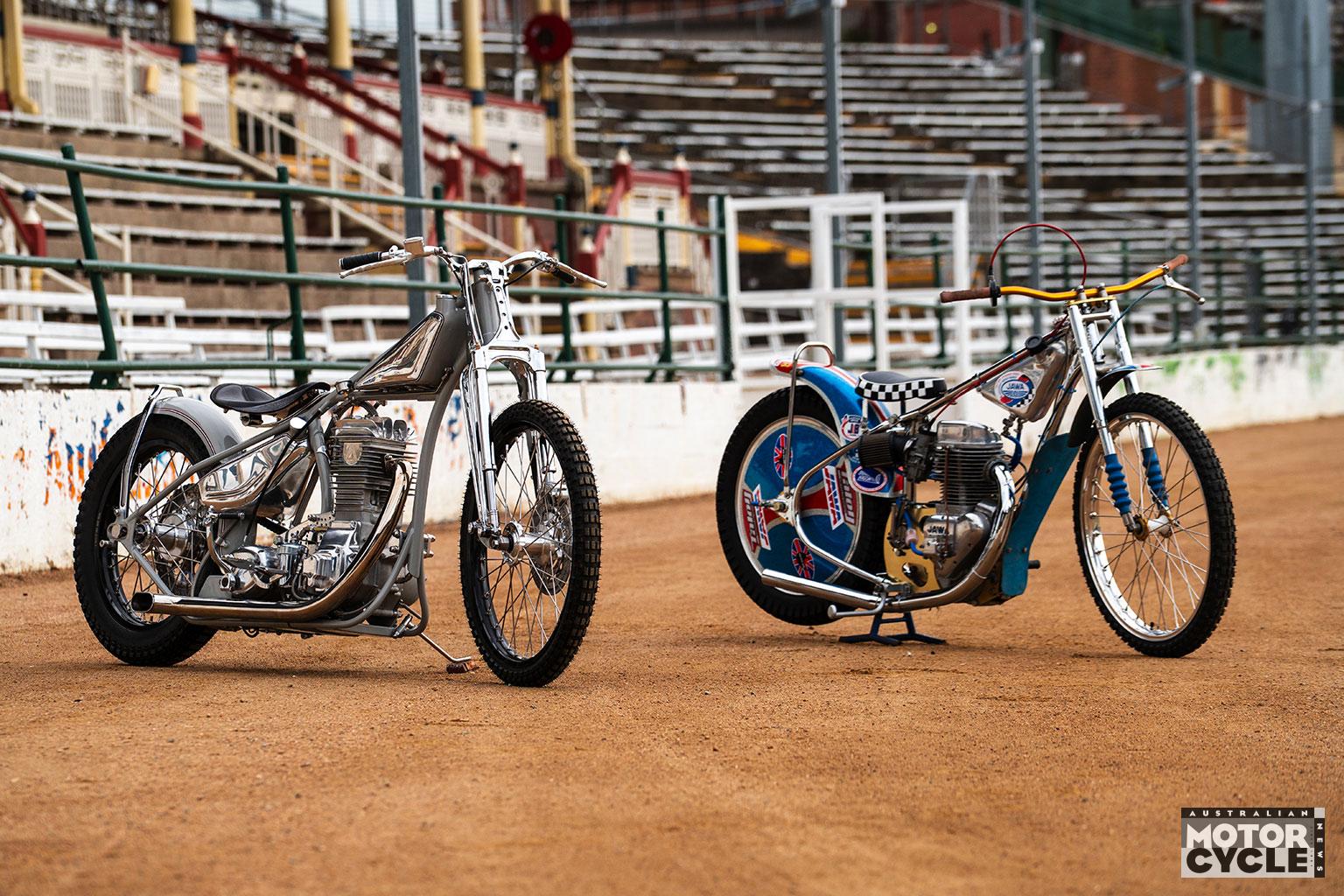
“We approached the build with a completely clean slate, designing from the ground up a bike that would look at home covered in dirt, trackside, but held the craftsmanship and qualities of a show bike,” Tom says. “Our inspiration came from 20s and 30s dirt-track racers, speedway bikes and Jake’s ultimate passion for the sport and its history.”
A typical set-up for a speedway solo is an 18 or 19-inch rear wheel with a 23-inch front. Starting with that foundation and some measurements taken from a solo bike Jake (of course) has on display in his loungeroom, Tom began designing a frame that would both handle the rigours of street riding while keeping a reminiscent eye on early dirt-track racers and their associated art-deco styling.
“We borrowed a steep neck angle, but extended the wheelbase to both create a better line for the tall motor and creep closer to a streetbike set-up for stability and rider position,” explains Tom. “The frame is made from chromoly tubing with the rear section heavy walled so we could keep the frame visually light while maintaining the rigidity we needed.”
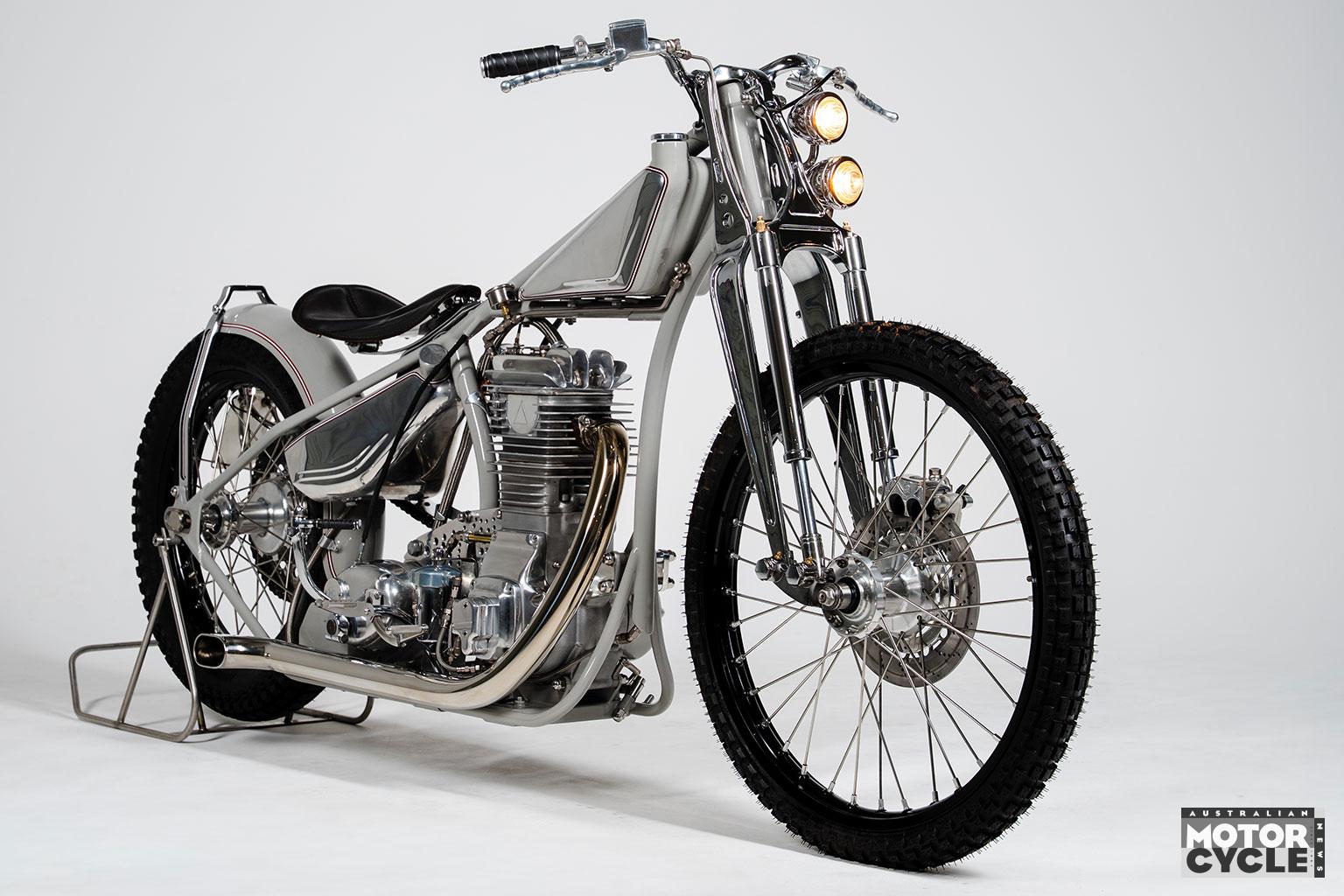
With everything on the frame designed and handmade at PBM, balancing clean lines with ornate detailing was always front of mind. A good example is the neck and axle plates, which have been fabricated to look like cast pieces. The lines alternate between tight, hard edges and long, sweeping curves, all working to frame that oversized front wheel.
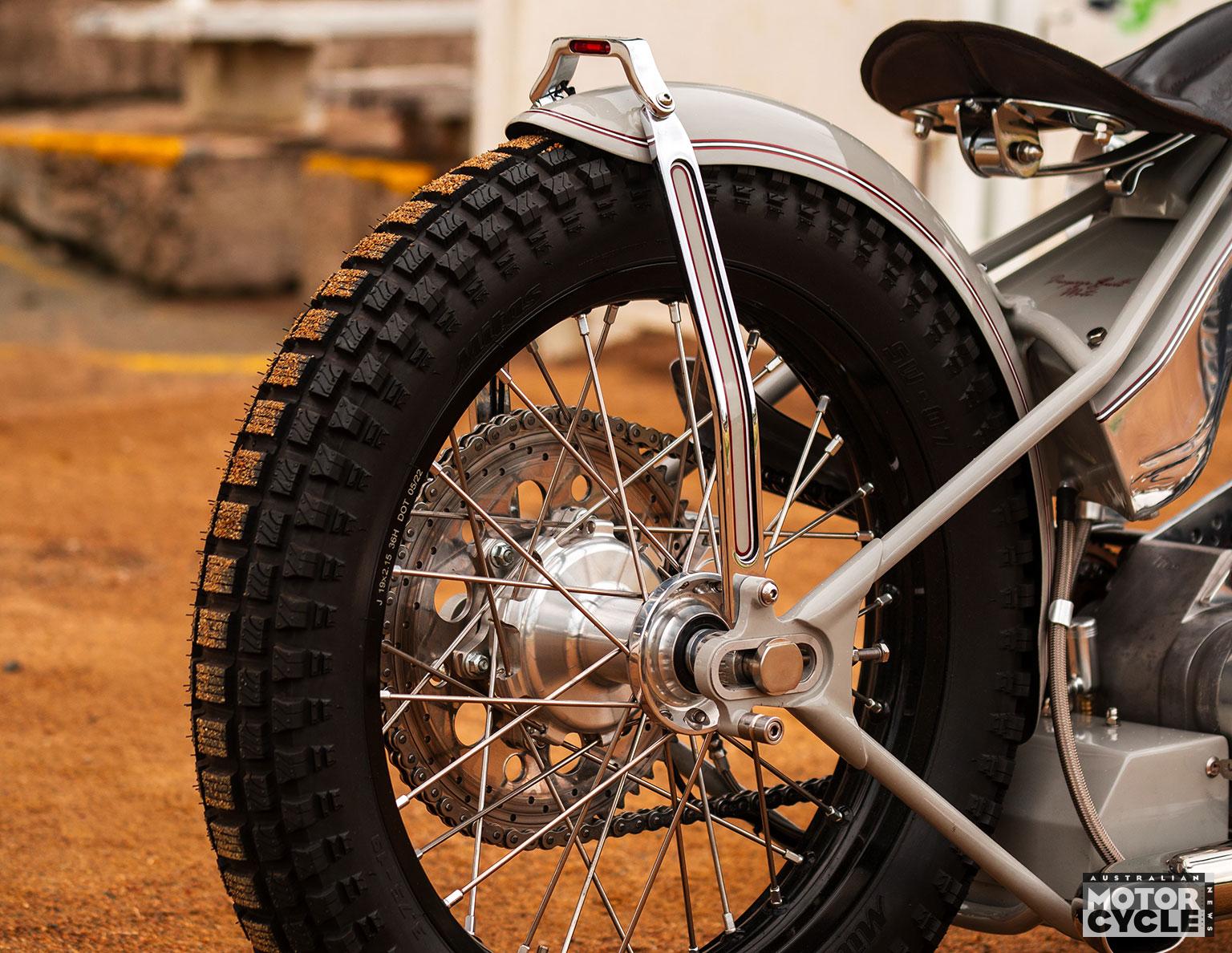
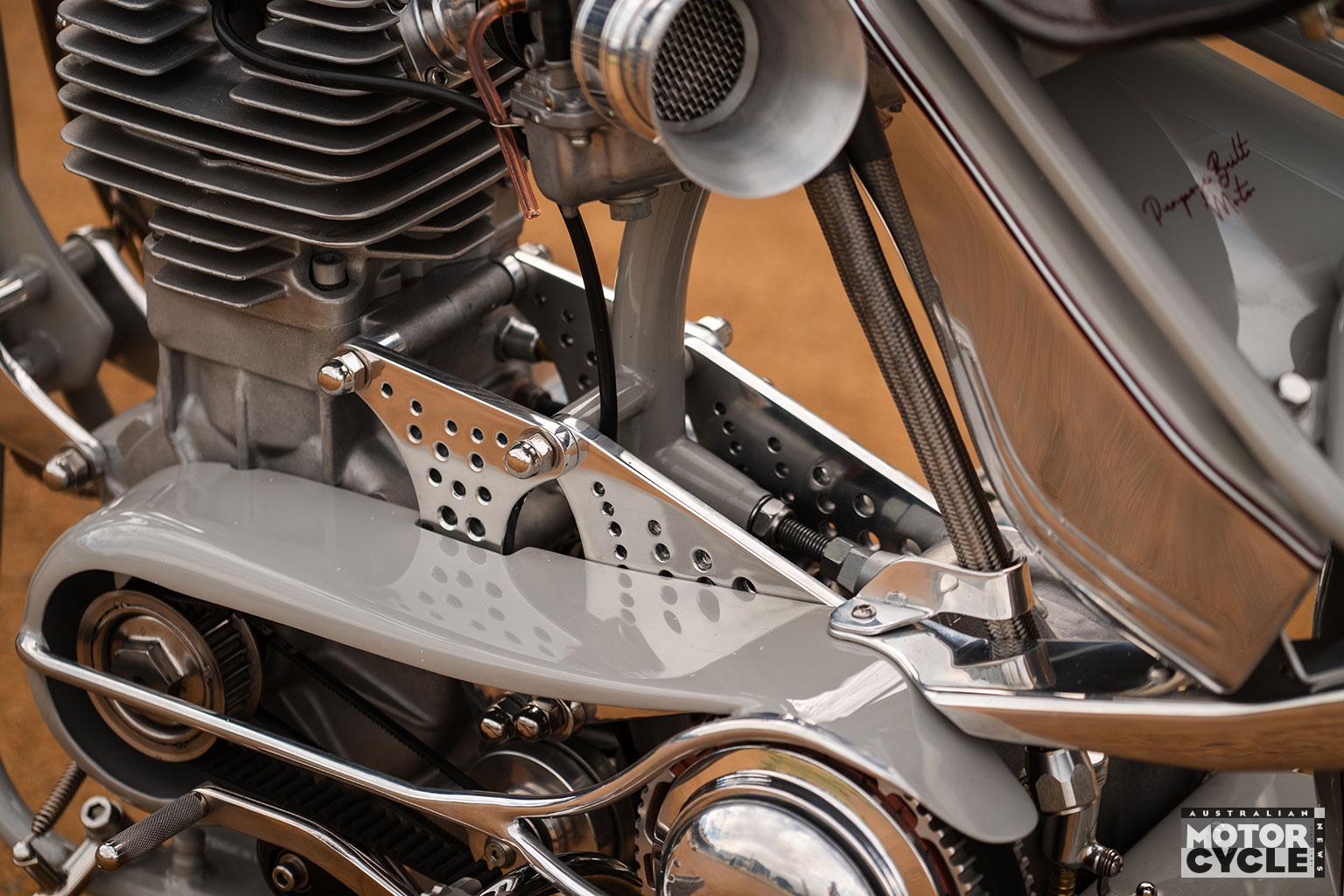
Once the frame was resolved, the engine, gearbox and rear wheel were positioned and locked in using billet mounts – with what Tom calls “the obligatory speed holes” – while modern racing hubs were laced to aluminium rims. The rear wheel runs a cush drive and sprocket/brake disc combo, while a Wildwood racing caliper allowed the minimalist aesthetic of a true speedway race bike to be retained.
A speedway bike doesn’t need a front brake, of course, but a roadbike does and the solution is one of the more considered pieces on the bike.
“We fabricated a custom rotor and caliper combo (and) custom making a front brake for a springer-style front end isn’t an easy thing to make look nice and fit the build,” explains Tom “With some trial and error we managed to make a clean and functional mount for the Brembo brake that looks at home on our 1930-style set.”
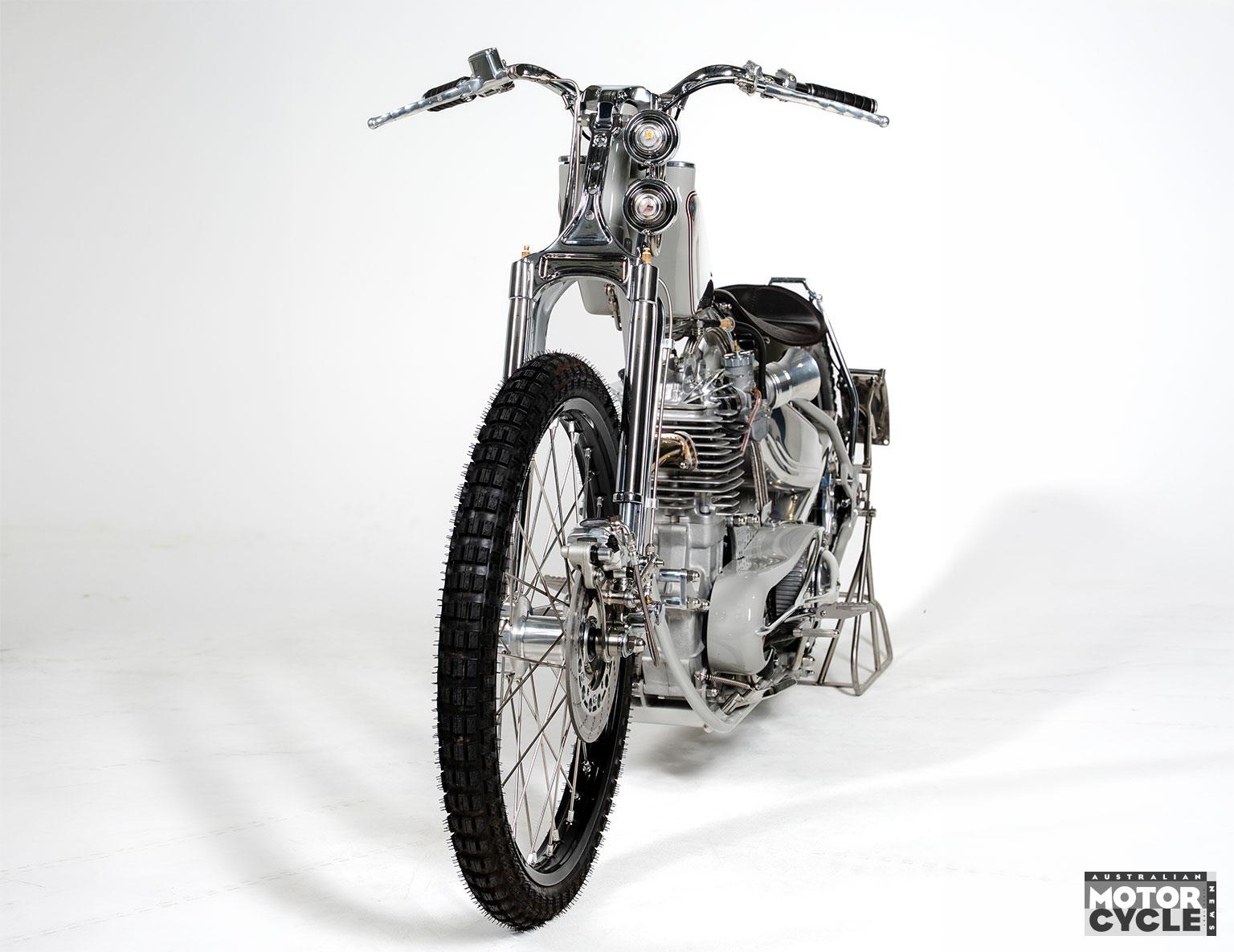
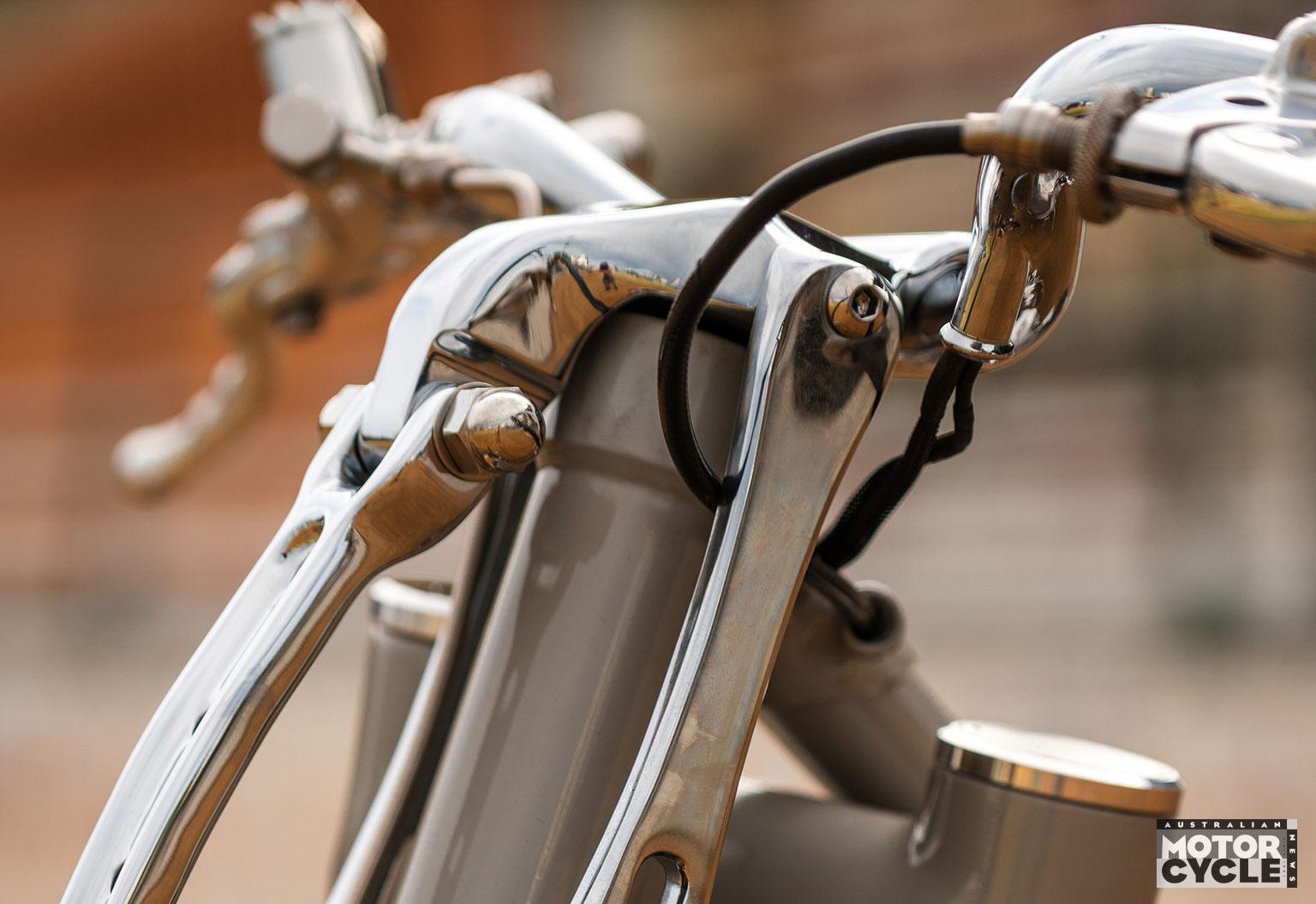
Which brings us to the front end itself. Tom reckons modern speedway front ends are ugly and said a vintage speedway bike’s front end didn’t seem all that inspiring to make. So, after a long discussion with owner Jake, Tom conceived the idea of a hybrid springer-style fork that utilises telescopic forks as the suspension.
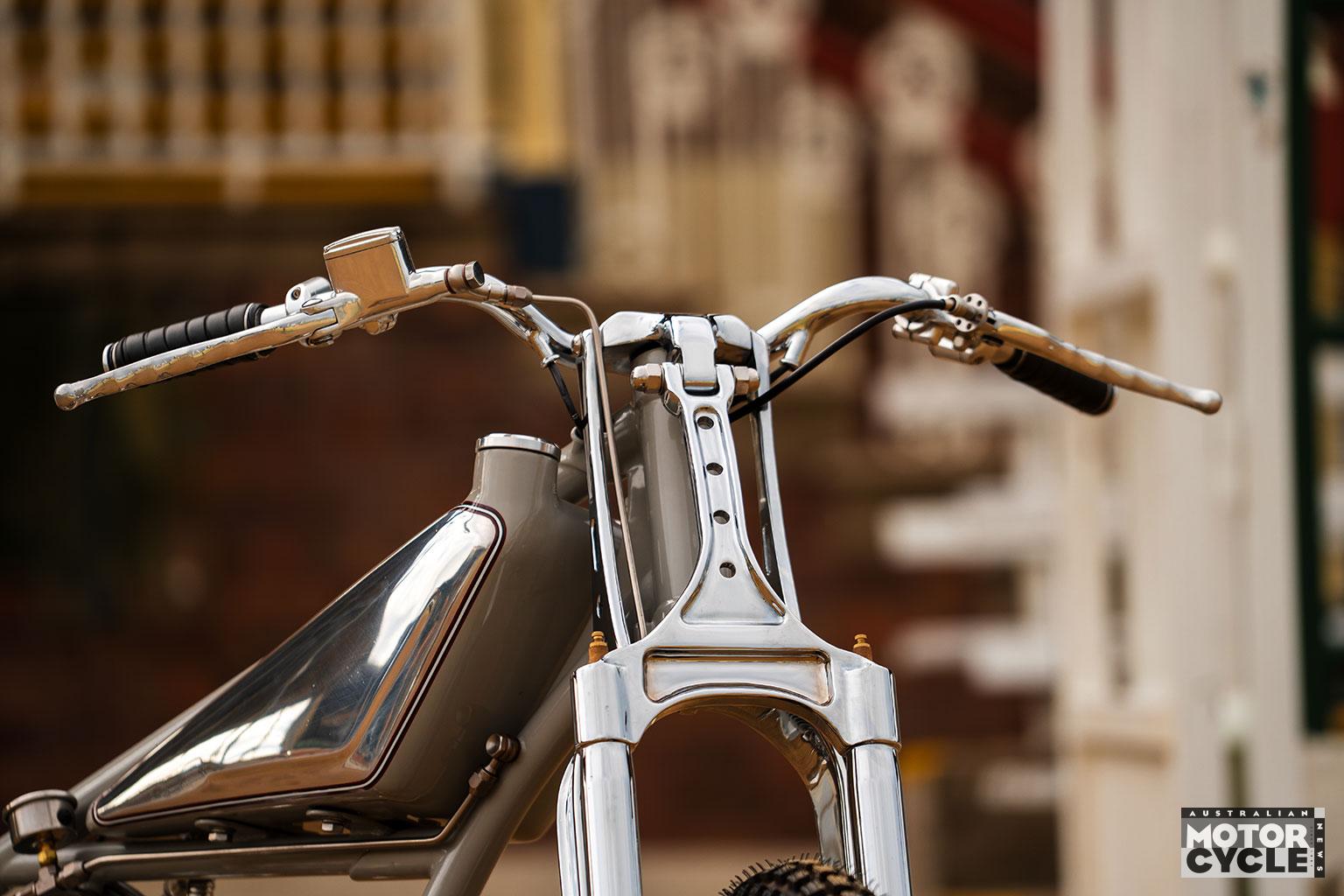
“I sketched it up and got an instant tick of approval,” he says. “It satisfied both our desire to create something unique and fitting for his
one-of-a-kind build and it gave me a huge machining and fabrication challenge.”
Every component had to be hand made. The head stem, mounts, fork legs, bracing, clamps. Hardened chrome rod became the stanchions as raw material became parts through hours at the lathe and milling machine. Each piece shaped, tested and refined until it worked as a system.
“Fabricating a functioning fork completely of my own design was a goal I had set for myself and I wouldn’t stop until I got it,” says Tom. “The end result is a completely bespoke design, functional, solid and, most importantly, a beautiful piece. Making it was a stretch of my skills at the time and it taught me a lot.”
The cockpit draws on experience gained through PBM’s Project Delta build, with the reasonably flat profile handlebar with single mount point and internal throttle and wiring. The lighting, required for registration though never appearing on a speedway bike, presented its own hurdles. But rather than trying to replicate something that never existed, Tom took a different approach. The lights are repurposed automotive units – B-51 guide lights – rebuilt, chromed and mounted on a custom bracket that hides the wiring.
“Something a little more flashy than the rest, but I can’t completely hide who I am on these builds,” says Tom.
Once the rolling chassis and front end were resolved, attention moved to the bodywork and this is where Tom’s self awareness comes into play, for he had to keep reminding himself of the design brief he was given and stay within the lines.
“I have a habit of over detailing, or making complex intricate shapes that I really had to pare back on this build. This project was about nostalgia, history and paying homage to a forgotten era of racing.”
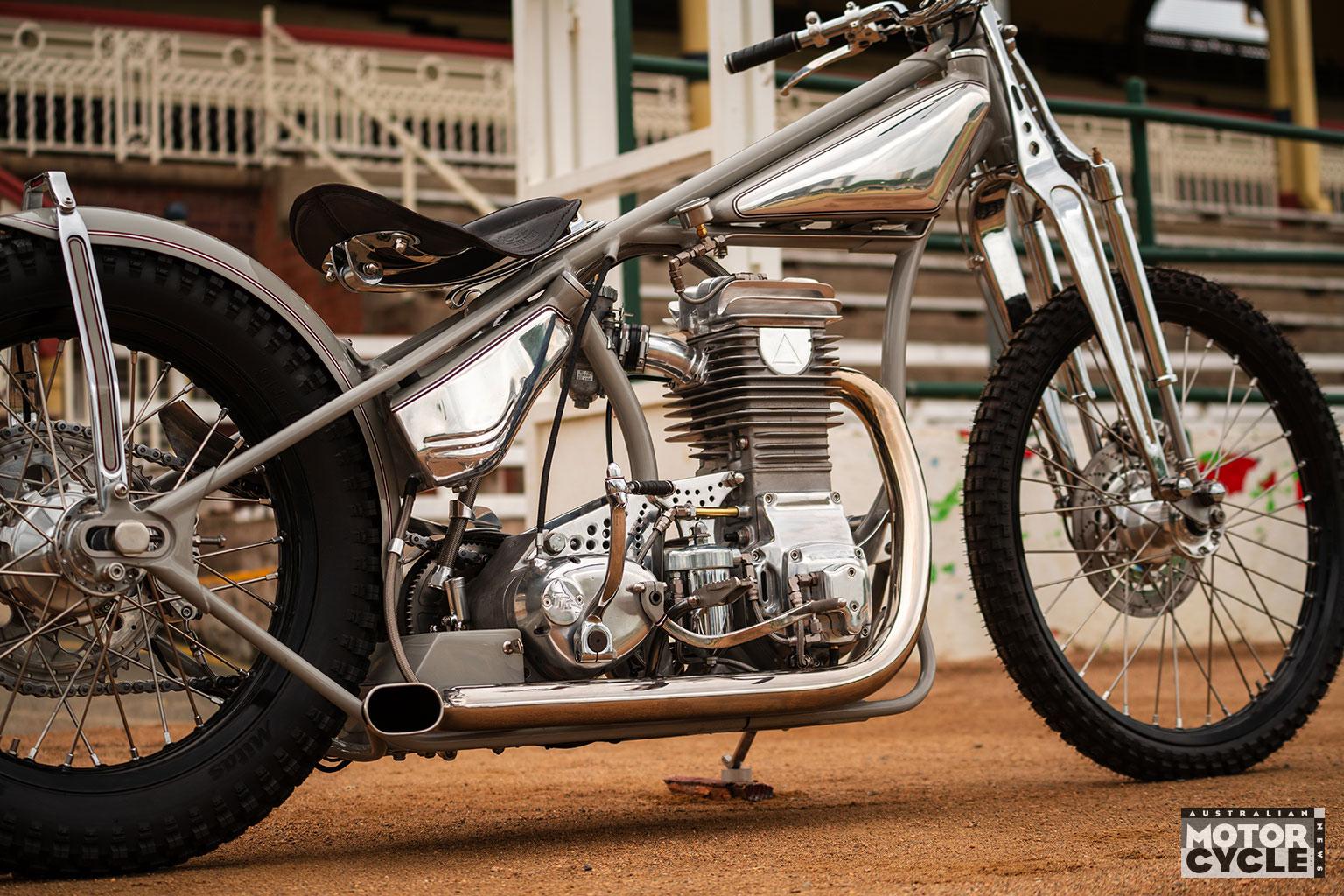
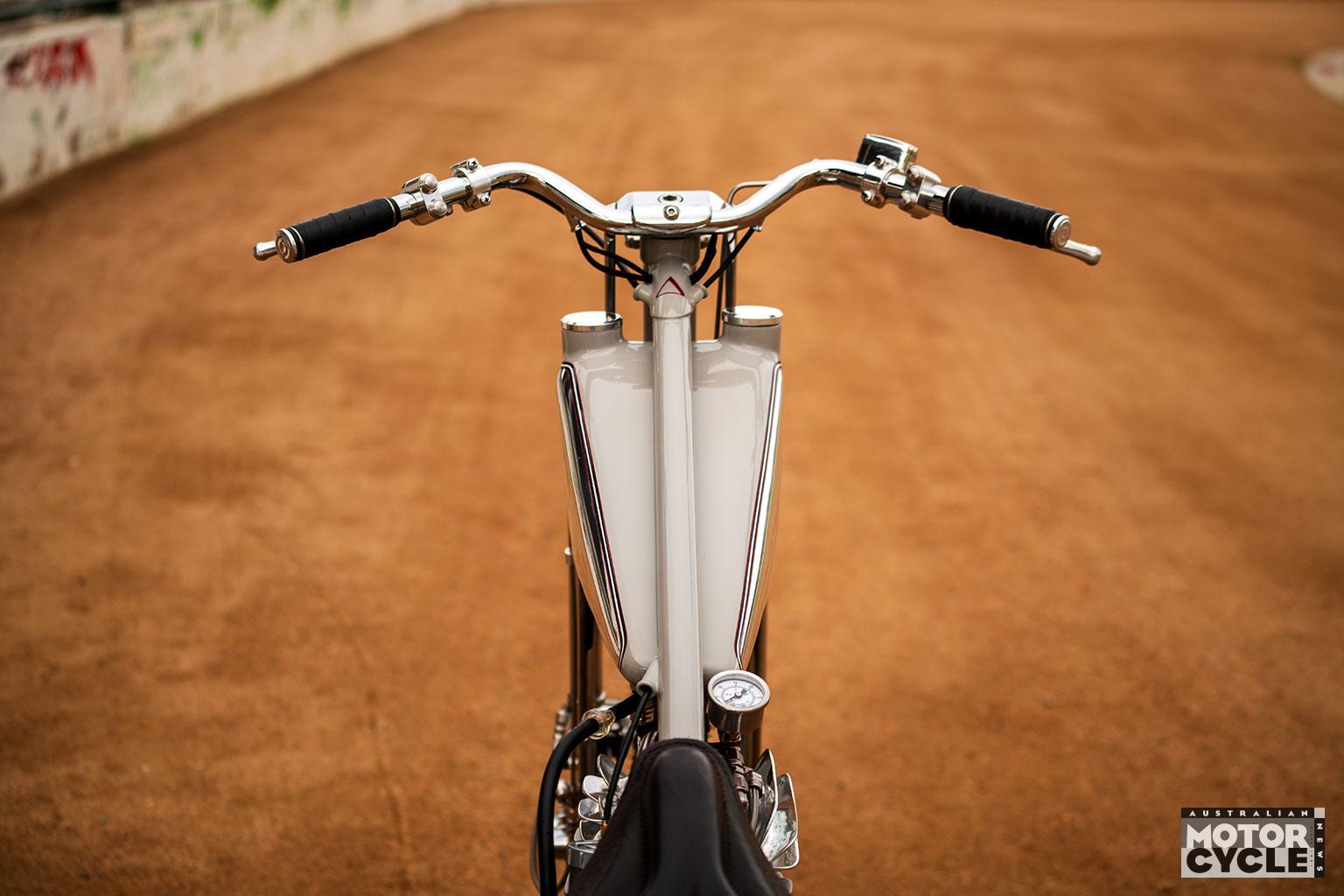
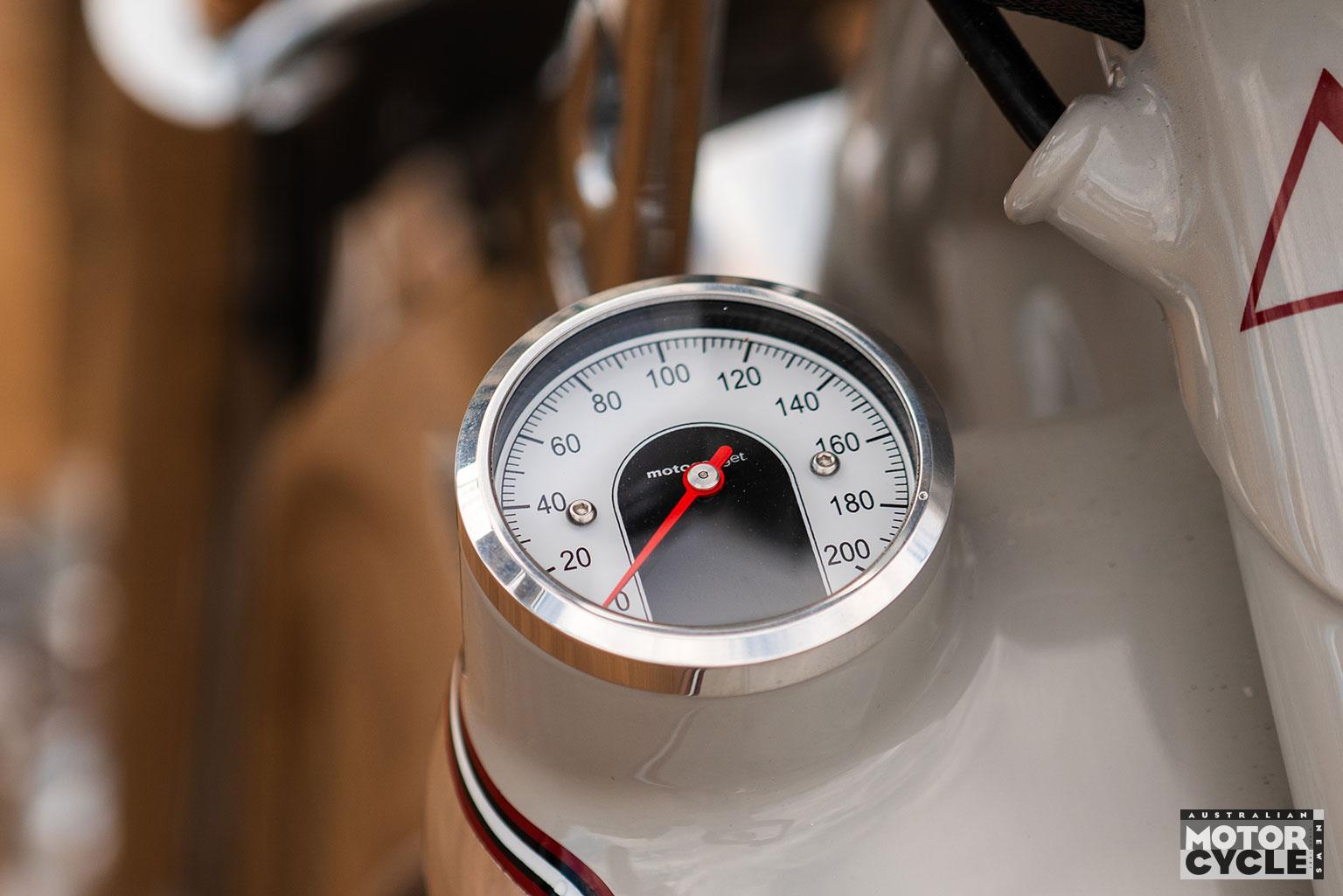
It was about restraint becoming part of the goal – and the tank is probably the best example of that. It sits low between the frame rails, narrow and clean, with polished side panels that catch the light without overwhelming the form. The speedo is integrated into the top surface, opposite the fuel cap, a detail that may feel obvious when you’re looking at it, but one that requires planning to execute cleanly.
The oil tank and rear fender follow the same philosophy; simple forms, carefully proportioned, working together rather than competing for attention. Even the rear fender struts reflect that thinking. Flat steel, machined and shaped with just enough detail to avoid looking generic, but not so much that they distract from the overall line of the bike.
“With this came a lot of firsts for us, conceiving an idea from scratch with very few boundaries,” Tom says.
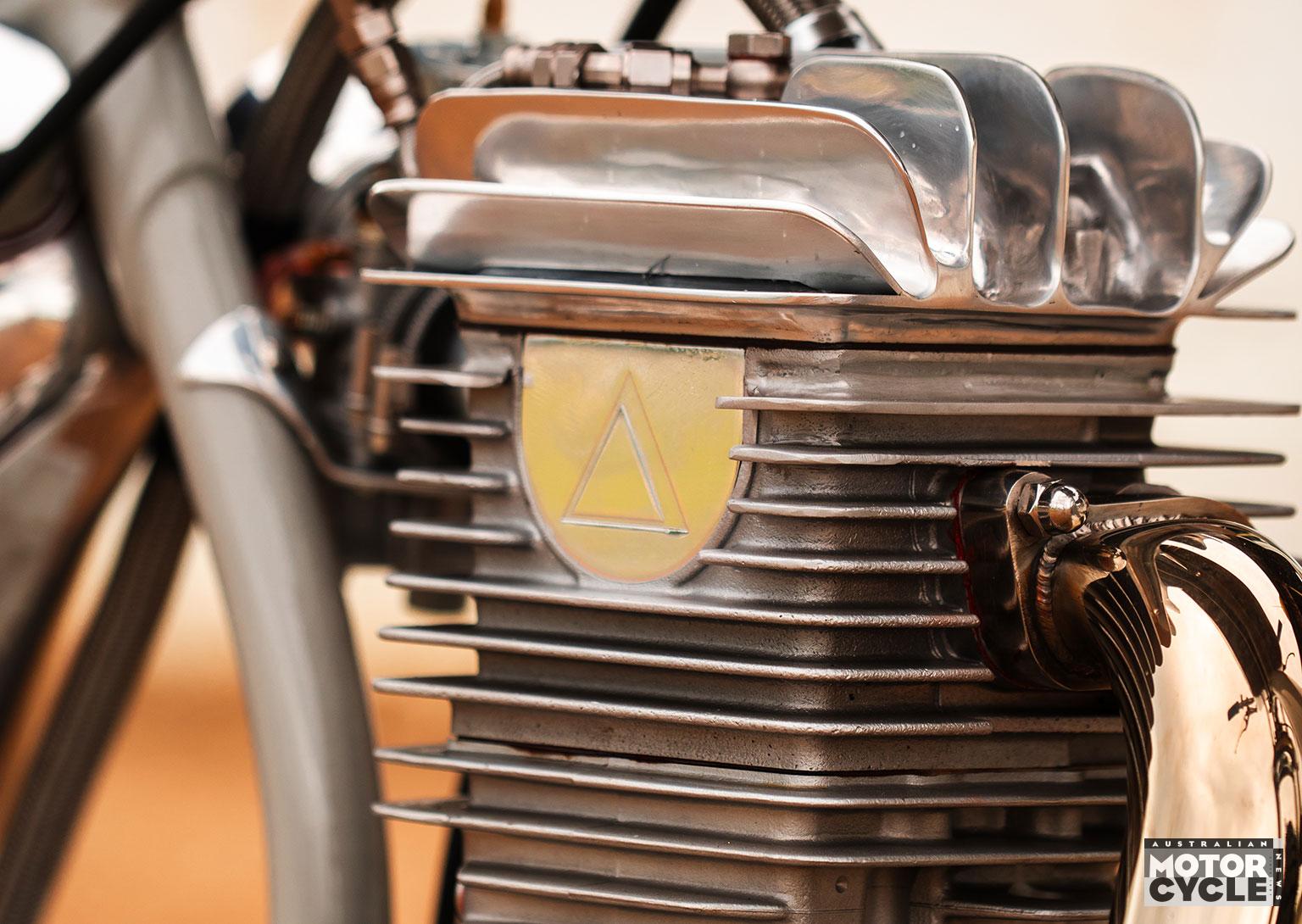
As well as fixing leaks and bringing the aesthetics of the race engine into line with the gorgeous show bike feel of the build, PBM had to devise a way to keep the engine cool and lubricated enough to withstand its new life as a road-going unit. Because the GM was designed for short bursts of high-intensity track work, the racing fuel played a big role in keeping the engine cool, while a low-capacity splash-fed lubrication system was lighter and simpler than a pressurised system. It’s worth noting the engine was modified for the build by none other than speedway great Phil Crump.
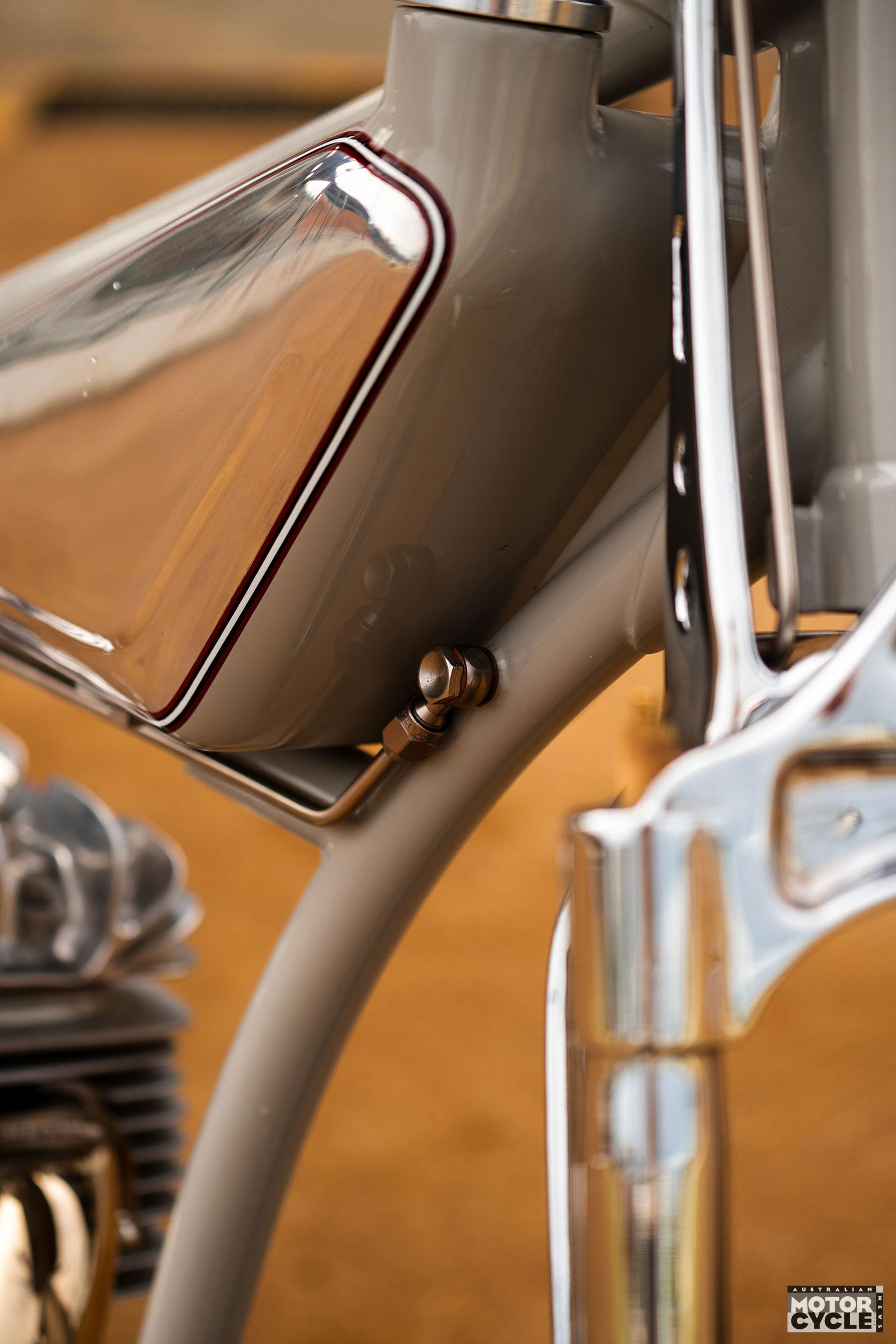
“Our approach was first adding cooling fins to the rocker cover then designing an external oiling system,” Tom explains. “It runs through an external filter borrowed from a Harley-Davidson Panhead and through the main downtube on the front of the frame as it pumps its way to the feed that’s been machined into the rocker cover. Run by a Jawa external oil pump – common on bikes of the era – this increases the volume of oil significantly, as well as exposing it to a longer run of oil lines exposed to air cooling.”
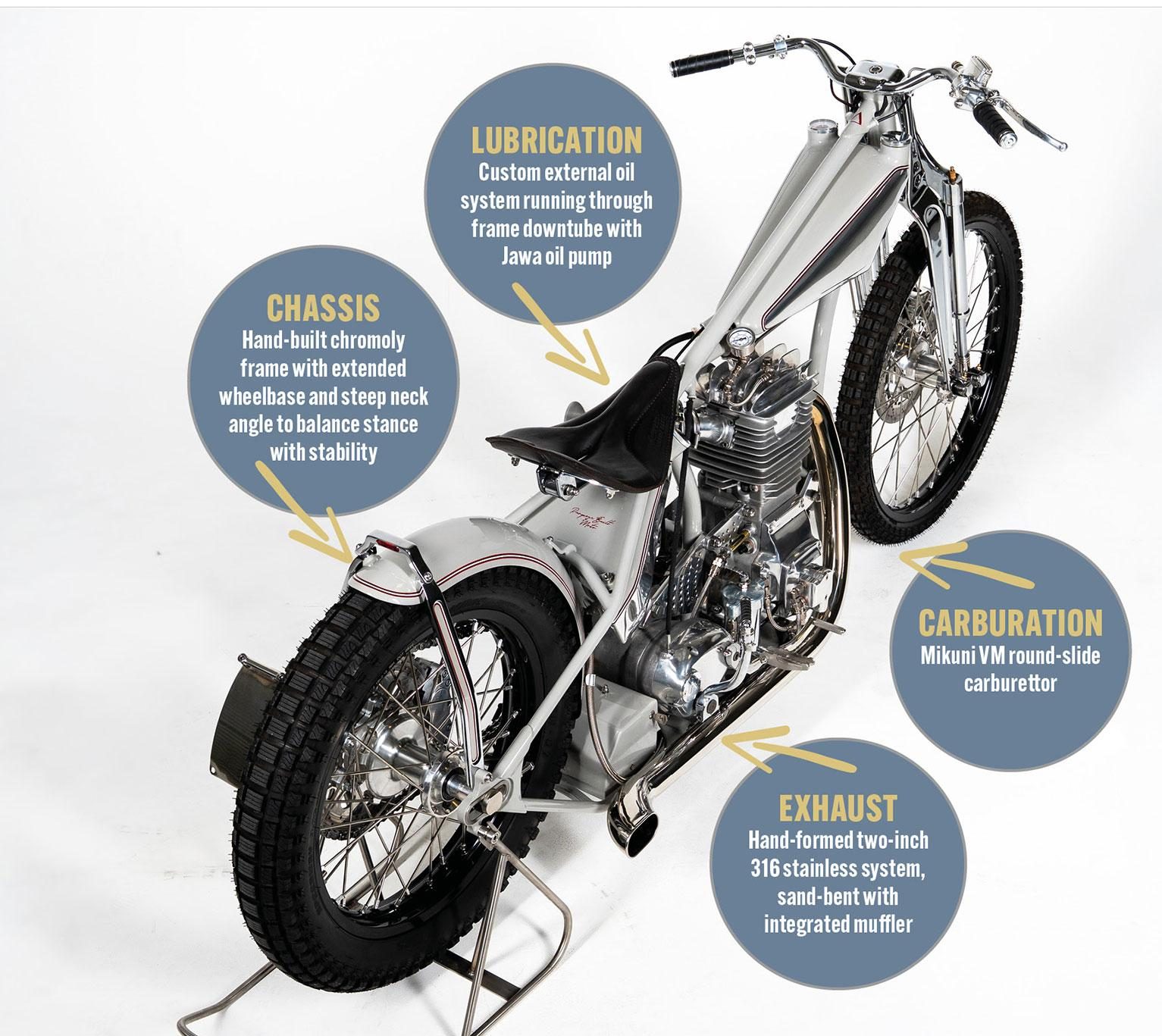
The hand-bent exhaust follows the same approach. Tom sand bent the pipe by hand, whereby the piece of two-inch 316 stainless steel tube was packed with sand then heated and bent into shape to prevent kinking. It was completed with an integrated muffler, a neat little handmade turn out and tip, and then polished. It’s functional and beautiful without becoming a focal point.
“And it’s now perfectly golden after the test rides,” Tom says.
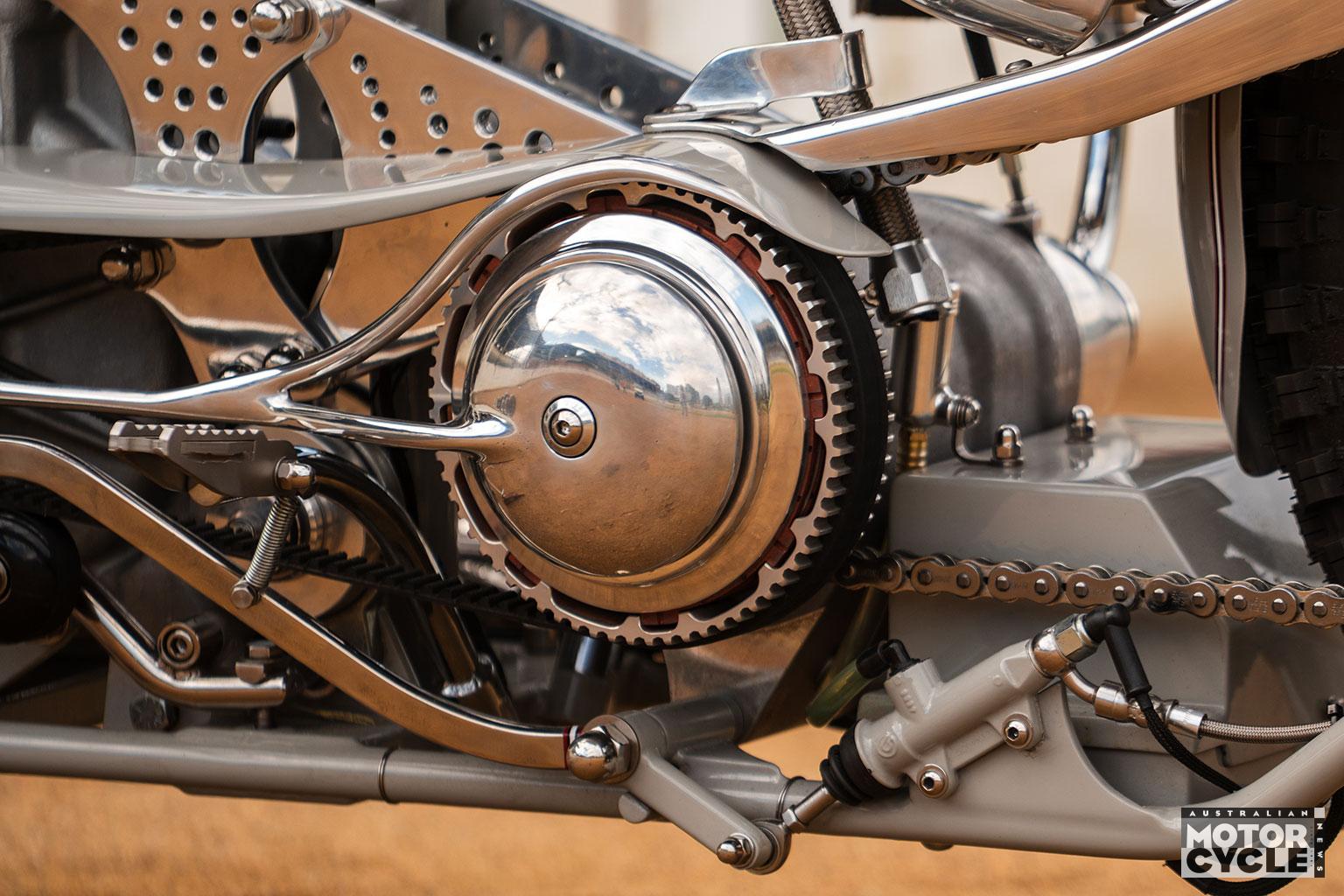
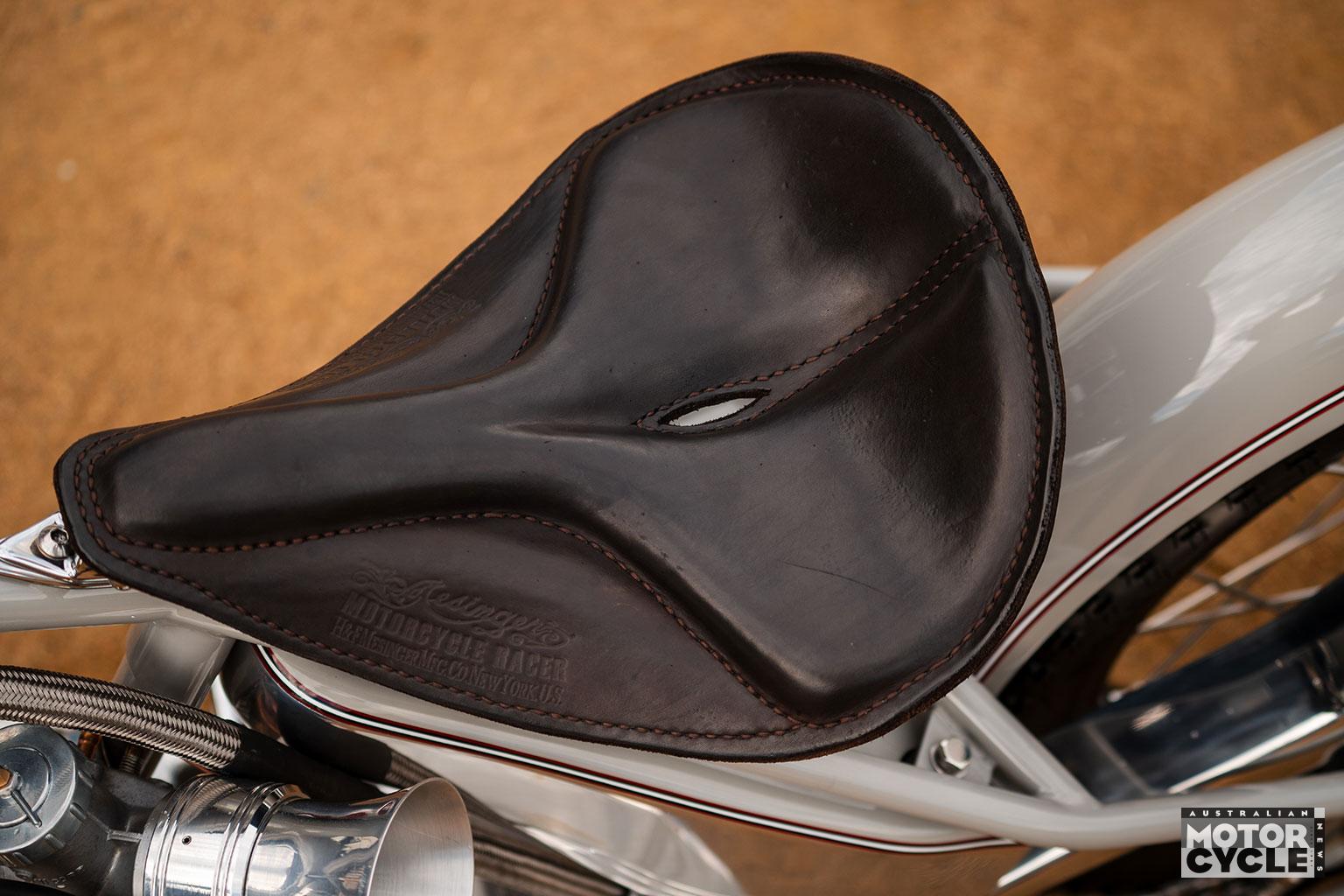
Then came the finishing elements. The primary drive cover flows from the front sprocket to the gearbox, tying that section of the bike together visually. The seat mount – handmade in New York and shaped to match a Mesinger vintage racing seat – uses a modified trailer leaf spring instead of traditional springs, which allows for movement but without breaking the visual line of the frame.
When it came to the paintwork, Tom wanted his work to do the talking on this bike, rather than be a wild paint design. So he and Justin from PopBang Classics workshopped a finish that was deliberately restrained. A bone grey base, broken up by fine pinstriping in red, white and black, separating painted surfaces from polished metal.
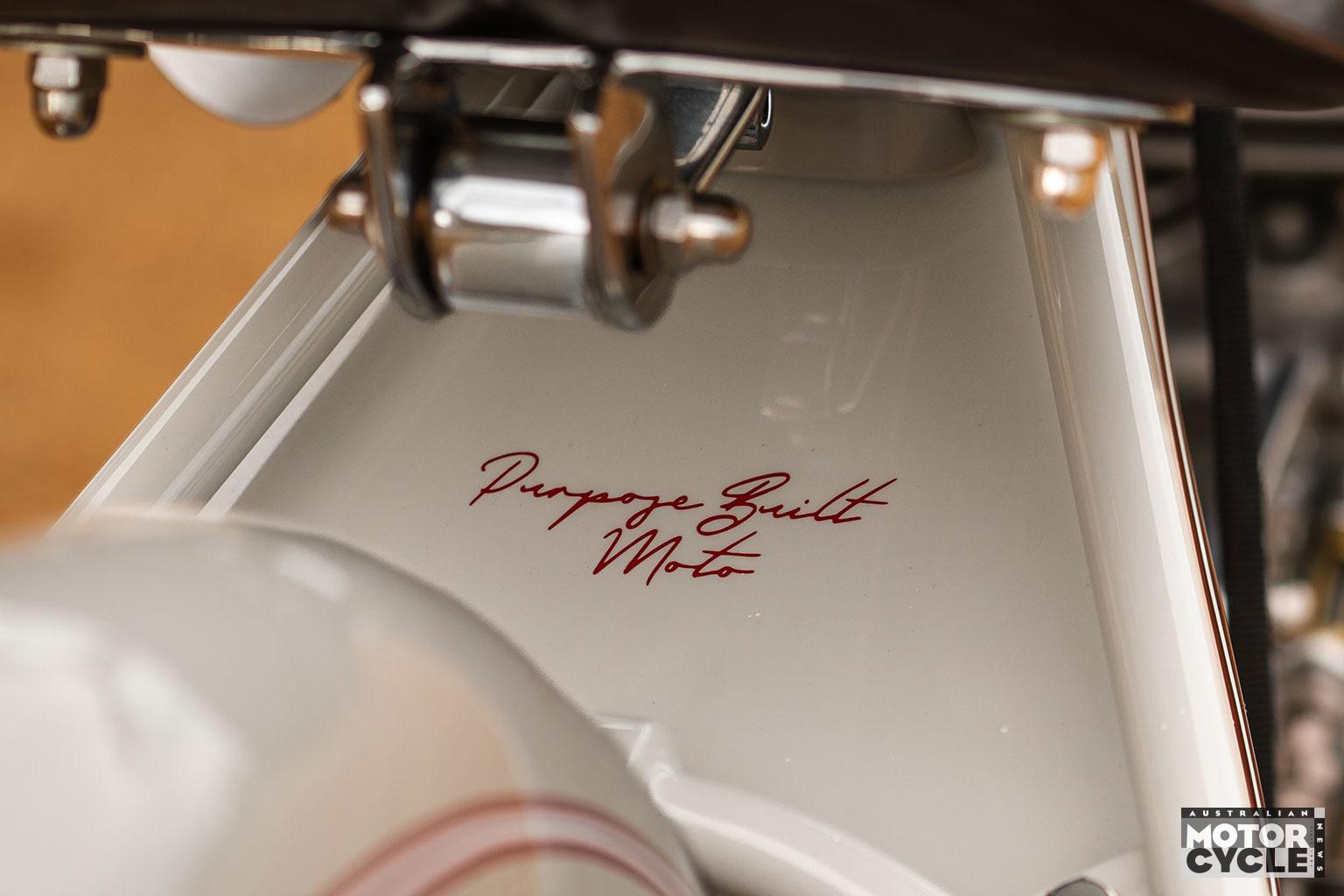
“Plus some subtle inclusions on the neck of the frame with the Purpose Built Moto Delta and the Signature series badge placed under the oil tank,” adds Tom.
The speedway build had a clear direction, yet a deep void of pre-existence. Not dissimilar to its creator, Tom knew what he had to do, yet lacked any prior experience of a ground-up build. And that’s the genius of what Tom Gilroy and his crew have successfully achieved. They’ve constructed something that never existed, built with enough understanding of history to make it believable.
But there’s only one person Tom needed to convince, at that’s Jake.
“My love of speedway, and the slow erosion of the sport I grew up with, led me to dream of preserving it in some tangible way that I can see, hear and smell every day,” explains Jake.
“Tom has bought that dream to life with craftsmanship and with deep respect for what speedway stands for.
“The Speedway Commission is both a piece of rolling art and a living tribute to Australia’s gift to the world – speedway.
But why?
Jake Tobin isn’t a racer but speedway has shaped his life. The appeal is simple. Strip a motorcycle to its essentials, remove the brakes and add an engine with a power-to-weight ratio that rivals a hypercar, and you’re left with something brutally honest.
Speedway bikes are built for one thing: full commitment. Throttle, traction and nothing else. It’s a form of motorcycling that has stayed close to its roots, even as everything around it has evolved.
First run in 1924, speedway is widely regarded as an Australian creation. In 2026, Brisbane’s Ekka speedway marks 100 years of racing, a milestone that highlights its place in local culture.
Across south-east Queensland, tracks have steadily disappeared, taking pieces of that history with them. This build is Jake’s way of carrying it forward – a physical connection to speedway and why it’s important.