While the reborn BSA marque is about to return to Aussie shores, one Melbourne man has been hand-building them for two decades. Meet the BSA V-twins that never were…
BSA’s return to the Australian marketplace with a range of 350-650cc singles comes 53 years after the last-ever motorcycle rolled out of its Birmingham Small Heath factory in 1973. This makes it the latest of Britain’s historic trophy brands to be awakened from its slumbers, this time courtesy of Indian conglomerate Mahindra Group. But over the past two decades a dedicated, ultra-skilled BSA enthusiast in suburban Melbourne has created a series of ground-up new models with the historic BSA badge on their tanks.
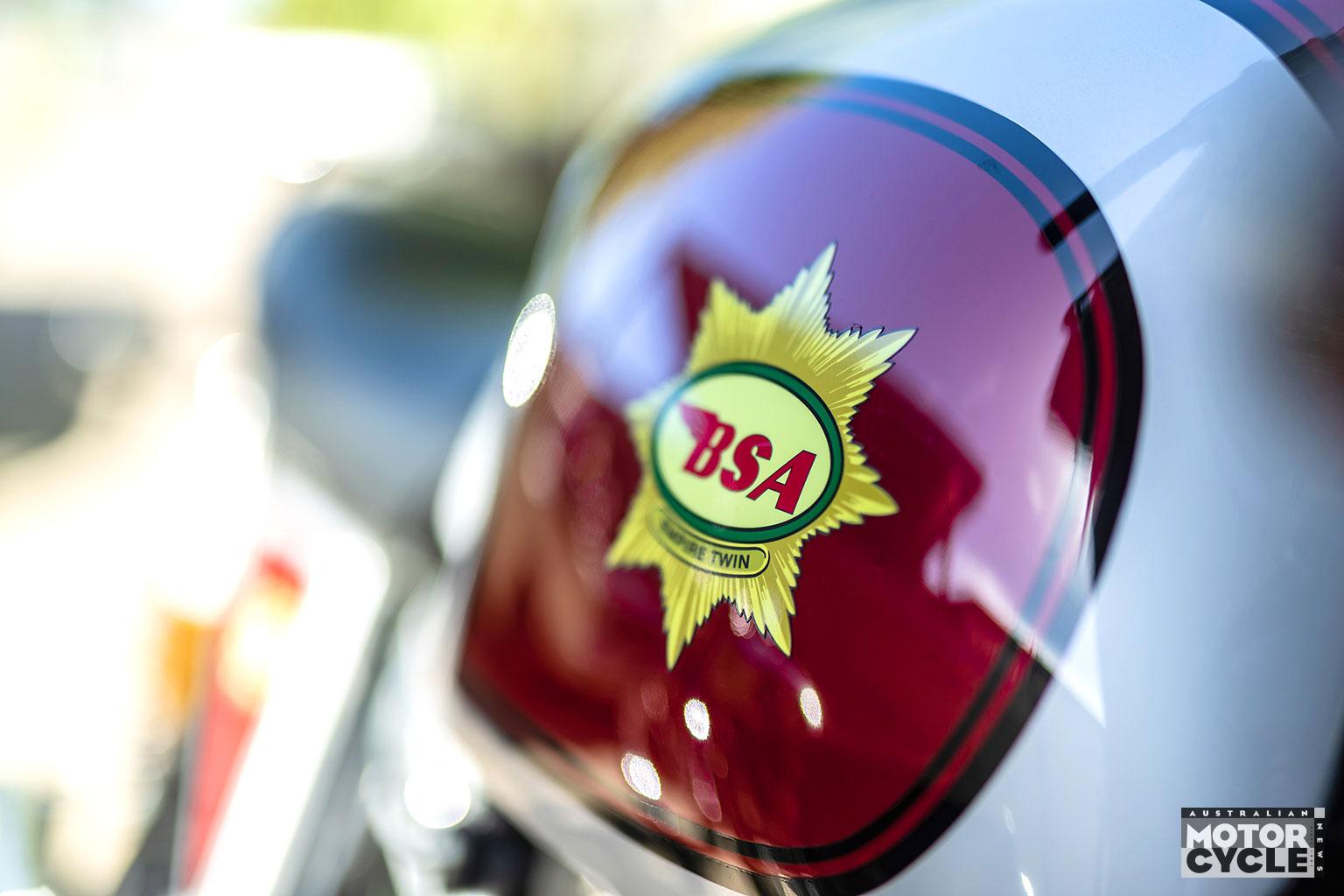
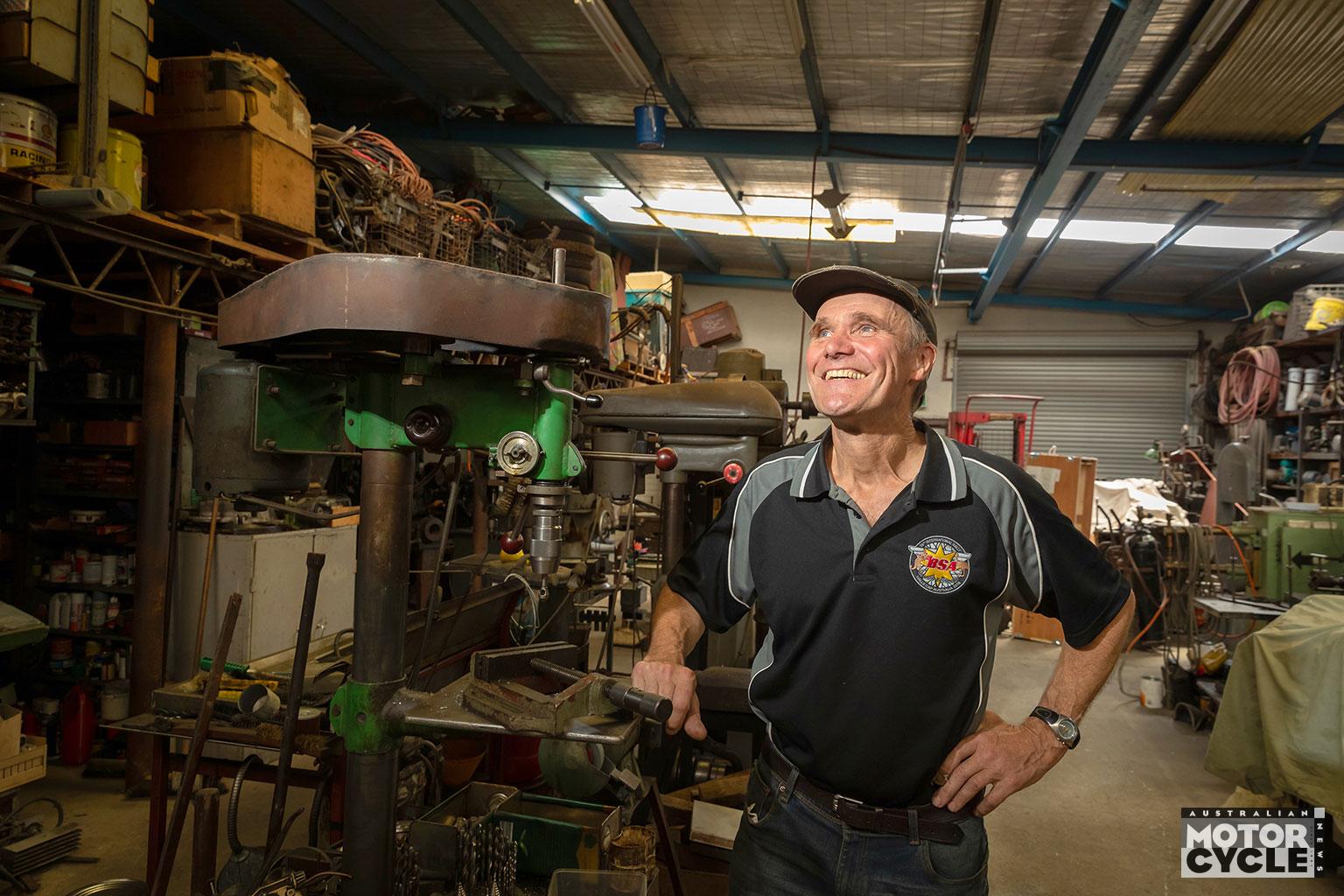
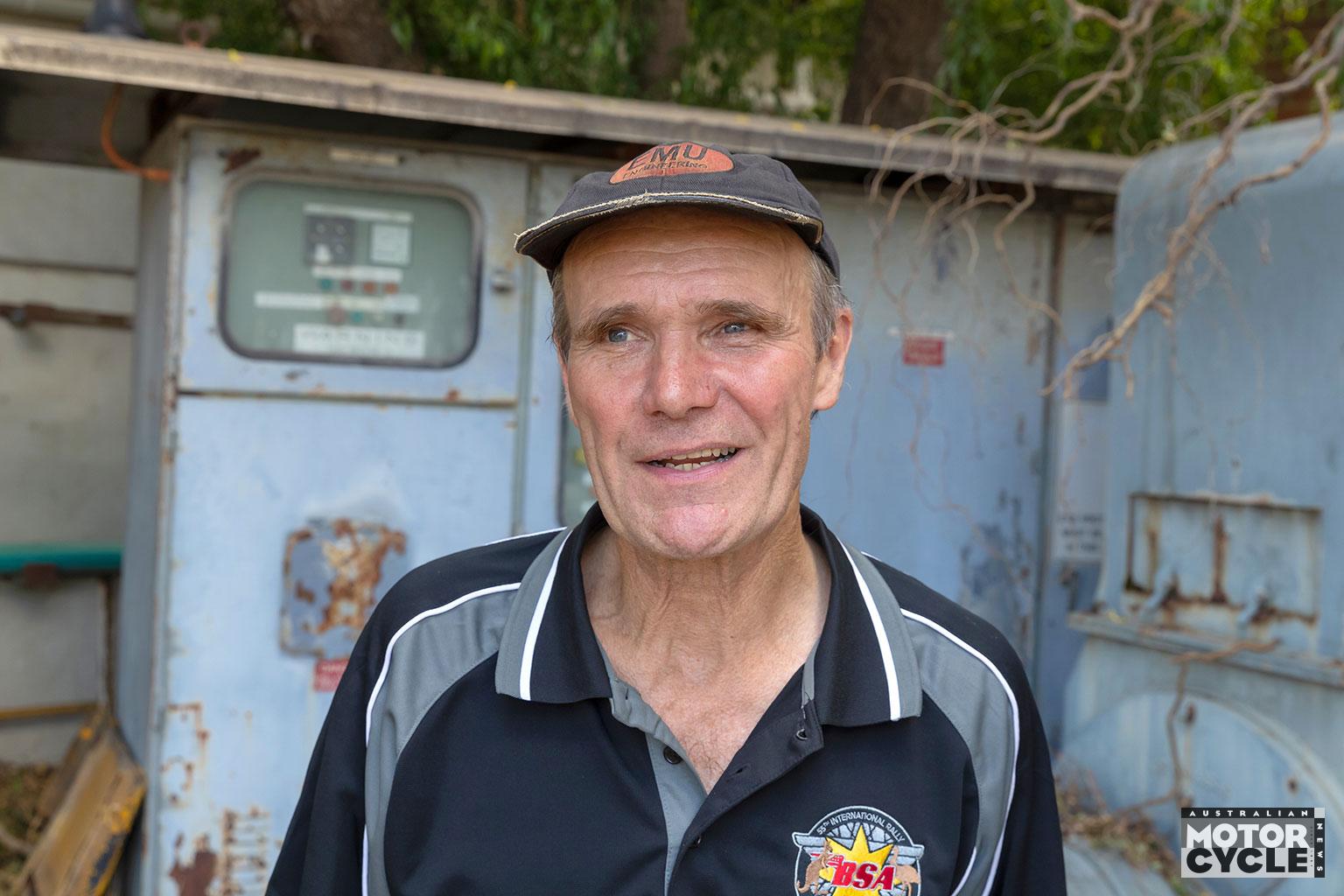
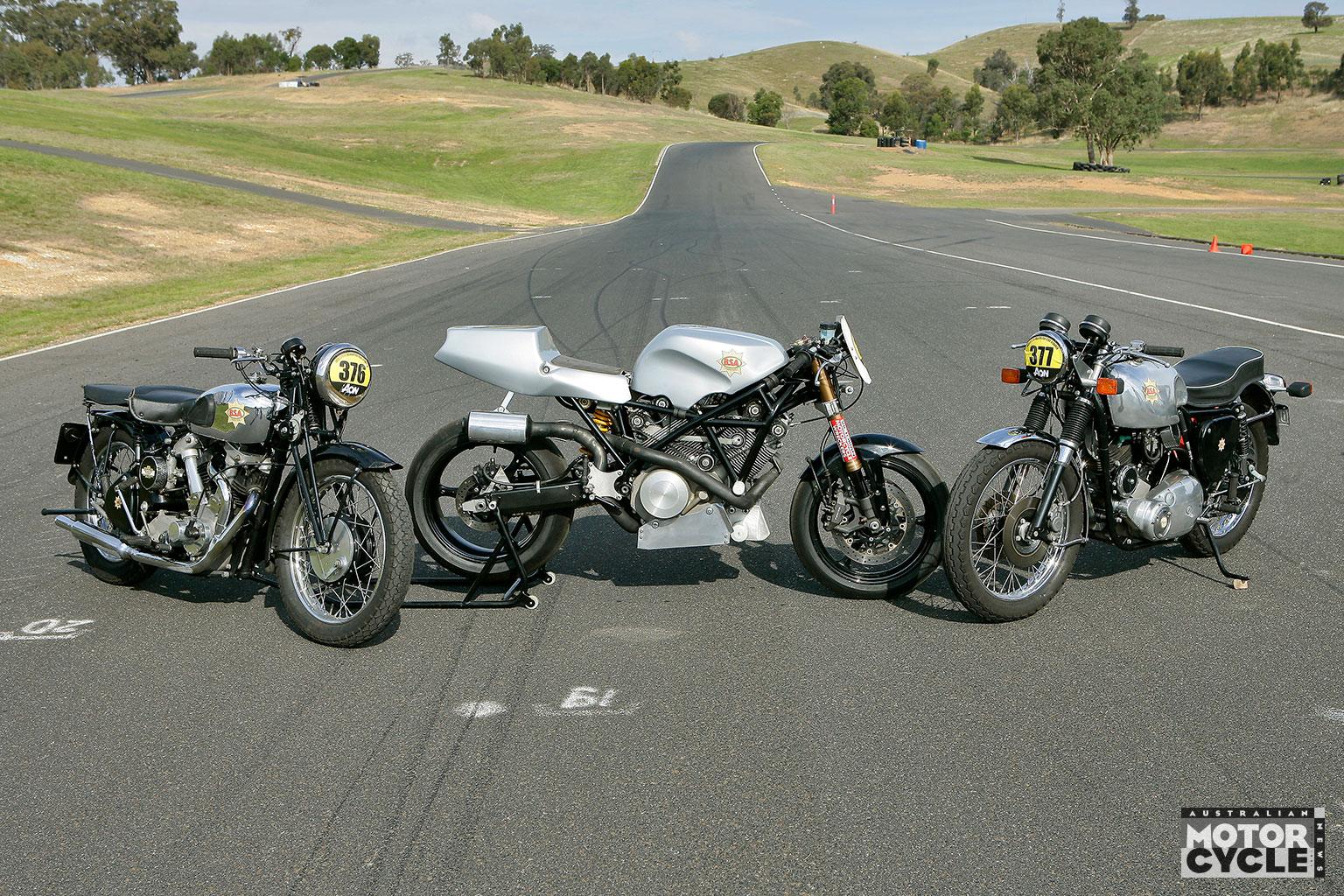
Emu Engineering’s owner Doug Fraser has conceived and built not one, not even two, nor three, but no less than four completely individual V-twin tributes to the BSA marque, in the form of models he’d like to have seen the British firm make at some stage in its 62-year-long history as a motorcycle manufacturer, but never did.
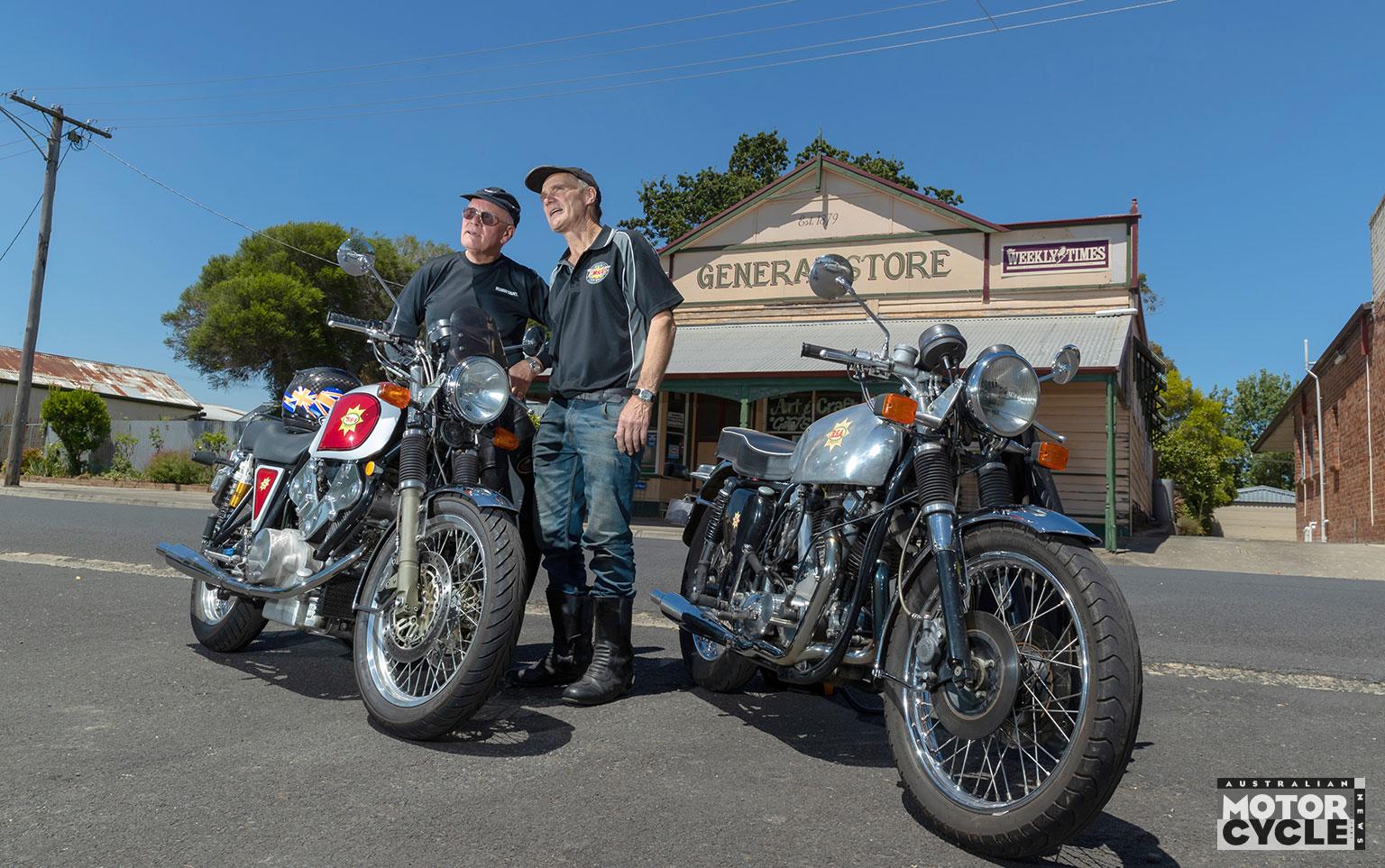
Seventy-something Fraser is a toolmaker by trade who today is an electrical engineer focusing on heavy-duty industrial electric motors, and the design and manufacture of related switchgear. Hence his large but crowded suburban factory on the road to Phillip Island is packed with an array of lathes, grinders, milling machines and welders, all of which can also be used to build a bike from the ground up!
So it’s fair to say that Fraser is somewhat smitten by vehicles Made in England. Parked outside the Emu factory are his company wheels, a 1970s Hillman Hunter workhorse that’s clocked up over 2,000,000km and is currently on its third bodyshell, but quite improbably still has its original engine, now sporting a five-speed Toyota gearbox. Then, garaged inside the workshop is his daily driver, a V12 Jaguar E-Type Series 3 coupe of the same vintage, and tucked in behind that is the Norton Rotary racer that Fraser built 25 years ago to compete against Ducatis and Aprilias in BEARS racing, the anything-but-J-bikes category he ended up dominating in Australia and New Zealand on a motorcycle whose engine came from the UK as a 190,000km ex-West Midlands police bike.
Doug imported the Norton Rotary Down Under, concocted a five-speed gearbox for it made mainly from Triumph parts, made an ignition system and then designed a race frame for it. He took the resultant self-built special to the starting line in over 40 races, winning most of them against far more thoroughbred opposition like one-litre Ducati and Aprilia V-twin Superstock models, aided by his own considerable racing skills.
Riding the Irving Vincents, built just 10km from the Emu Engineering nest, I’ve diced several times with Doug aboard the Norton Rotary, and he is FAST – especially for a boffin who builds his own bikes, and who takes pride in the fact he started racing in the late 60s, so can claim to have competed in seven different decades before calling a stop to his racing career with the advent of Covid! Yet Doug is also a big fan of the BSA Gold Star single, and has several of them, including the 500cc Goldie on which he and his wife Jenny spent six weeks in 2008 touring Britain and the Isle of Man, two-up with luggage. That’s dedication to the cause.
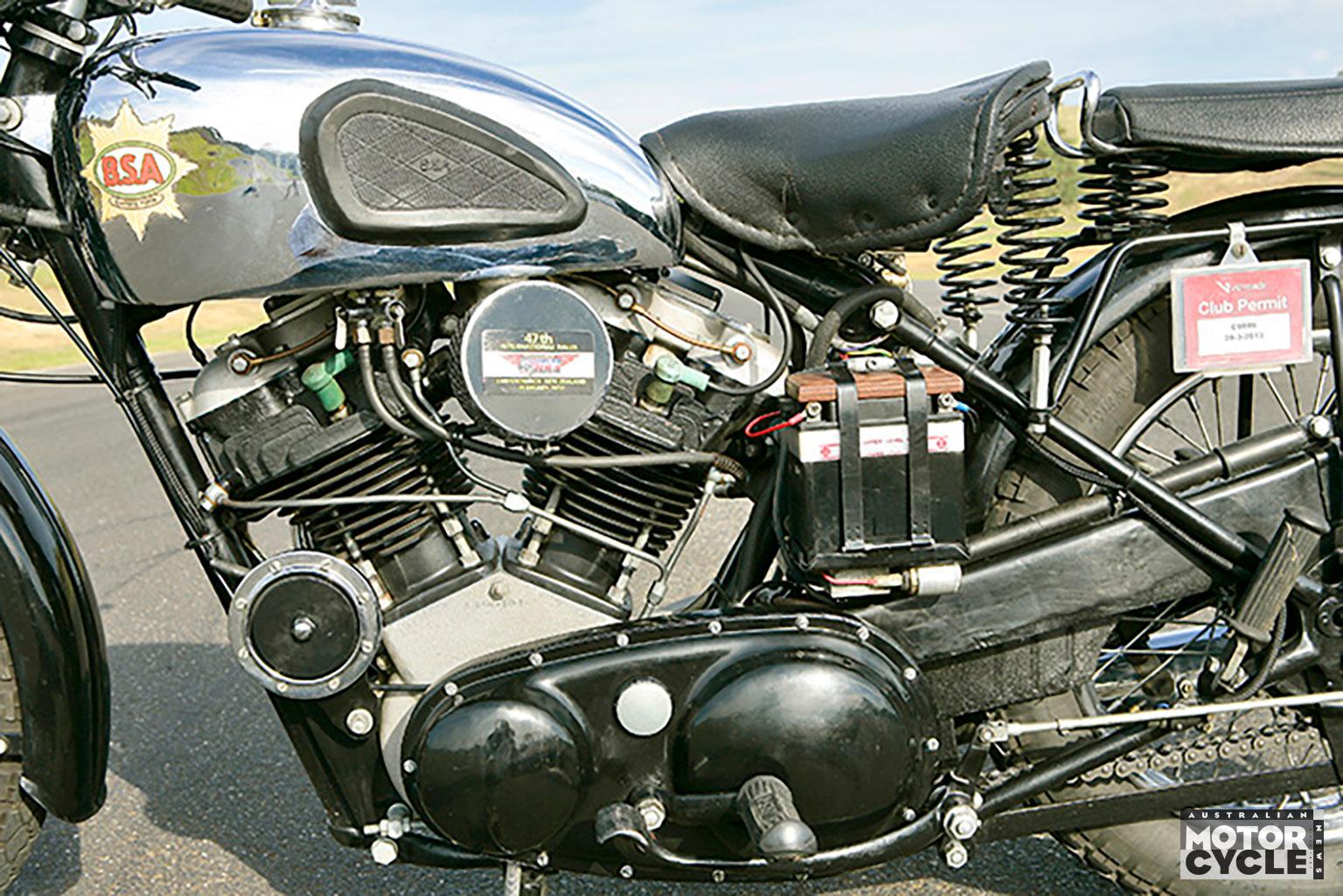
Doug’s self-built quartet of BSAs is quite unlike anything that ever rolled out of the Birmingham factory. “I’ve always liked BSA V-twins, even though they only built them from 1920 to 1938, and despite the fact they were known to be a little short-fused, while looking so nice,” he says. “But they still had exposed valve-springs right up to the end, and I’ve never understood why BSA didn’t build a more modern version based on their M23 Empire Star single, which was a brilliant bike. After all, a V-twin is only a pair of singles sharing a common crankcase! So, since they didn’t, I decided to do it for them, and the M46 was the result.”
In case you wondered, 2 x M23 = M46, quite apart from this being Doug’s race number for decades, long before Valentino Rossi was born!
Measuring a period-style longstroke 87mm x 94mm for a capacity of 1120cc, the side-valve M46 Empire Twin was completed in 2008 after over 1400 hours of work, with its engine carrying a pair of bored-out 500cc Empire Star cylinders. Combined with 30mm Amal Mk1 Concentrics and a four-speed Gold Star close-ratio gearbox, it was fitted into a modified M20 girder-forked rigid frame carrying the dual front brakes needed to stop what is an improbably fast motorcycle.
Having shown what BSA might have built but didn’t for the 1939 model year just as the shutters came down for World War II, next on Fraser’s to-do list was to demonstrate what kind of V-twin the company omitted to develop in the 1950s, when that earlier model would have run its course. Except for the fact that what he created has non-period electric start and a Rob North replica disc-brake front end, it’s a what-might-have been 1960s BSA Gold Star V-twin sports model – which Fraser dubbed the ‘B66’, since the 1140cc OHV engine uses two BSA 500cc B33 cylinders from the forerunner of the legendary Gold Star.
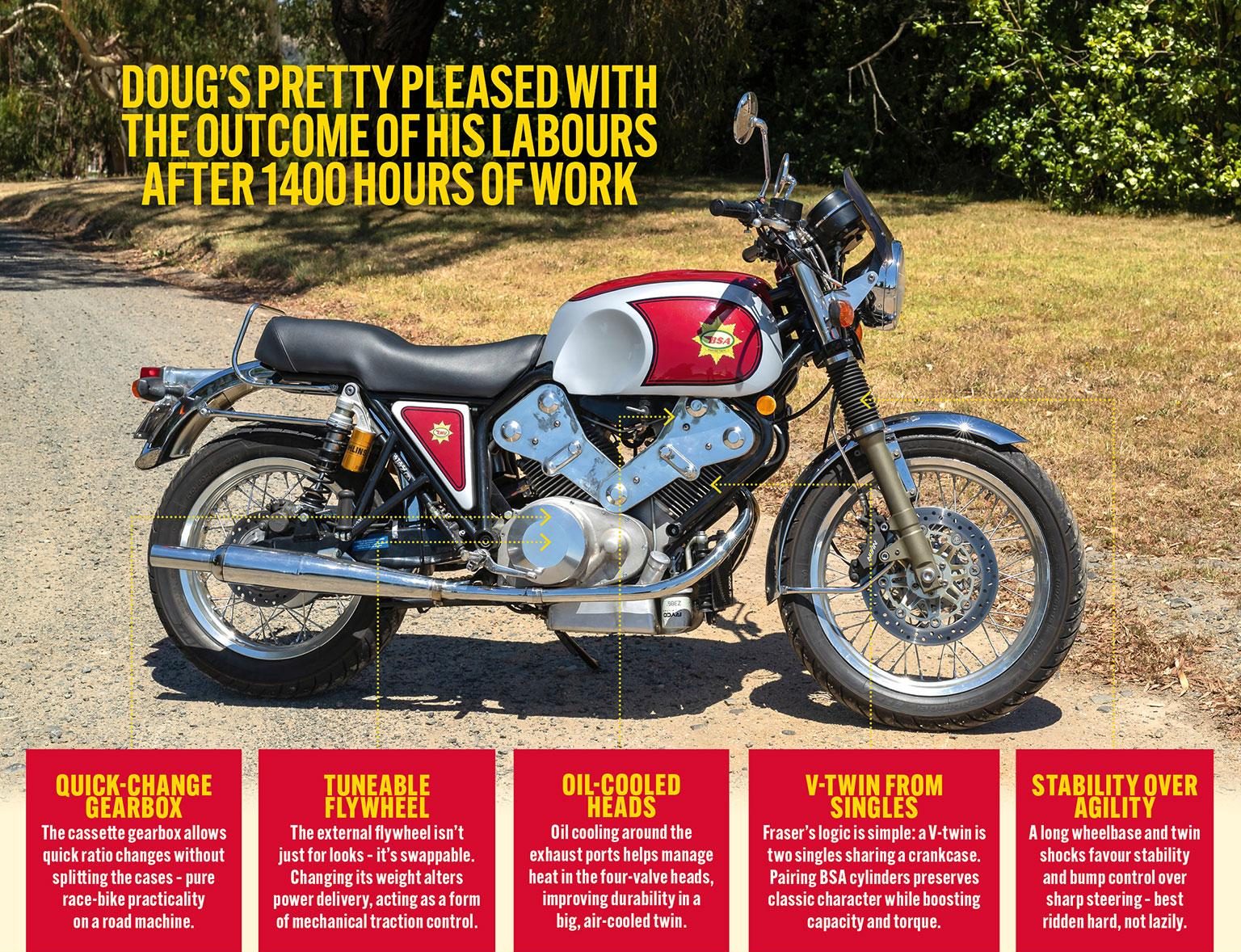
Doug’s pretty pleased with the outcome of his labours after, again, roughly 1400 hours of dedicated work: “It’s almost too fast!” he enthuses. “At 70mph on the speedo, it’s only pulling 3000revs, which is halfway to the redline. For sure it’s a 130mph bike – but I also got 55mpg on it covering 2500 miles in two weeks going to the National BSA Rally in NSW one year. It’s a really effortless long-distance ride, as well as a great country roads bike.”
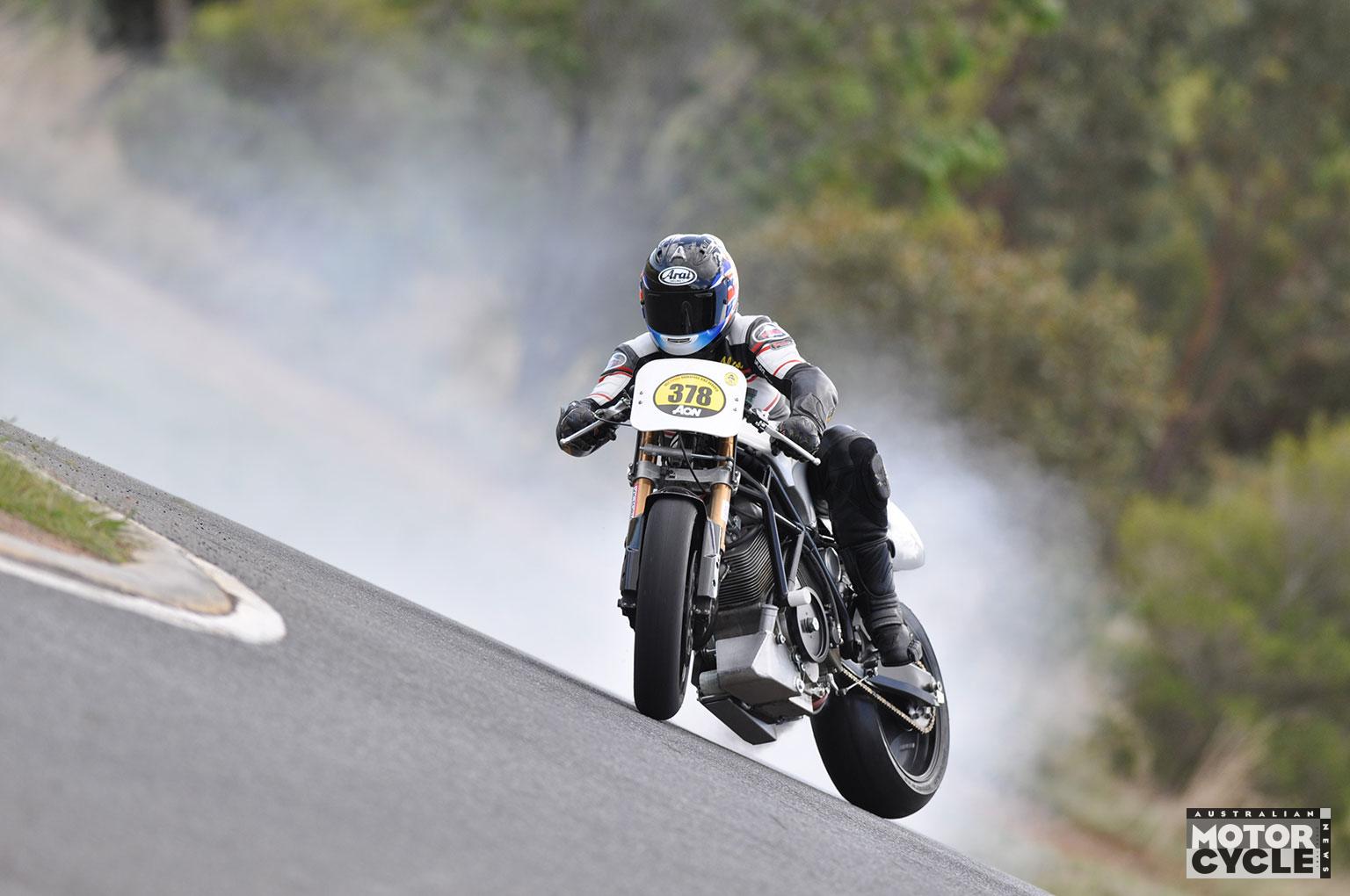
So satisfying, in fact, you almost wonder why he turned to building the third and fourth bikes in his quartet of Beezas – the ultimate Empire Twin, designated the E120R which made its racetrack debut in 2012, and the E120S street version he completed in 2018.
“It was the logical follow-on to the other two models, showing where BSA would be if they’d decided to keep going with the V-twins into the modern era,” Doug says. “Both the first two bikes have a lot of BSA parts in them, and they’re based on the styling that BSA used in that period – but unfortunately we can’t really say what their bikes would have looked like today. I therefore opted for a thoroughly modern design in creating this, and tried to imagine how BSA engineers might have responded to today’s engineering solutions.”
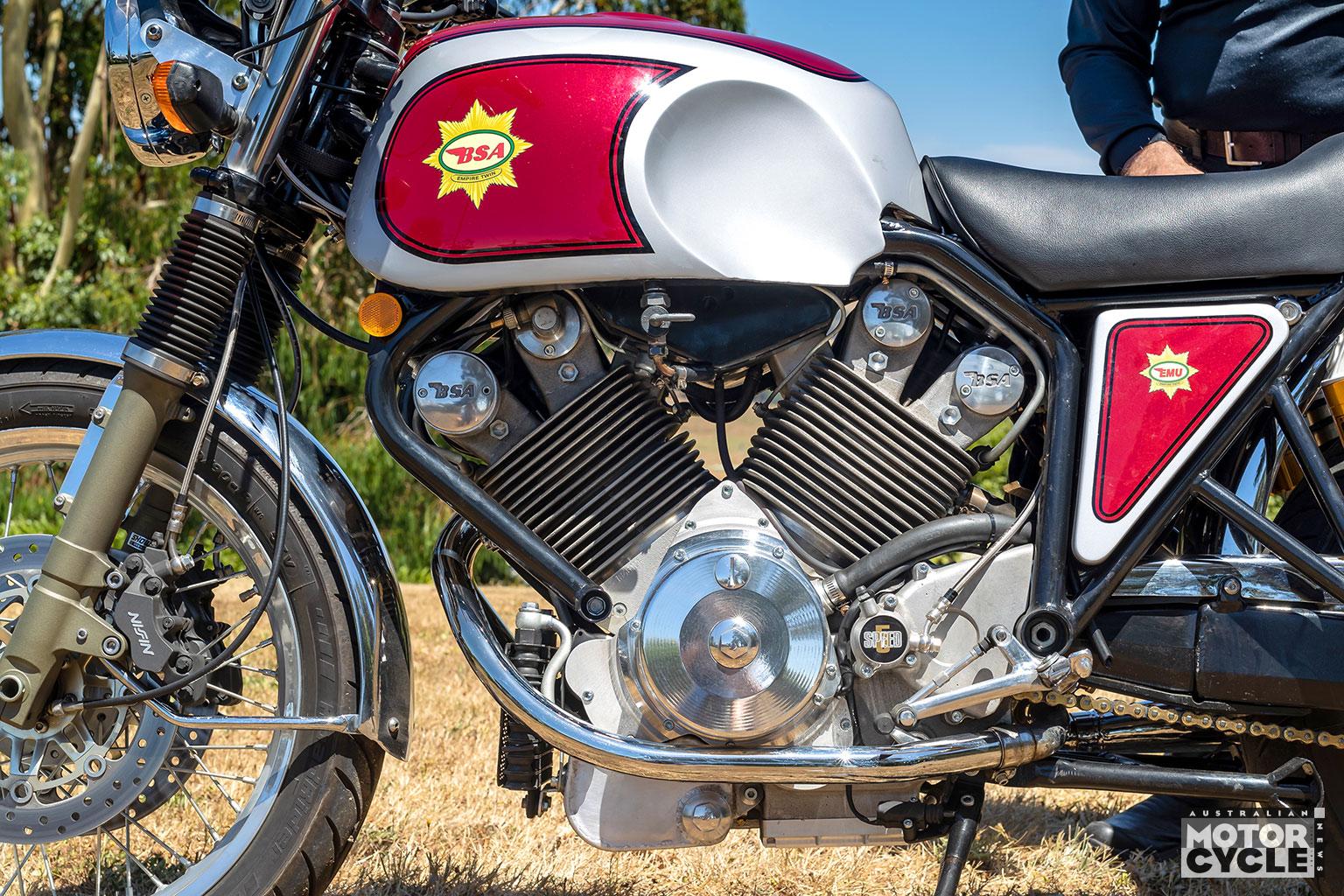
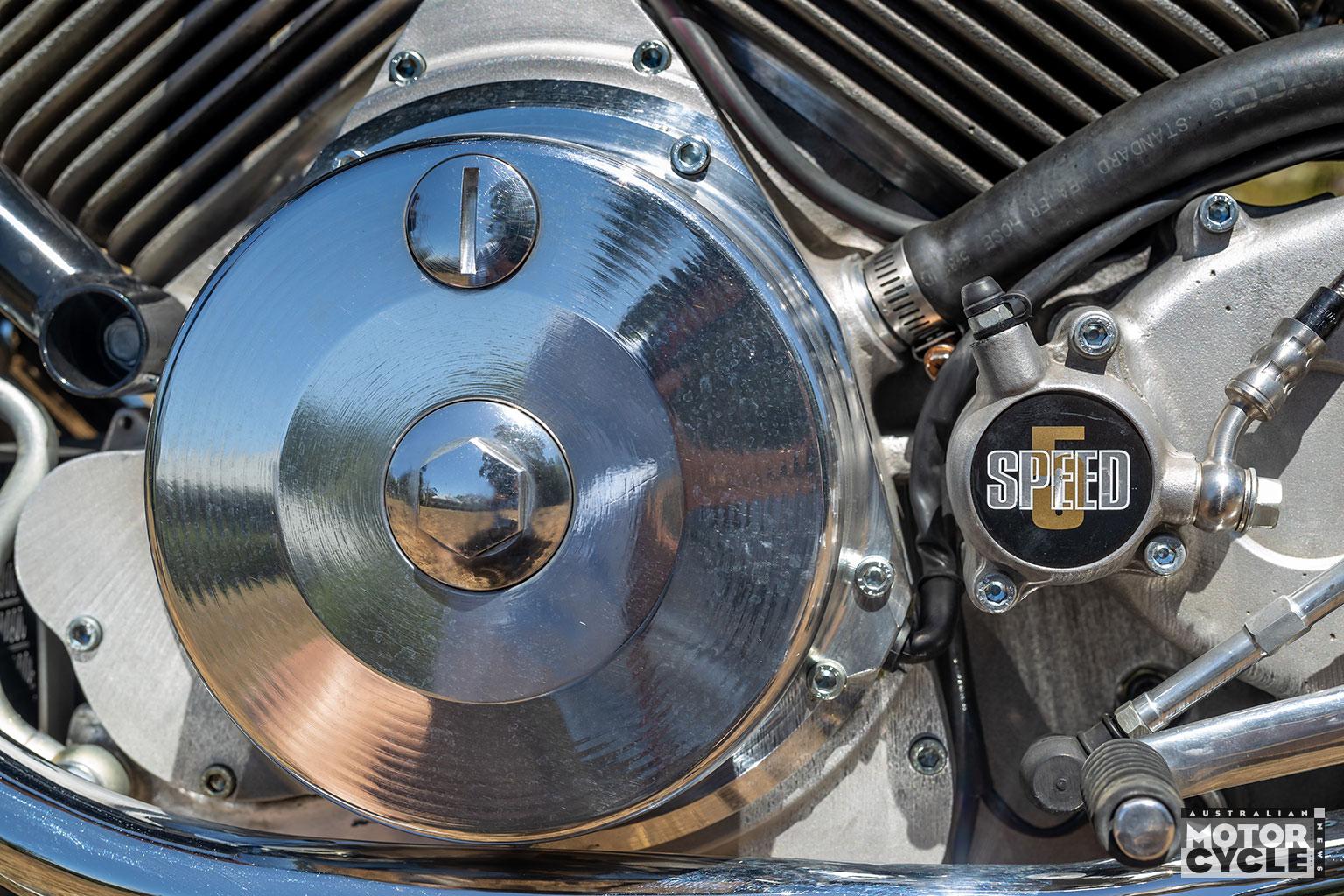
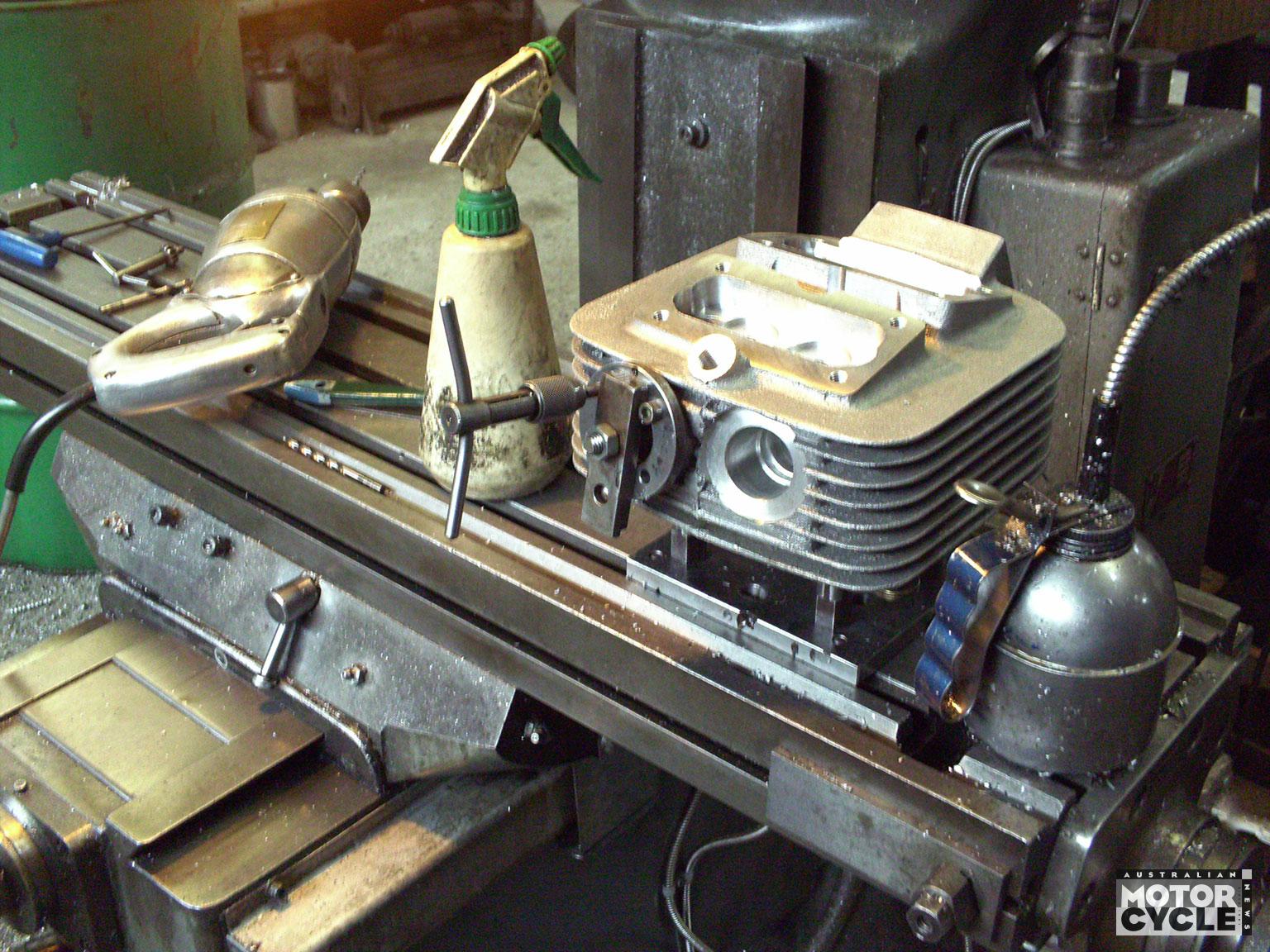
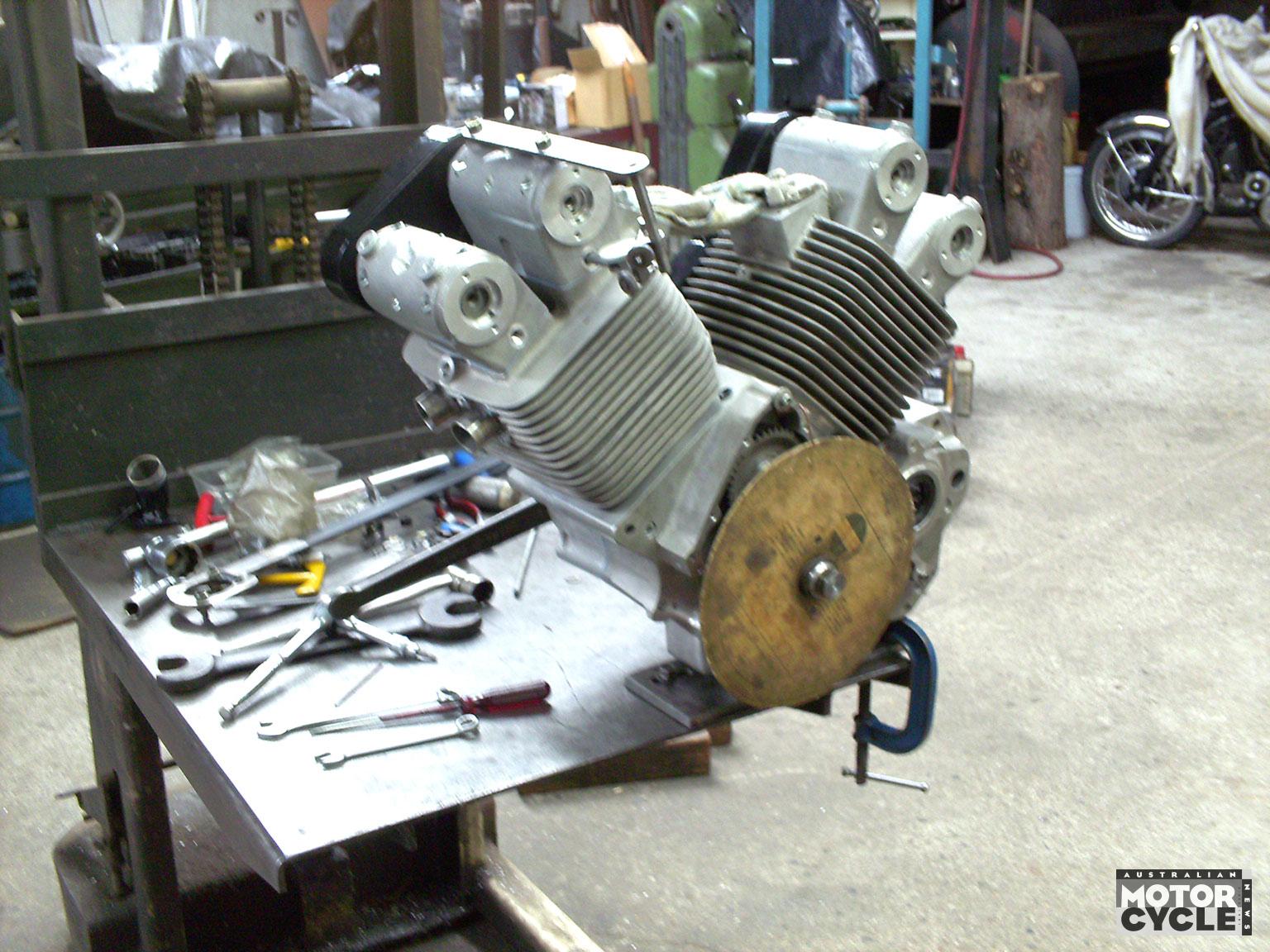
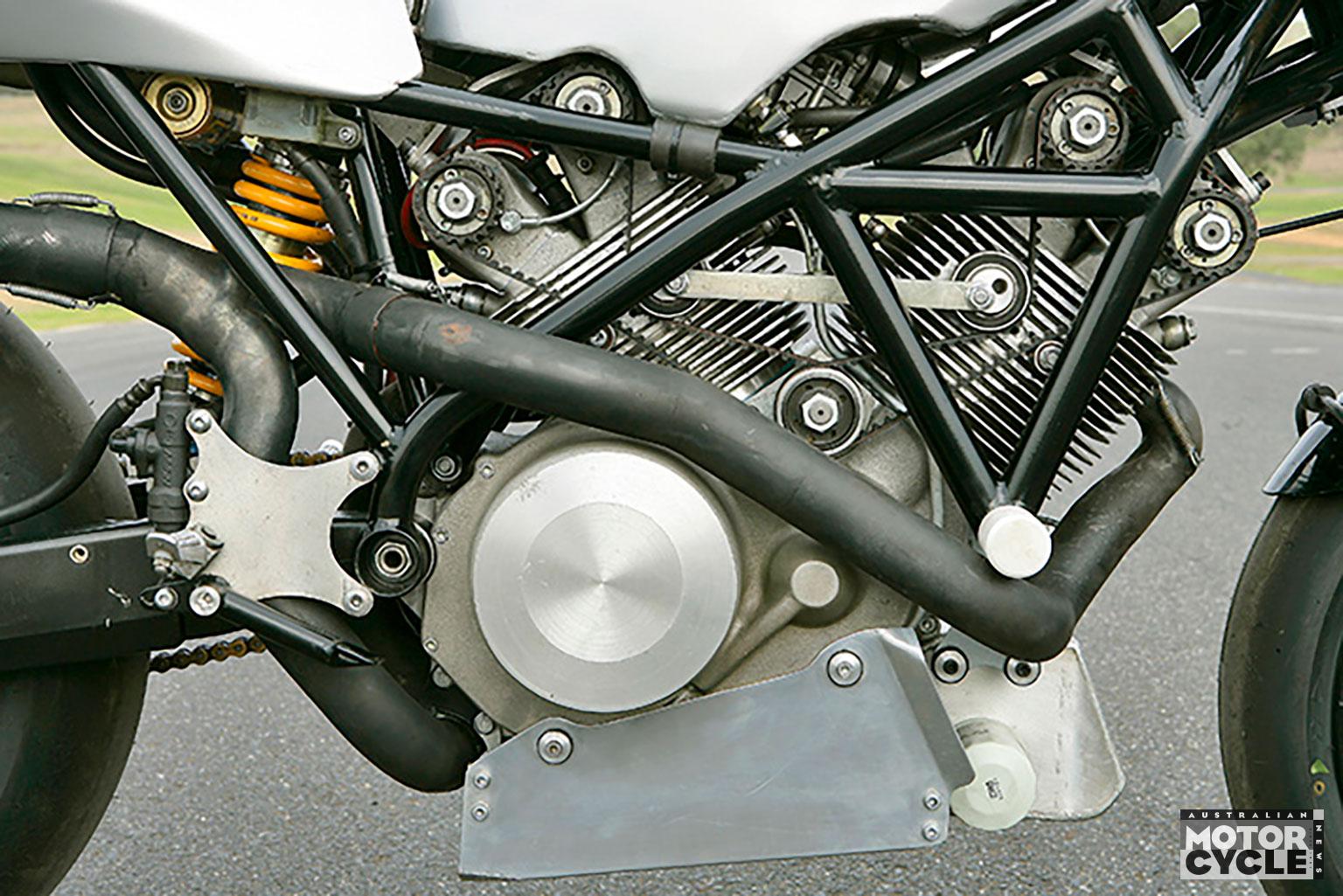
Both these bikes are powered by a meaty-looking air/oil-cooled 1194cc eight-valve DOHC dry sump engine measuring 100mm x 76mm, with narrow crankcases for extra stiffness, thanks to the hefty old-style Moto Guzzi-type bacon-slicer external flywheel on the left side, surmounted by twin cylinders set at 75º to each other, whose extensive finning originally maintained the same size and shape as the legendary BSA DBD34 Gold Star, while also being oil-cooled.
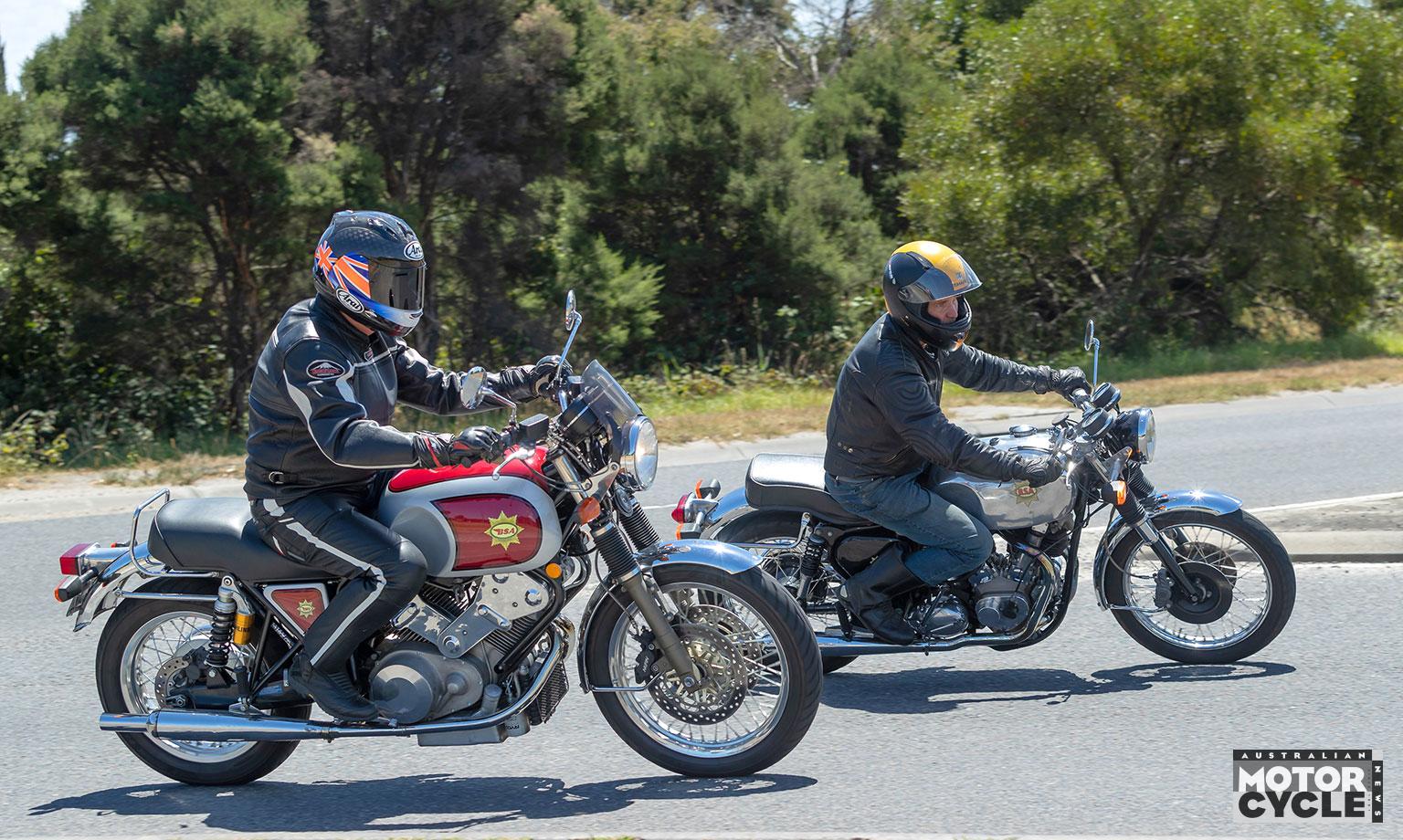
The 38mm Amal Mk2 Concentric carbs are fitted to the street legal Emu BSA E120S on which I covered 220km alongside Doug aboard his B66 on a ride through the Mornington Peninsula and South Gippsland on a sultry 36°C day.
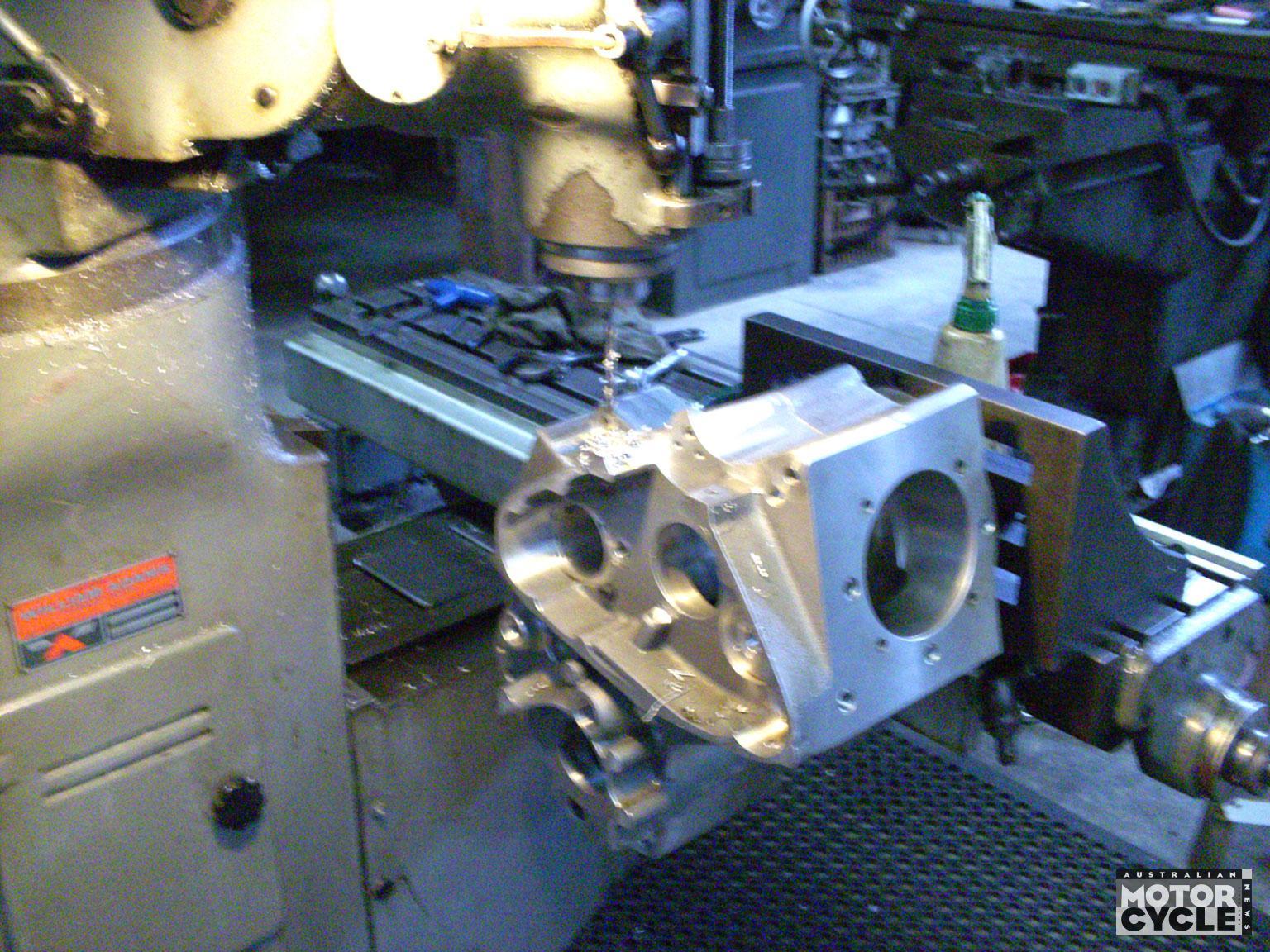
“I designed this as a true BSA Superbike sports model, which could be ridden on the road, as well as giving a good account of itself on the racetrack,” says Doug. “Originally I thought that when we were looking for more performance, we could switch to injection, so I allowed enough metal in the head castings to machine them to install single injectors at the bottom of the ports. But after covering thousands of road miles using Amal carbs and my own points ignition with ballast resistors on each of the coils for ease of starting, I’ve decided I don’t need the whole new level of complexity EFI brings in its wake. Simple is best!”
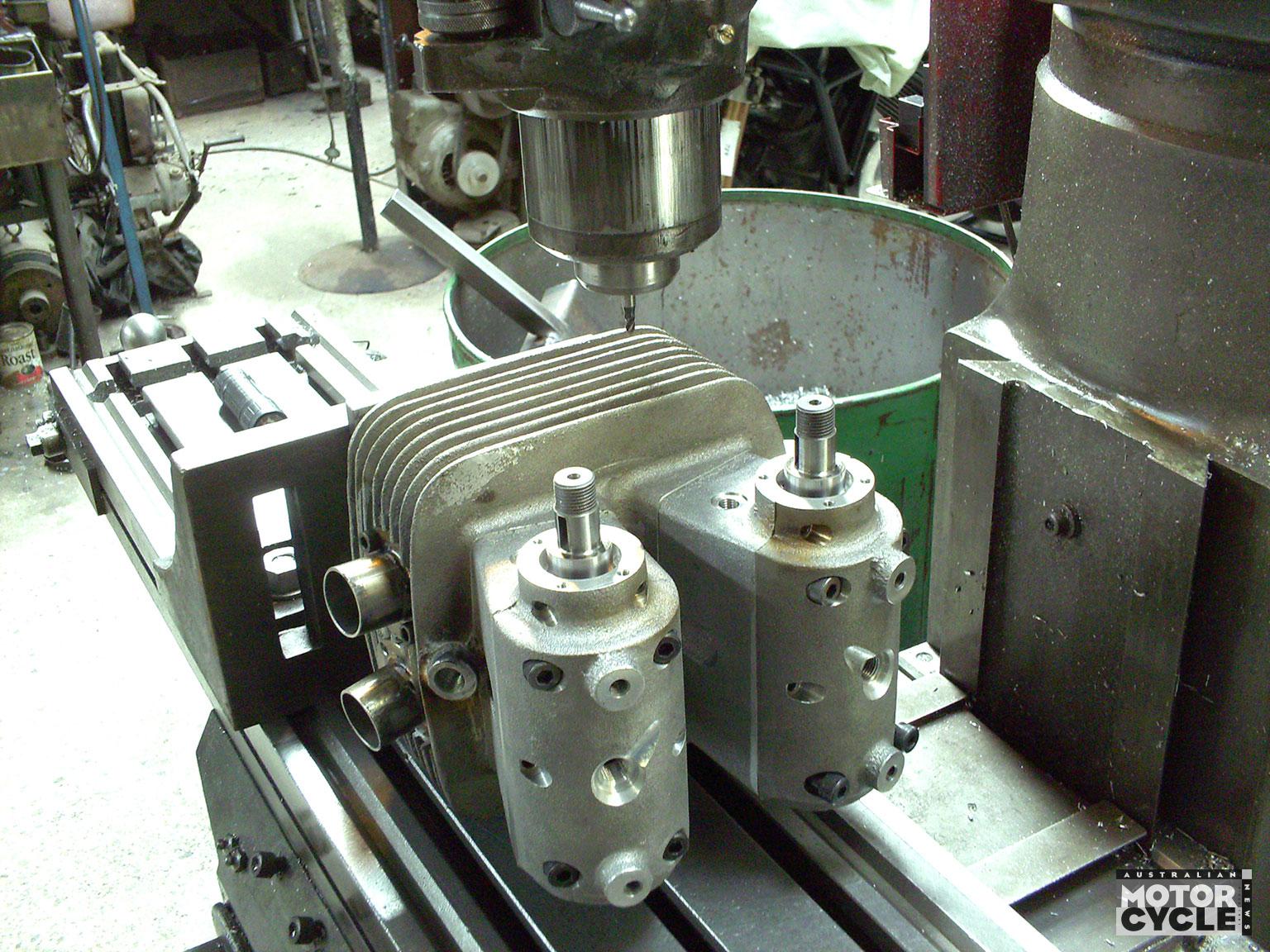
The E120 Emu BSAs’ narrow crankcases are vertically split, encompassing a one-piece plain-bearing crankshaft which Fraser machined up out of a single EN26 steel billet. That did take a bit of time, though – he started off with a 52kg lump of metal and ended up with a crank weighing just 7.5kg. “There was a lot of swarf!” he admits.
The crank’s mainshaft is 40mm in diameter, and the assembly runs on two very large roller main bearings, plus a support bush on the far right-hand side where oil is pumped into the crank. This runs a 50 per cent balance factor, same as on Fraser’s other Emu BSA creations, and carries Pankl titanium conrods bolted up side-by-side on a 53mm diameter big end, with forged Mahle pistons sourced from a flat-six Porsche 996RS delivering 11.5:1 compression, and running in Nikasil-lined Mahle sleeves.
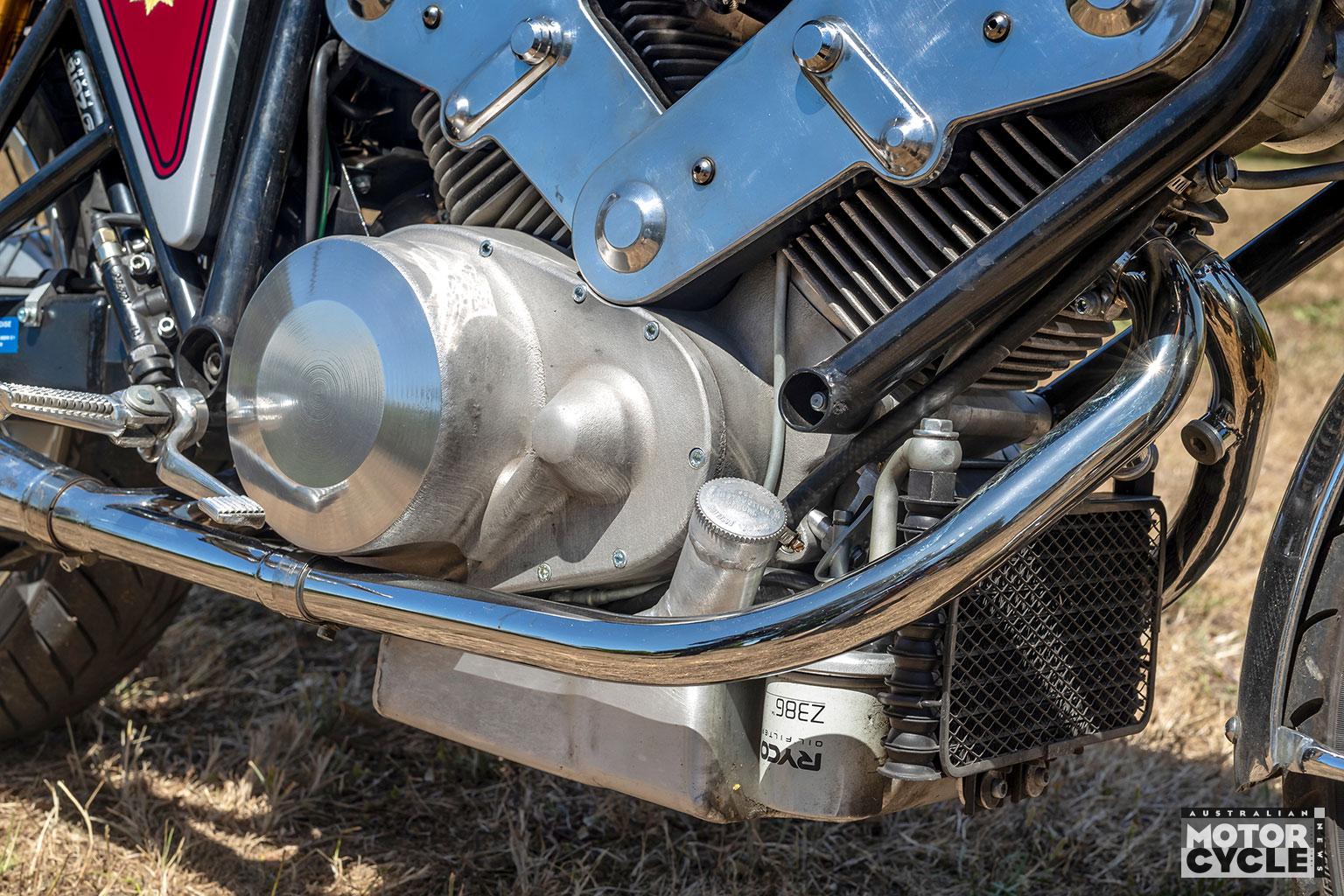
The spec of both E120 Emu BSA engines is almost identical, save that the S-version runs a milder cam and its ignition timing is tuned for torque rather than horsepower, plus it also has a quieter ADR-legal exhaust. But transmission on the road bike is provided by a five-speed Honda Varadero gearbox (the E120R has a six-speed VTR1000 ’box), which Fraser has cassette mounted to be fully extractable for speedy internal ratio changes on the racer – it takes less than 30 minutes to change a gear ratio, he claims. Even Ducati’s ultimate 1198R V-twin Superbike didn’t have this facility, despite having comparable vertically split cases!
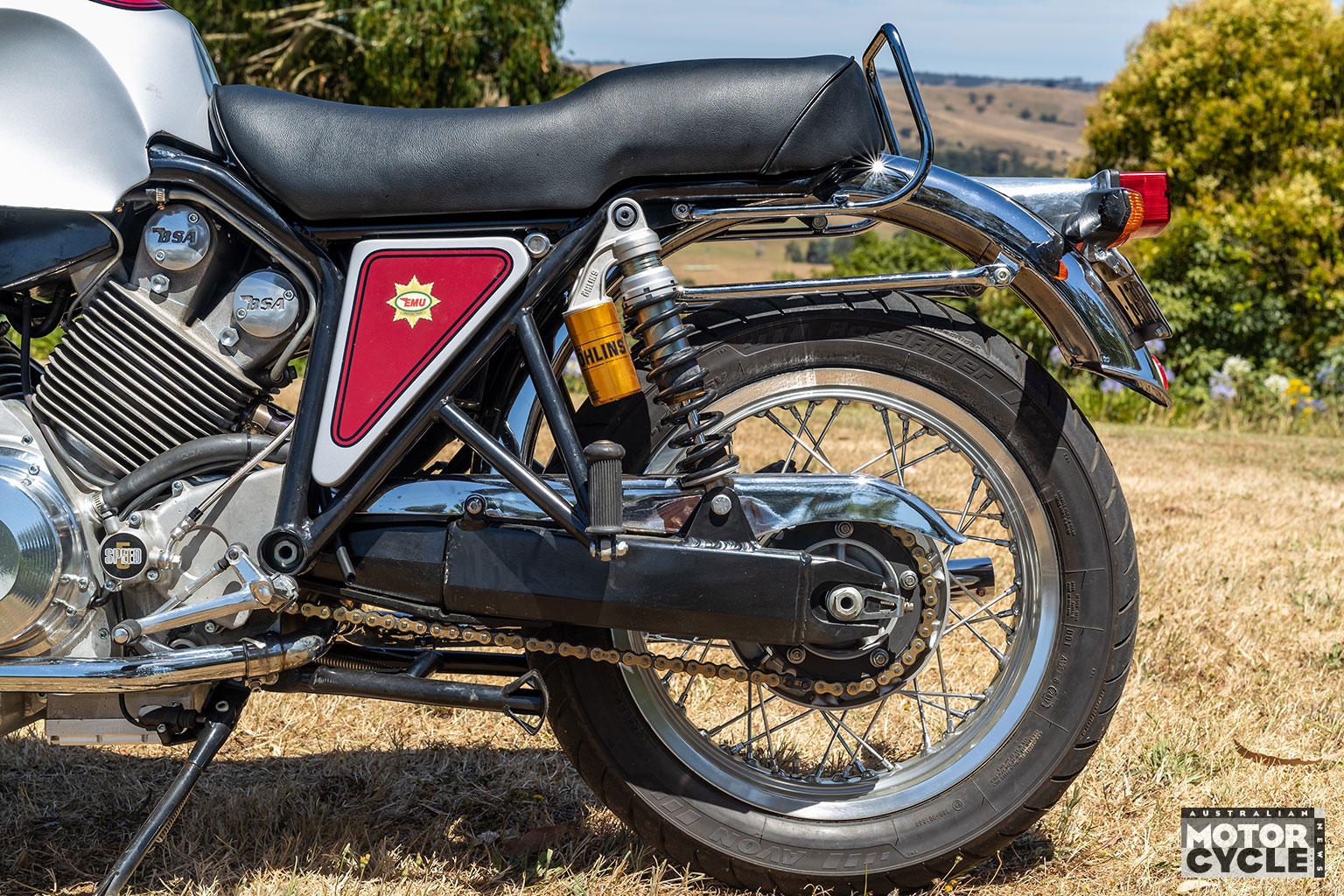
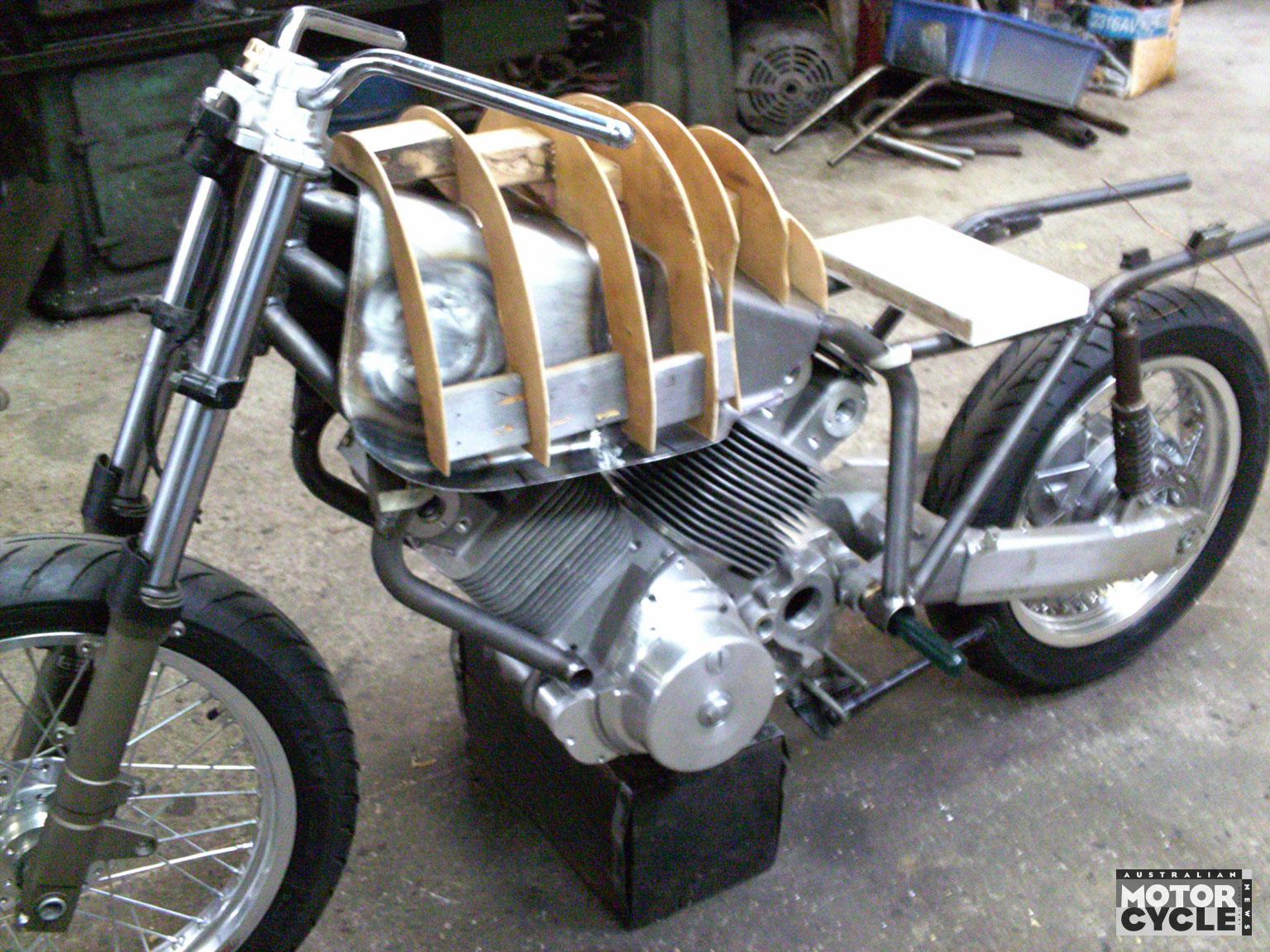
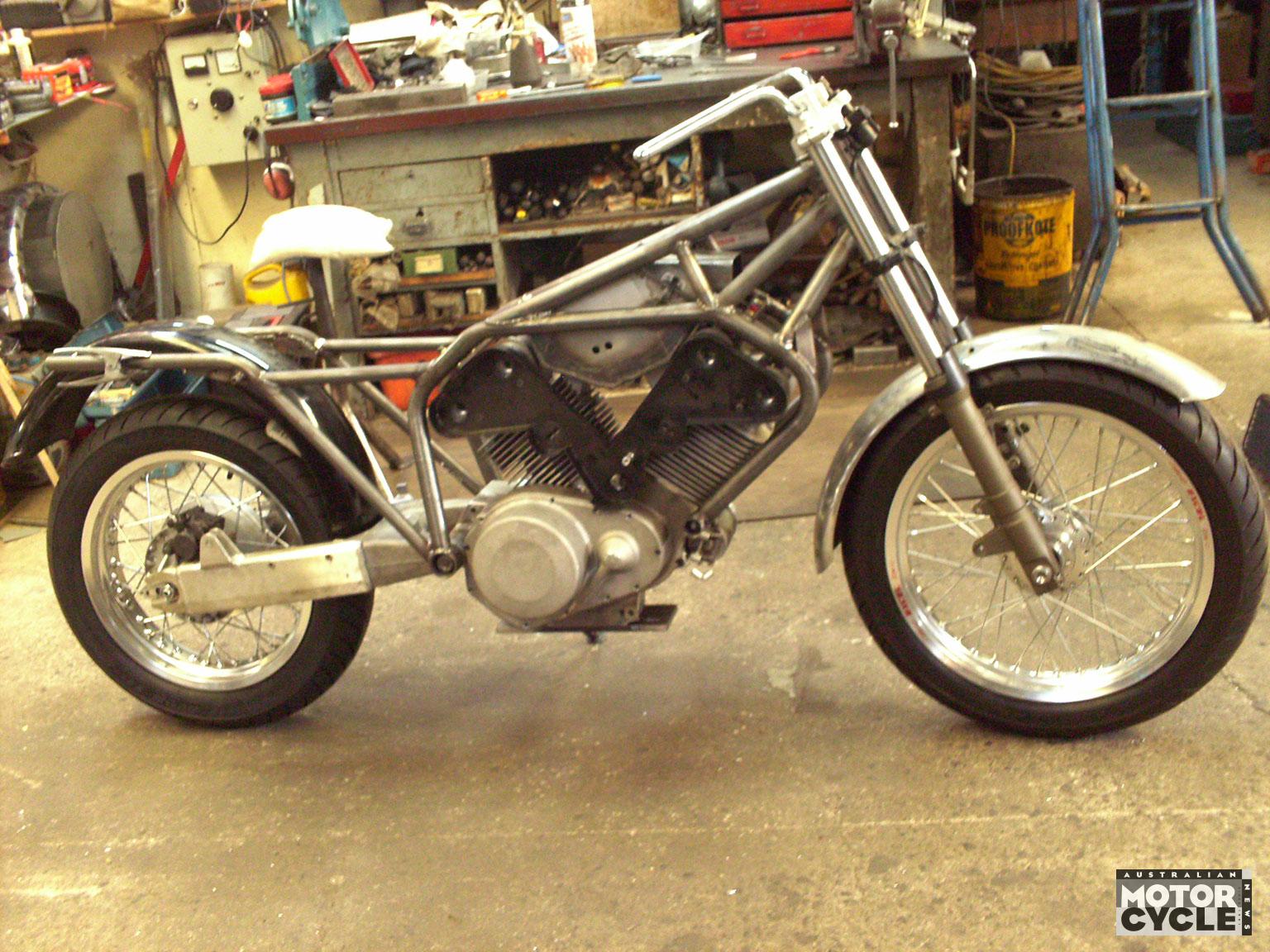
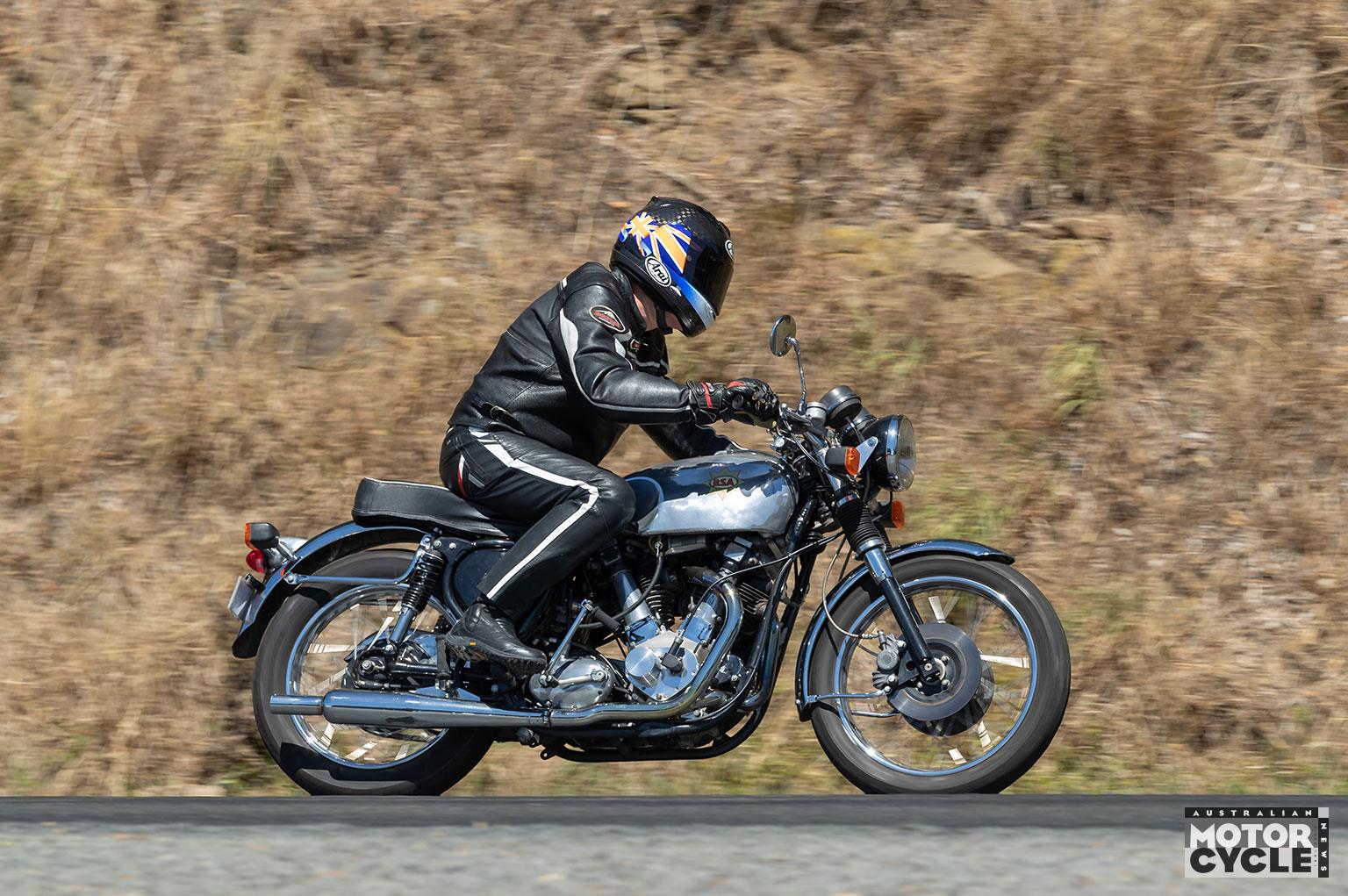
On the E120S, this beefy-looking engine is installed in a fully triangulated chrome-moly tubular steel spaceframe weighing less than 10kg while using the engine as a fully-stressed, load-bearing component. However, the street version of this is quite different from the racer, resulting in a 75mm longer 1500mm wheelbase that gives extra space for an optimum run for the exhaust headers for street use. A modified Honda CBR600RR extruded alloy swingarm pivots on the back of the engine as well as in the spaceframe. Unlike on the monoshock E120R, to give more room for a passenger and provide a lower 32in/810mm seat height this has twin Öhlins rear shocks that are adjustable for spring preload and rebound damping. “Sorry, I’m old fashioned, but I’m not very fond of bikes that have a foot of space between the rear underside of the seat and the back tyre, and you need a step ladder to get on the pillion seat,” says Doug. “They also generally don’t have a rear mudguard, so in the pissing rain you get covered in shit. Twin shocks rule!”
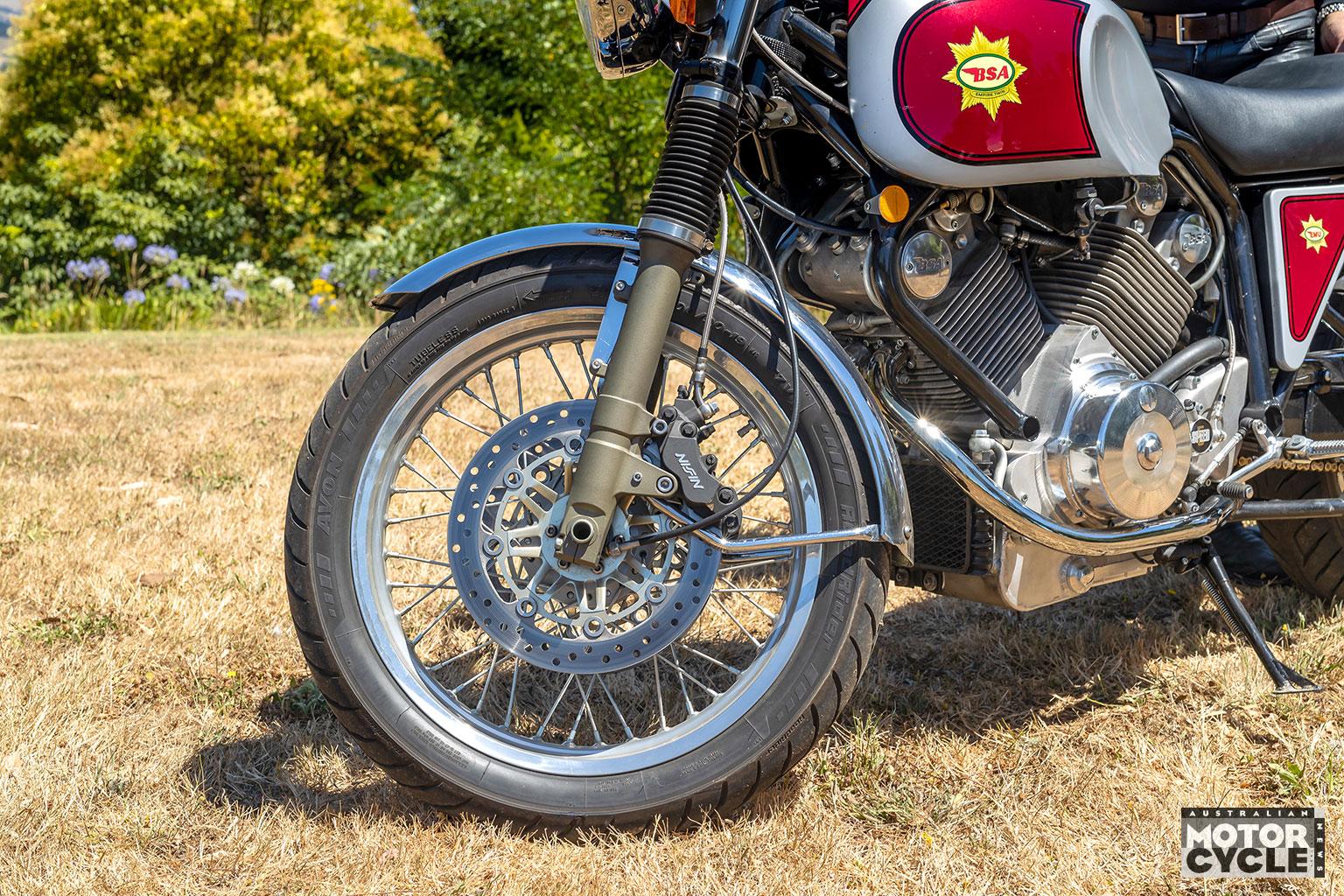
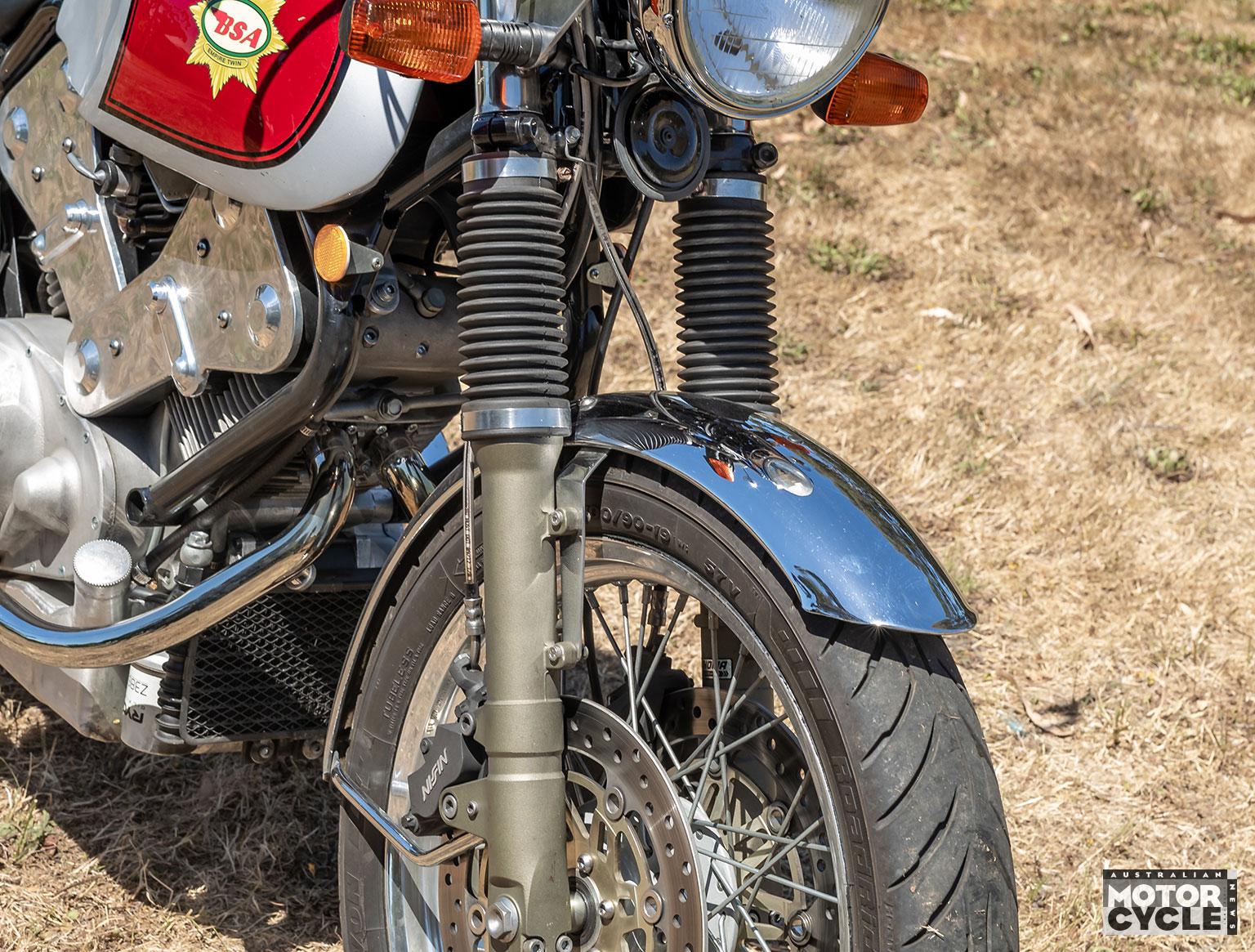
The Emu BSA’s complete front-end assembly is taken from a V-twin Honda VTR1000, with a 41mm Showa fork set at a 26º rake carrying Öhlins cartridge internals, again adjustable for preload and rebound damping. Twin 296mm VTR discs are gripped by Nissin four-piston calipers, with a 220mm rear and single-pot caliper. “The VTR runs clip-ons, but I was able to find a yoke I could use with conventional handlebars,” says Doug.
The wire wheels Fraser was eager to retain on the S-model – the Emu BSA E120R racer carried 17-inch Suzuki cast aluminium wheels at both ends – were obtained by using a 2006 Triumph Bonneville rear hub with the cush drive needed to handle the engine’s meaty torque, laced to a 17-inch Takasago alloy rim. But the front end was more complicated, since finding a 19-inch wheel that Doug had determined he wanted – which had the right spoke angle and would fit between the relatively narrow fork – was difficult. So he made a hub himself and spoked on a Takasago rim, same as the rear, which was cross-drilled with a special lace pattern to increase spoke angle to produce a rigid wheel. Both wheels are shod with Avon RoadRider rubber.
The Emu BSA 120S weighs 190kg with oil but no fuel, split 52/48 per cent, with fuel contained in a five-piece 17-litre steel tank that Doug welded up to replace the modified Yamaha TRX one used on the racer. The evocative BSA paint job comes thanks to noted Jaguar E-Type restorer Glen Olsen.
I’d already ridden the Emu BSA E120R a couple of times, enjoying the narrowest of escapes on the first occasion while running in the newly built engine at Broadford circuit, when the rear tyre got coated with oil via inadequate crankcase ventilation. That reminded me one more time – fortunately not the hard way! – of the risks of riding prototypes that are still a work in progress. It’s a tough job, but someone has to do it…
Riding the street version of this bike was quite a different experience, for Fraser has spent the past seven years since completing his E120S in covering 26,700km on it and constantly improving it – one reason he doesn’t want to mess with EFI. With 77kW (103hp) delivered to the rear wheel at 6800rpm at the time I rode it, his Big-Twin Beezer had quite sufficient grunt on paper to be an endearing road ride, and that’s the way it turned out. For the engine is indeed just as lusty and torquey as you’d hope a performance V-twin would be, with no real vibration despite not having a counterbalancer – KTM has to run one in its own 75º V-twin LC8, so what does Doug Fraser know that the Austrians don’t?!
The five-speed Honda street-pattern gearbox worked as well as ever, and there’s an ultra-rideable power delivery that Doug says comes from the fact there’s more than 100Nm of torque from 3500rpm all the way to 7200rpm, peaking with 110Nm at 6000rpm. The BSA pulled strongly right off the 1500rpm idle speed, and would run okay up to my appointed 7500rpm redline and maybe beyond, but the last thousand revs were hard-won. I could tell that it had stopped breathing hard if I held a gear and tried to run it much higher than seven grand, presumably thanks to the small 38mm carbs fitted. While ideal for touring in terms of throttle response and fuel consumption, these are too restricted in terms of outright performance for 600cc cylinders – Ducati ran a 42mm Dell’Orto on its works 450GP single, and the Honda VTR1000 Firestorm V-twin had 48mm Keihins, as the last big-engined Honda model wearing carbs.
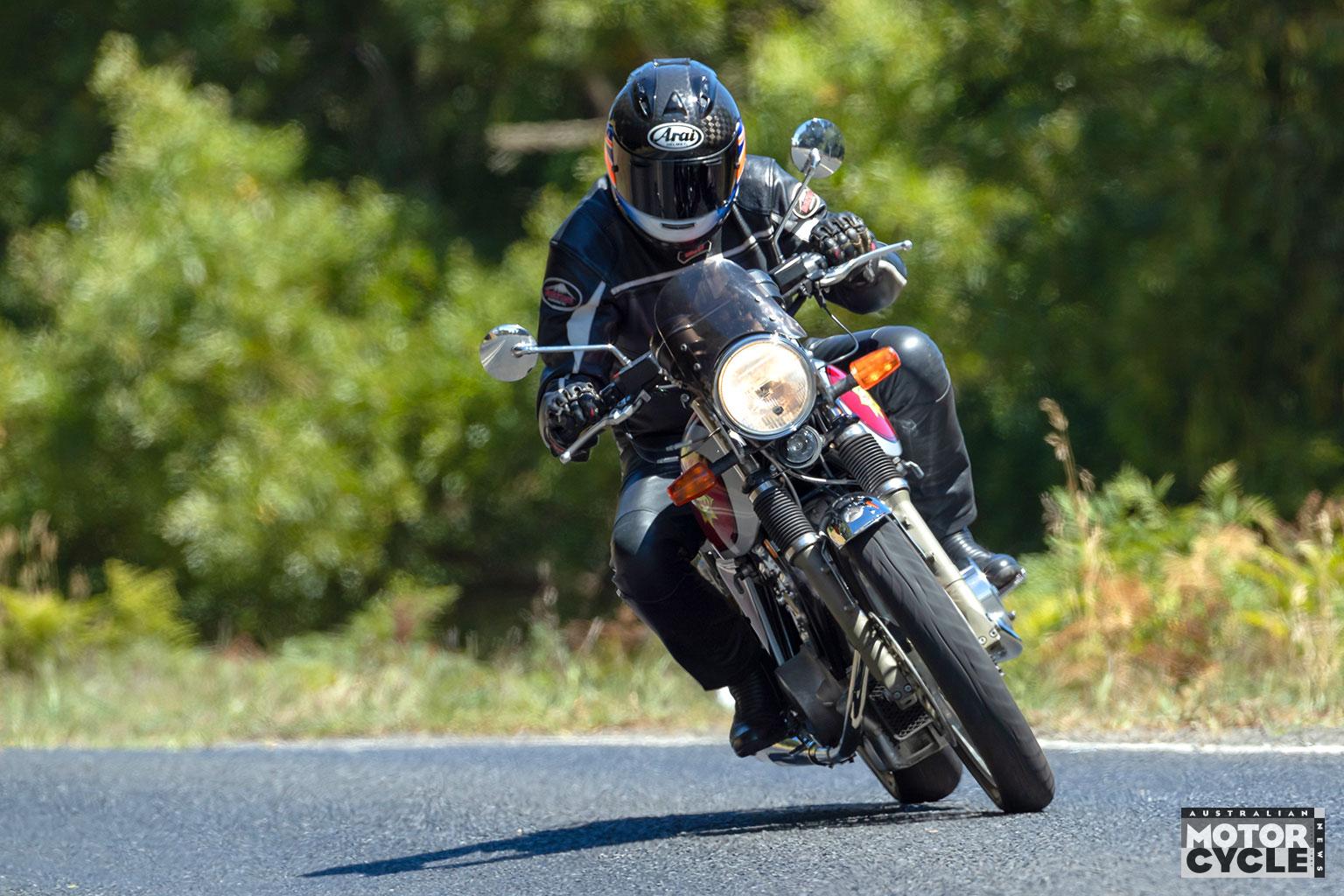
So, despite a rather slow-action throttle, the E120S accelerates strongly through the gears until you get to top (fifth), which with such massive reserves of torque you’re best off staying in most of the time. It’s a very relaxed, long-legged motorcycle, as befits the Touring nature Doug created it to have. 160km/h comes up with the engine turning at just 5300rpm, and 4000rpm sees the speedo parked at 120km/h for all-day cruising in Australian road conditions, with excellent top gear roll-on from 3500rpm up. But if you feel like attacking a series of bends you can notch it down a couple of gears and treat the Emu BSA like the sportsbike it is at heart. It’s important to work the gearshifter there, because the Emu Beeza will understeer if you try to take a reasonably tight bend in top gear on part-throttle – it likes to be hustled through turns hard on the gas to tighten up the steering, while the well set-up Öhlins suspension and that long wheelbase will ensure it rides any bumps you encounter while cranked over with total stability.
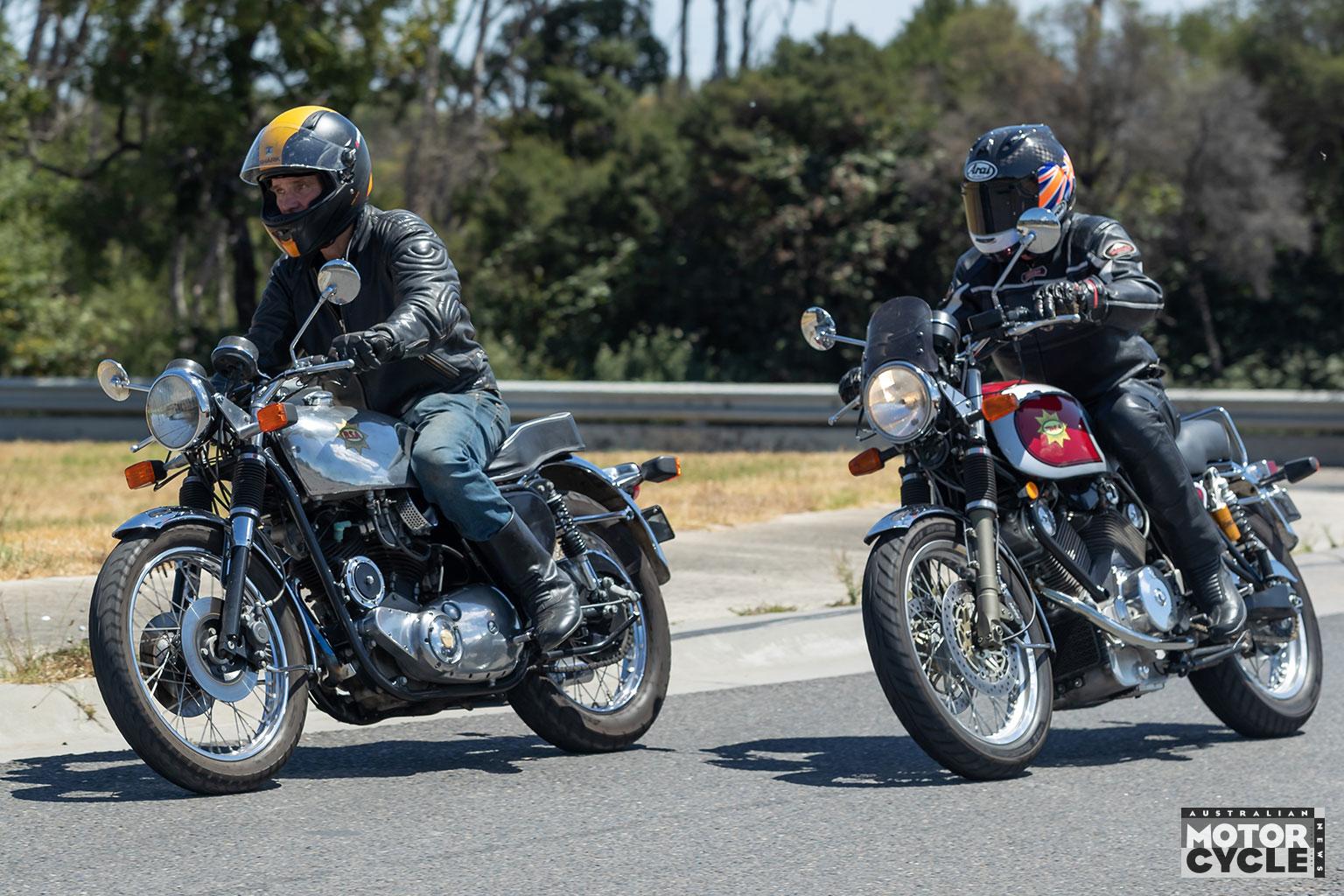
Fraser and Mamoru Moriwaki are obviously brothers in arms in extolling the virtues of twin shocks, especially when they work as well as they do here! For the suspension is very well damped at both ends, which took good care of coping with the variable quality of Victorian road surfaces in South Gippsland. The Emu BSA rode smoothly over the numerous lumps and bumps we encountered, and there was never any front-end chatter when running over a rippled road surface while cranked over. What a nice real-world ride.
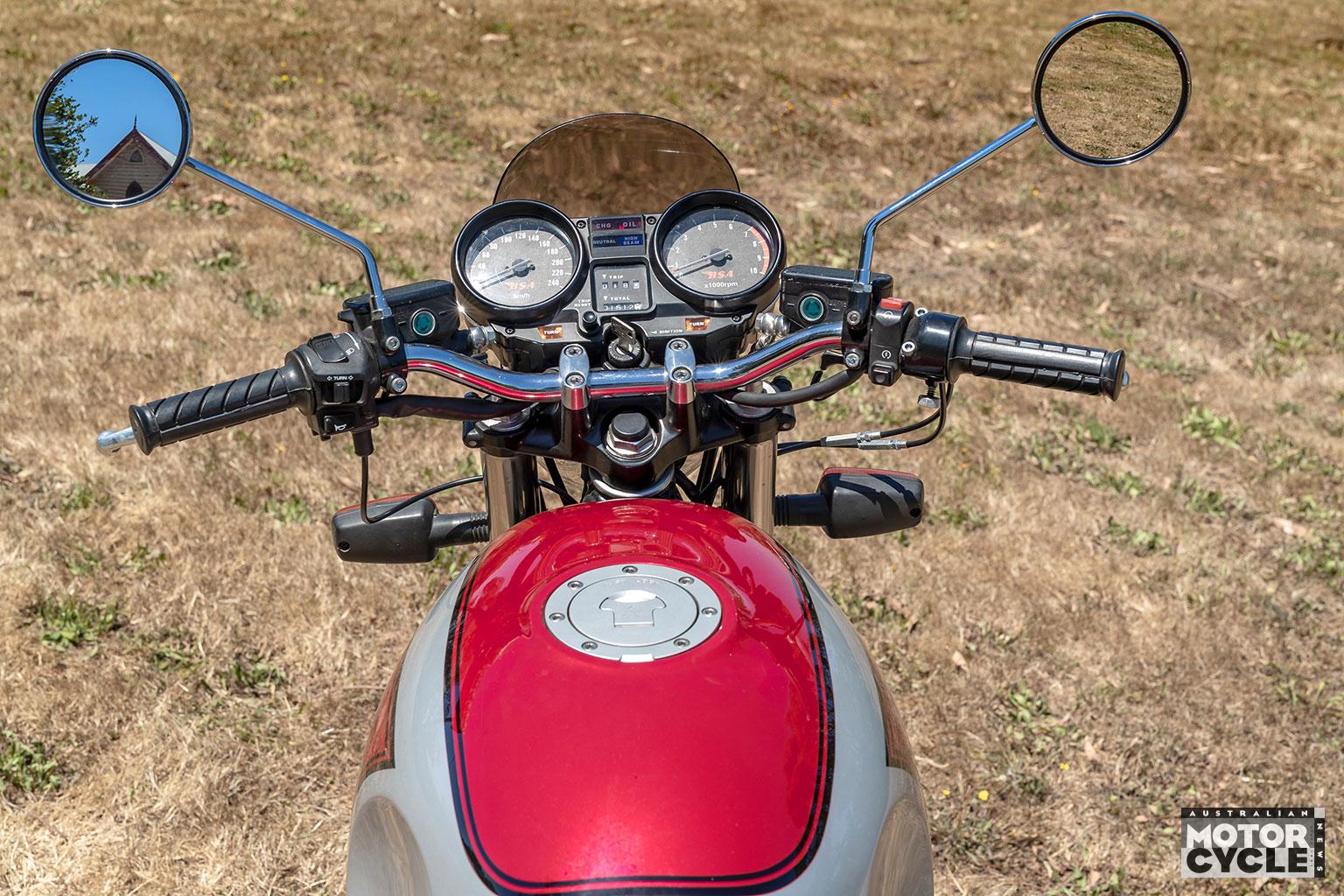
Doug’s a little shorter than me, so the seat he’s tailor-made for himself sees the footrests closer to the plushly padded, smoothly-stepped seat than I’d have preferred, even if it meant I could put both feet flat on the ground at a traffic light. But that apart, the E120S’s riding position is very welcoming – you feel you’re sitting within the bike and very much a part of it as you swing from side to side through a series of turns on a Victorian country road. The one-piece handlebar is quite flat, so you find yourself leaning forward just slightly. It’s a stance that feels good for a long haul, and it felt pretty comfortable during my 220km day, when the vestigial flyscreen mounted atop the round headlamp gave better wind deflection than I was expecting in the heat.
Like its E120R twin sister, you can trailbrake the Emu BSA into the apex of a turn hard on the stoppers, without excessive front-end dive closing up the steering geometry and making it feel like it wants to tuck the front wheel. It felt nice, but above all predictable. It did pay to use a fair bit of engine braking to help out the Nissin front brakes, though – at 296mm in diameter I did have to squeeze the lever pretty hard to haul the bike down from high speed, although the smaller single rear disc worked really well, with more bite than up front. Pad choice, maybe, Doug? Just choose the right gear for engine braking, though, and be ready for the considerable amount of inertia you feel when you back off the throttle, which presumably is down to the weight Fraser has chosen for the detachable outside flywheel. Still, I didn’t get the rear wheel lifting and street-sweeping the tarmac, and with the smaller front discs I soon learnt to give stopping more margin.
With his Emu BSA E120S V-twin road bike, Doug Fraser has yet again demonstrated his resourcefulness and inventiveness in creating his own motorcycle from the ground up, all by himself – and this time a 1200cc V-twin performance bike, which is an even bigger ask (love that rego plate, Doug!). But this latest BSA Empire Twin isn’t the first British mile-eater Doug has built – so he’s had plenty of practice at making Emus fly!
✅ PROS – Massive, effortless torque, clever engineering touches, rock-solid real-world handling, unique hand-built detail, surprisingly usable for a 1200cc twin.
❌ CONS – Limited top-end from small carbs, front brake needs a firm squeeze, understeers if ridden lazily, mixed parts must surely complicate maintenance!
SPECIFICATIONS
ENGINE
Type Air-cooled DOHC 75° V-twin eight-valve four-stroke, with toothed belt camshaft drive
Dimensions 100mm x 76mm
Capacity 1194cc
Compression ratio 11.5:1
Carburation: 2 x 38mm Amal Mark 2 Concentric
Ignition: Emu 12v auto-advance points ignition
Gearbox: 5-speed extractable cassette Honda Varadero gearbox
Clutch: Multiplate Honda Fireblade oil bath clutch
PERFORMANCE
Power 77kW (103hp) @ 6800rpm (at rear wheel)
Torque 110Nm at 6000rpm
CHASSIS
Type Tubular steel spaceframe
Head angle/trail: 24°/100mm
Swingarm Braced extruded aluminium box-section
SUSPENSION
Front 41mm Showa telescopic fork with Őhlins cartridge internals adjustable for spring preload and rebound damping
Rear Twin Őhlins shocks adjustable for spring preload and rebound damping
WHEELS & BRAKES
Wheels/tyres Front: 110/90-19 Avon RoadRider on 3.50in wire-laced Takasago aluminium rim
Rear: 130/80-17 Avon RoadRider on 5.50in wire-laced Takasago rim
Brakes Front: Twin 296mm Nissin discs with four-piston Nissin calipers
Rear: Single 220mm Nissin disc with single-piston Nissin caliper
DIMENSIONS
Weight 190kg with oil, no fuel
Weight distribution Split 52/48%
Wheelbase 1500m
Fuel capacity 17L
Seat height 810mm
Year of construction 2018
Owner Doug Fraser, Emu Engineering Carrum Down, Victoria