Zongshen patent shows planned three-wheeler
Tilting three-wheelers aren’t a new idea. As well as modern machines like the Piaggio MP3, Yamaha Niken with two front wheels and one at the back, there were older versions like the BSA Ariel 3 of 1970 with two rear wheels and an engine on a platform that remained horizontal as the front section of the bike leant into corners. That short-lived machine is widely blamed for BSA’s demise in 1973 but formed the basis of a successful line of 1980s Hondas including the Gyro that remains available to this day.
Despite that long history, we haven’t seen a tilting trike quite like the one that’s just emerged in a new patent application from Chinese brand Zongshen, best known for its Cyclone range of motorcycles.
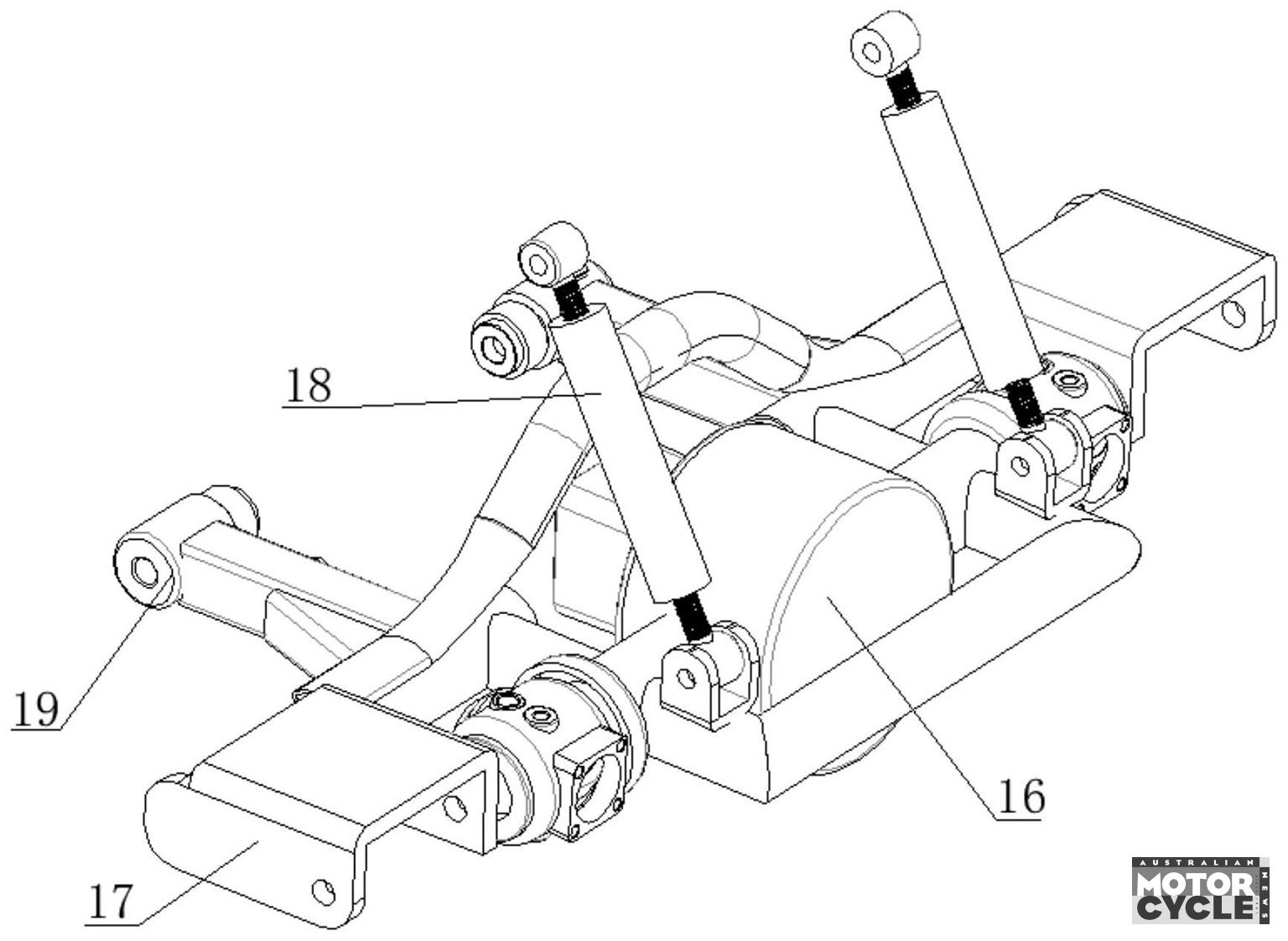
This patent illustrates a leaning three-wheeler with two back wheels and one front, based on a conventional motorcycle frame but with two swingarms instead of one, each carrying its own wheel.
Power from the engine goes to a differential mounted between the two swingarm pivots, taking drive to bevel gears, concentric with those swingarm pivots, and shaft drives to the back wheels. But the idea starts to get weirder with the suspension setup, which uses three coil-over shock absorbers to give the bike two distinct riding modes. In one mode, it’s a non-leaning trike, not unlike the sort of thing Harley-Davidson makes, or perhaps one of those famously-lethal three-wheeled predecessors of modern ATVs. In the second mode, it leans through corners like a motorcycle.
How? The trick is that the middle of the three rear suspension units is an air shock that can be raised and lowered at the touch of a button, while the outer pair of coil-overs have pivoting linkages between their lower ends and the swingarms.
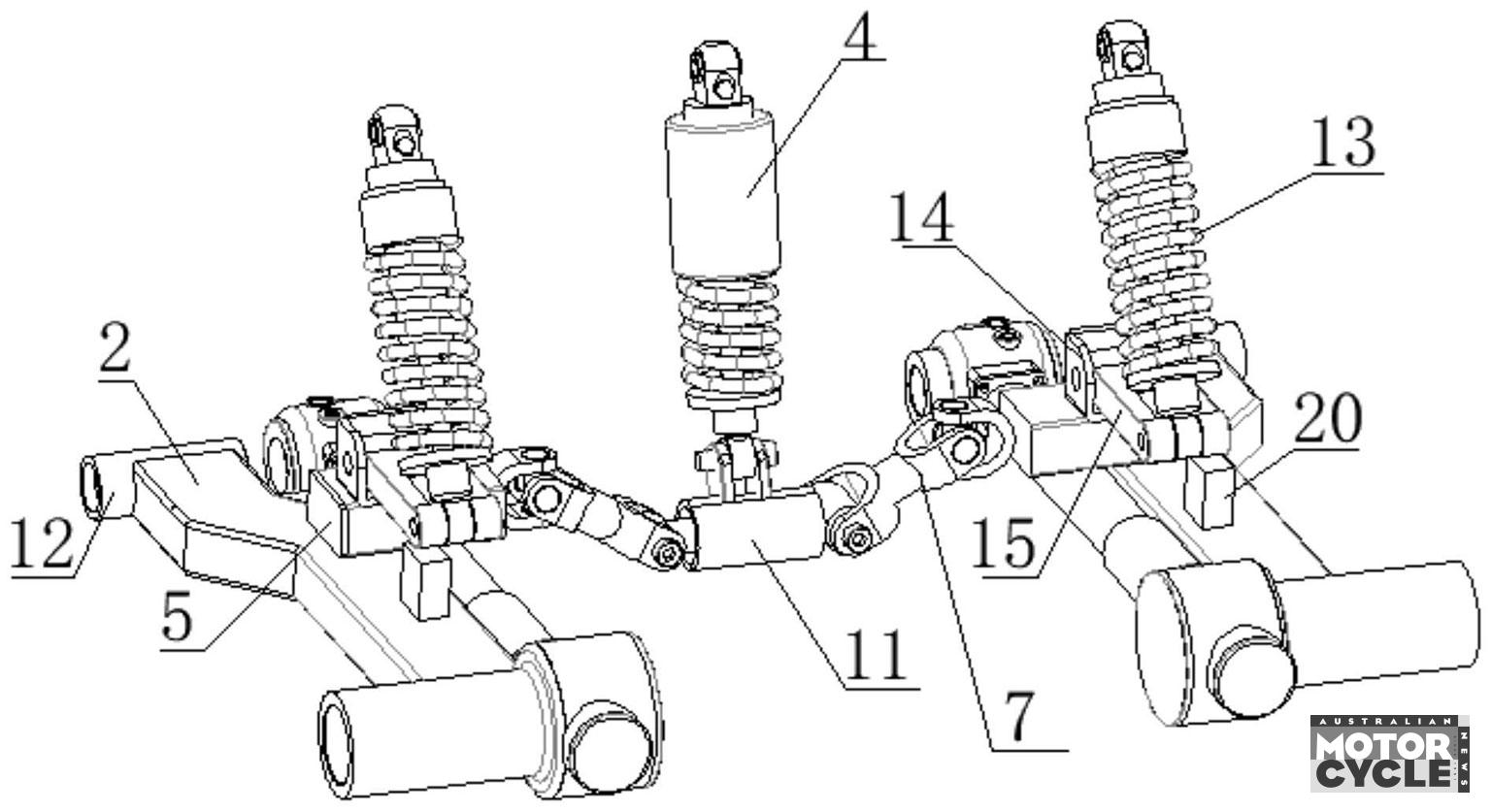
When the centre shock is set at its lowest, dropping the back of the bike, the other two shocks settle onto bumpers on the top of the swingarms. That fixes the bike in a non-tilting mode for low-speed riding or parking. It still has suspension, but it can’t lean.
By extending the rear shock, which is attached to the two swingarms via linkages on each side, each with two universal joints, the back of the bike rises and the side-mounted shocks are lifted away from the bumpers on top of the swingarms. In this state, the middle air shock carries all the weight of the back of the bike and the swingarms can freely move independently, allowing the whole machine to lean into corners. The idea is to have stability at low speed, but also to let the bike lean into corners at high speed so it doesn’t suffer the sort of tip-over risk associated with non-leaning trikes.
It’s undoubtedly a clever solution, but whether there’s a market for such a machine that isn’t already catered for by the existing tilting three-wheelers with two front wheels and one at the rear remains to be seen.