Tech-laden, semi-active suspension, heated everything and the sort of touring kit you find on bikes costing thousands more… is there a catch coming?
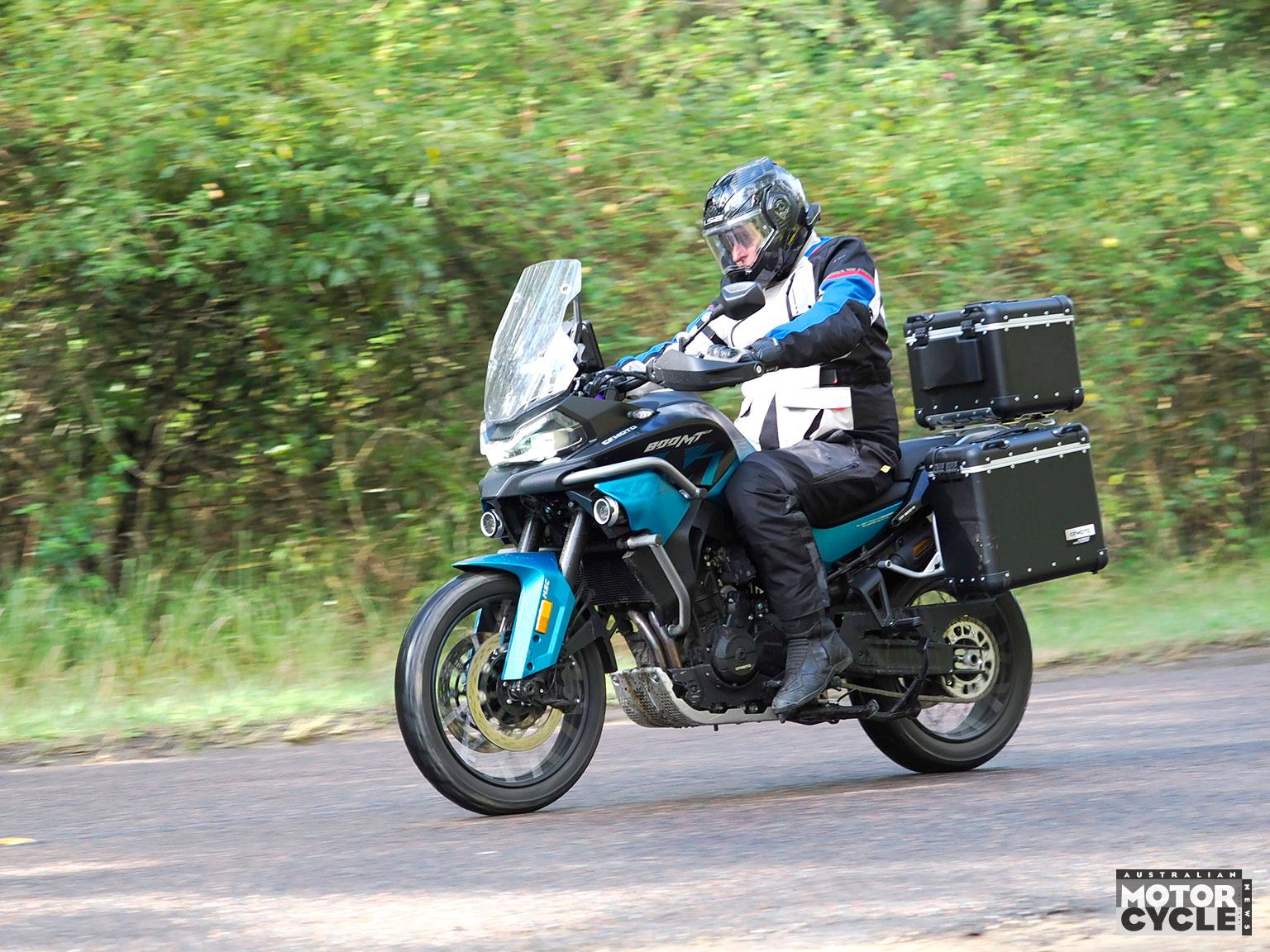
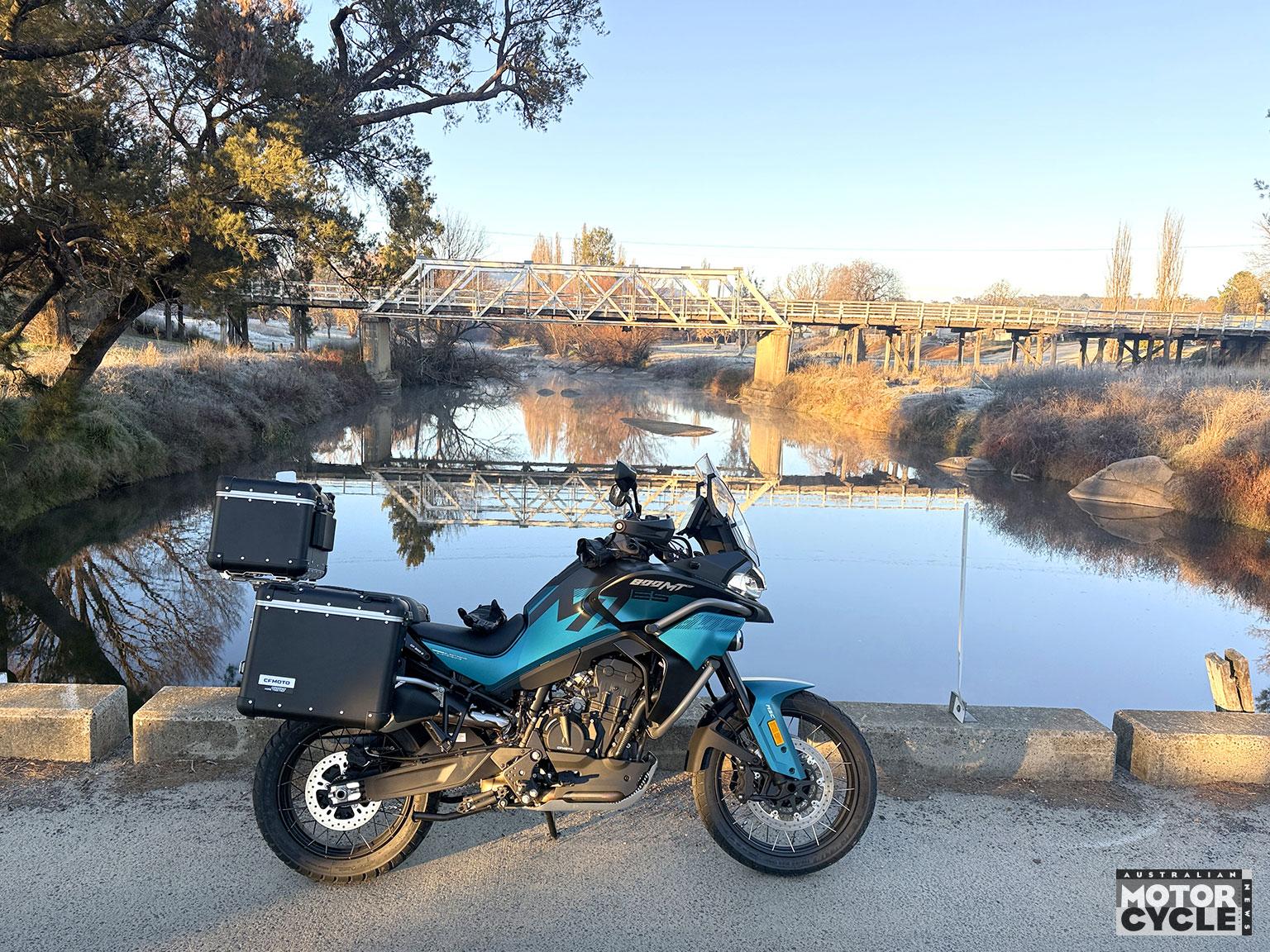
I was pondering the big questions of the universe as I rode north up the eastern seaboard to see John Rooth and photograph his shed full of goodies for a future issue of AMCN – (Nigel! Spoilers! – Ed) questions like “When does an adventure bike morph into a tourer?” and “When should I stop for lunch?” I ended up skipping lunch (well, chips were consumed at the Bendemeer Hotel), and I’ve decided the CFMoto 800MT-ES can be an adventure bike if you like – but I think it’s a tourer for the 21st century.
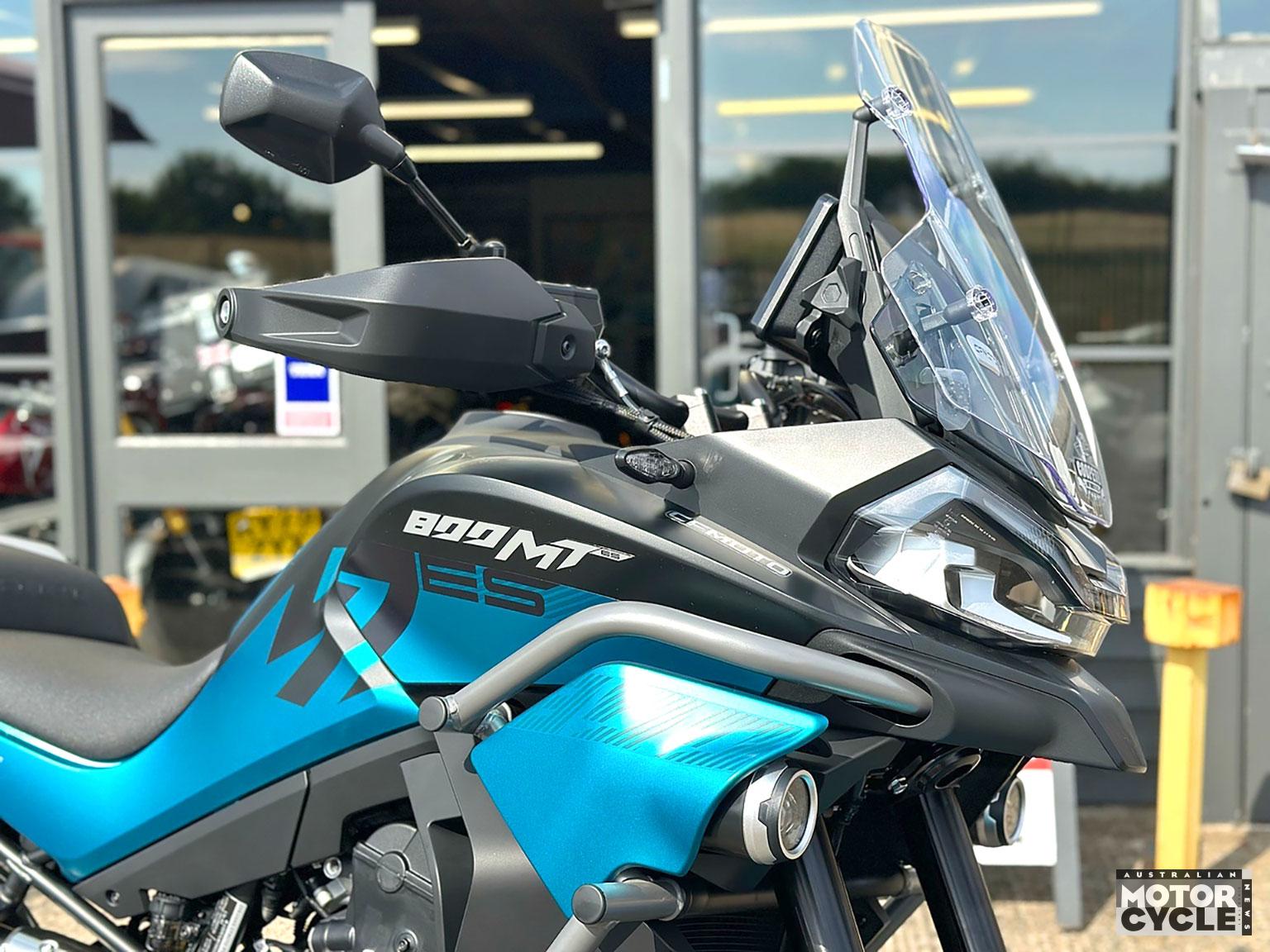
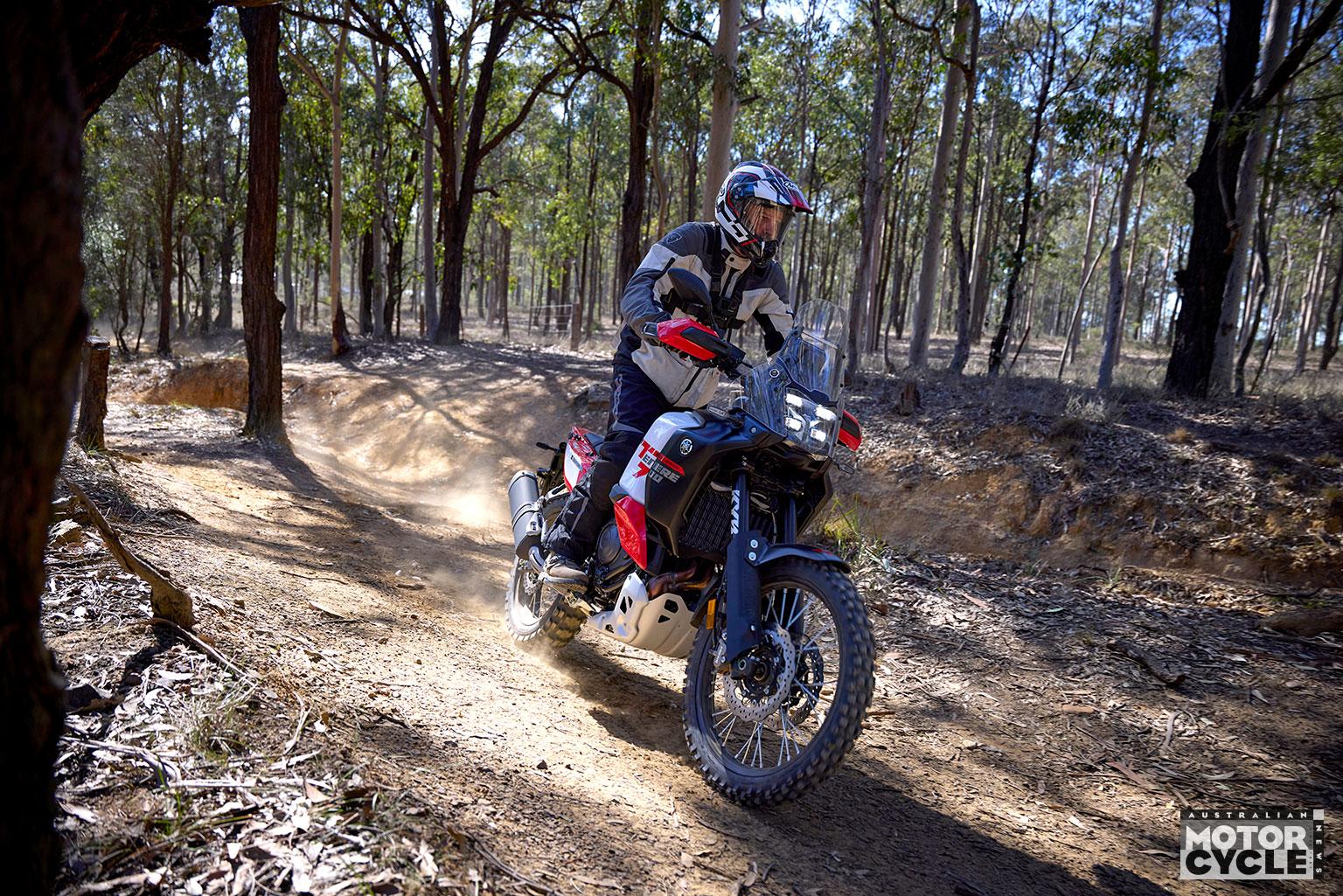
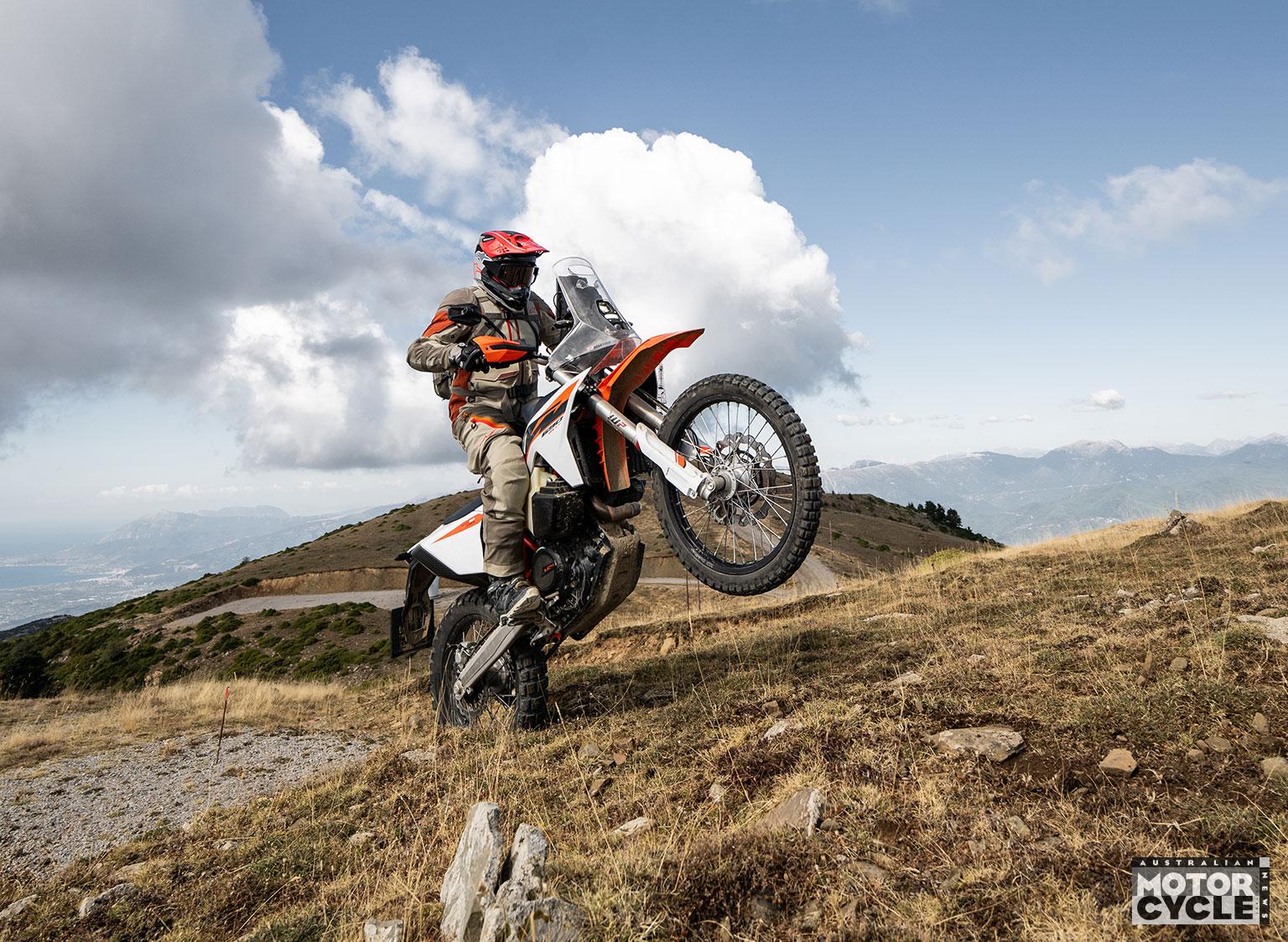
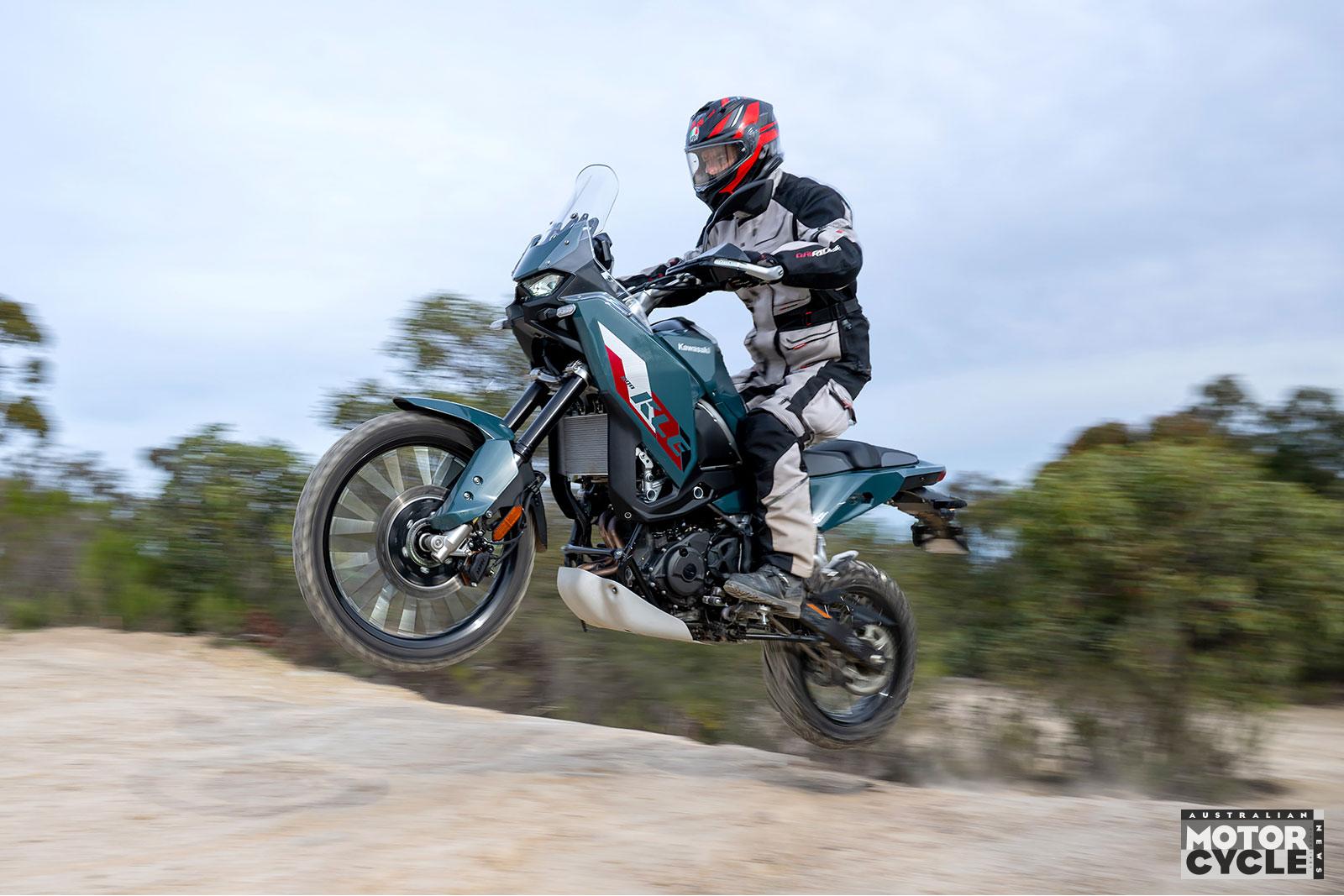
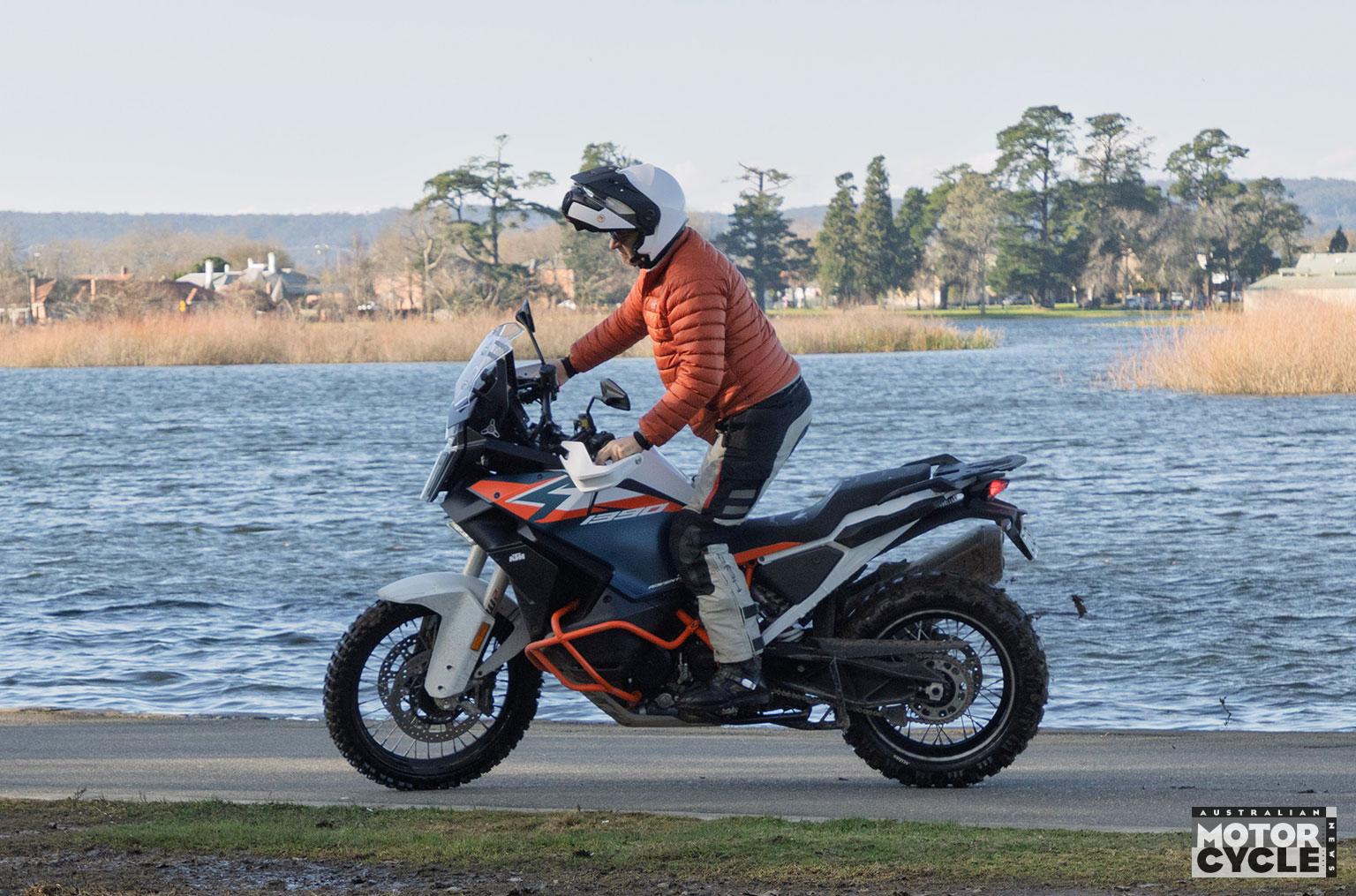
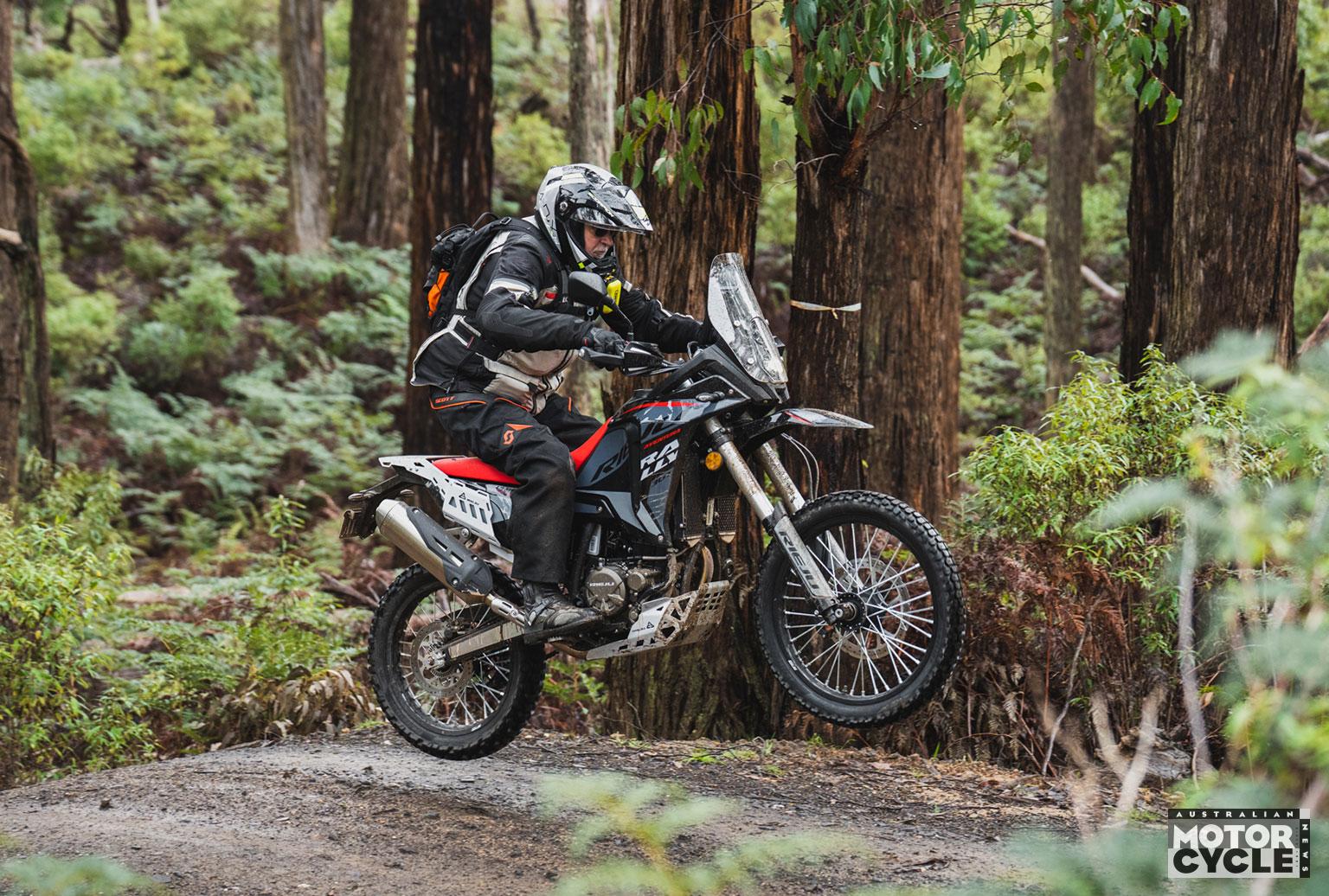
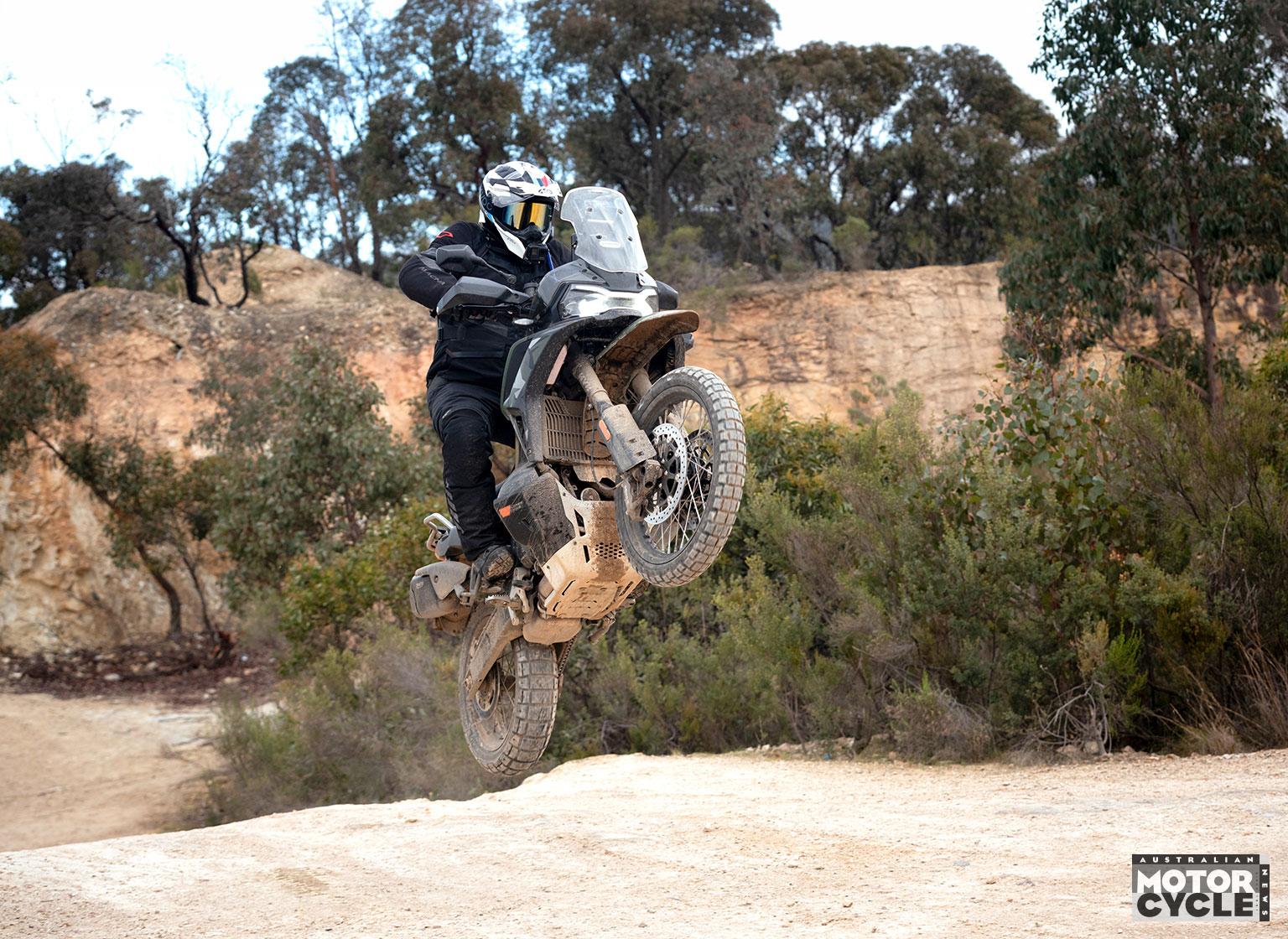
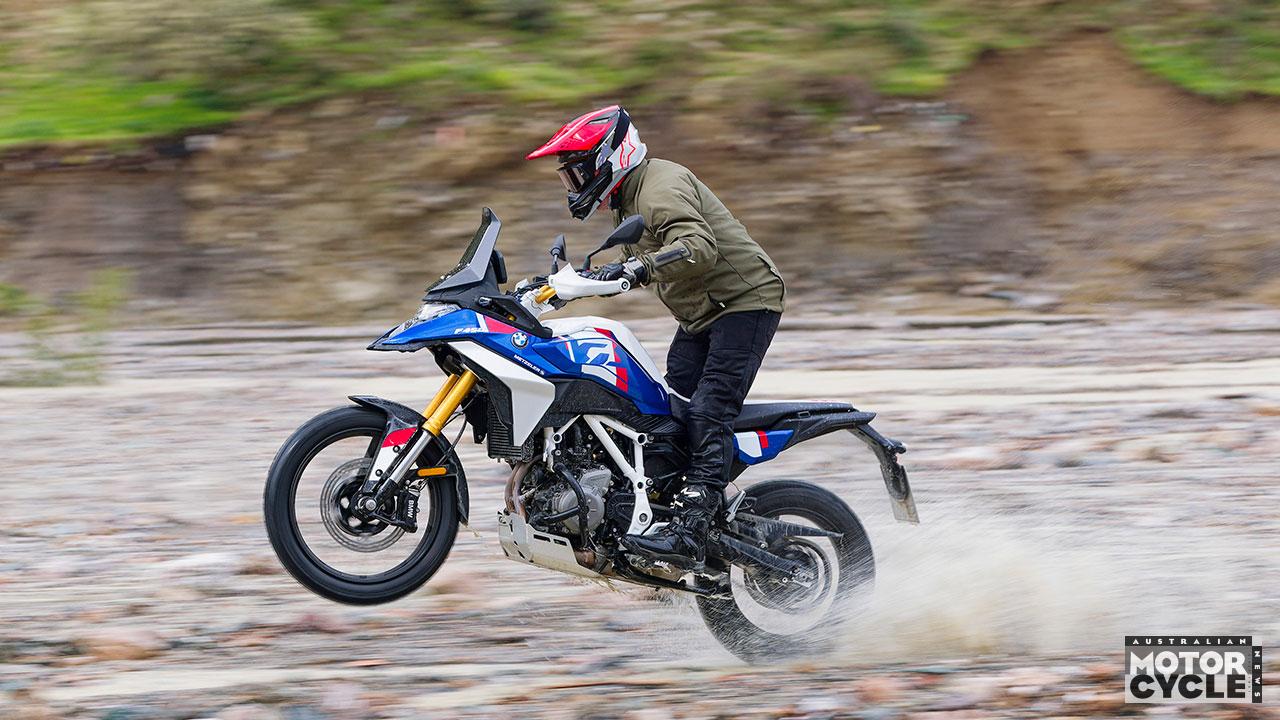
Seriously, if you want to get dirty in 2026, you’re not going to buy a bike with a 19-inch front wheel, are you? You’re going to go with a 21-inch front – a Honda Africa Twin, a Triumph Tiger 900, and a whole bunch of others from Suzuki, KTM, BMW and, of course, CFMoto.
19 vs 21
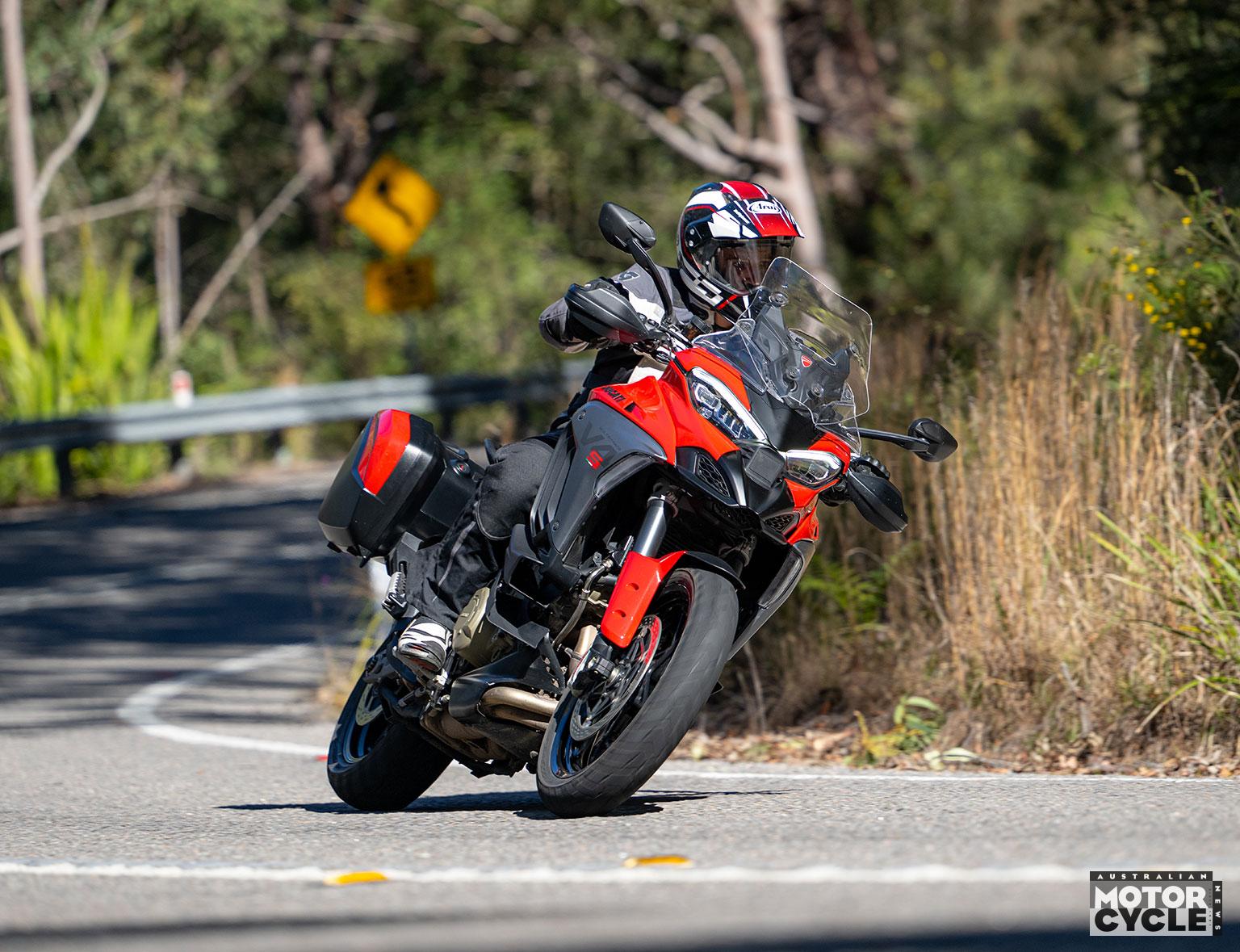
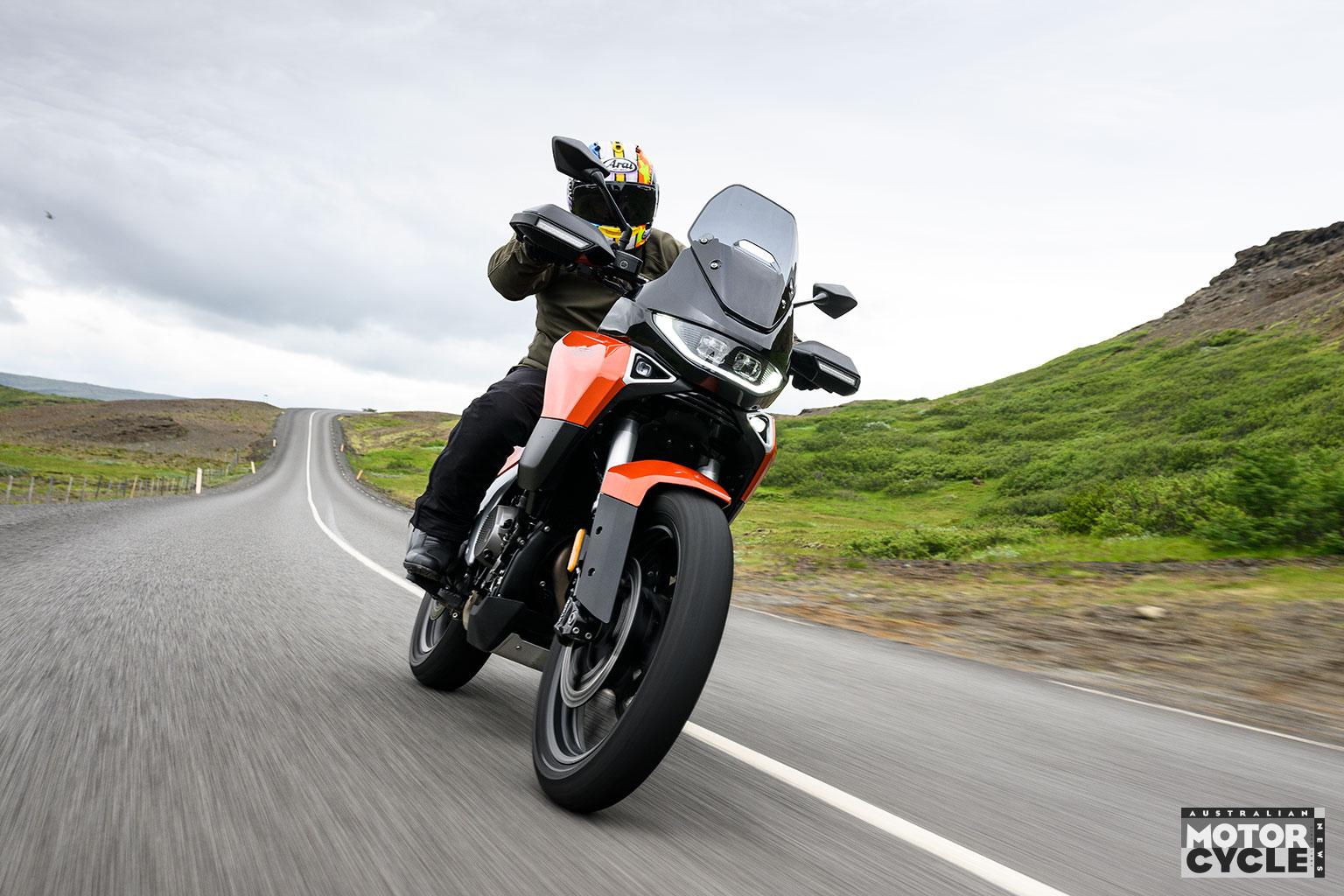
Most of the adventure bikes equipped with 19-inch front wheels are adventure tourers – Harley-Davidson describes the Pan America in exactly that way, while bikes like the Suzuki V-Strom 650, Ducati Multistrada and Yamaha Super Tenere are 50/50 bikes at best (all of them with 19-inch front wheels). They’re great tourers, equally comfortable on bitumen or gravel.
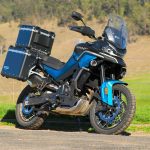
The 800MT-ES looks like it will go harder in the dirt, with its alloy panniers, crash bars, tall stance and modern styling. And it will. But its MTX stablemates will be better.
If that pushes the MT-ES sideways into the touring category, that’s fine, because it has all-day comfort, enough power and torque for Australian highways, and is extremely well equipped – especially when you look at the value on offer, with the price of accessories very low too.
Every road is an adventure
Australia’s highways might be improving – the Pacific Highway from Sydney to Brisbane is probably only months from being four lanes all the way – but it’s come at a price to the backroads. I rode the Thunderbolts Way up to Bendemeer for day one of this test, then the Mount Lindesay Highway to the edge of Brisbane, and despite this road only recently becoming fully sealed, much of it is still as bumpy as a hormonal teenager’s chin. From rim-bending potholes to motocross-worthy stutters, there are arse-puckering moments every which way if you’re not paying close attention.
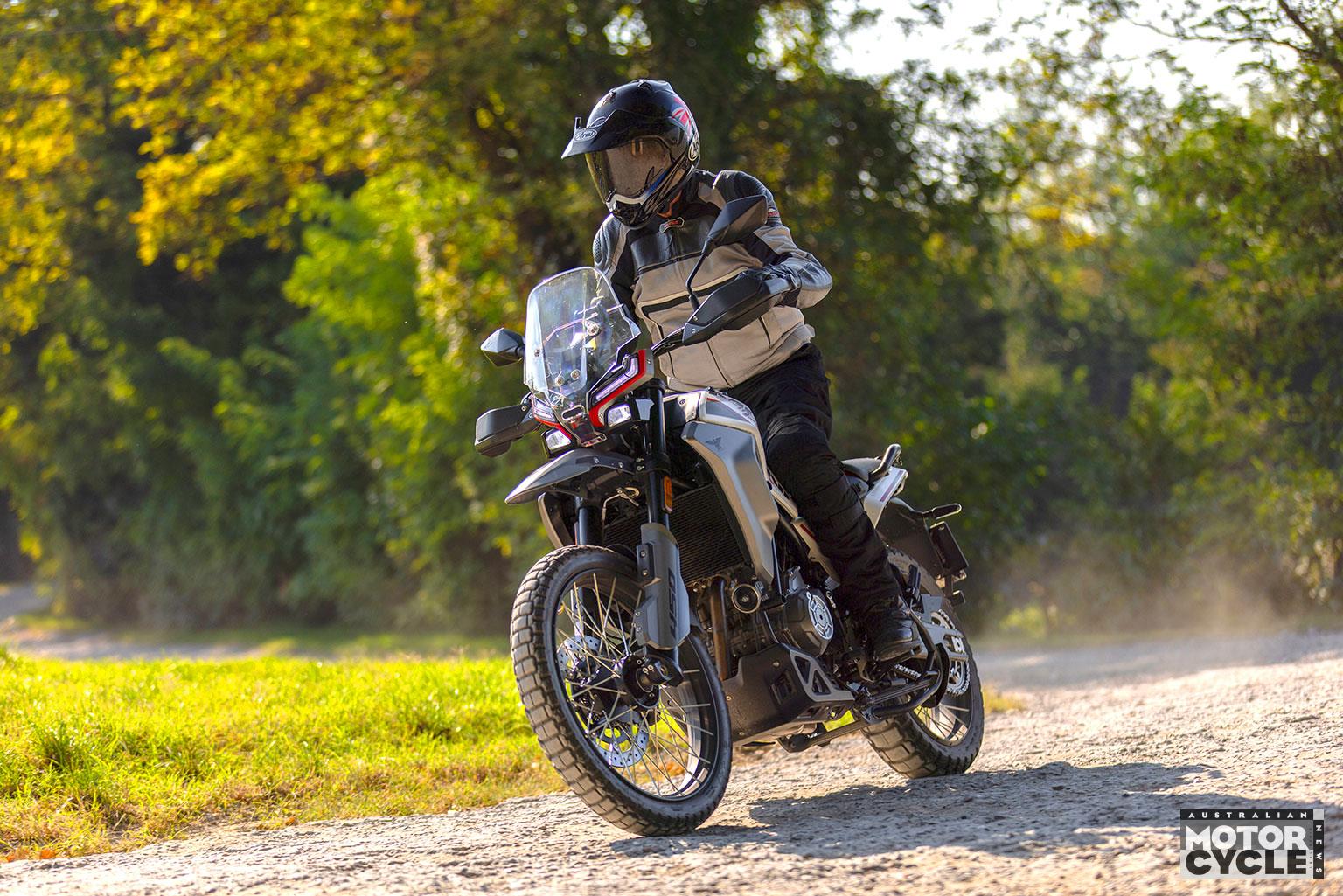
Which means a bike like the 800MT-ES makes a lot of sense, even if you never want to ride a gravel road – although you’ll be missing out if you don’t. When I learnt to ride, we rode plenty of dirt roads on our road bikes, because that was often how you got from one great piece of bitumen to the next. Nowadays I love travelling on an adventure tourer, because the dirt roads are often more fun than the bitumen.
Peaceful, winding and carrying far less traffic than most sealed routes, the dirt roads of the Great Dividing Range can be a lot of fun on a bike like the 800MT-ES.
Getting active
I’ve liked semi-active suspension since the first time I rode a bike so equipped – not so much because it’s inherently ‘better’ than conventional suspension, but because it’s so much quicker to set up and adjust, whether you’re changing your load or letting the bike’s electronics work out the best ride for the changing conditions.
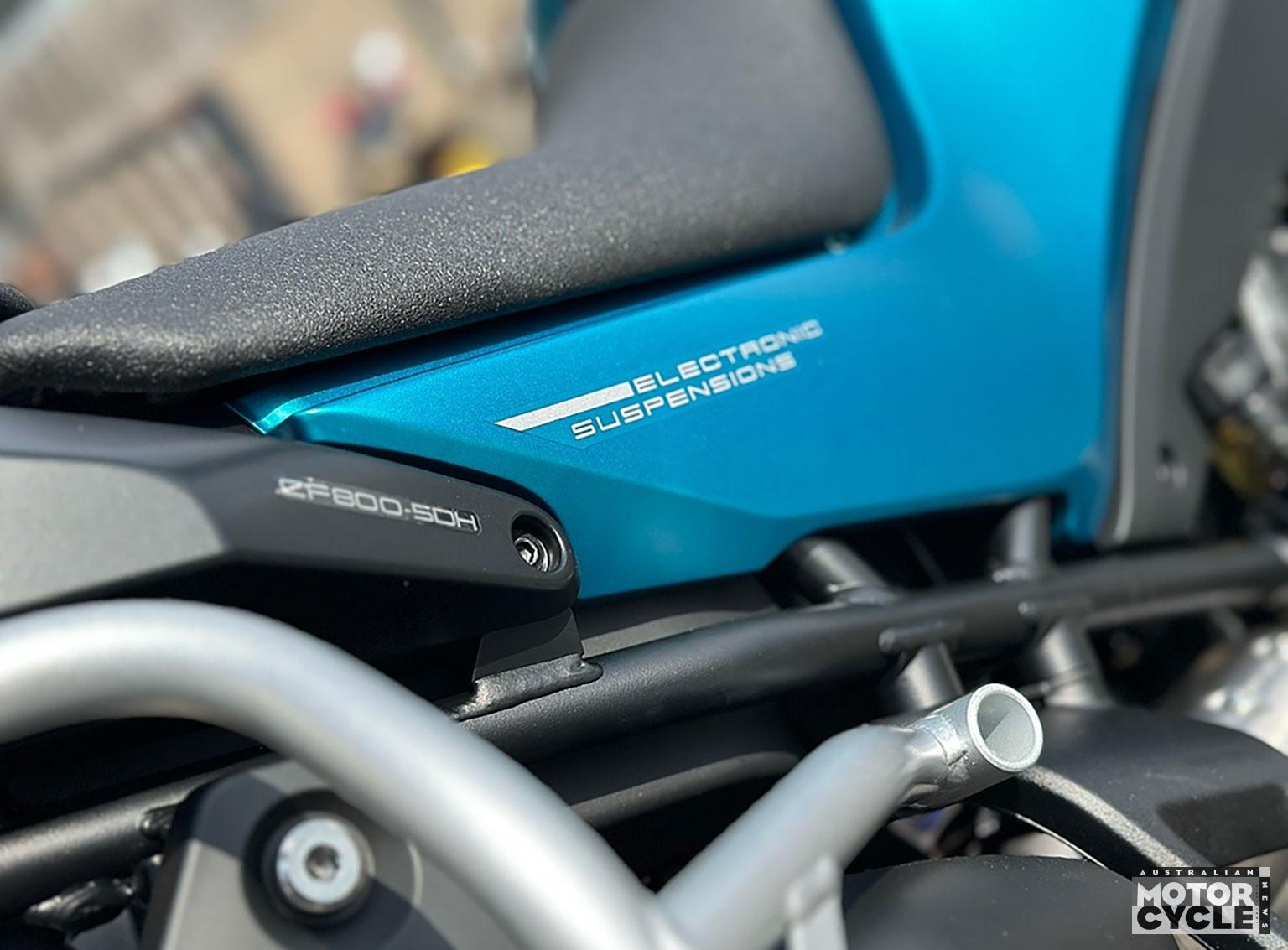
The semi-active suspension is part of a range of electronics on the 800MT-ES, built around a Bosch six-axis IMU (Inertial Measurement Unit) – increasingly common kit on bikes these days.
The IMU measures acceleration and angular velocity across pitch (forward acceleration and braking), roll (leaning) and yaw (effectively, when the wheels aren’t pointing in the direction the bike is travelling, i.e. sliding). This feeds the bike’s stability control system, which offers cornering ABS, cornering traction control, wheelie control, drag torque control and the intelligent suspension support – the semi-active damping that, for example, increases compression damping in the front fork under braking to reduce dive.
Do you need these high-tech features? No. Until you do. Most of them simply do their job in the background while you’re riding – I doubt I braked hard enough to trip the ABS into action, accelerated hard enough for an accidental wheelie, or powered out of a turn hard enough to slide the back tyre while leaned over. I’ve been trained not to ride like that on public roads. However, I did find myself going a bit faster over a short bridge than was prudent, and while trying to slow for the sharp turn where the bridge became road, a concrete edge sent the bike skyward – it’s hard to slow down when there’s little weight on the tyres.
I then needed to brake at emergency levels, just for a second or two, to scrub off enough speed to make the turn and not run up the embankment – and did it easily. Did the ABS kick in? Dunno, maybe, but I didn’t feel any pulsing at the levers. Did the semi-active suspension provide better stability under heavy braking? Probably. Would I have made the corner on an earlier 800MT that doesn’t have these features? Who can say?
What I do know is that modern bikes with fancy IMUs, assist-and-slipper clutches, quickshifters and flat torque curves are easier and safer to ride than bikes from previous generations – something I call progress.
Still, for the moment at least, you can buy other models of CFMoto’s 800MT that don’t come with the same level of technological fruit, and are often thousands of dollars cheaper.
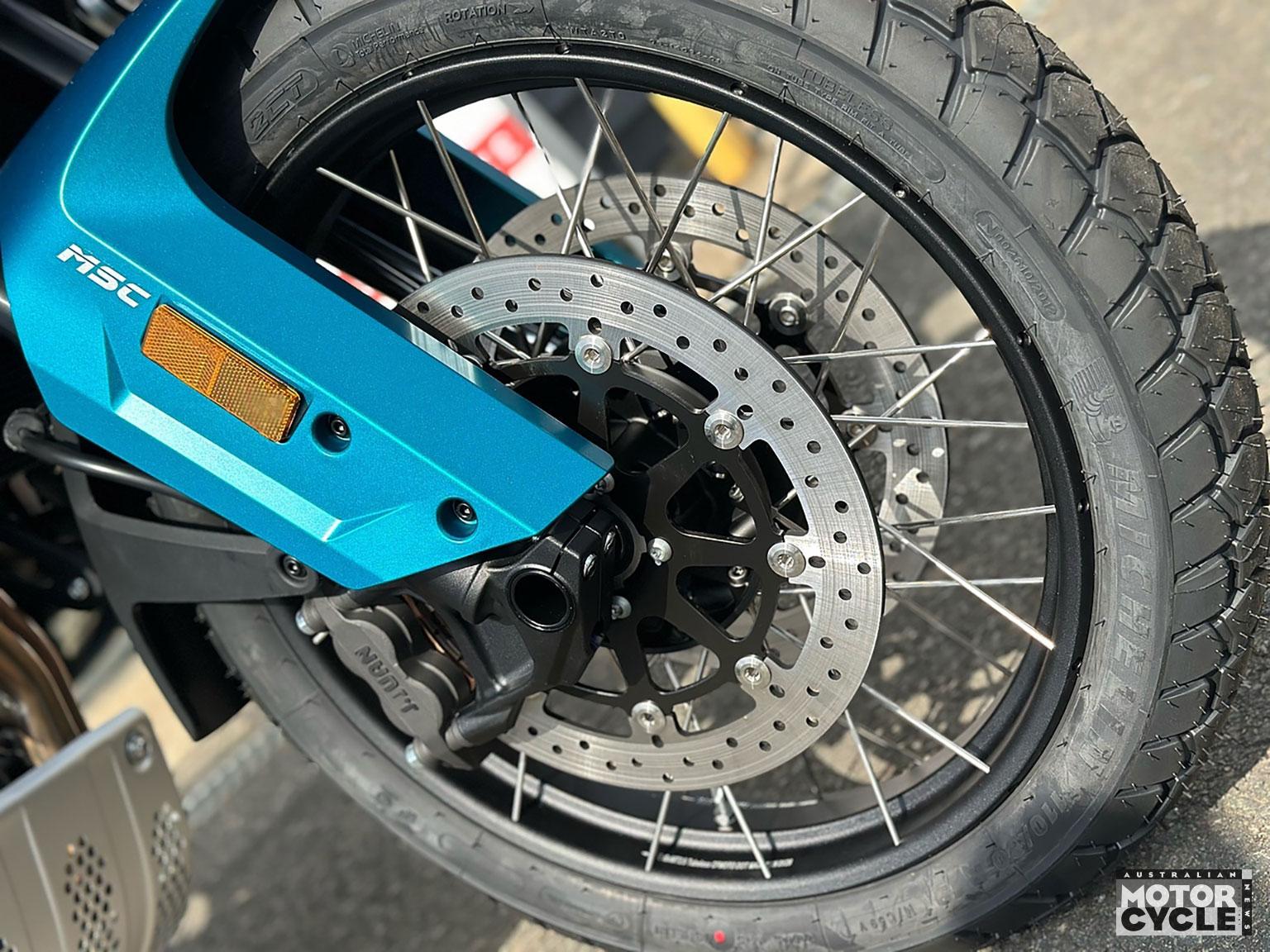
The motive force
Hmm, a mid-range adventure tourer powered by a twin-cylinder, fuel-injected, water-cooled four-stroke with a 270-degree crank – how unusual. Not.
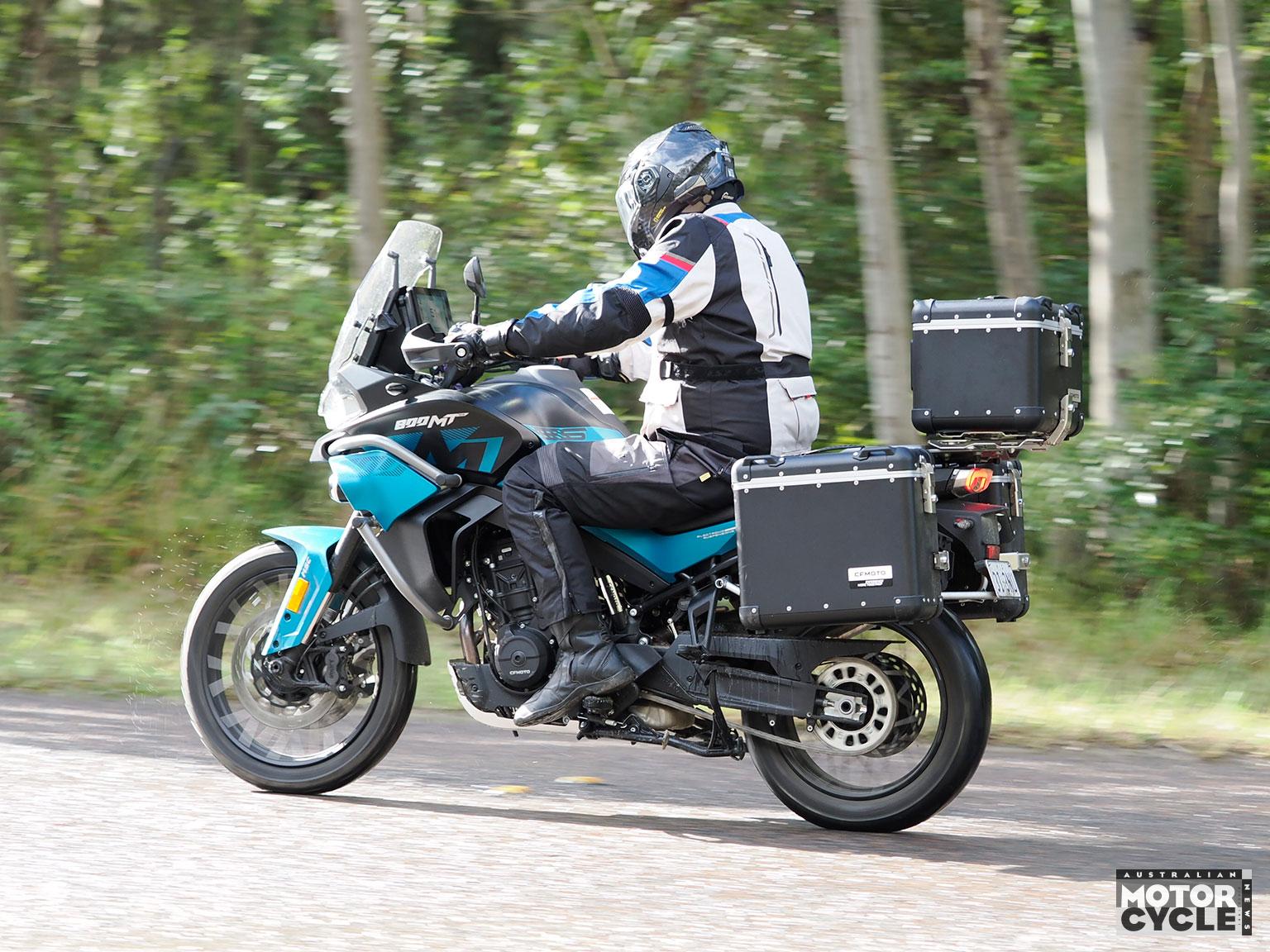
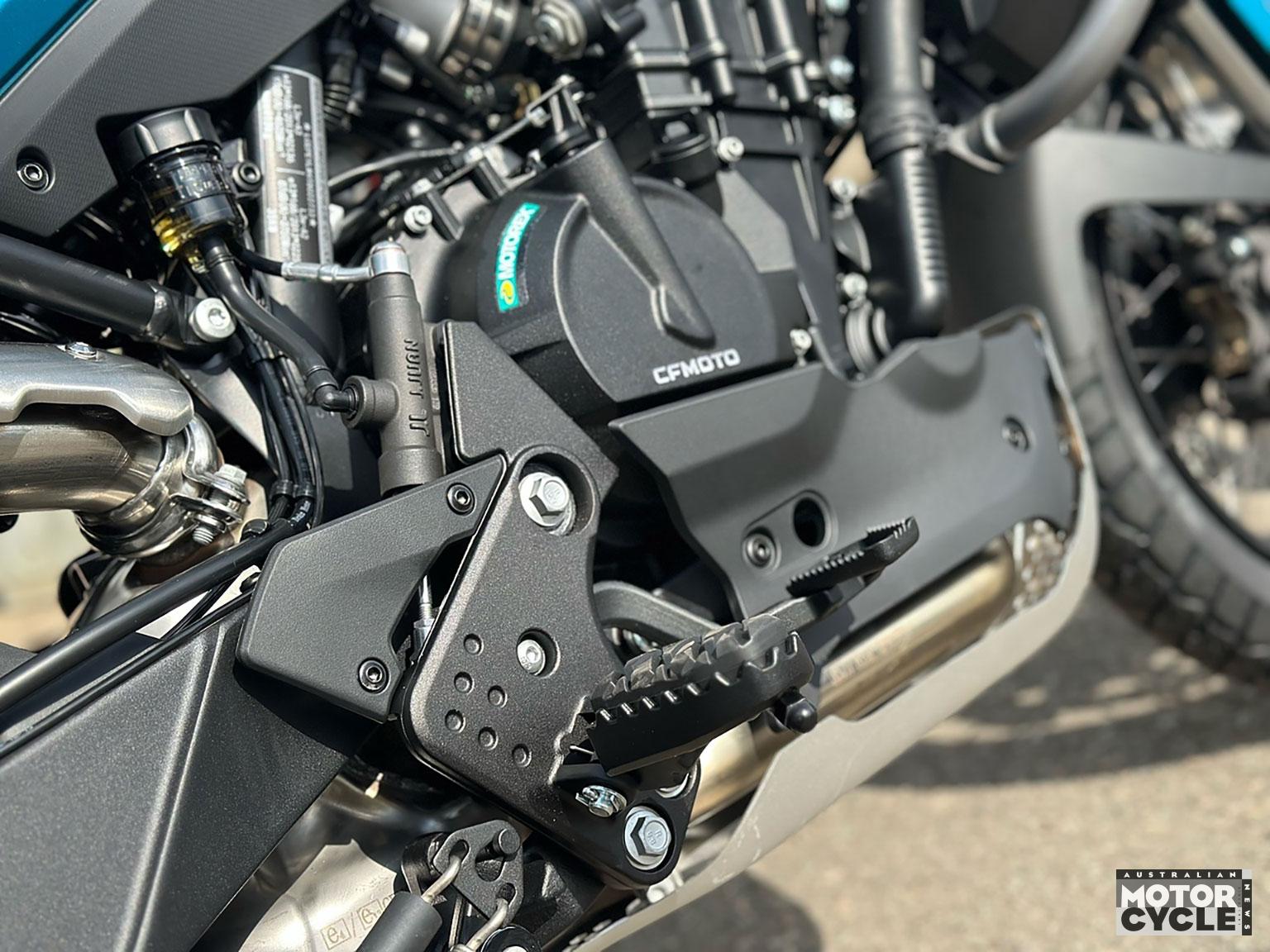
What can I say about the 70kW (90hp) engine that you haven’t read before? Not much. It makes useable bottom end, has a strong midrange, and there’s top-end power there that most people won’t bother using. The manual claims a top speed of 195km/h, but I never went anywhere near that – the panniers carry stickers recommending you don’t exceed 120km/h with them fitted. I did, and the steering got vague, so be aware. High speed isn’t what this bike is about.
The engine is smooth enough – there are a few tingles but nothing too annoying – and uses fuel at a rate of around 5.2L/100km. It’s happiest between 80 and 130km/h.
The test bike suffered from poor fuelling at low speeds and small throttle openings – think 40-60km/h in third gear through town – which was annoying, and something CFMoto planned to check out when I returned the bike, because it shouldn’t be like that (earlier models were worse but the fuelling has improved). A mate with an 800MTX said his is fine in this regard. At touring speeds, or if you’re up it for the rent, fuelling was fine.
A long feature list
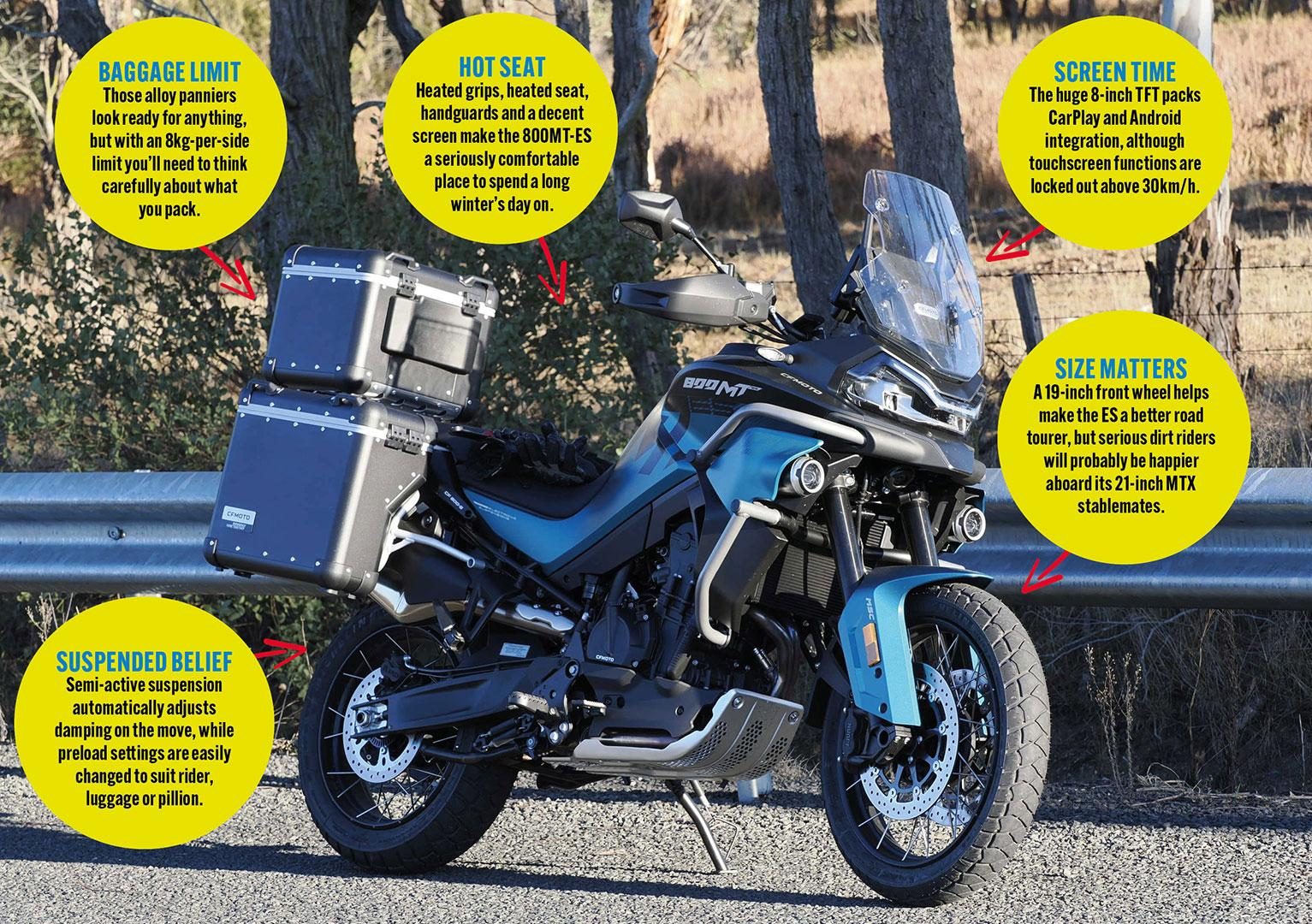
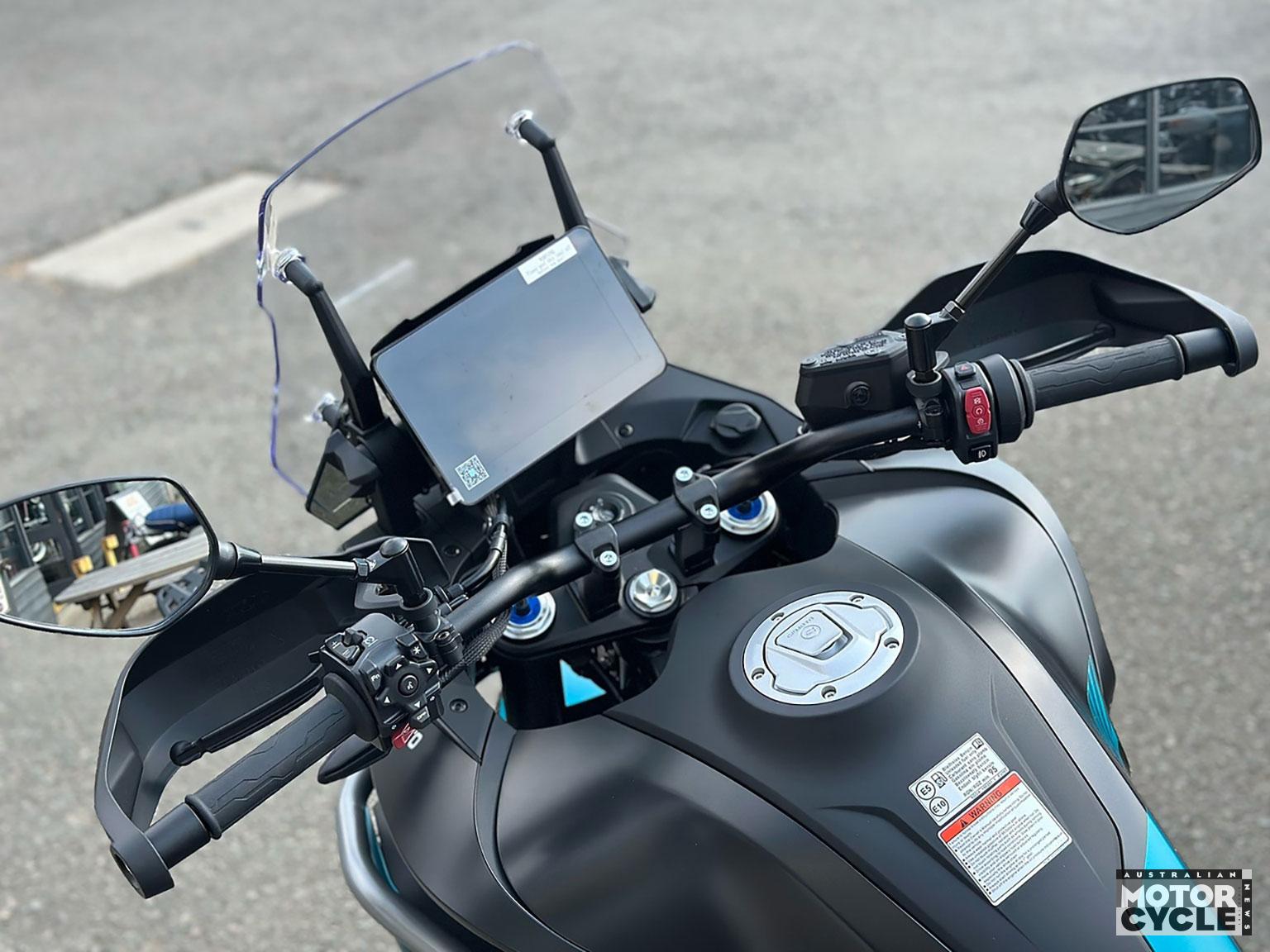
For my 2000km-plus tour, which happened to fall slap-bang in the middle of winter, I knew I’d want my Venture Heat electric jacket liner – heated riding gear turns winter into spring. Having heated grips, handguards and a heated seat as well meant my derriere and hands were looked after by the bike, while a decent-sized, adjustable screen took the wind blast off my chest.
Power for the heated jacket liner was easy to organise, since the battery sits under the seat – although I could also have taken power from the accessory socket on the right fairing panel. My phone went on a Quad Lock mounted to the handlebar, powered by one of two USB ports on the left fairing panel, while the other powered my GoPro, mounted on the standard-equipment crash bars.
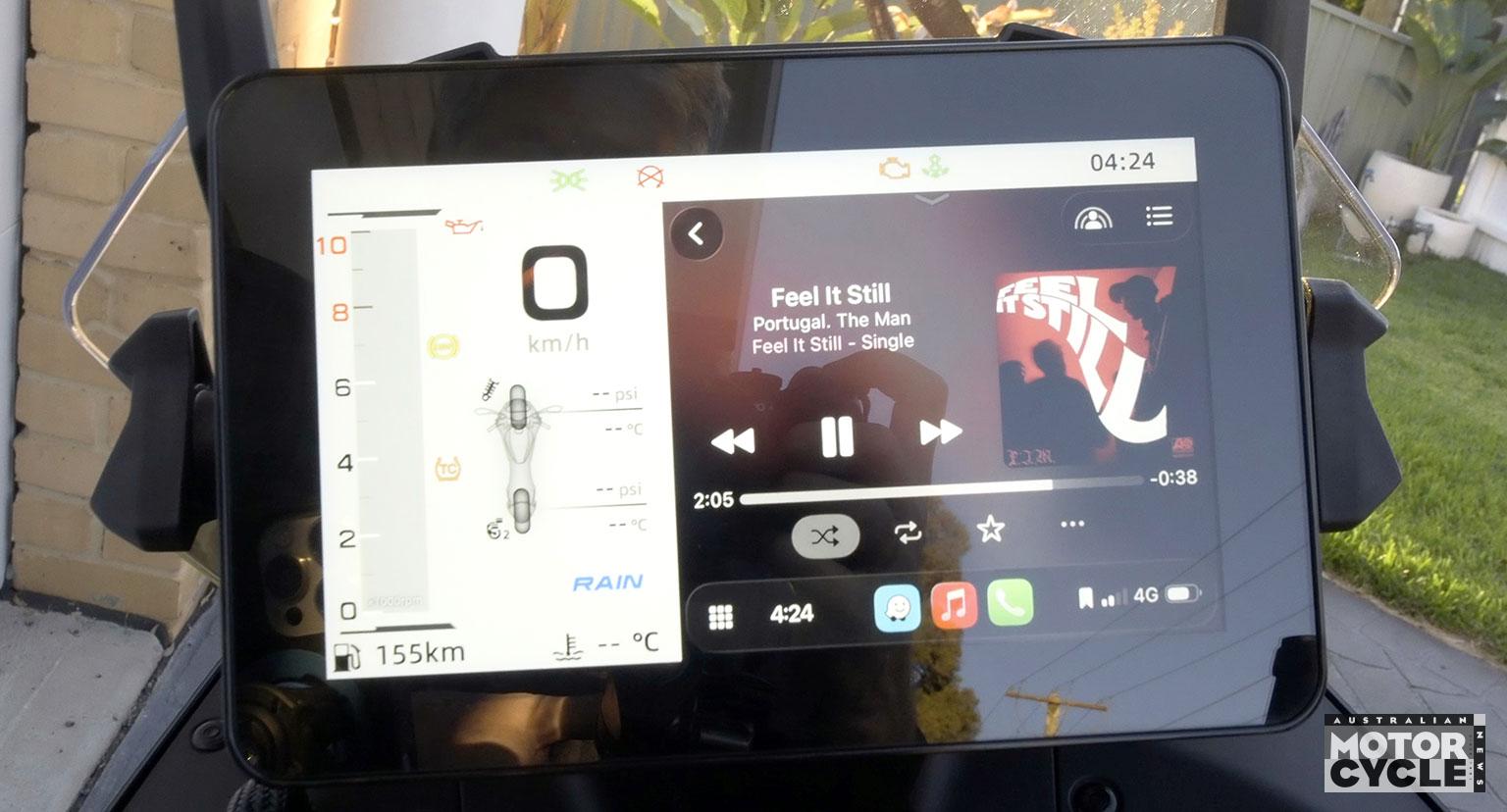
The instruments are a huge 8-inch TFT display with CarPlay and Android integration (not full Android Auto, though). As an iPhone user, I found it easy to link my phone and Interphone headset to the bike for excellent sound – both microphone and speakers – inside my helmet.
The CarPlay integration was good, although the connection dropped out a few times and sometimes refused to restart automatically after stopping – which is, unfortunately, typical of my experience with bikes and wireless CarPlay. I could control some functions through the left switchblock – volume, track forward/back, some phone functions – but others were better handled on the Interphone unit. Maddeningly, CFMoto has restricted touchscreen functions to below 30km/h, so there’s plenty you can’t do while riding. Hopefully improvements come via software updates.
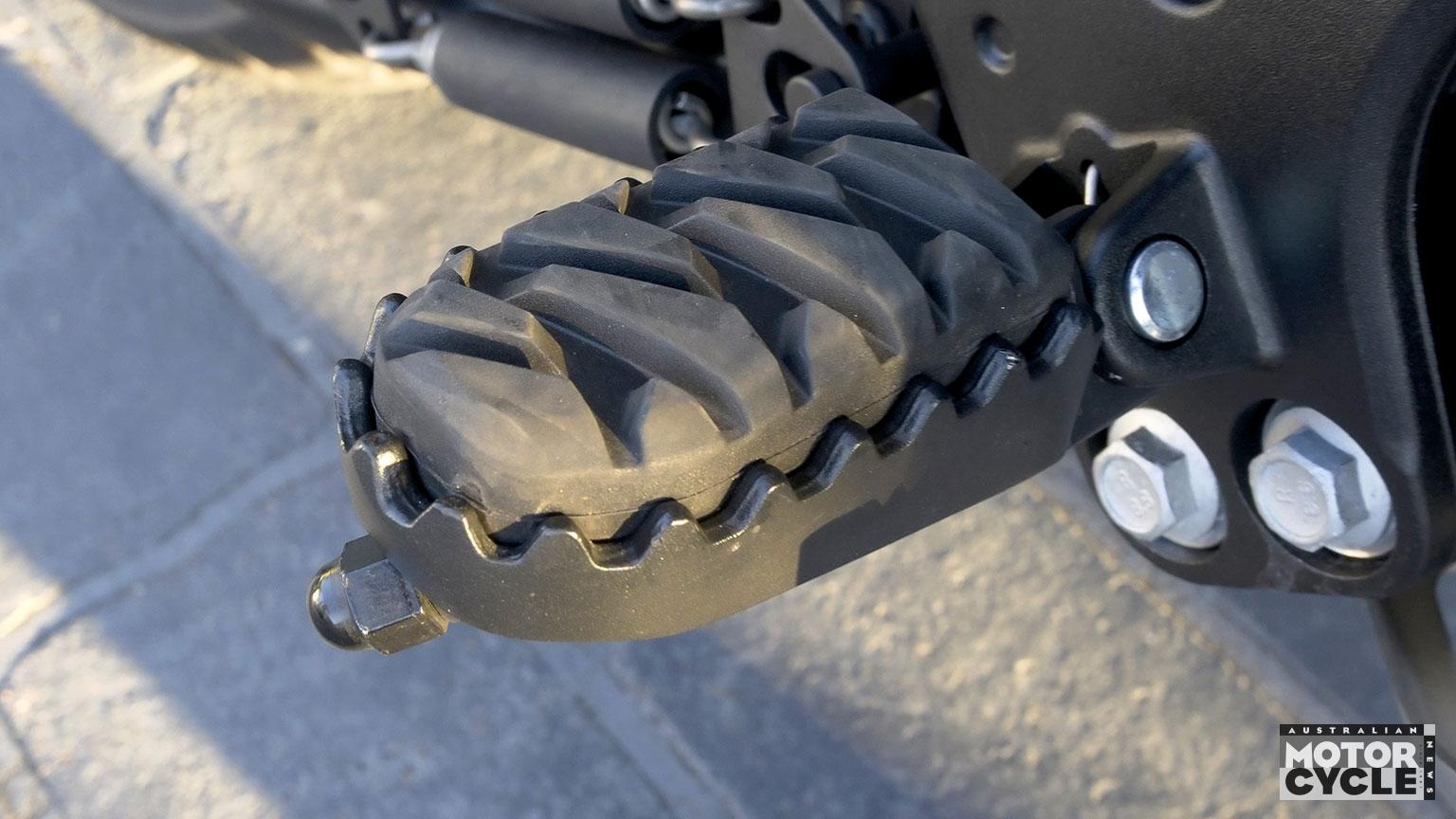
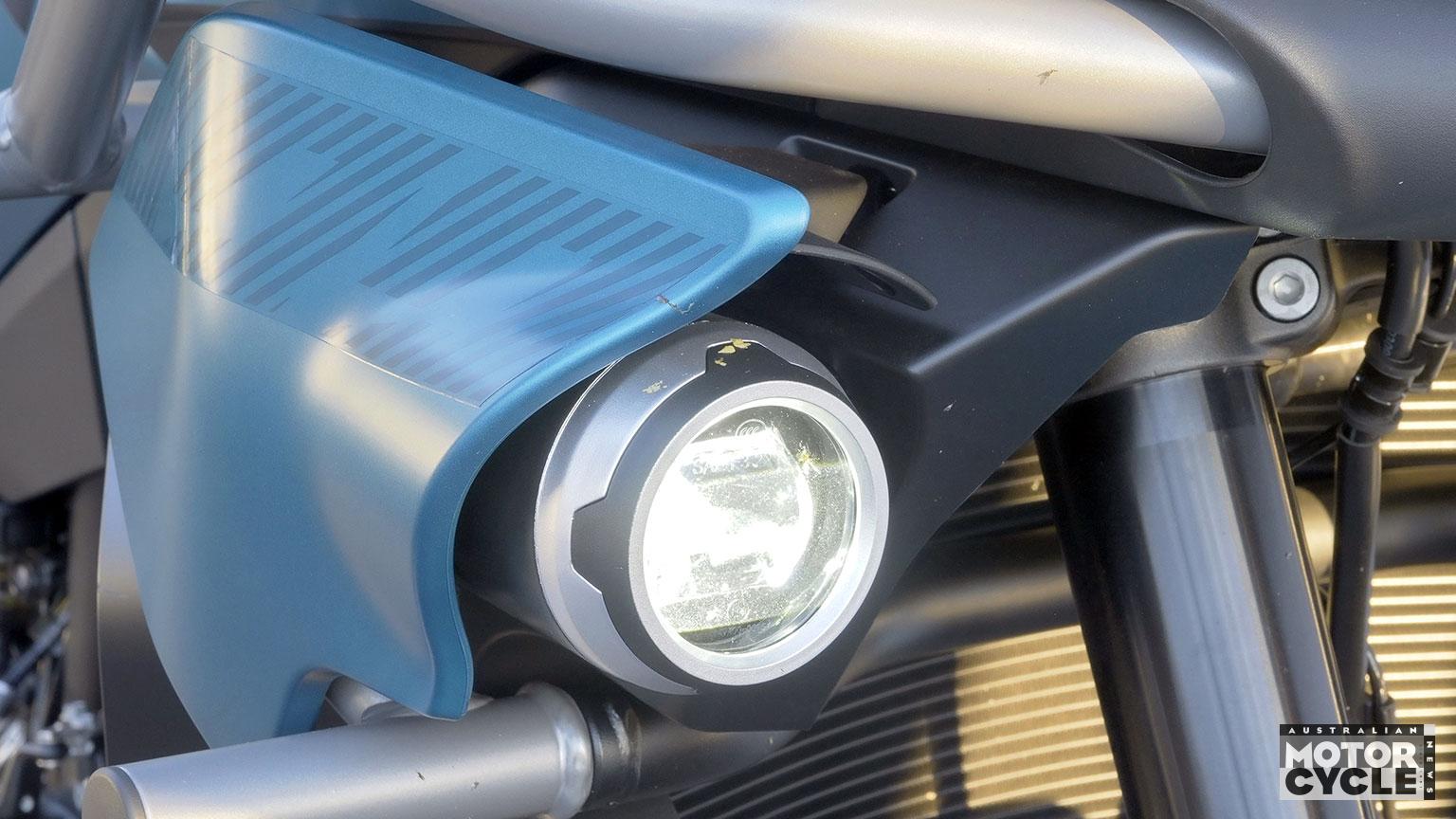
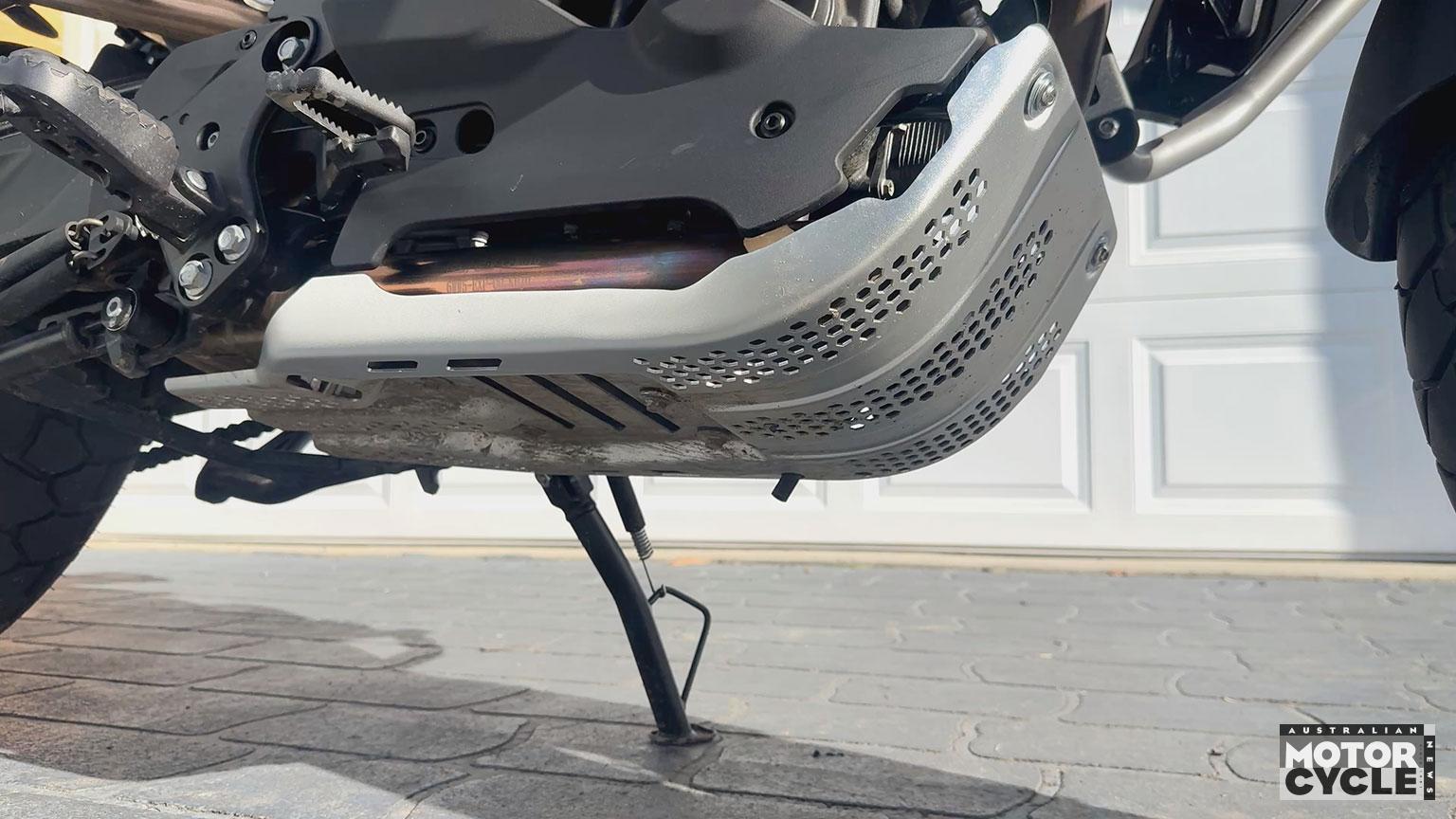
LED lighting is fitted all round, with a pair of auxiliary lights standard too. There’s a lightweight alloy bashplate as standard, along with some plastic guards to protect the bottom of the engine. Serrated footpegs with rubber inserts and a centrestand are also standard.
Overloaded
I’ve almost stopped checking the load capacity of panniers these days, because if they come standard with the bike they seem to invariably be rated at 10kg per side. The 800’s panniers are 28 and 35 litres (the right smaller due to the high pipe), while the top box holds 36 litres. Top boxes are usually restricted to 5kg, and the 800 was no different there.
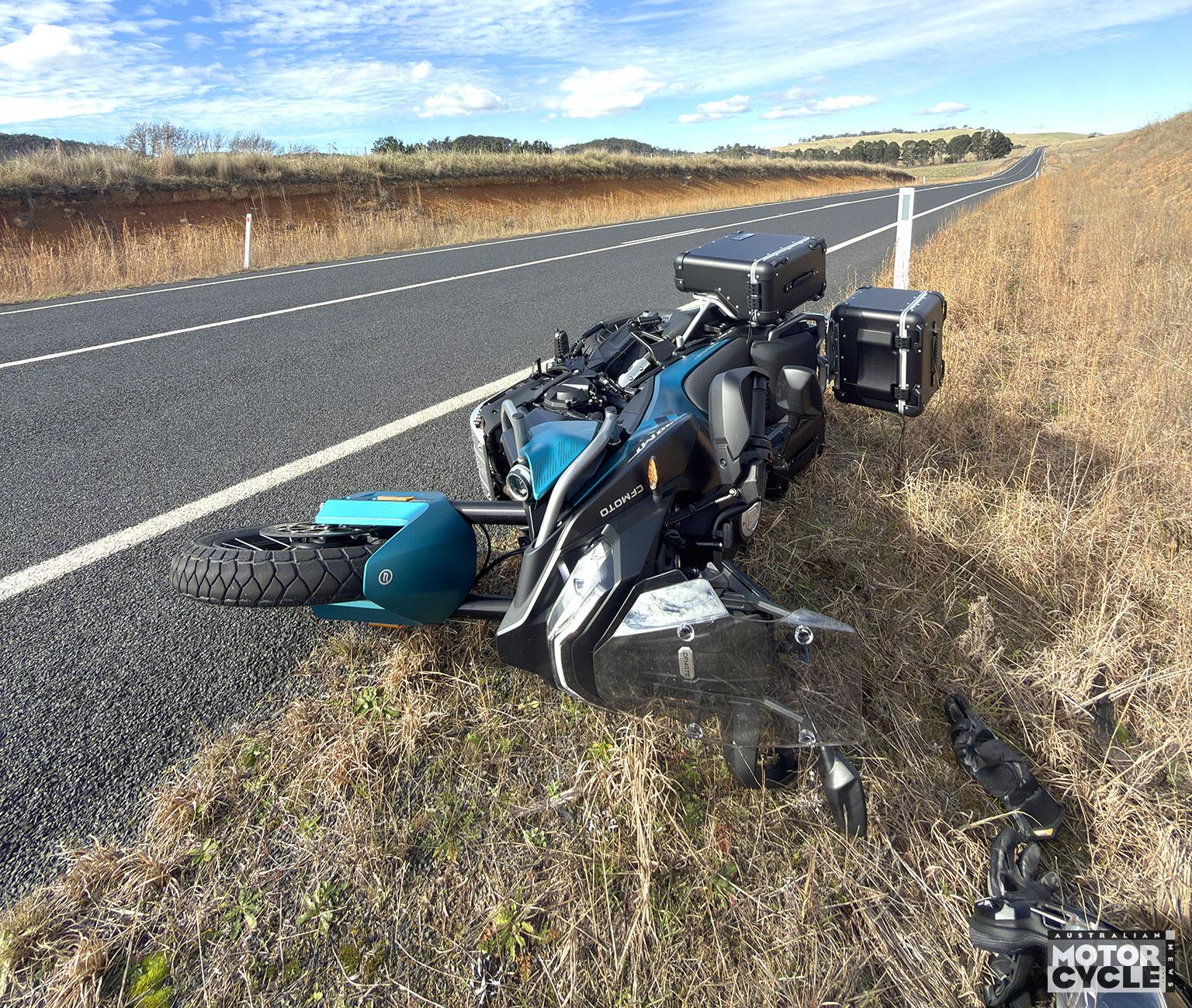
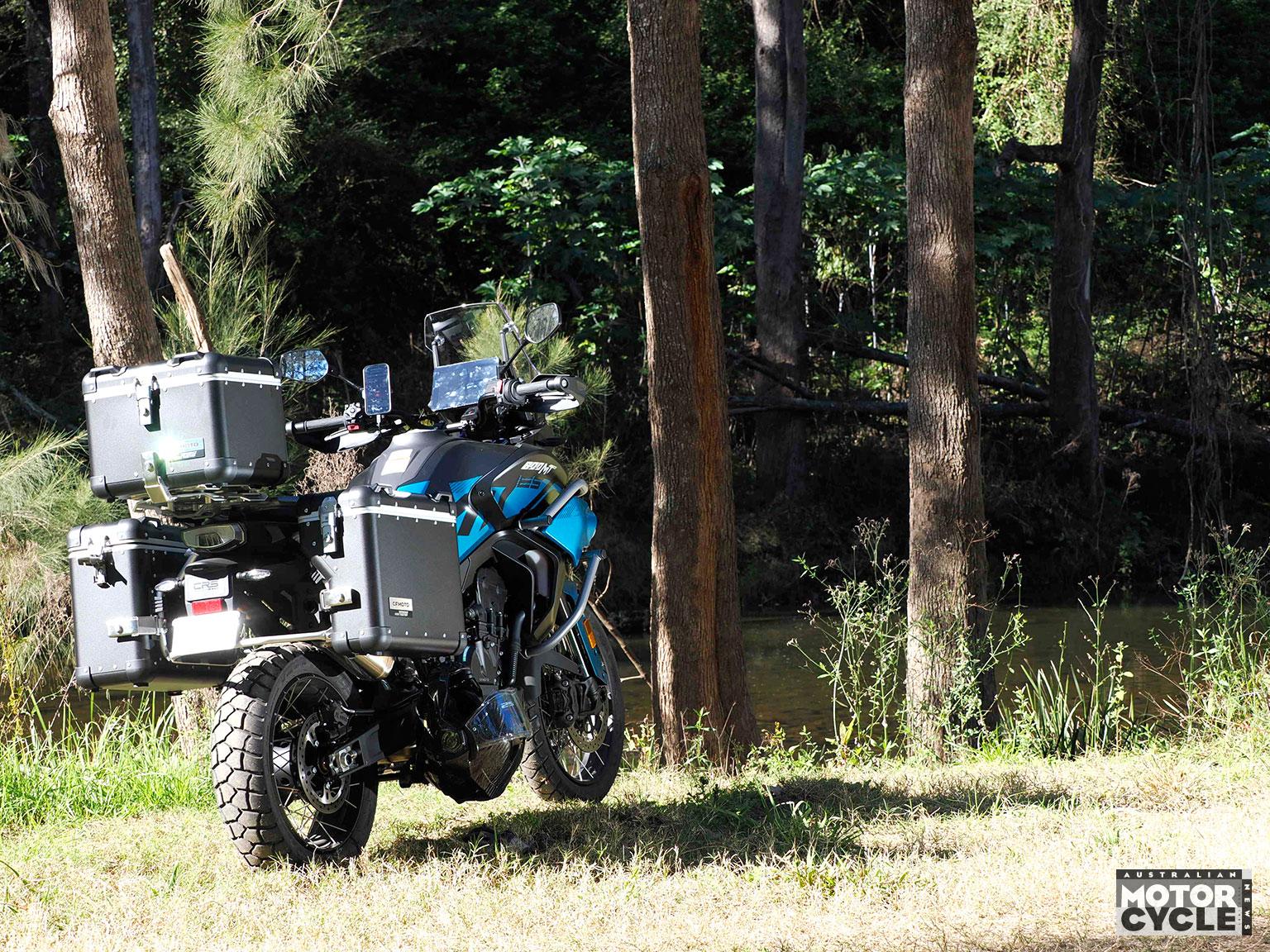
However, the 800MT panniers are actually rated to only 8kg per side. I didn’t weigh my camera gear, laptop, toolkit, clothing and so on – I just packed it – only to later discover I’d overloaded the luggage by about 4kg, which was probably a major factor in the bike falling over! And I hadn’t strapped anything extra onto the boxes, despite them having built-in hooks for this.
My GoPro had stopped recording, so I decided to stop along the Thunderbolts Way to pull its battery for a reset, which usually does the trick. I pulled over and put the sidestand down, but as I put the weight of the bike on the stand it didn’t stop rolling to the left, tipping the bike over and sending me sprawling into the grassy ditch by the side of the road.
After getting over the shock of letting a test bike have a lie-down, I realised the camber and mild incline of the road, the fully loaded panniers, and my own weight meant there was too much load at the back of the bike, and the ditch didn’t let me get my left foot out wide enough to stop the tip-over.
Luckily there was no damage to bike or rider (beyond a bruised ego), but it got me thinking about load limits, luggage position and what you actually need to pack on tour.
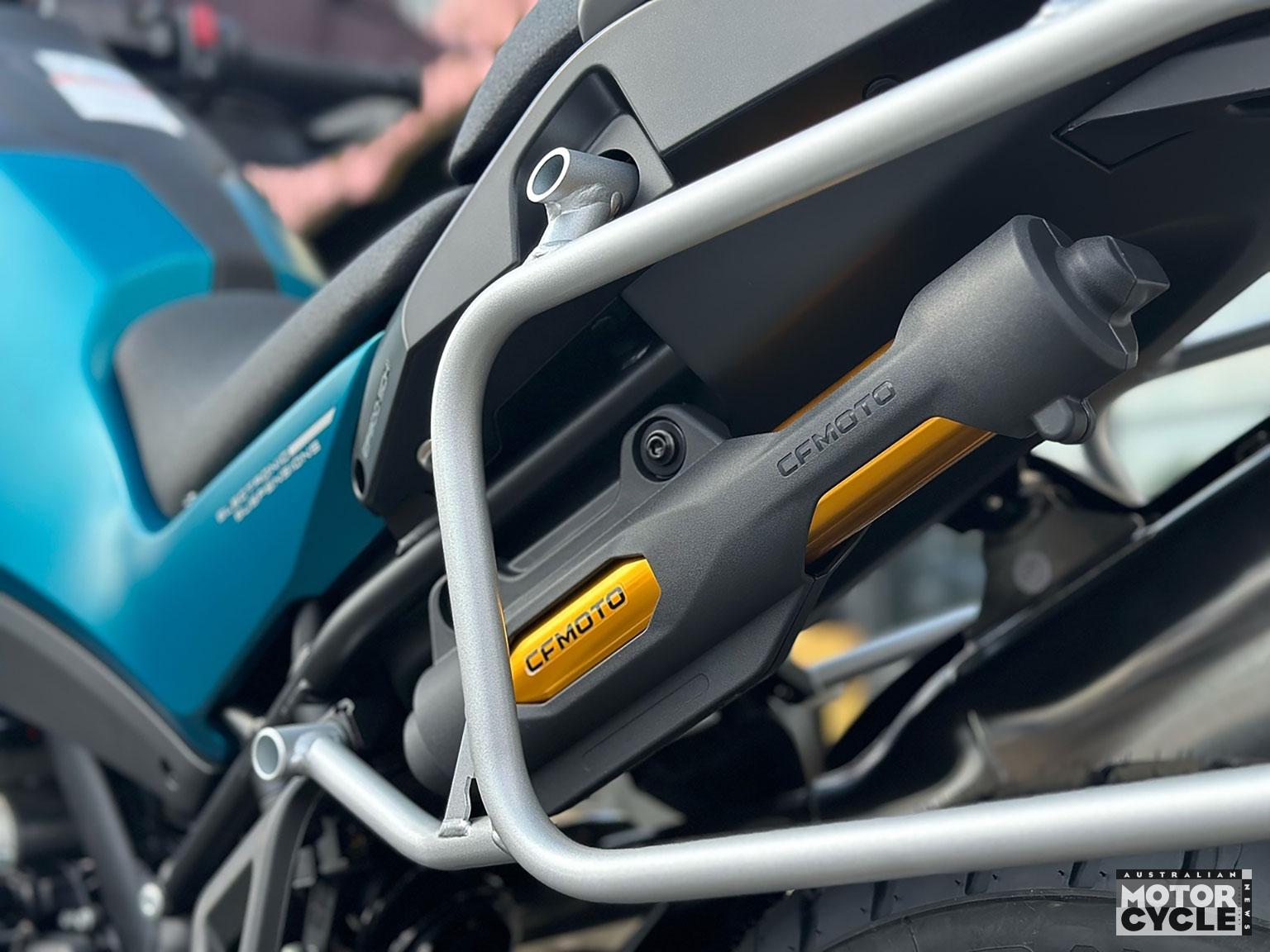
The first thing I realised is that the sidestand is too short unless you’re parking on a nice, flat surface. The second is how the panniers carry most of their weight, and the top case carries all of its weight, behind the rear axle, and the panniers are wide compared to the rest of the bike. Ever wondered why very few motorcycles come with a standard top case, other than mega-tourers like Gold Wings and Grand American tourers? Weight bias is one reason.
It’s interesting that the back seat of a bike can easily take an 80kg passenger, yet a top case – with its mounting system and a full 5kg load – weighs less than 15kg, despite the two being only a body-width apart. A passenger usually sits directly above the rear axle, while a top case sits out on a diving-board-like platform, doing its best to bend and twist like the pendulum it is. The G-forces acting on it are magnified far more than those acting on luggage carried lower down and farther forward – like panniers, or gear strapped to the passenger seat.
I noticed in the owner’s manual that the maximum permitted weight is 413kg – deduct 231kg for the rolling wet weight and that leaves 182kg for rider, passenger and luggage, so it might be prudent to pack lightly if you’re two-up on tour.
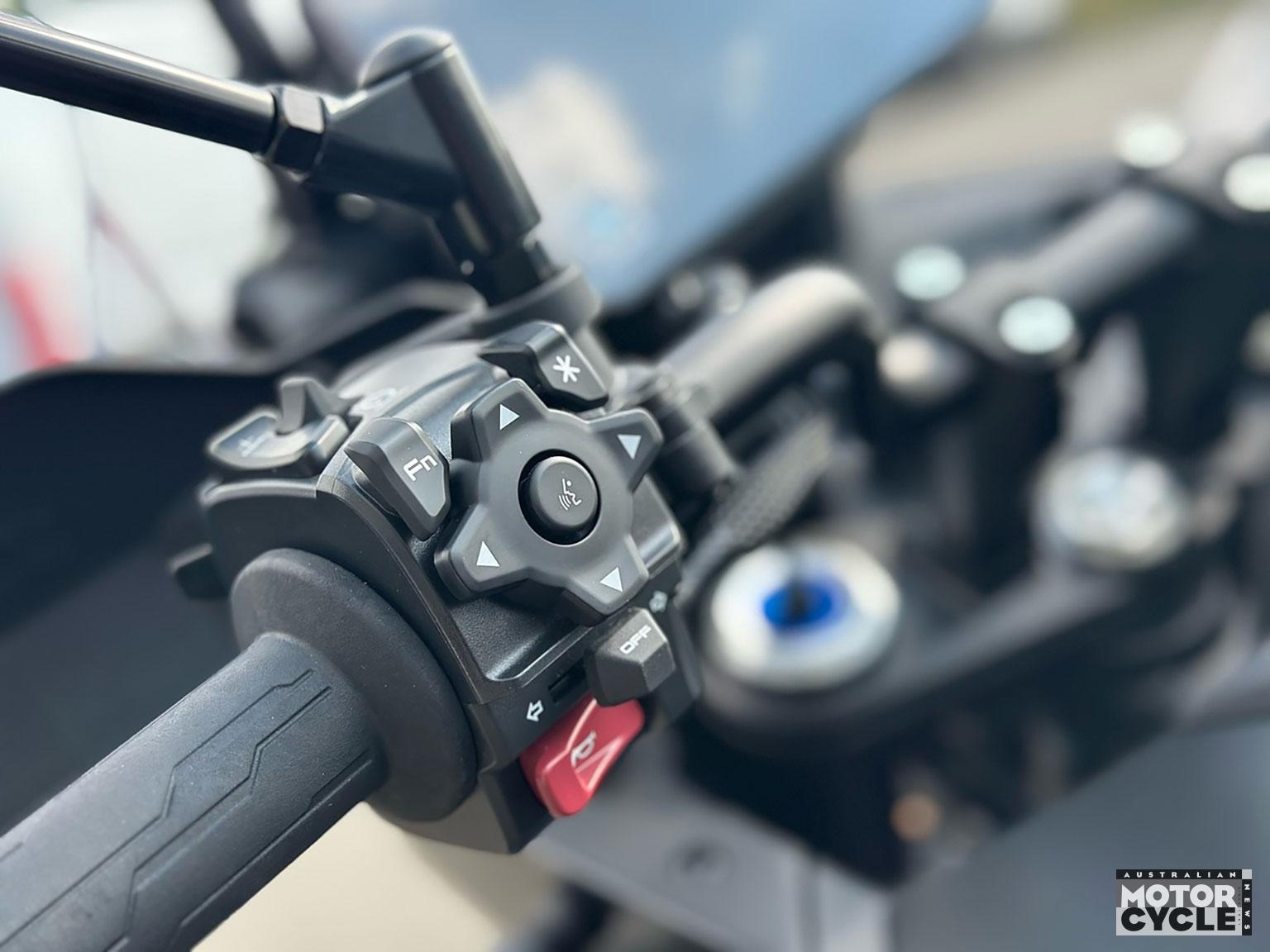
In the case of the 800MT-ES, though, technology came to the rescue, at least while riding. The preload suspension settings can be changed easily via the left switchblock and are displayed on the instrument screen. The rider chooses between Solo, Solo+Load, 2Up or 2Up+Load. I started out on Solo+Load but soon switched to 2Up – being at least 20kg heavier than the ‘average’ rider, wearing heavy winter gear, and having overloaded the luggage all added up to a firmer setting working better for me.
It’s genuinely great being able to set up suspension so easily. The damping settings are Comfort, Standard and Sport, and each offers a different feel.
Modes & more
The 800MT-ES has Sport, Rain, Off Road, Off Road+, All Terrain and All Terrain+ modes. Sport is the standard road mode; if you can’t work out what Rain mode is for, please go back to just looking at the pretty pictures. The difference between Off Road and All Terrain is a little more subtle. Off Road mode softens throttle response and dials down the traction control. Off Road+ turns off rear-wheel ABS and Drag Torque Control. All Terrain goes a step farther, disabling traction control as well. All Terrain+ does all that and disables ABS completely – front and rear. These modes carry over from the earlier Explore model, and it’s good to have them available, but anyone wanting to make real use of All Terrain is probably better off buying an 800MTX.
I spent most of my time in Sport because 1) I spent most of my time touring on bitumen; 2) I dodged the rain and generally hate Rain mode anyway; and 3) the bike defaults back to Sport on every restart. So a couple of times, riding on dirt roads, I found myself back in Sport after stopping to take a photo or answer a call of nature, only to discover traction control kicking back in too soon. At least you can change modes via the handlebar – you just have to close the throttle first.
Comfort, ergos and on tour
The CFMoto is one of the most comfortable bikes you can buy today – at least for touring. It can be awkward to get on and off, especially with the panniers fitted, and the standard seat height is quite high, but on the road the riding position is fantastic. There’s a comfortable knee bend (and it’s easy to stand on the pegs for a stretch), the handlebar ‘falls to hand’ really well, the adjustable screen takes the blast off your chest, and seat comfort is up among the best out there.
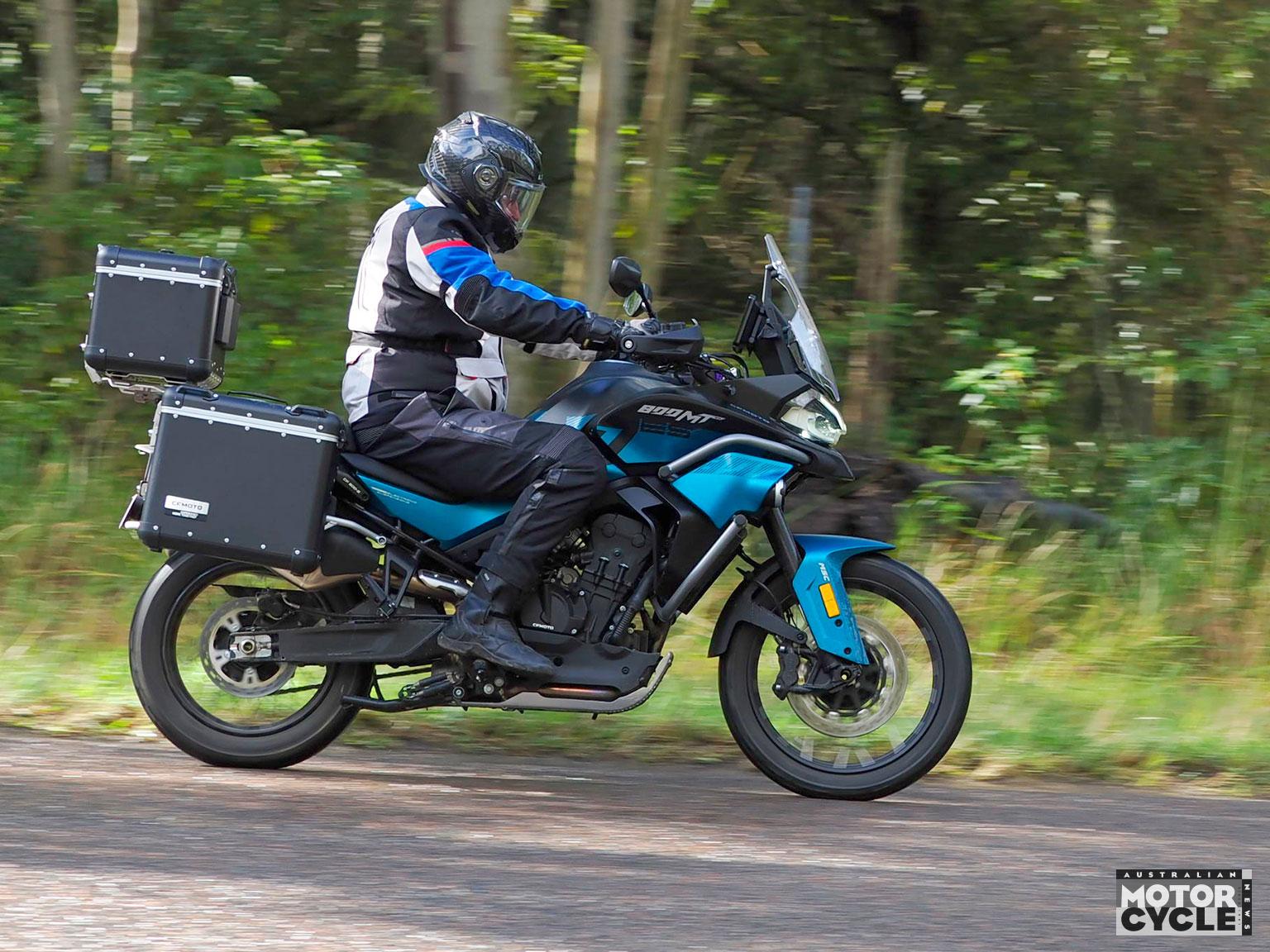
Add in the heated seat and grips, plus handguards, and it all adds up to a bike I can ride all day, day in and day out.
Sure, I got a sore backside late in the afternoon, but that’ll happen on anything.
A bargain price
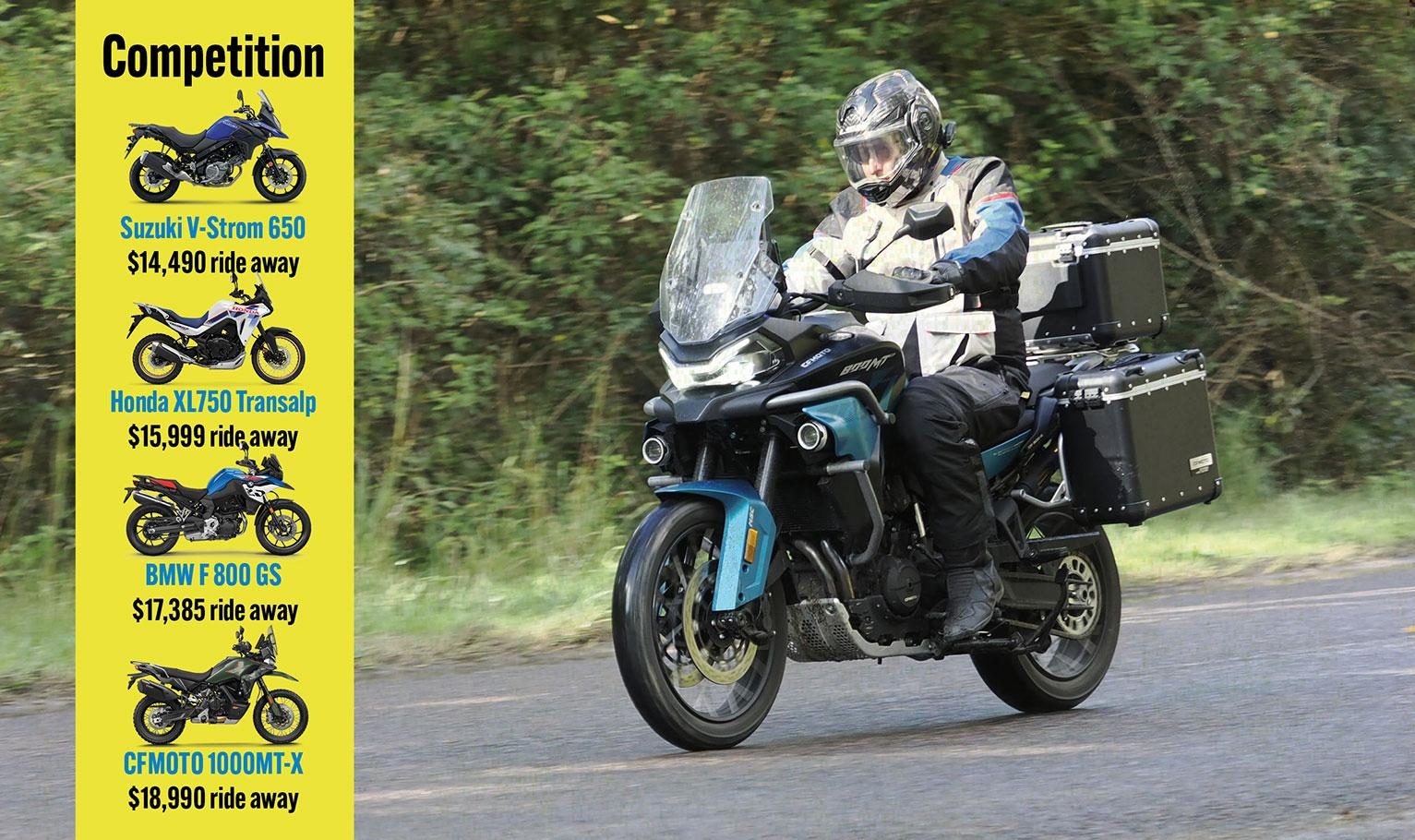
If there’s another motorcycle on the Australian market offering heated grips and seat, panniers, CarPlay and electronic semi-active suspension for $18,490 ride away, I’m not sure what it is.
But there is one awkward comparison sitting very close to home: CFMoto’s own 1000MT-X – released in the weeks right after my test of the 800MT-ES – is just $500 more. It doesn’t offer quite the same touring-focused equipment package, but with a bigger engine and more serious off-road ability, that tiny price gap makes for a very interesting showroom decision.
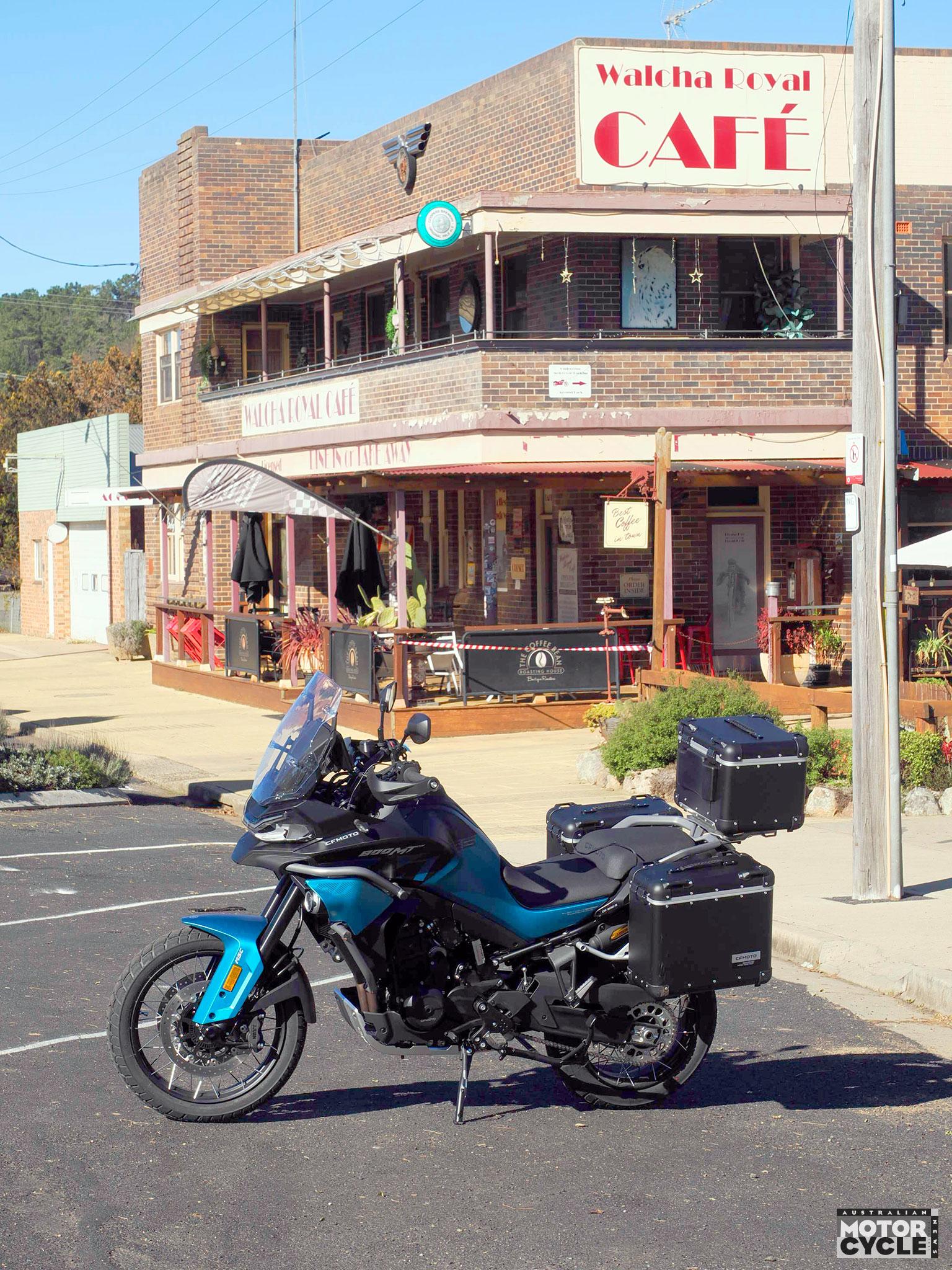
At any rate, I really enjoyed touring on the 800MT-ES. I had a fantastic ride up through the Great Dividing Range, with the bike well suited to the conditions and the speeds I was happy to travel at. I can’t think of any bike costing even $10,000 more that I’d have preferred to be aboard, given I was keen to tackle plenty of gravel roads.
The 800MT-ES ate up everything I threw at it. It’s heavier than the competition, although it’s also better equipped out of the crate.
As a solo touring bike, it’s fantastic, although its low load capacity makes it less suitable for two-up tours. Handling is great, thanks in part to the electronic suspension.
If you’re looking for an economical, well-equipped bike that can follow the map almost anywhere in comfort, you’d be mad not to have a very close look.
✅ PROS – You get a hell of a lot for your money, and it works. Comfortable.
❌ CONS – Low weight capacity, back-heavy when loaded, poor fuelling at low speeds.
SPECIFICATIONS
ENGINE
799cc liquid-cooled DOHC eight-valve parallel twin
Transmission Six-speed, slipper clutch
PERFORMANCE
Power 70kW (90hp) @ 9250rpm
Torque 77Nm @ 6500rpm
CHASSIS
Frame Tubular steel
SUSPENSION/BRAKES
Front 41mm USD electronic fork, 160mm travel
Rear Electronic monoshock, 150mm travel
Brakes 2 x 320mm front discs, radial J.Juan calipers; 260mm rear disc; Bosch cornering ABS
WHEELS/TYRES
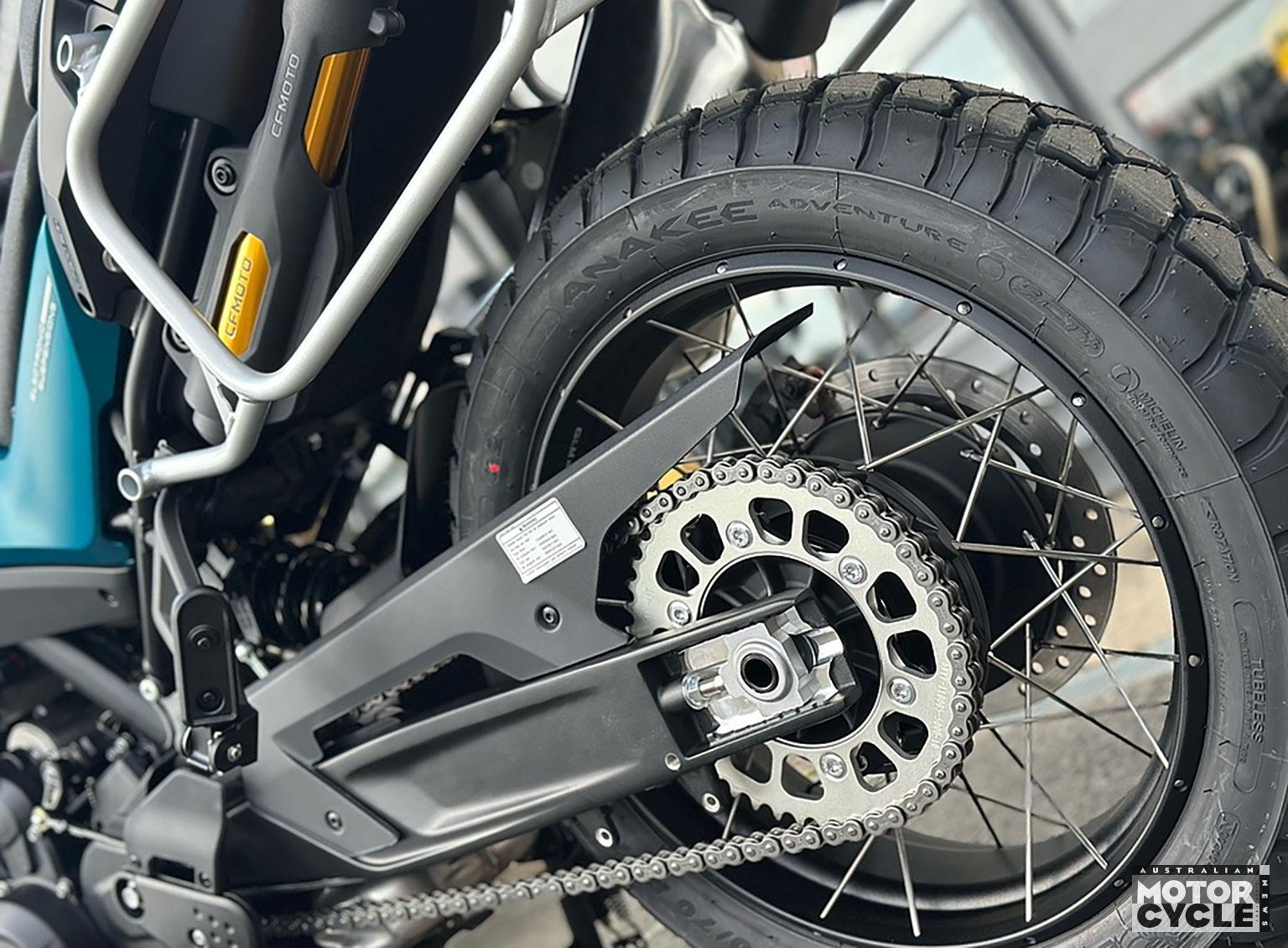
19-inch front, 17-inch rear; 110/80 R19, 150/70 R17 Michelin
DIMENSIONS
Seat height 825mm
Fuel capacity 19L
Wet weight 231kg
BUSINESS END
Colors Neptune Blue, Glacier White
Price $18,490 ride away
Contact cfmoto.com.au