30 years ago, Ducati developed a prototype that would eventually define World Superbike racing
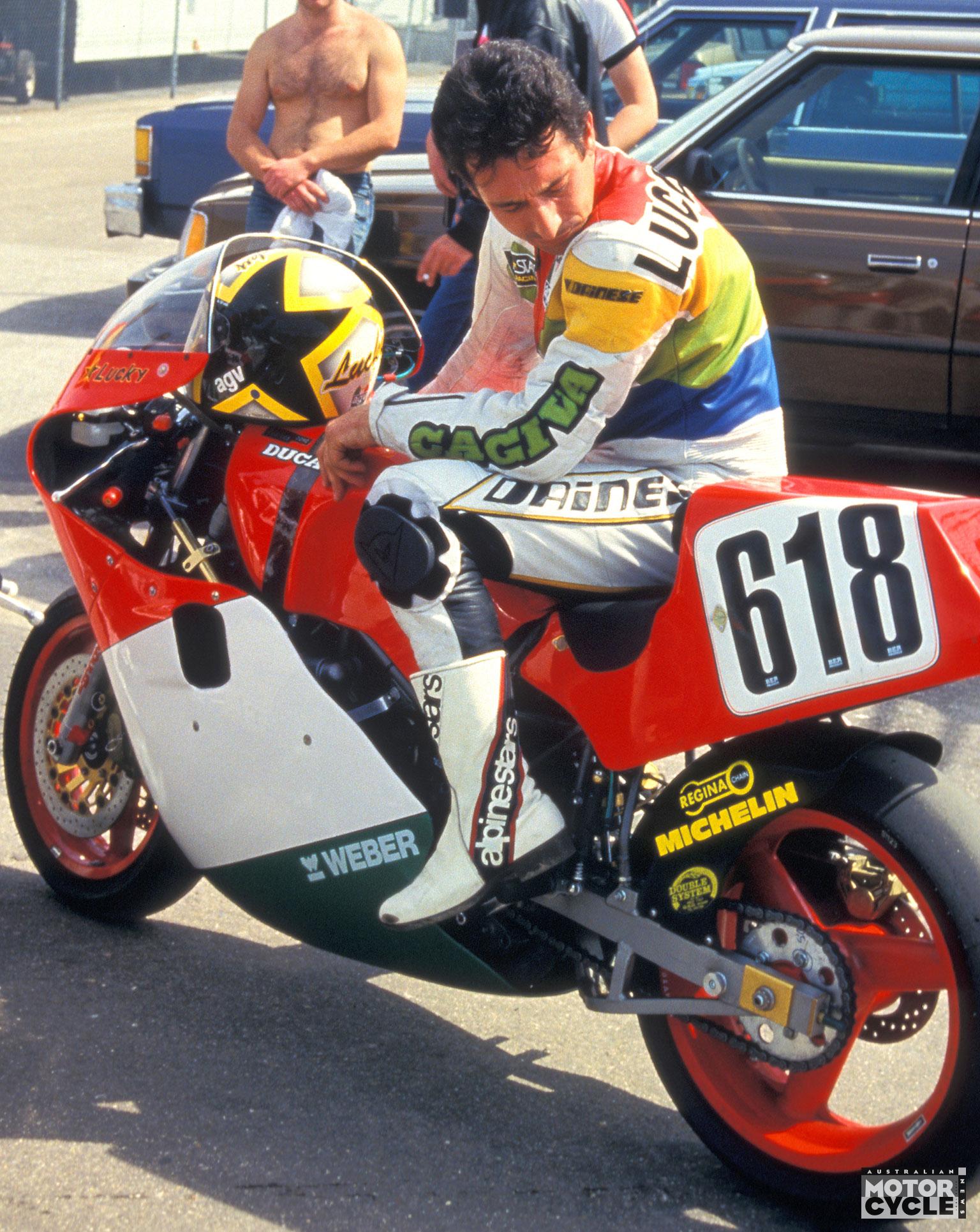
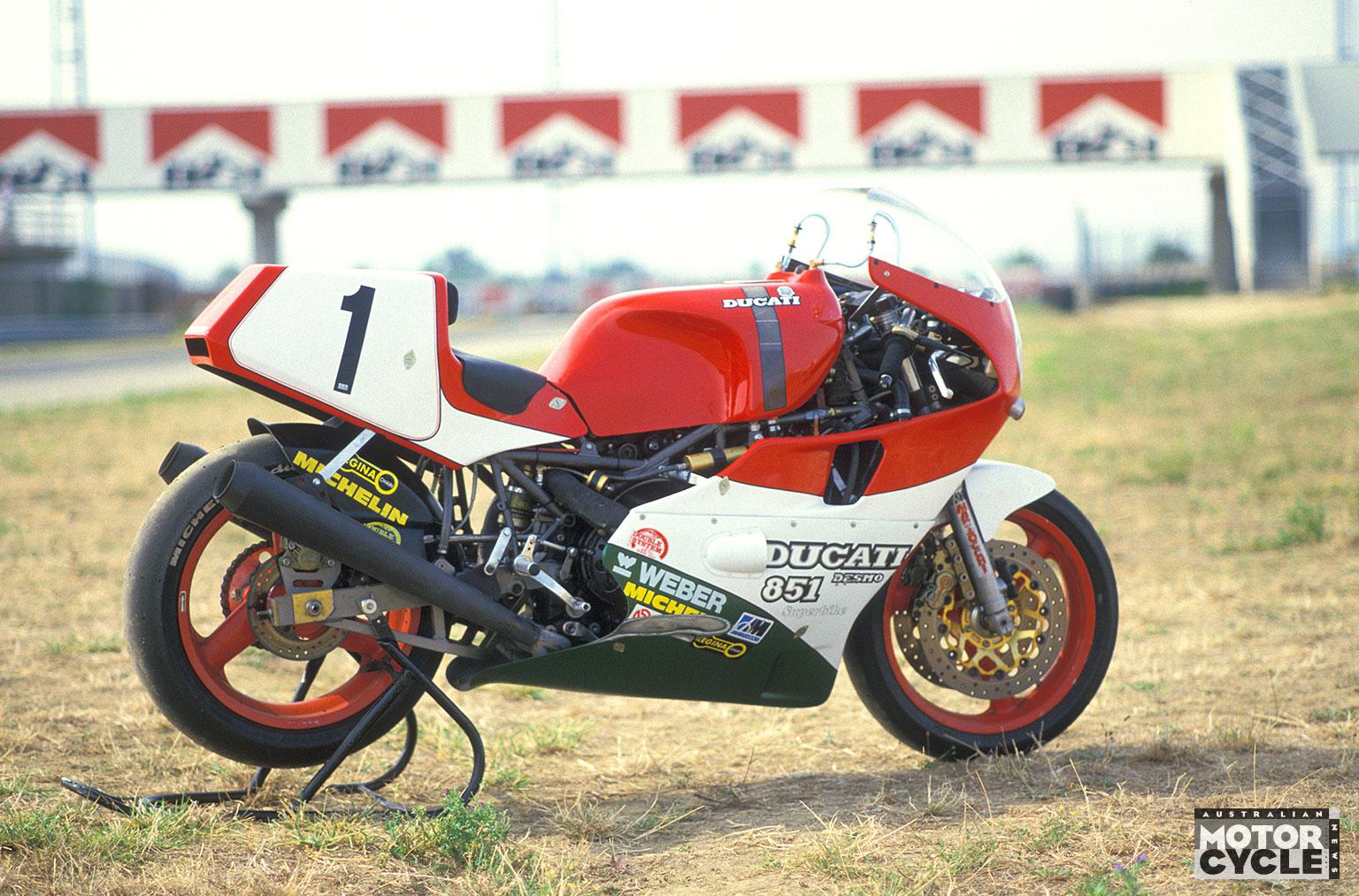
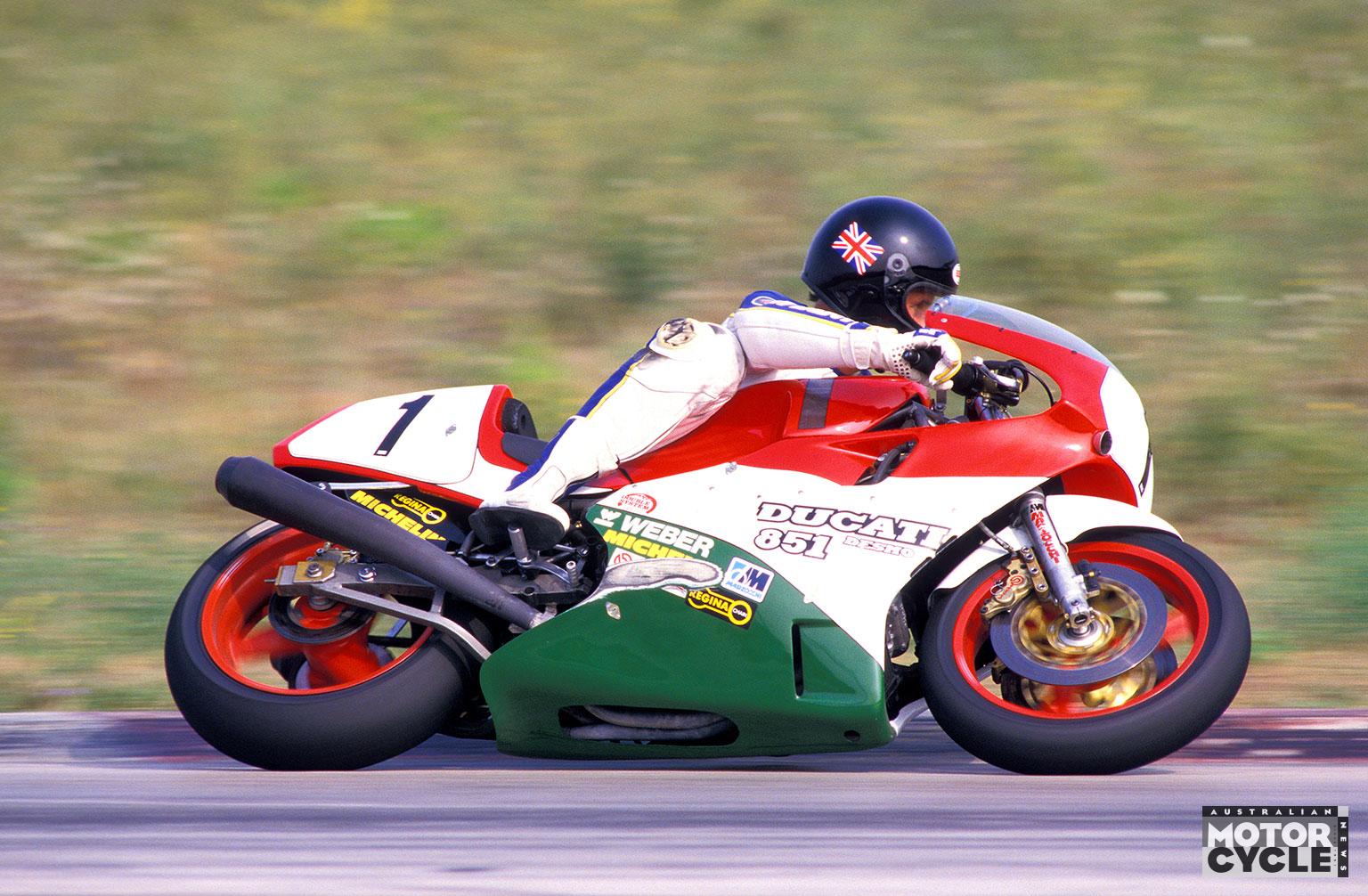
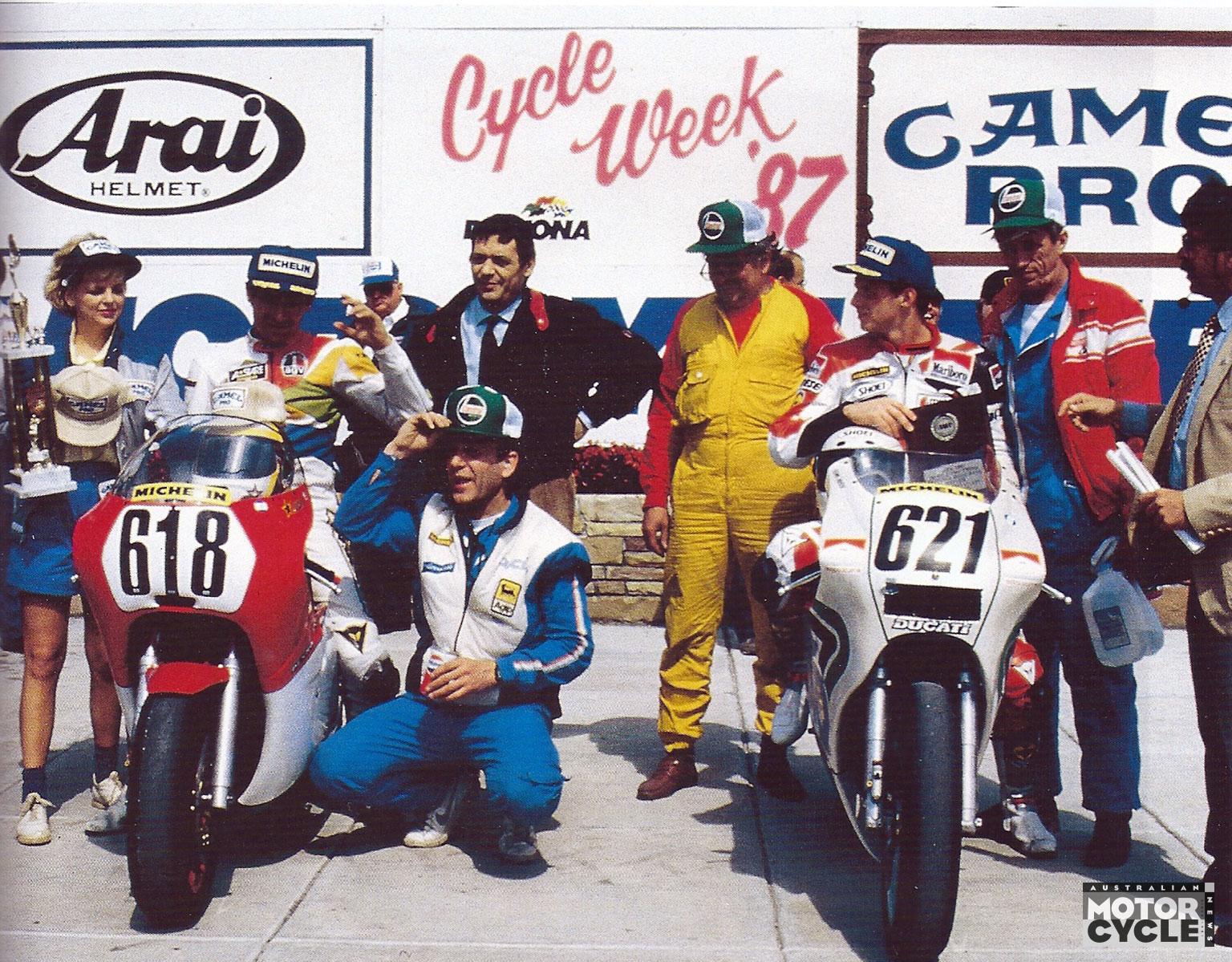
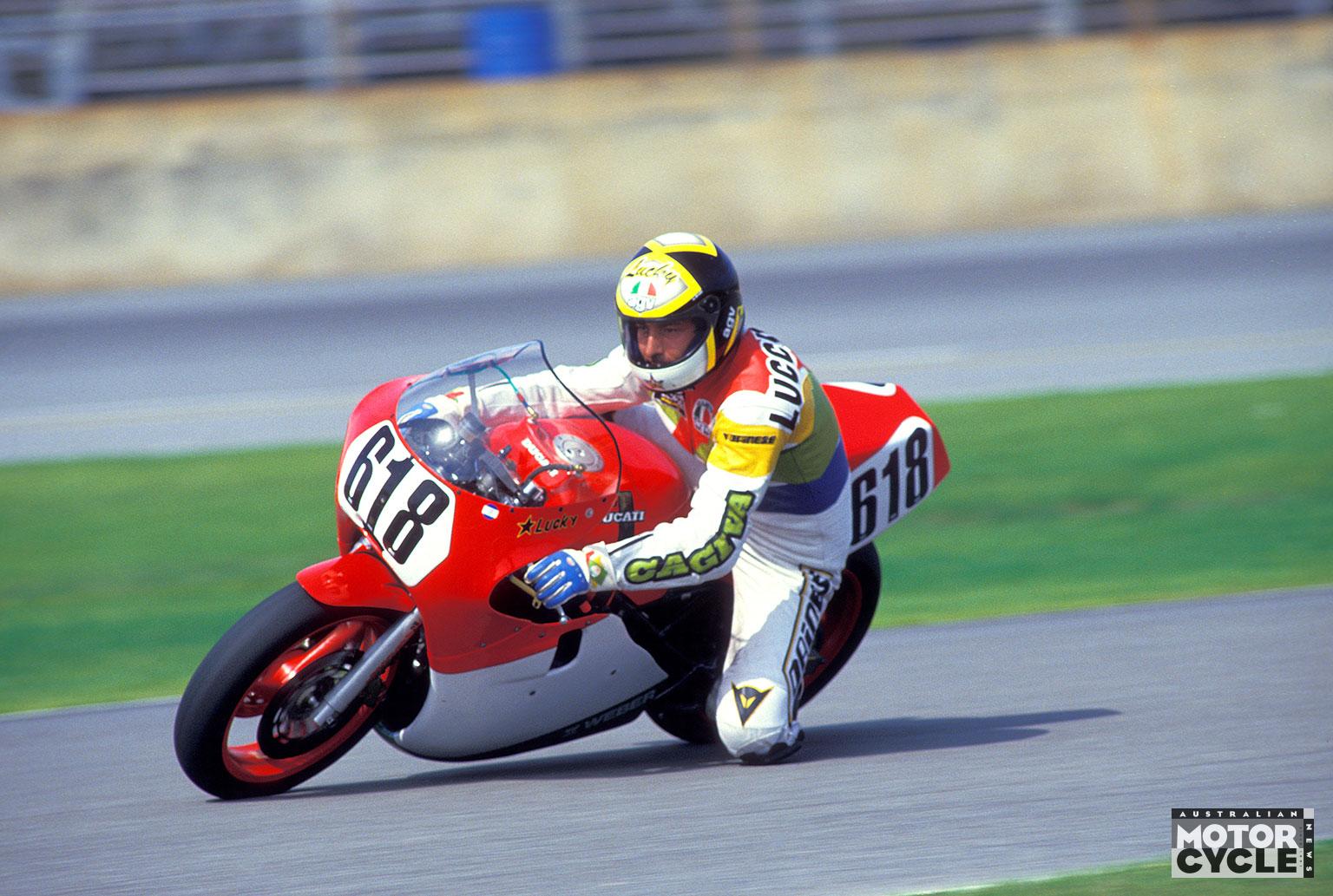
Five of us, each riding a specialist-framed Ducati desmo V-twin racebike powered by the single-cam aircooled 750cc Pantah engine, were drafting one another nose to tail round the Daytona bankings on the first day of qualifying for Cycle Week 1987’s Battle of the Twins/BoTT race. One thing was already clear: we were all Daytona old hands, mounted on bikes each with a top speed of within a couple of clicks of one another, and thus so evenly matched we could look forward to a race-long drafting duel over the bankings of the Florida speedway, with a final desperate last-lap dash for the flag and, who knows, maybe a place in Victory Lane. Well, you can always hope, and anyway – here was proof that my ex-works Bimota DB1 seemed to be able to run with the good guys I was riding with, like John Long and Kurt Liebmann on their Harris and Spondon Pantahs, with the same benchmark BoTT engine. Lookin’ good! But just then, exiting the infield onto the far banking, a blast of sound bounced off the speedway walls, as a twin-cylinder tricolore projectile thundered past our five-bike freight train a good 30km/h faster than any of us. From my position as fourth in the line-up, I saw each of the other three riders in front of me do the same: a spontaneous slight swerve down towards the apron to subconsciously make space for this red, white and green rocketship. But in a matter of seconds, Marco Lucchinelli on the works Ducati desmoquattro prototype, here making its competition debut in 851cc form, was clear of our little group – a killer shark looking for bigger prey, like the Quantel-Cosworth or Lucifer’s Hammer, the factory Harley.
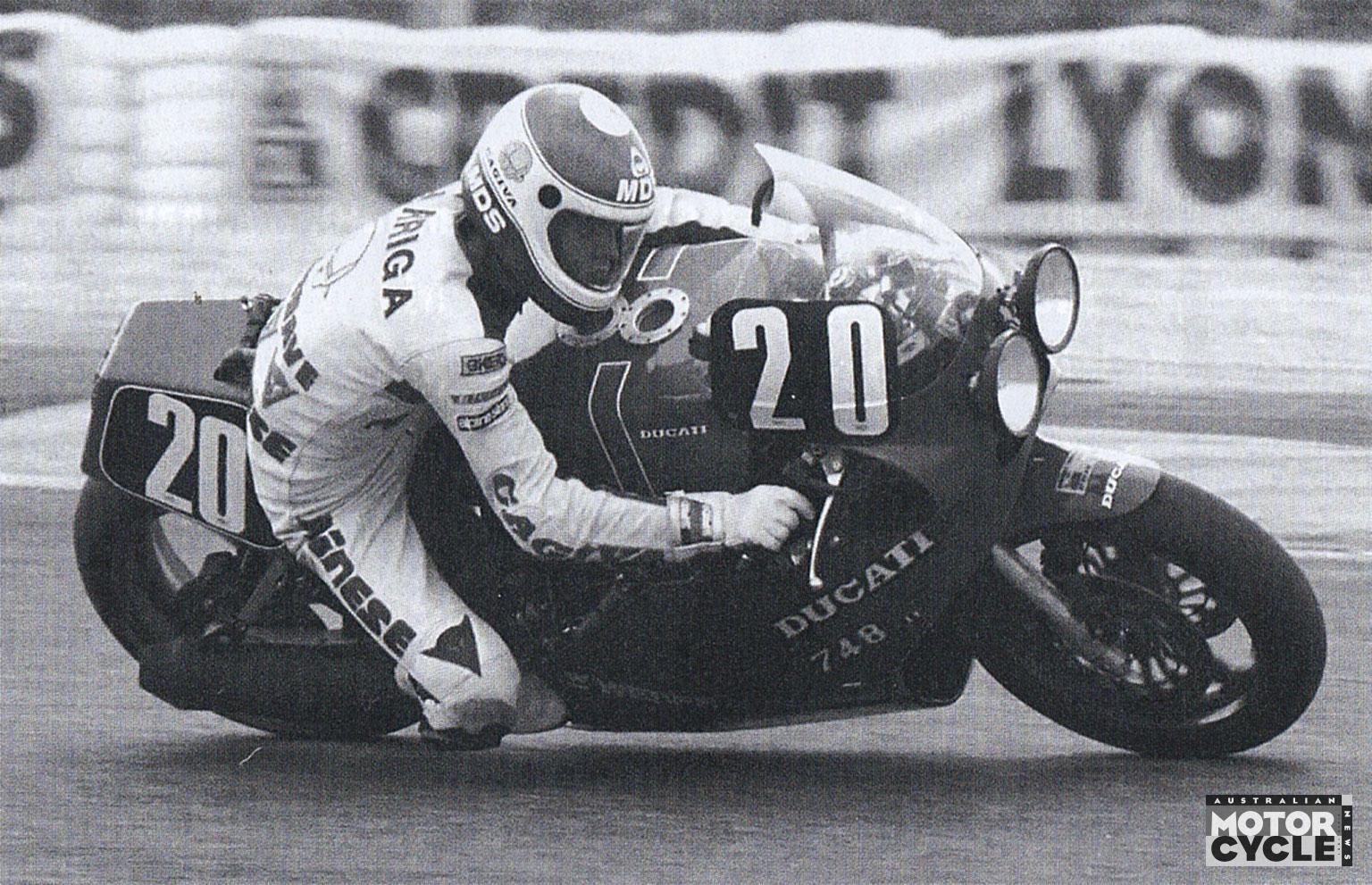
The speed and suddenness of Marco’s passage left me stunned, so much so I wasn’t paying attention and almost clouted the rear wheel of my mate Pete Johnson’s Spondon-Ducati in front of me, as the slipstream effect brought me up closer to him. Swerving away and pulling alongside, I glanced across at Pete – who nodded in the direction of the departed desmoquattro, and then shook his head in eloquent disbelief. Just then, with a double draft to take advantage of, John Long pulled alongside on his Harris-framed TT1, and wiggled his left arm to gesture in the direction of the bike that’d just blitzed us, before shrugging his shoulders in an eloquent expression of wonderment. No need for words to share our feelings – though there were plenty of those afterwards. We’d just been Desmoquattro’d!
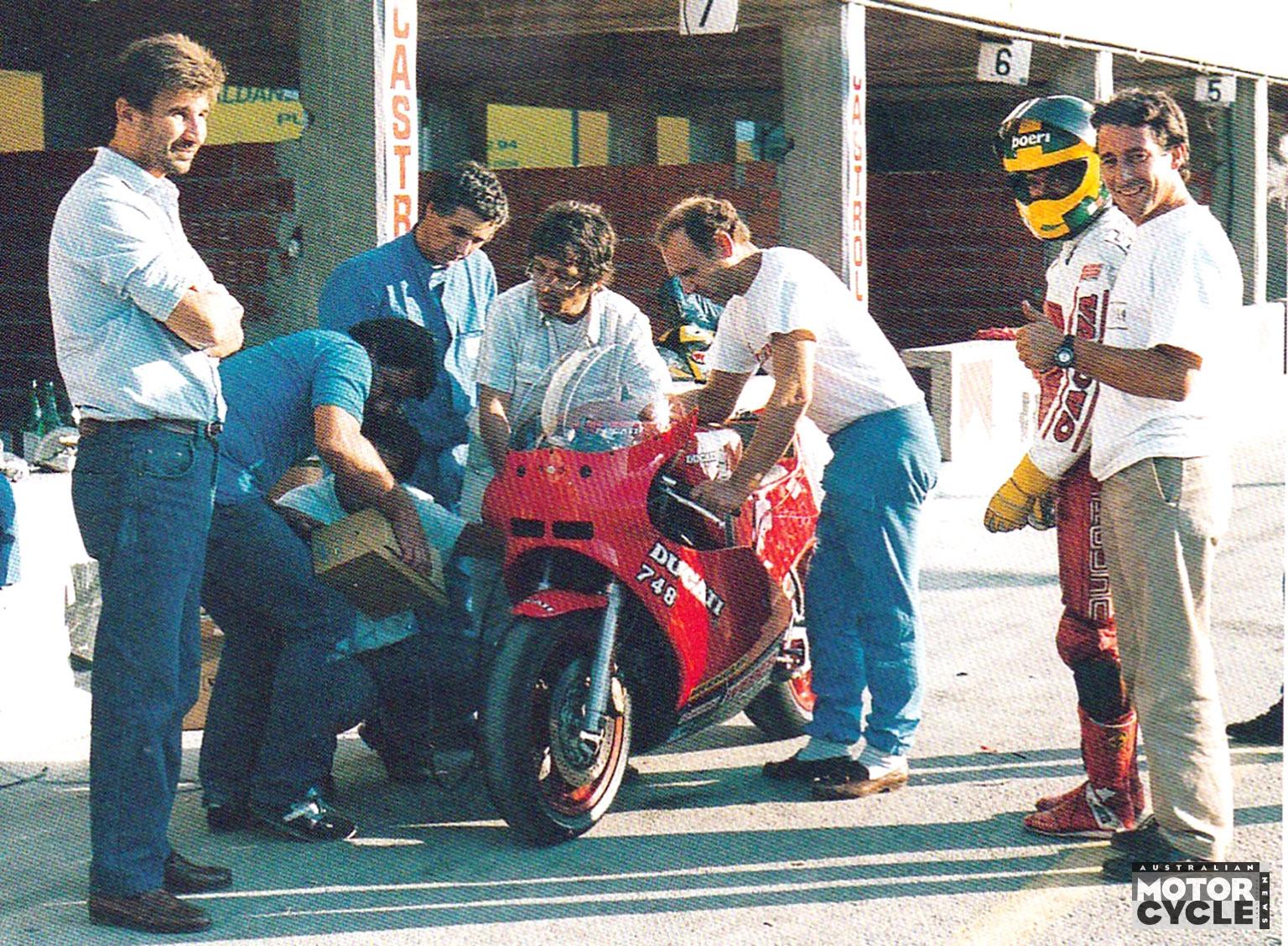
Back in the pit garages the speedway was a-buzzing: in just a handful of laps, Lucchinelli had been trapped at over 265km/h (Daytona officials recorded 165mph), equal to the best speed of the four-cylinder Yoshimura Suzuki of Satoshi Tsujimoto, who’d go on to finish second in the Daytona 200 later that week. By the end of practice week, Marco’s best lap time would have placed him sixth on the grid for that Superbike classic, on a par with the factory 750 fours after just 16 laps practice and using, according to team chief Franco Farne, a maximum of 11,000rpm in the interests of reliability on the hitherto un-raced 851cc engine.
“If we’d used all the revs available, which on the dyno we know is at least 12,000rpm, for sure we could have trapped 170mph,” said Farne nonchalantly. An 850 twin that’s as fast as a 750 four? For sure that upset conventional wisdom.
This 851 was the final version of a factory project that had begun the year before, when a new generation of Ducati technicians had worked with amazing passion to short-track development of a liquid-cooled, eight-valve successor to the trusted and proven air-cooled Ducati Pantah engine.
In early 1986 Marco had had to muscle his way past the determined Aussie Grand Prix rider Paul Lewis on the liquid-cooled Quantel Cosworth ex-Norton twin to win Daytona’s Battle of the Twins race. A hard-fought victory using an engine enlarged to 850cc looked like being a walkover in 1987.
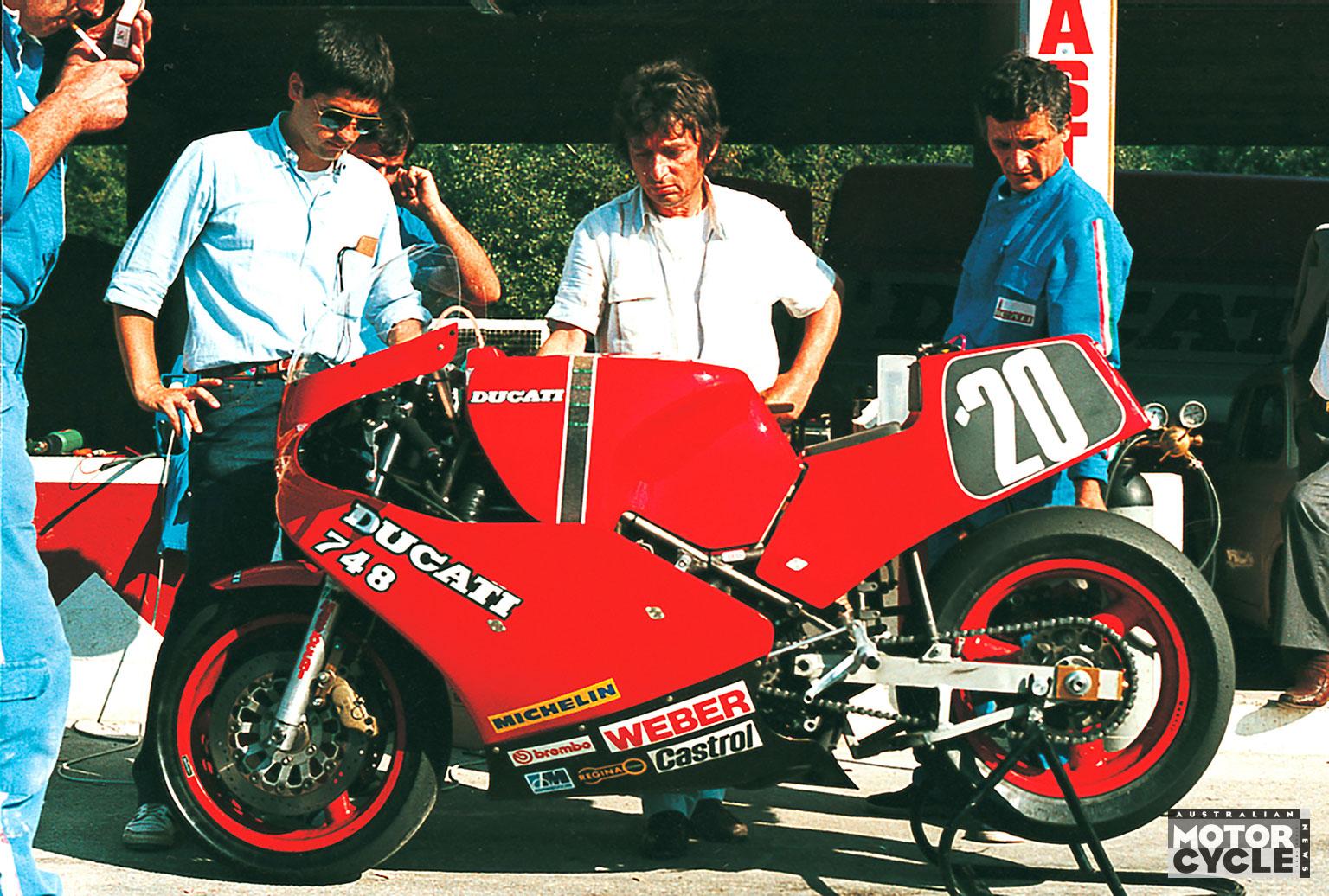
However, it had been a huge achievement to even get the 851 prototype to Daytona. The first version of it had only debuted the previous September in the Bol d’Or 24-Hours, in 750 form to conform with World Endurance rules.
HOW IT ALL BEGAN
Fabio Taglioni’s retirement in 1985 as chief engineer at Ducati, after a glorious 30-year reign, coincided with the pressing need after that year’s Cagiva takeover for a new-generation engine that would allow Ducati to compete on even terms with its mainstream Japanese rivals.
It would also have to meet ever more stringent noise and pollution regulations – yet without losing its products’ unique identity and Latin character.
This meant the way was clear for Dr T’s successor, the youthful Massimo Bordi, to break with Ducati tradition and design the first eight-valve Ducati twin destined for production.
Even so, it was a surprise when word leaked out of the factory that the new engine would not only be watercooled, as was expected, but in best Bologna tradition, a desmo as well.
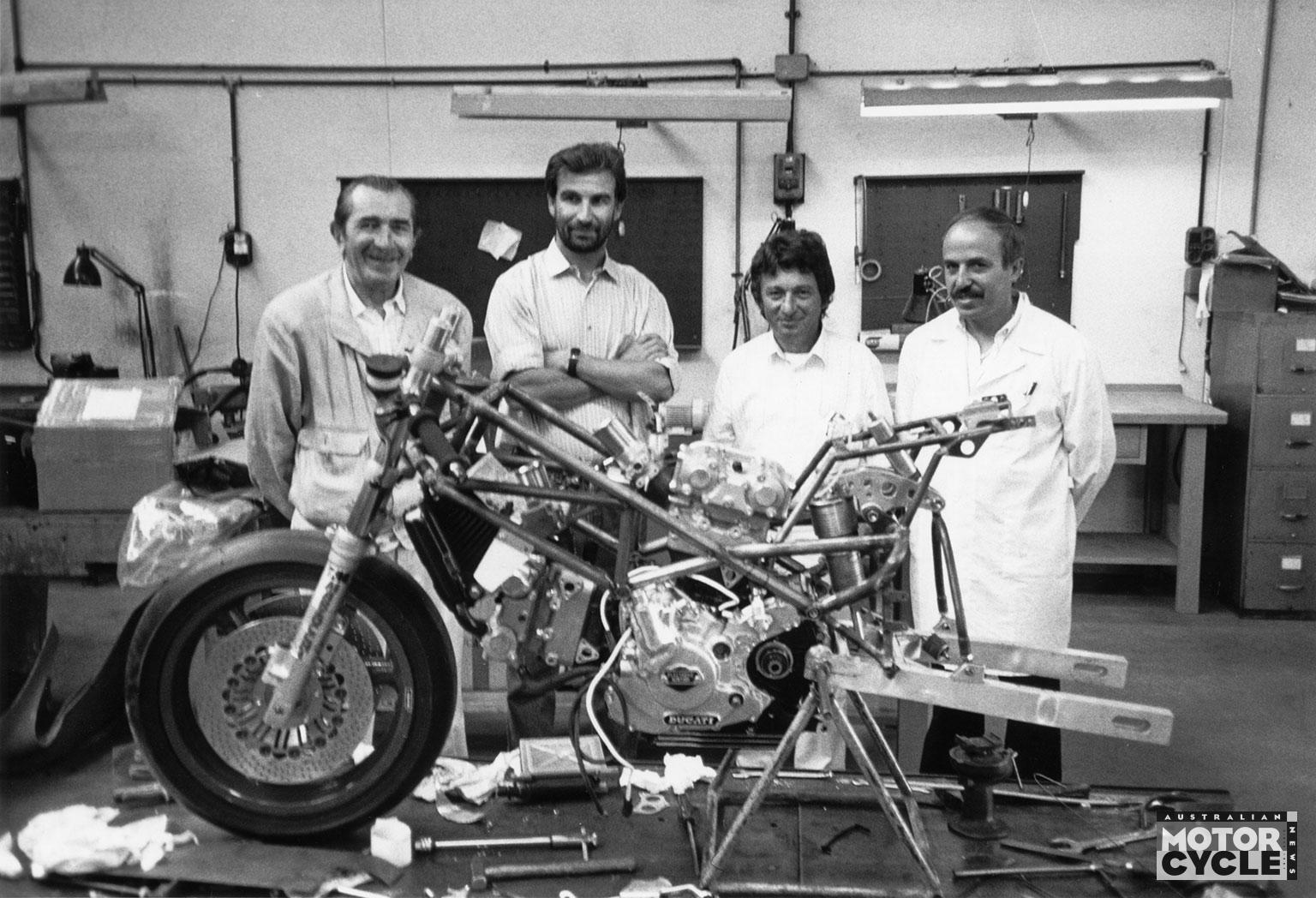
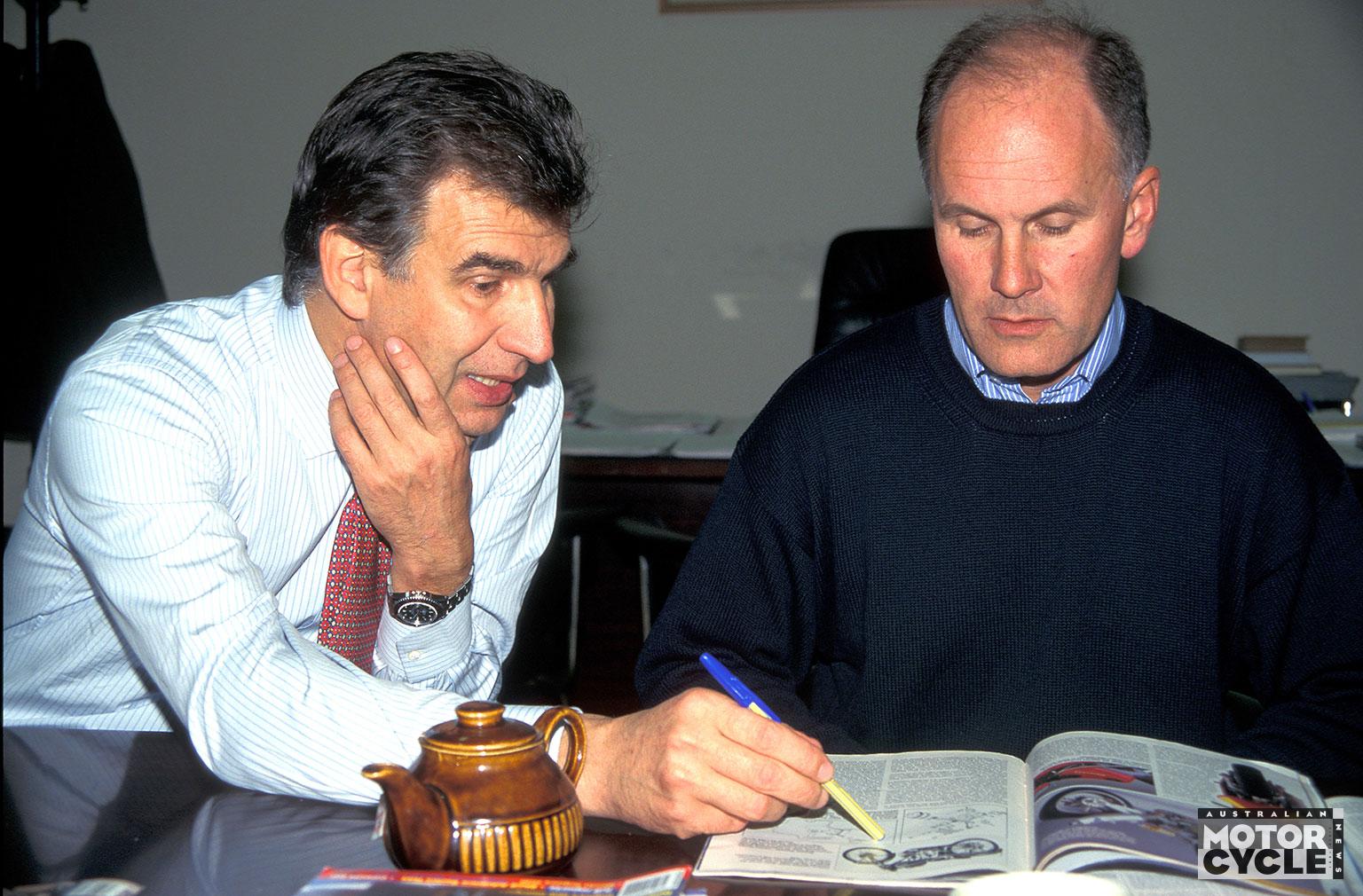
I got an even bigger surprise in August 1986 when Bordi invited me to be the first person outside the factory to see the new engine, sitting in the uncompleted prototype racer which, in typical Italian haste, he and his R&D team had sacrificed their summer holidays to construct. The rush was on to meet the deadline of its public debut just one month later in 750cc form in the Bol d’Or 24 Hours. (It retired with a broken conrod bolt after 15 hours.)
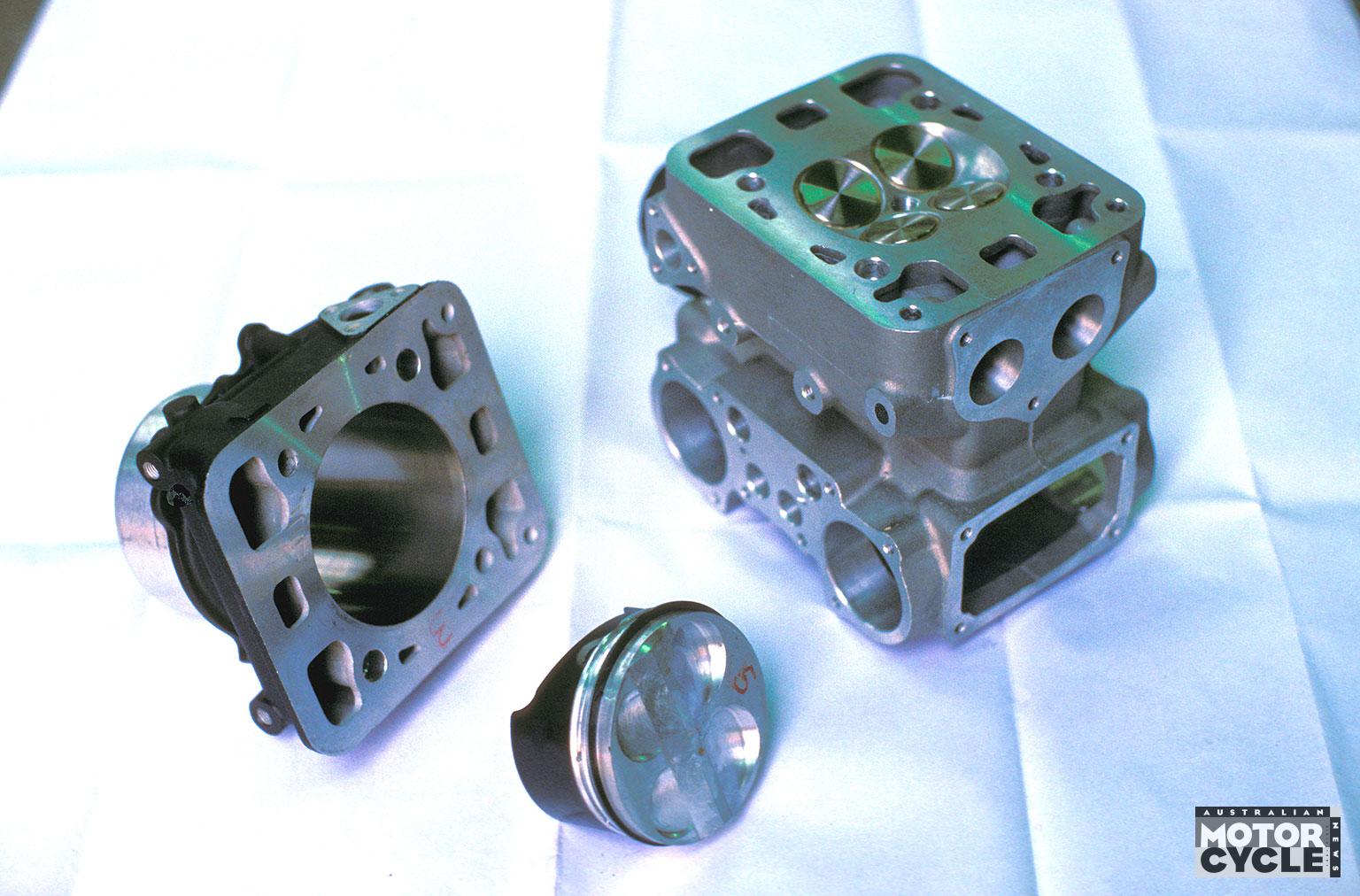
How could such small cylinders each contain no less than EIGHT rockers, four valves and two camshafts? Truly, by twin-cylinder standards, Bordi’s eight-valve desmo design represented an engineering tour de force. This was quickly proved by Lucchinelli’s victorious performance on the Daytona bankings at Cycle Week 1987, let alone the almost insolent manner with which he later defeated RC30 Hondas and Yamaha-powered YB4EI Bimotas in the Italian Superbike series that summer.
A VERY DIFFERENT BEAST
The prototype was, in the context of the times, a very unusual motorcycle.
For the first time ever on a motorcycle engine, it successfully combined two established routes to improved four-stroke performance: four-valve cylinder heads and positive desmodromic operation of those paired valves in a period trailer of the pneumatic valve operation which later became standardised in Formula 1 and then used by Aprilia in MotoGP.
Ducati may not have been the first to have developed desmo valve gear successfully – apart from pre-WWI efforts by Peugeot and especially Delage, the mighty Mercedes-Benz team scored two Formula 1 world championships with desmodromic engines, plus several sportscar successes, including victory in the 1955 Mille Miglia. But only Ducati had successfully productionised the desmo concept, thanks to design guru Taglioni’s trademark belief in the benefits of positive valve gear.
Sadly, such well-directed trust was not matched by corresponding confidence in the by-then well-established advantages of employing four valves per cylinder. Dr T tried this rather half-heartedly in valve-spring form on his early-1970s 500cc V-twin GP racer, but rejected it in favour of his beloved, yet flawed, two-valve desmo layout. Flawed, because it didn’t reap the advantages offered by paired valves, including improved combustion, reduced reciprocating weight, better intake flow and superior cylinder filling, all accompanied by higher revs. At around 100hp in air-cooled form, the 850cc single-cam Pantah desmodue engine Lucchinelli used to win the 1986 Daytona BoTT had effectively reached the limit of contemporary two-valves-per-cylinder engine design. I guess every great designer has his blind spot – and this was Dr T’s.
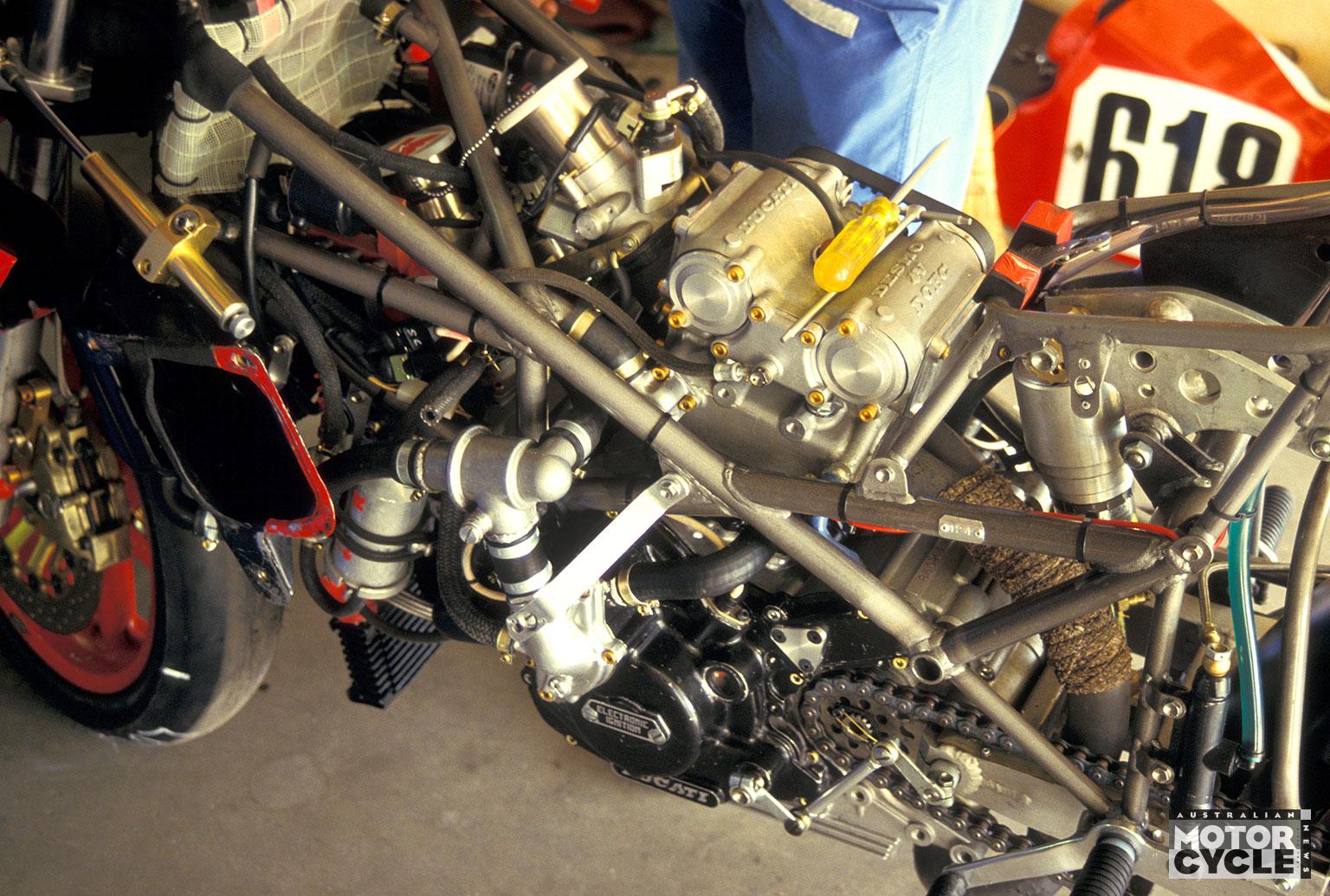
Bordi’s prototype plain-bearing desmoquattro engine set the benchmark for future generations of Ducati Superbikes, with a Cosworth-inspired shallow included valve angle of 40°, traditional Ducati paired big ends with sturdy Pankl deeply-ribbed Austrian-made titanium conrods, and ultra-slipper Mondial pistons running in Gilnisil chrome bores.
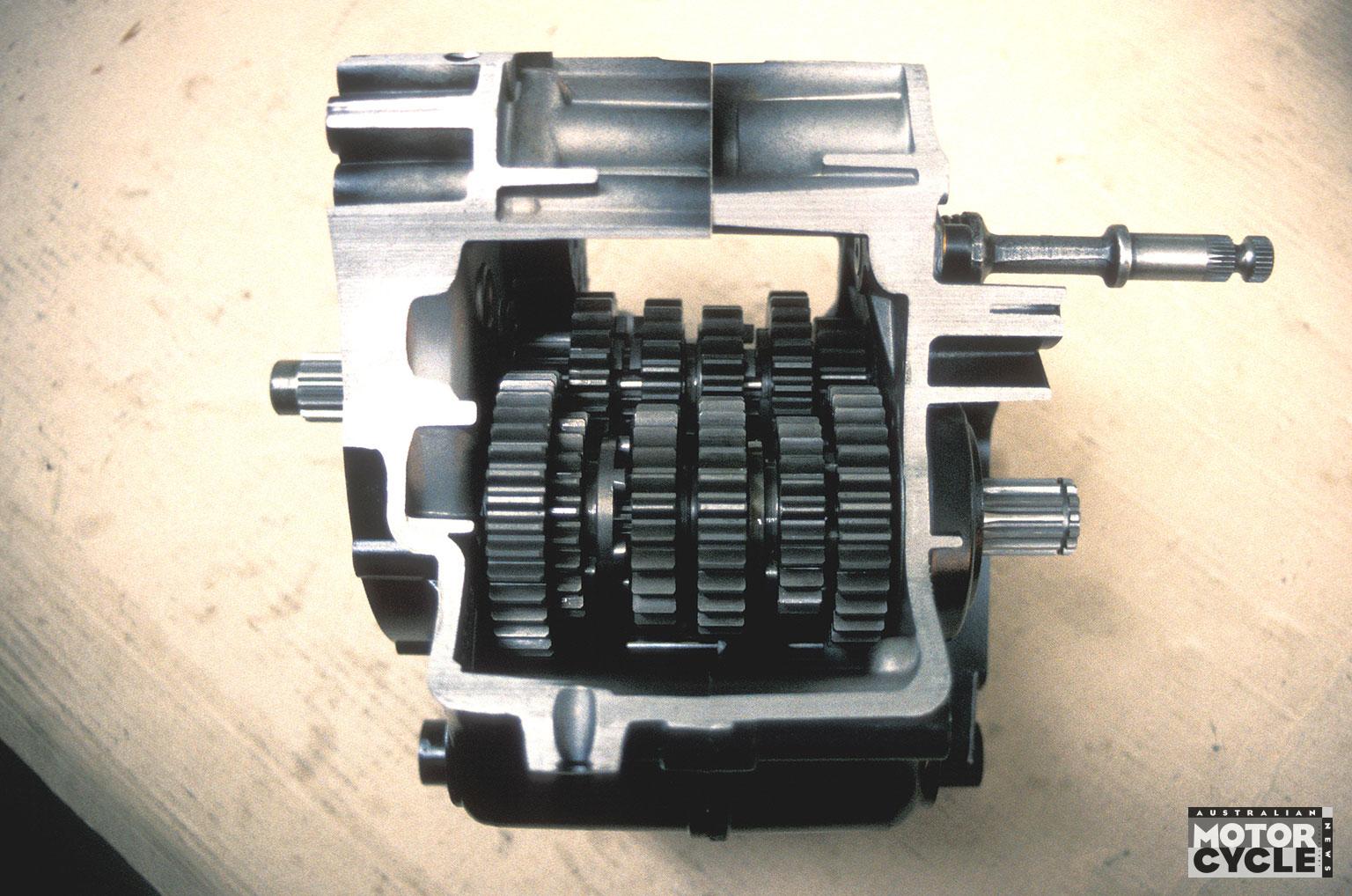
The first 750 prototype used modified Pantah crankcases but the 851 version had new castings that gave room for a needle roller six-speed gearbox, albeit retaining a standard F1 Pantah dry clutch – a surprise, as I’d always been told by Dr T that the clutch diameter was one of the inhibiting factors in extracting more power from his two-valve desmos.
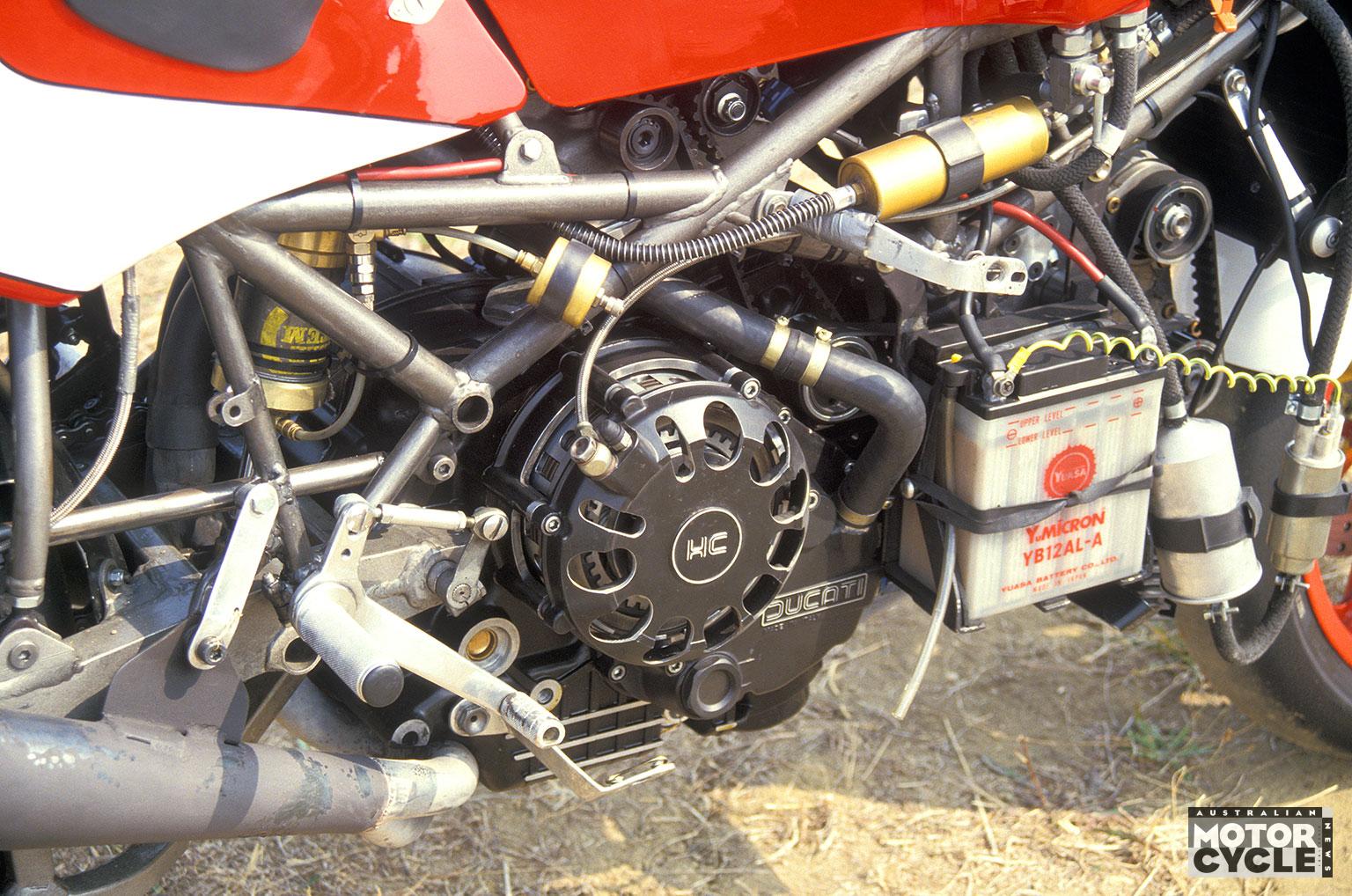
The water pump sat in a very exposed position on the left of the engine, so not only prone to damage in a crash but also largely responsible for the bike being so wide for a V-twin, something surprisingly never tidied up on the production bikes.
Bordi told me he’d had a change of heart in designing the new crankcases, since originally he’d planned to jettison the trademark Pantah feature of pivoting the swingarm in the rear of them, and opt instead for a more conventional chassis design. However, the fabricated alloy swingarm on the 851 pivoted in the new crankcases as before, benefiting from their inherent strength for added stiffness, as well as allowing the pivot to be located closer to the gearbox sprocket, in the interests of near-constant chain tension.
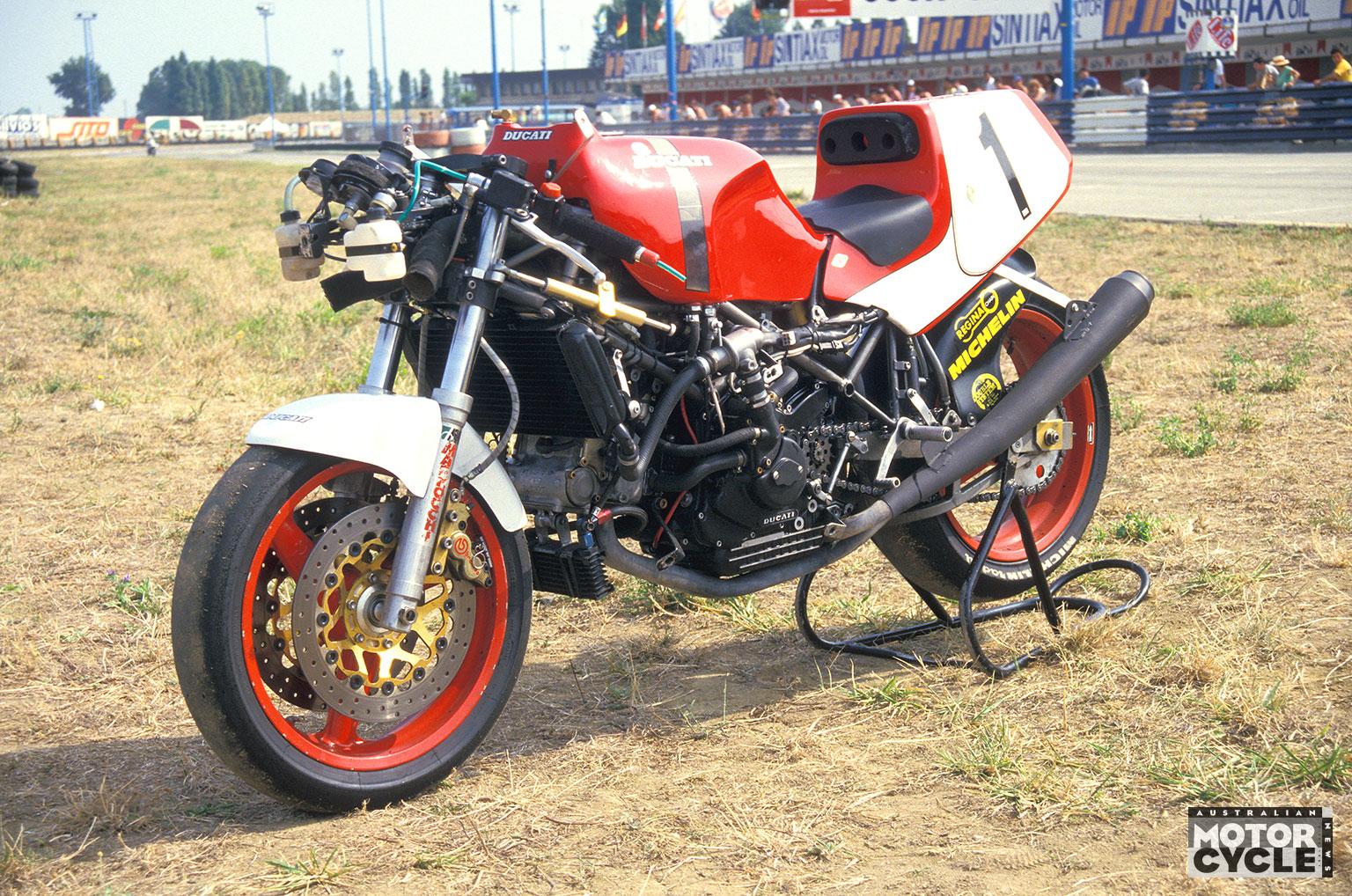
The cylinder head castings were a masterpiece of design and manufacture, with the twin overhead camshafts per cylinder driven by exposed belts as on the Pantah, and in turn actuating titanium valves whose dimensions had been a subject of some experiment that season.
The team tried various valve sizes, settling on smaller 32mm inlets and 28mm exhausts (instead of 34/30mm). A single centrally-located sparkplug per cylinder fired via the Weber/Marelli engine management’s digital ECU strapped to the right of the engine, which was the forerunner of all future Ducati EFI systems, and already incorporated a detonation sensor.
Unlike on related car systems, though, the Ducati EFI already featured twin injectors per cylinder to meet the flow requirements, while the twin Weber throttle bodies – measuring 50mm in diameter at the trumpets and narrowing to 46mm at the inlet – each fed inlet ports which were unusually straight compared to a four-valve Honda engine, for example, because of the elimination of valve springs thanks to the desmo format.
According to Bordi, this direct intake tract was a crucial key to the 851’s then-amazing power output for a V-twin of a claimed 86kW (115hp) at 11,500rpm at the rear wheel, an apparently justified figure born out by the prototype bike’s sizzling performance against four-cylinder opposition.
Exhausts were also a work in progress. To start with, the four separate exhaust ports each siamesed into a separate single megaphone in both the 750 Bol d’Or and the 851 Daytona winner. This 4-2-1 system was eventually replaced with twin megaphones.
RIDING THE BEAST
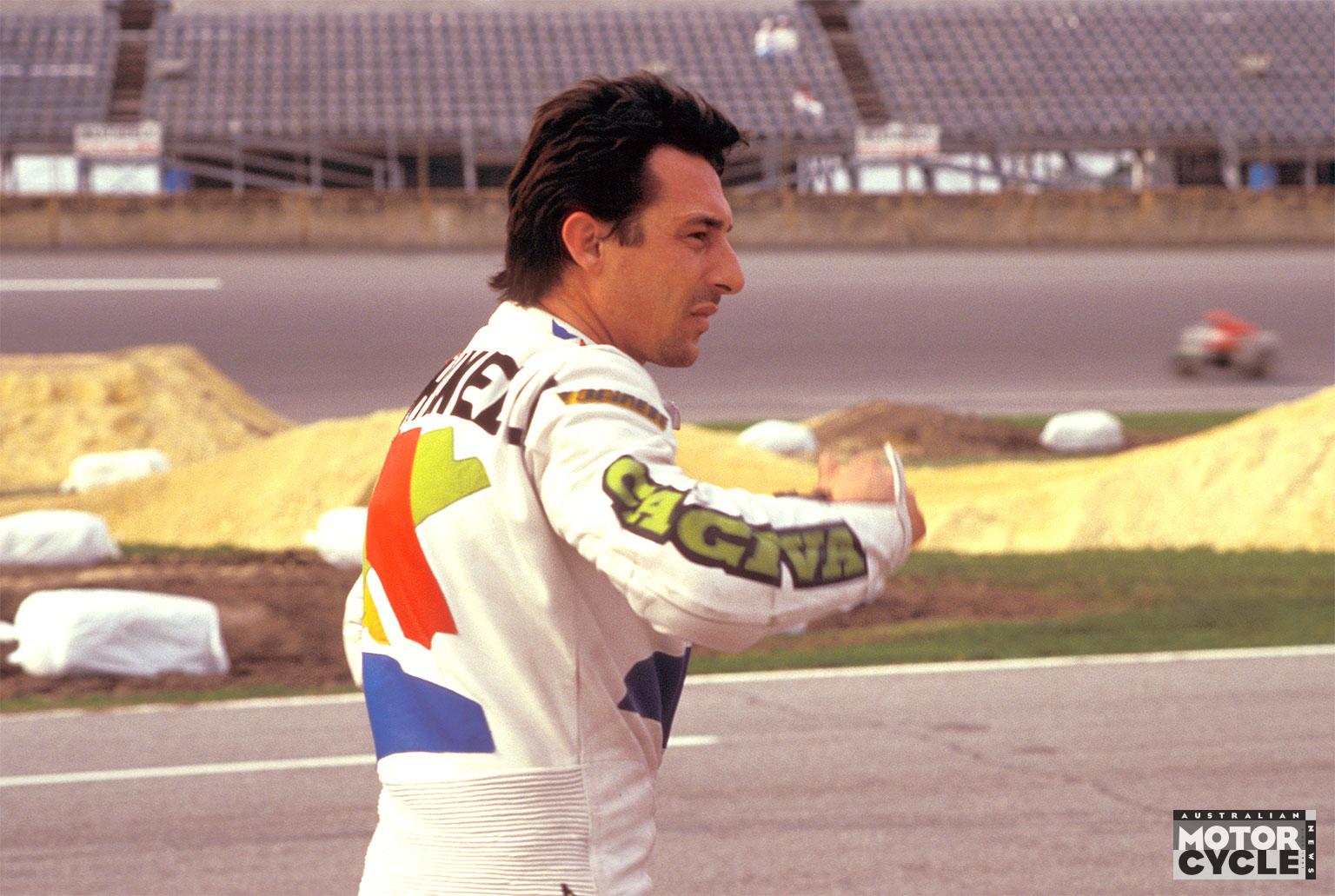
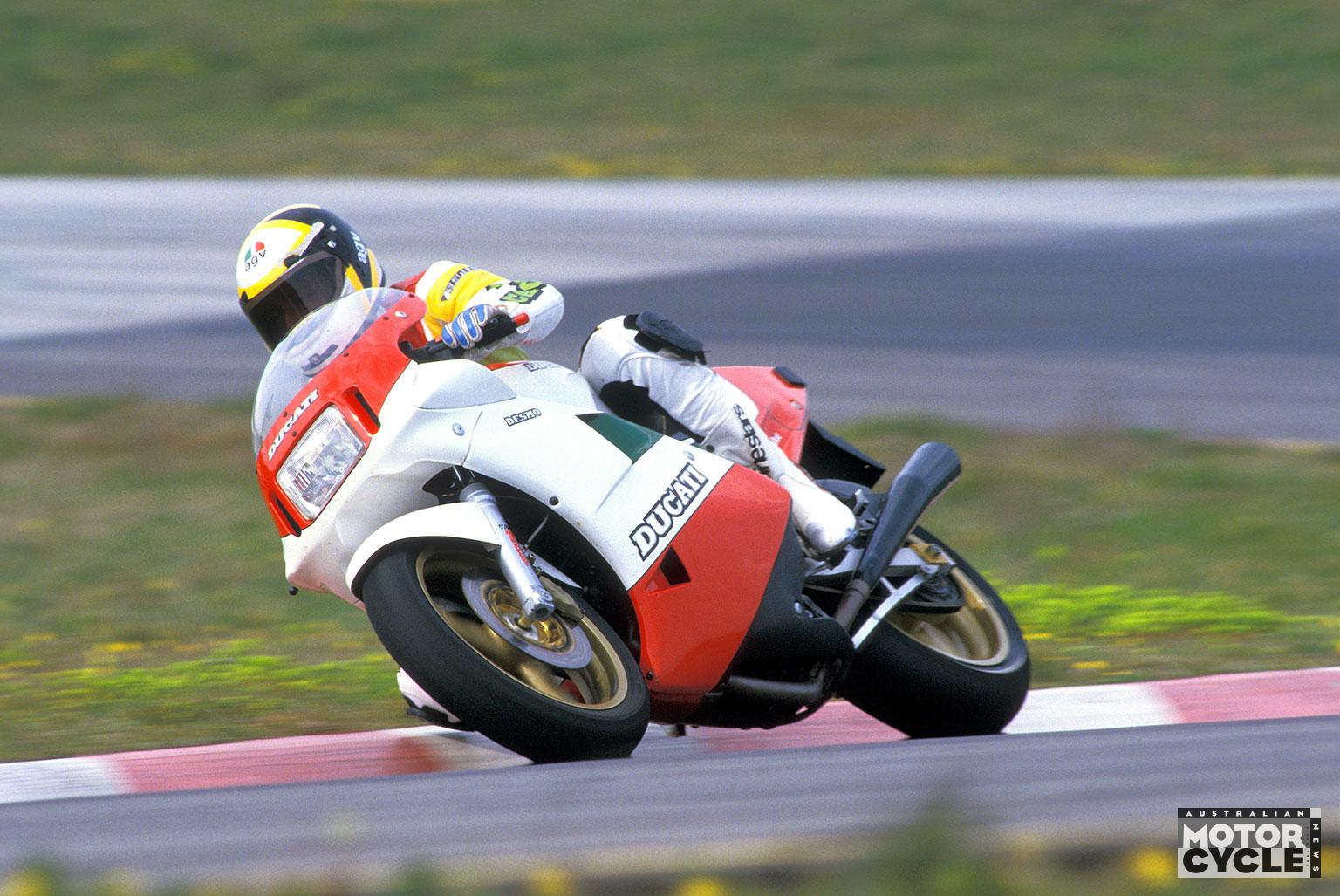
It was almost one year to the day after I’d seen it for the first time in 750 prototype form that I had the satisfaction of riding the 851 desmoquattro Ducati at Misano, in August 1987. The night before, racing under the floodlights at the annual Ferragosto festival race meeting (Misano was the only track in Europe licensed by the FIM for night racing without headlights), Lucchinelli had romped to unchallenged victory in the Italian Superbike round, lapping at night in a time that would have put the twin-cylinder bike on the third row of the grid for the previous year’s San Marino 500cc GP held on the same track. Next morning, I returned to the circuit for the ride which Cagiva-Ducati boss Gianfranco Castiglioni had promised me back at Daytona after I and everyone else had been as comprehensively desmoquattro’d in the BoTT race as we were that first day of practice. At that time Daytona was one of the world’s most important race meetings, with the BoTT support class a hotbed of innovation.
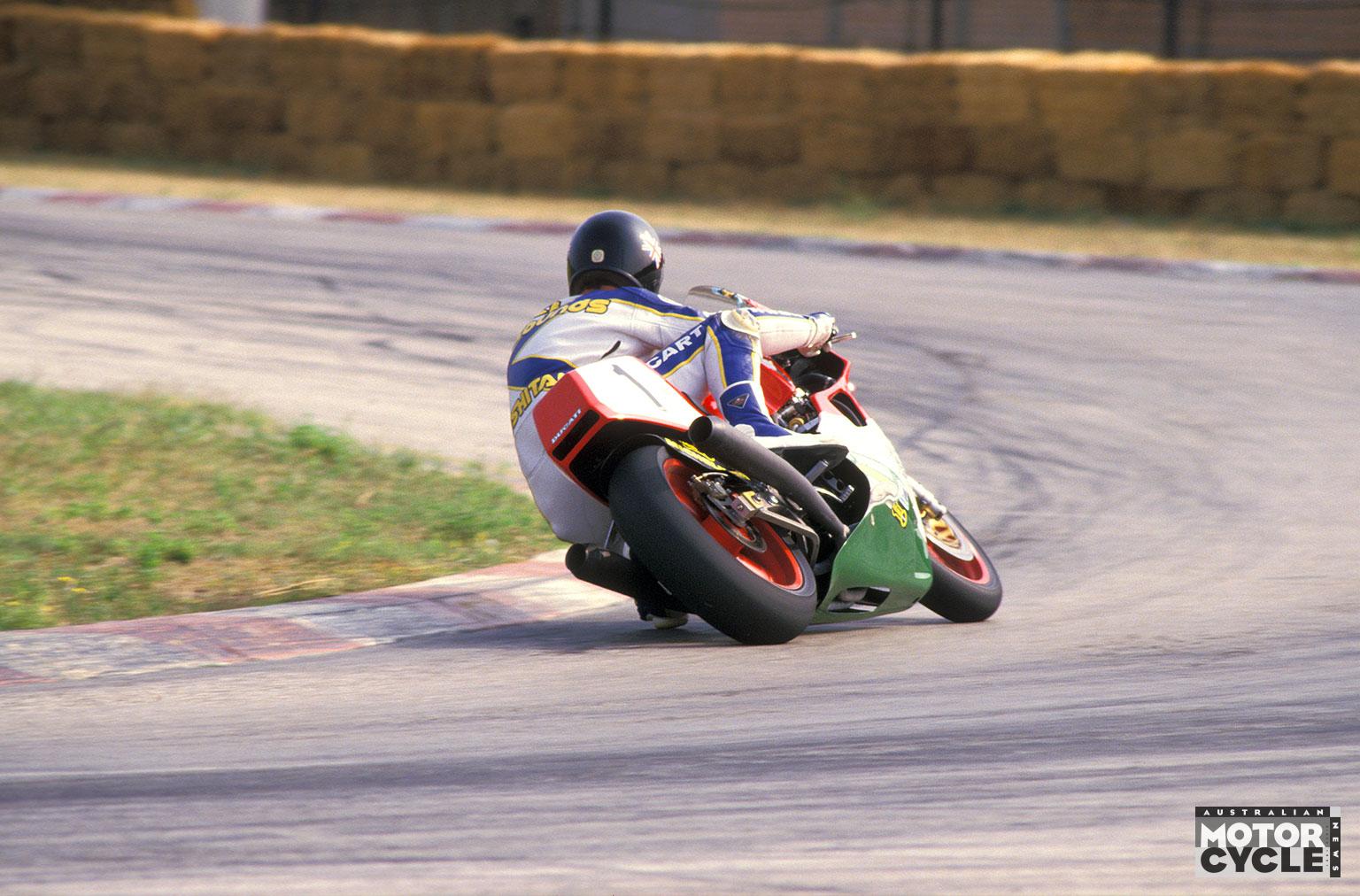
To say that I completed 20 laps of Misano in anything other than a state of gradually increasing euphoria would be a serious understatement. Franco Farne had to stand out in the track with a red flag before he could persuade me to stop – and that was only because the Ducati started to misfire as it ran low on fuel…. For an avowed ducatista, riding the 851 prototype was everything I’d hoped it would be, and more. Love at first ride? Undoubtedly…..
Actually, all was not entirely sweetness and light to start with.
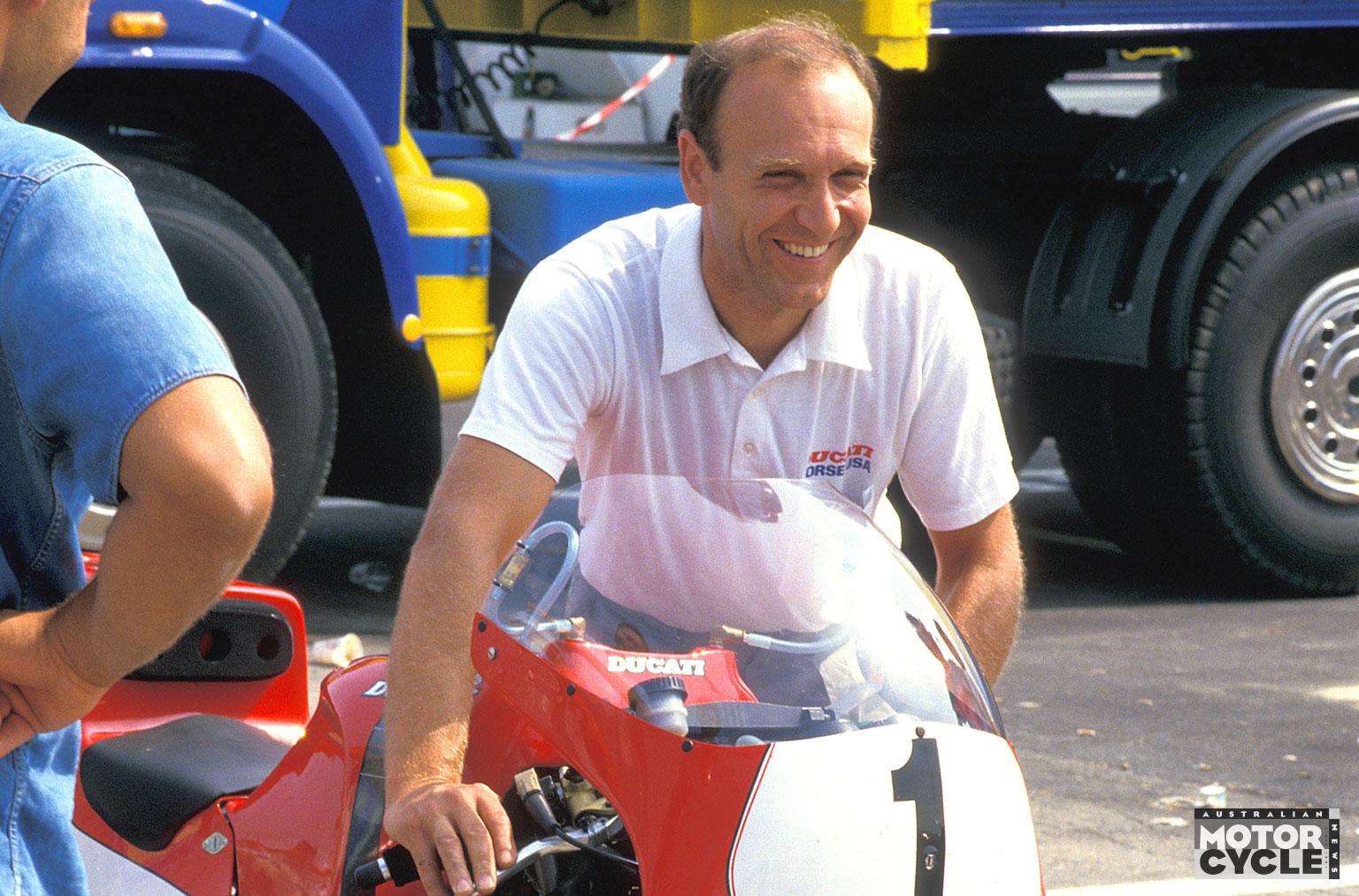
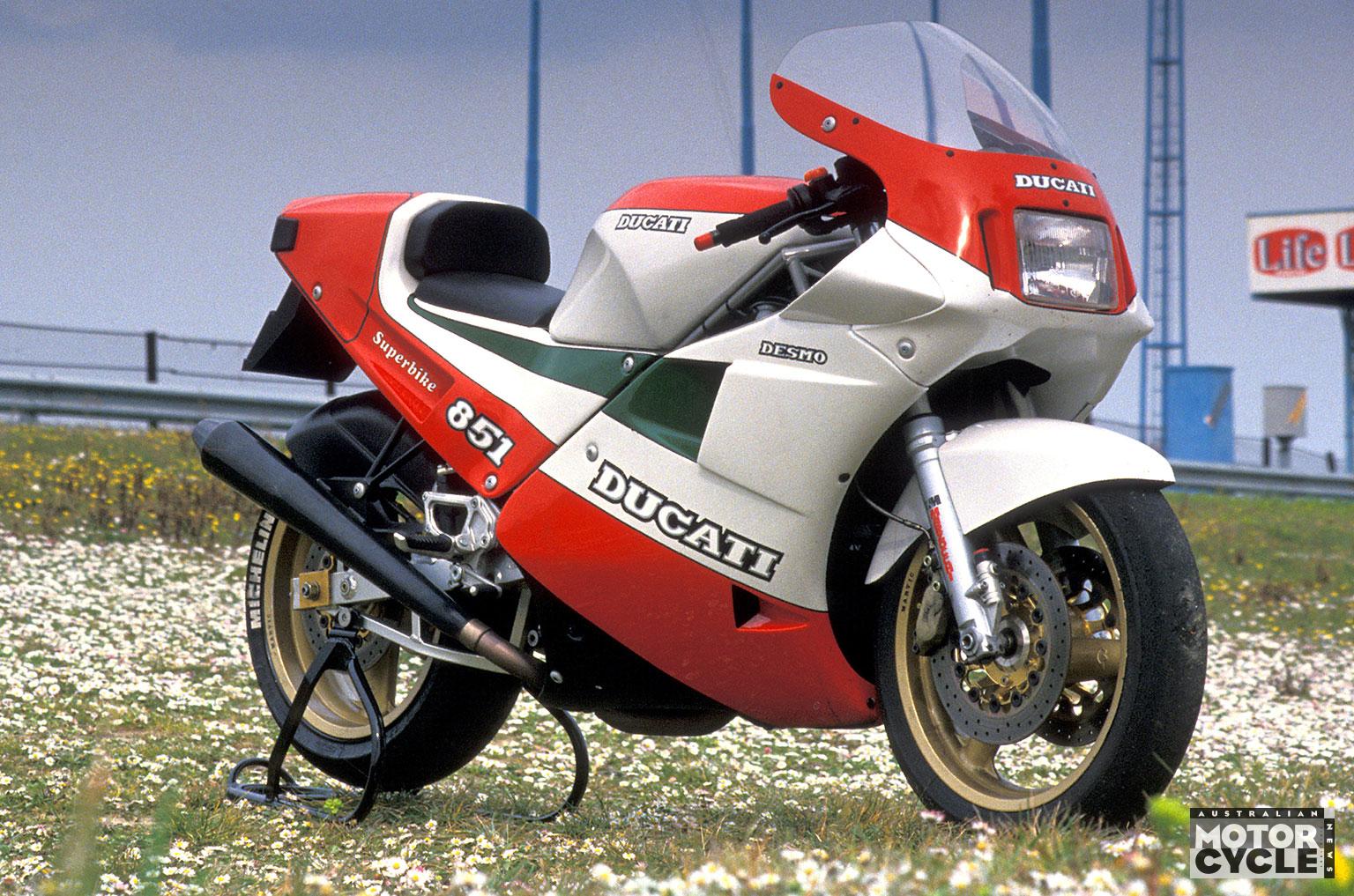
I found the GP-style riding position not ideal, though hardly unexpected for an ex-500cc world champion such as Marco to demand. You sat very far forward, with a lot of weight on your shoulders and arms, and the chin of your helmet making friends with the front of the rather bulky fibreglass fuel tank, complete with the same trademark clear sight strip down the side that the 750SS I’d started racing on more than a decade earlier also had, to show how much fuel there was inside.
The forward riding position perhaps compensated for an unfashionable claimed 50/50 per cent weight distribution without the rider (GP bikes then already had a lot more static forward weight bias, impossible with the L-twin architecture of the desmoquattro engine and its heavy front cylinder head).
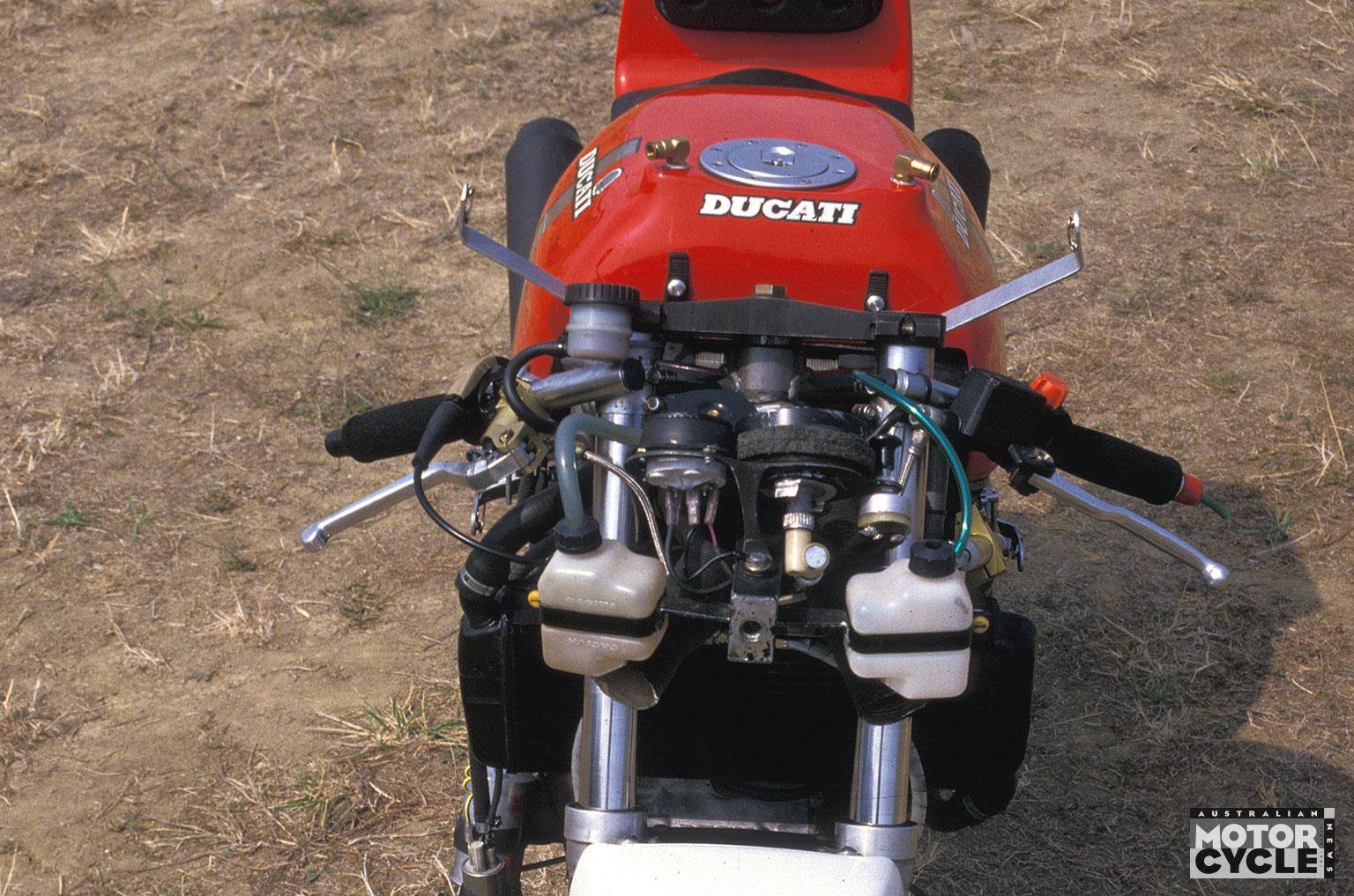
At the same time, the desmoquattro felt to be a big bike, very un-twin; the fairing was pretty wide, almost as much as a four’s, and the wide fuel tank added to the impression of bulk, even if the rather bulbous fairing, reminiscent of the old Wixom streamlining of the 1970s XR750 V-twin Harleys, at least enveloped you nicely down the straight. But the spaceframe chassis offered light but neutral steering, aided by the combination of 17in wheels and a fixed 25° head angle coupled with conservative geometry. But although it was very precise on turn-in, the new-generation V-twin required quite a bit more effort to switch it from side to side than I’d come to expect from such a bike, especially compared to the Bimota DB1 I’d been racing all season.
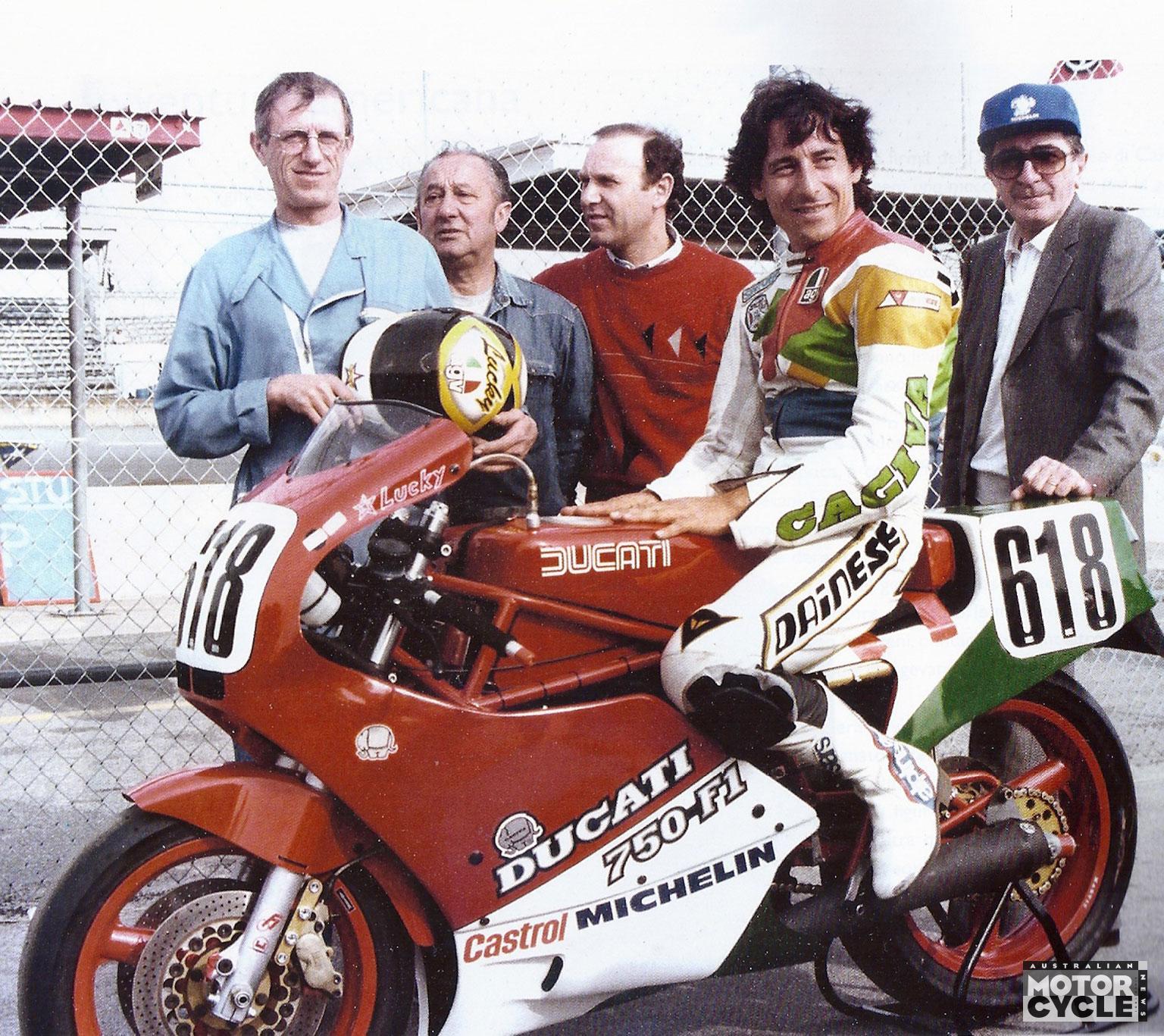
And though by later Superbike standards the 851 was a reasonably light bike, weighing in at 150kg half-dry even with the generator and self-starter fitted, it took some effort lifting it up to exit a turn, such as at the first corner after the pits at Misano, or flicking it from side to side.
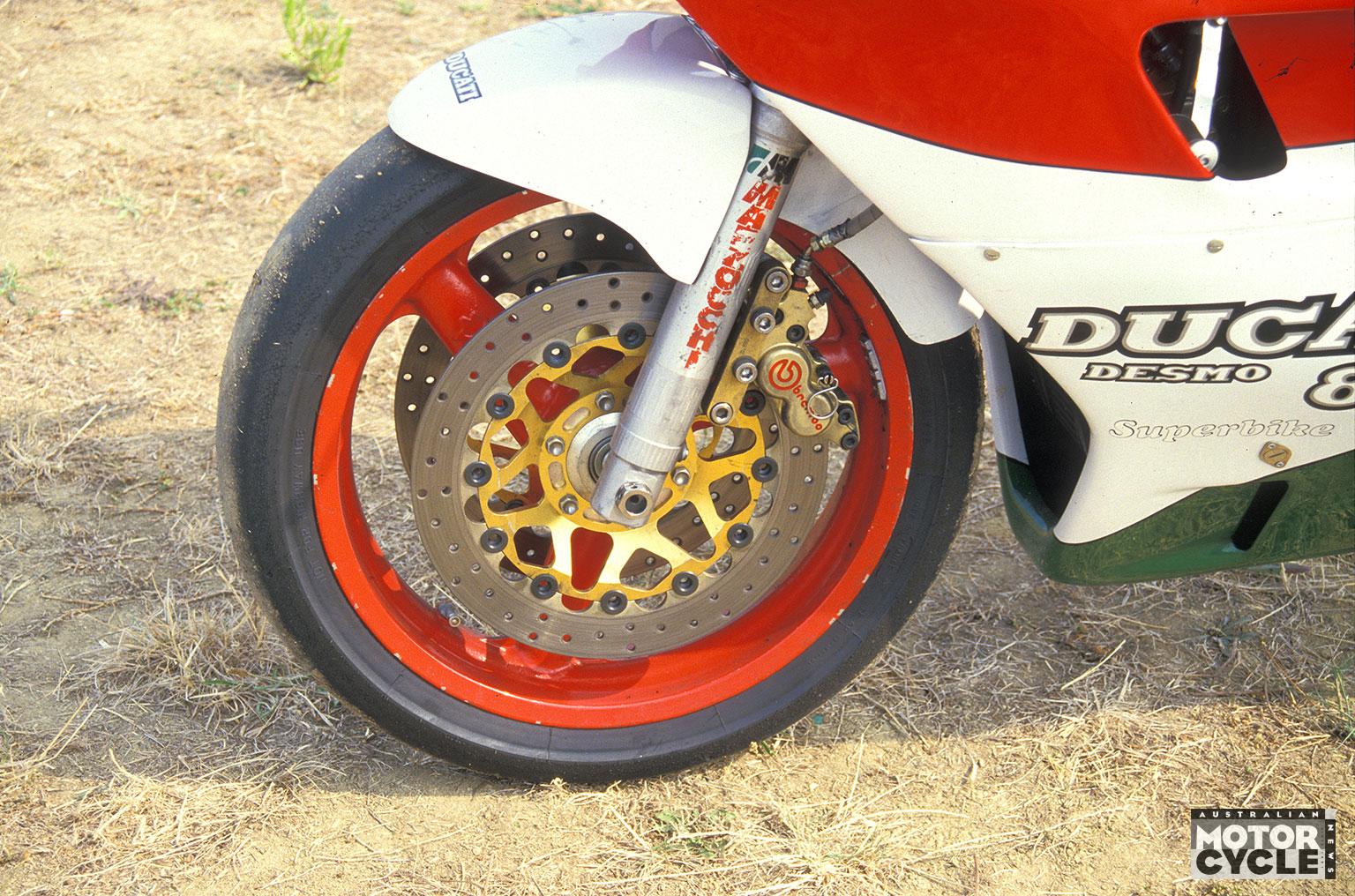
However, the Ducati’s handling, and the good bite from the 320mm Brembo front brakes, coupled with the engine braking offered by desmo valve gear (although I heard Marco have a good stab at knocking out the big end the night before, backshifting to third at about 12 grand for the Turn 2 hairpin – in those pre-slipper clutch days, you had to be ready to finger the clutch lever to stop the rear wheel chattering when slowing for a tight corner!), plus the good damping by mid-80s standards of the M1R Marzocchi fork – all that was secondary to the real heart and soul: an incredible water-cooled eight-valve engine that really performed above 10,000rpm.
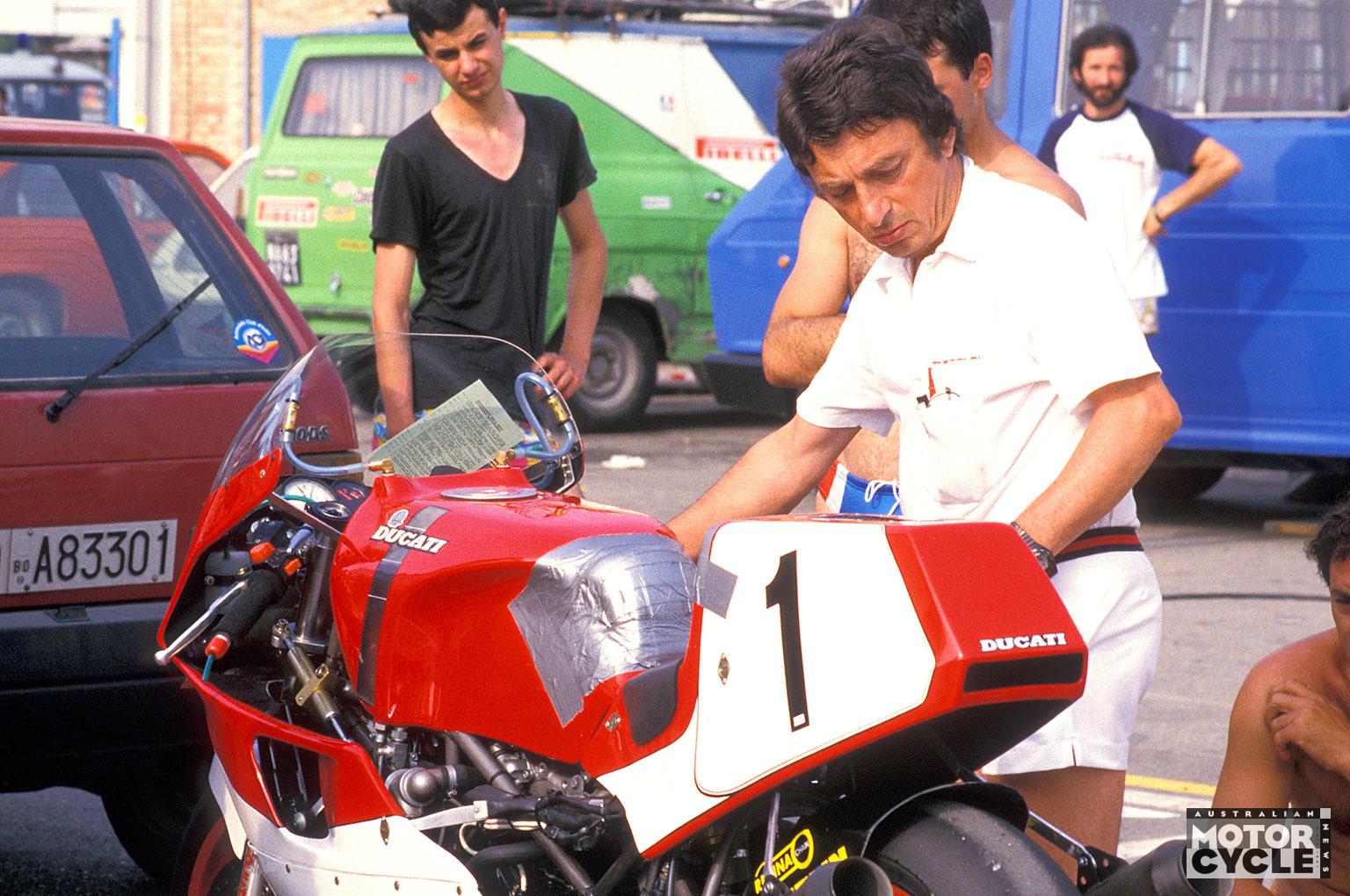
Yet this remarkable power hadn’t been achieved by forfeiting the legendary punchy rideability of a desmo V-twin. In fact, up to about 9500rpm the 851 gave the impression of being a sort of super-Pantah, both from its sound and feel. Just like any racing Pantah ever made, the 851 would pull cleanly away from about 2500rpm without any use of the clutch, although it wasn’t until 6000rpm that you got a strong shove in the back and serious power began to get delivered. Then suddenly the needle on the traditional white-faced Veglia revcounter would hit 9800rpm – and all of a sudden you’d be in orbit.
Chameleon-like, the Ducati took on an entirely different character: the engine note changed from a throb to a rasp, the exhaust from a thunder to a howl, as you felt yourself catapulted forward with decisive force. Still, it wasn’t a sudden increase in power that was hard to control, like with a rotary-valve stroker or a peaky four-cylinder Superbike, but a definitely thrilling surge of super-power that was distinctly noticeable once the engine revved above the five-figure mark.
There was a red line painted on the Veglia tacho’s glass at 12,000, and that’s how many revs I used in my test, to impressive effect, for this was the rationale – justification, even – for Bordi’s decision to break with Ducati tradition and design the world’s first eight-valve desmo V-twin.
Given that the old Pantah two-valvers couldn’t hope to surpass 10,000rpm reliably in 850cc or even 750cc form, there was no way to unlock the greater power outputs available farther up the rpm scale without resorting to four valves per cylinder.
In common with all Ducati V-twins ever made, the 851 had no significant vibration, even at higher revs, although the clutch lever pull was pretty stiff.
The prototype desmoquattro also had that unmistakable whine of one straight-cut gear meshing perfectly with another. This is the kind of noise you hear in a Ferrari or Maserati sportscar. It’s the sound of Latin engineering excellence. So it was inevitable that the desmoquattro Ducati streetbike would scale the same peaks of desirability in two-wheeled terms as such four-wheeled Italian exotica.
For the original 748-851 Ducati desmoquattro prototypes were unique then, and the production versions remain so today among the world’s most discerning collectors and enthusiasts. They are a mechanical tour de force, bristling with technical novelty and engineering allure, able to challenge the dominant performance of a Japanese four.
Riding the prototype eight-valve Ducati at Misano underlined the extent of Massimo Bordi’s achievement in ushering in a new standard in twin-cylinder engineering.
The day we all got desmoquattro’d at Daytona on the 8V/851’s track debut was the start of a quarter century of twin-cylinder Superbike supremacy for Ducati, which led in turn to its MotoGP dominance – the start of a story that’s still being told today.