Rain doesn’t just test the skill of the riders. MotoGP expert Peter Bom shows how every bike is transformed to survive – and thrive – on a slippery track
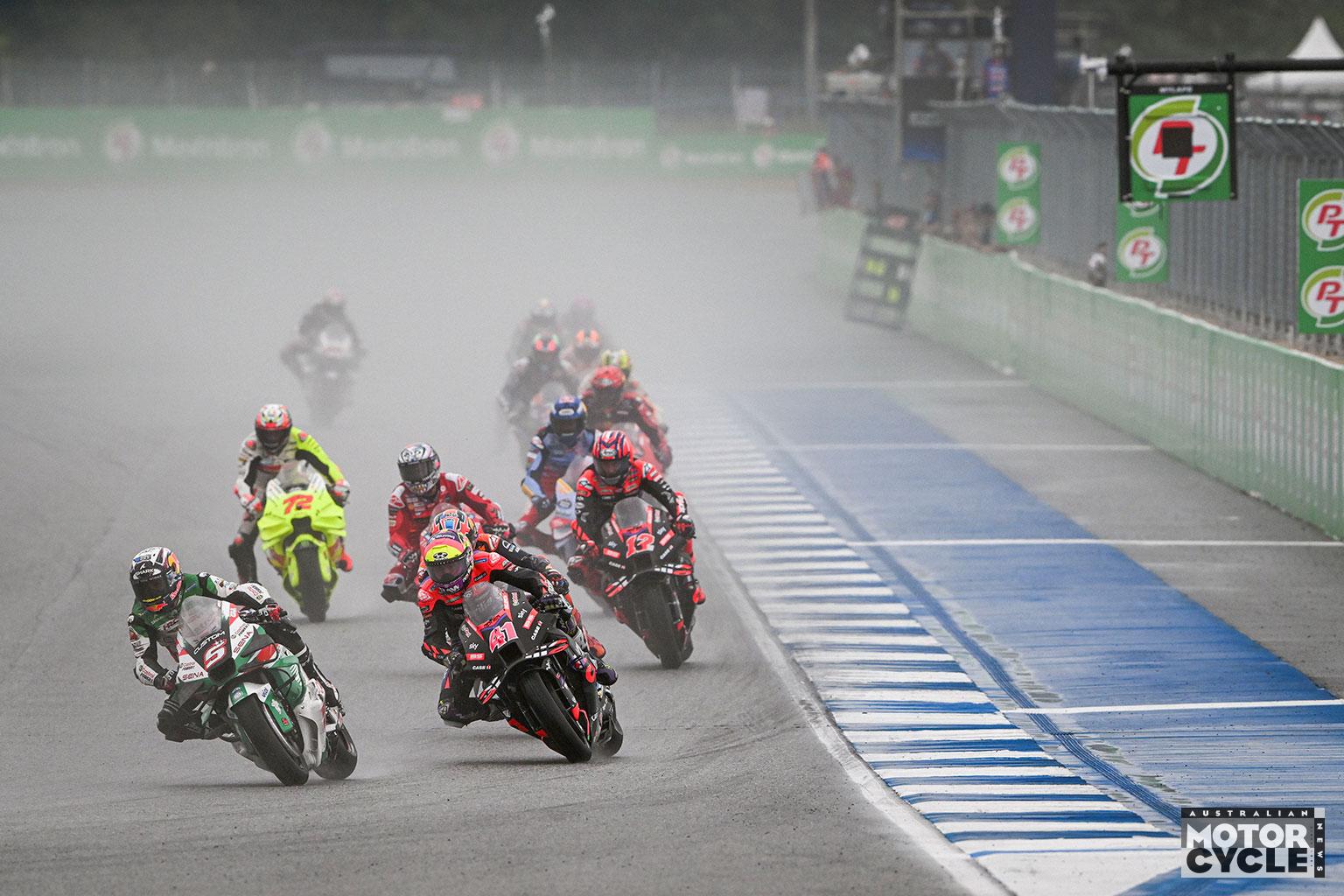
Accelerating, braking, leaning into corners… MotoGP races are won by riders who excel at the limit of grip. But what if it rains and grip suddenly decreases significantly? To be well-prepared for racing on a wet track, MotoGP bikes are modified and the set-up is altered. Here is the how and the why.
Get a grip
First, the theory: tyre grip depends on two factors: the coefficient of friction (think ‘roughness’) between the tyre and the road surface, and the load (think ‘weight’) on the tyres. This load is largely due to weight, but also to the position – the motorcycle’s position, so to speak. When braking, more load shifts to the front tyre; when accelerating, it shifts more to the rear. This shift is useful, as it moves the grip to the wheel that needs it most.
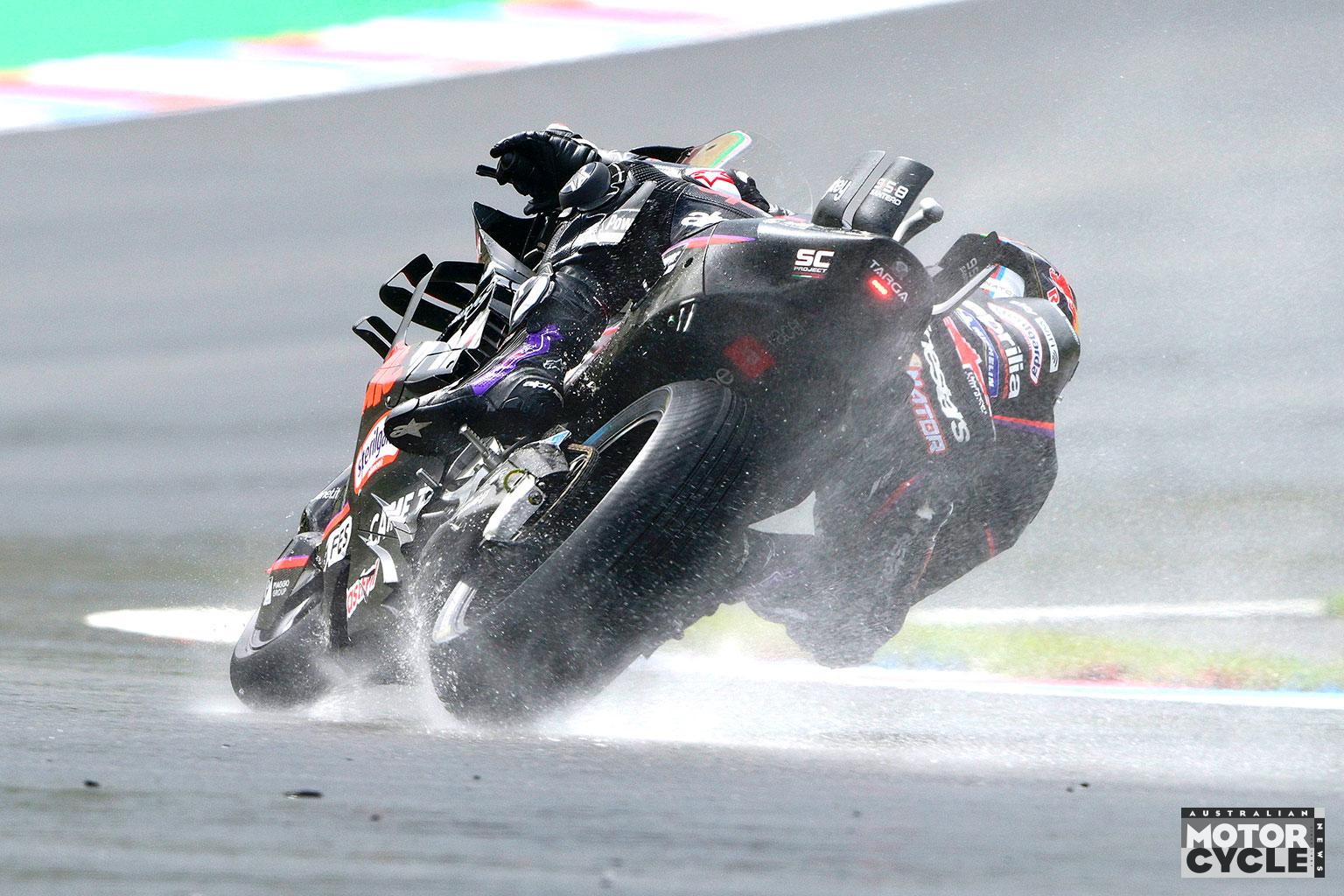
On a wet track, friction obviously decreases, meaning riders brake and accelerate less aggressively. This makes everything more difficult, because with less weight being shifted, the load on either the front or rear wheel doesn’t increase much during braking and acceleration. So, it’s a double downer. But, fortunately, there are ways to somewhat mitigate the loss of grip and tyre load when racing on a wet track.
Change everything
Because the grip limit on a wet track is reached much faster, it’s necessary to change a whole bunch of parts and settings on the bike. This is because, to ride fast in the wet, just fitting rain tyres and saying a little prayer is no longer sufficient.
While rain tyres used to be nothing more than extremely soft slicks with some grooves in them, today they’re completely different tyres with their own unique construction and compound. The carcase (or ‘chassis’) is softer to allow sufficient flex under the reduced load of racing on a wet track. This deformation helps maintain a sufficiently large contact area between the asphalt and the tyre. At the same time, this constant deformation also creates the necessary heat within the tyre. Michelin’s MotoGP rain tyres operate at temperatures as low as 45°C (where slicks require 100°C). This is important because rain tyres are essentially water-cooled!
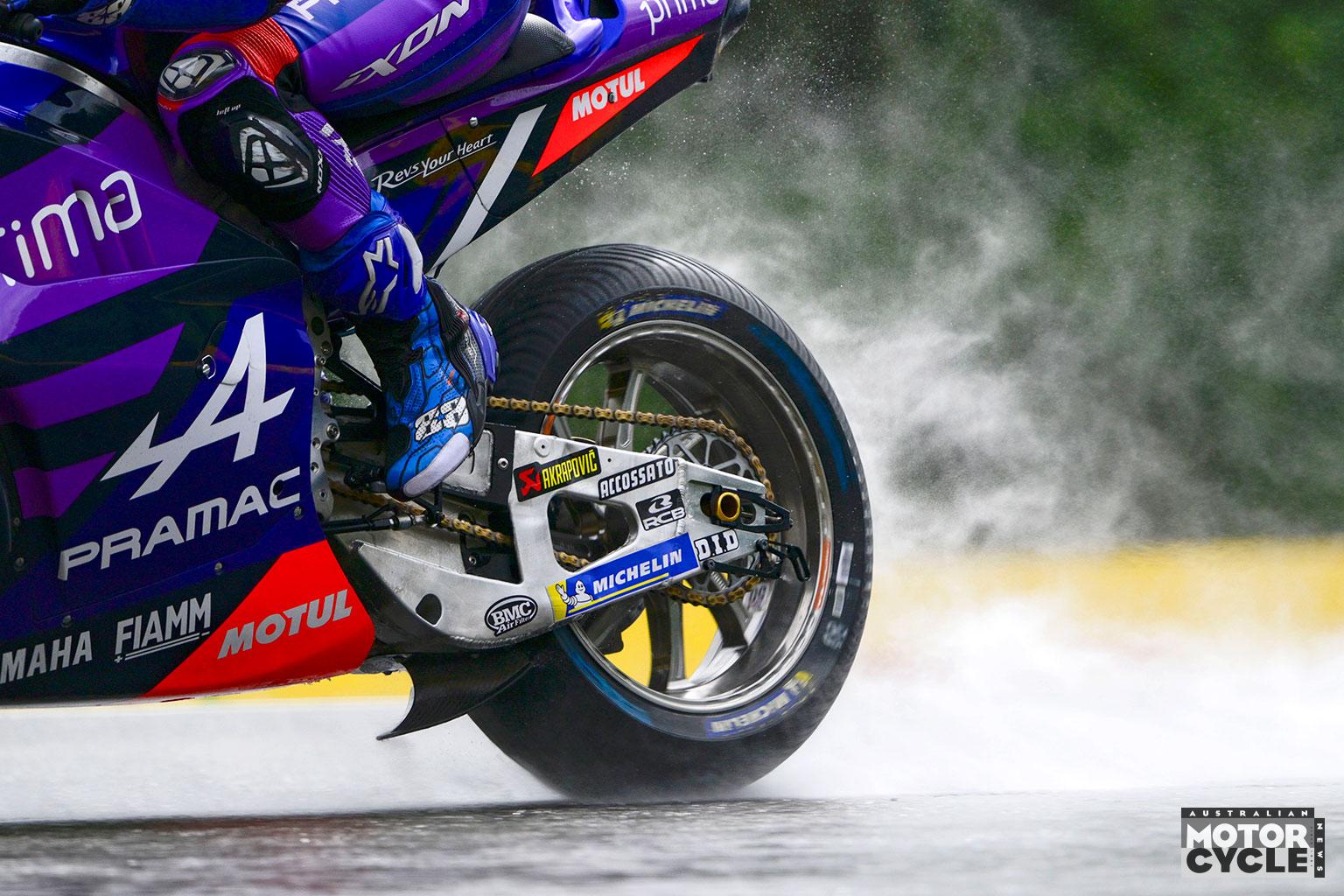
So rain tyres are not made of super-soft rubber, but instead are made from a compound that is rich in silica. This clever stuff significantly increases grip at these low temperatures.
To ensure significant water drainage even at high speeds, wide grooves have been engineered into the tread. Their job is to prevent a thin film of water from forming between the tyre and the road surface, causing aquaplaning. And it’s the ultimate nightmare because, when it occurs, all grip is suddenly gone, making rider and bike sail off the track without any hope of recovery.
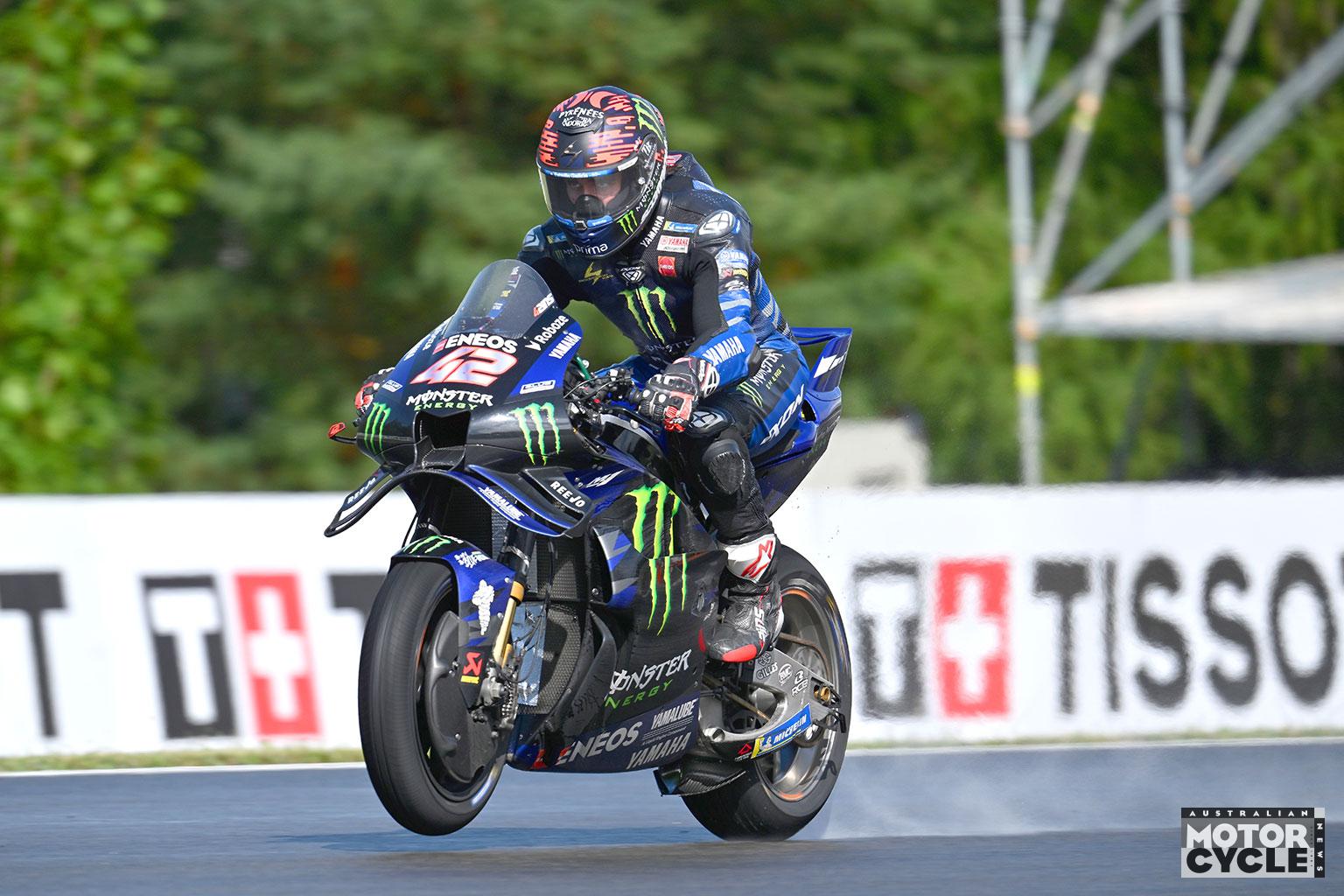
The width – but even more so the direction – of these grooves determines the direction in which the tyre must transfer forces.
Consider this: the front tyre primarily handles braking when riding upright, followed by lateral forces during cornering. The rear tyre primarily provides acceleration but also has to withstand lateral forces during cornering.
Work in progress (pitbox)
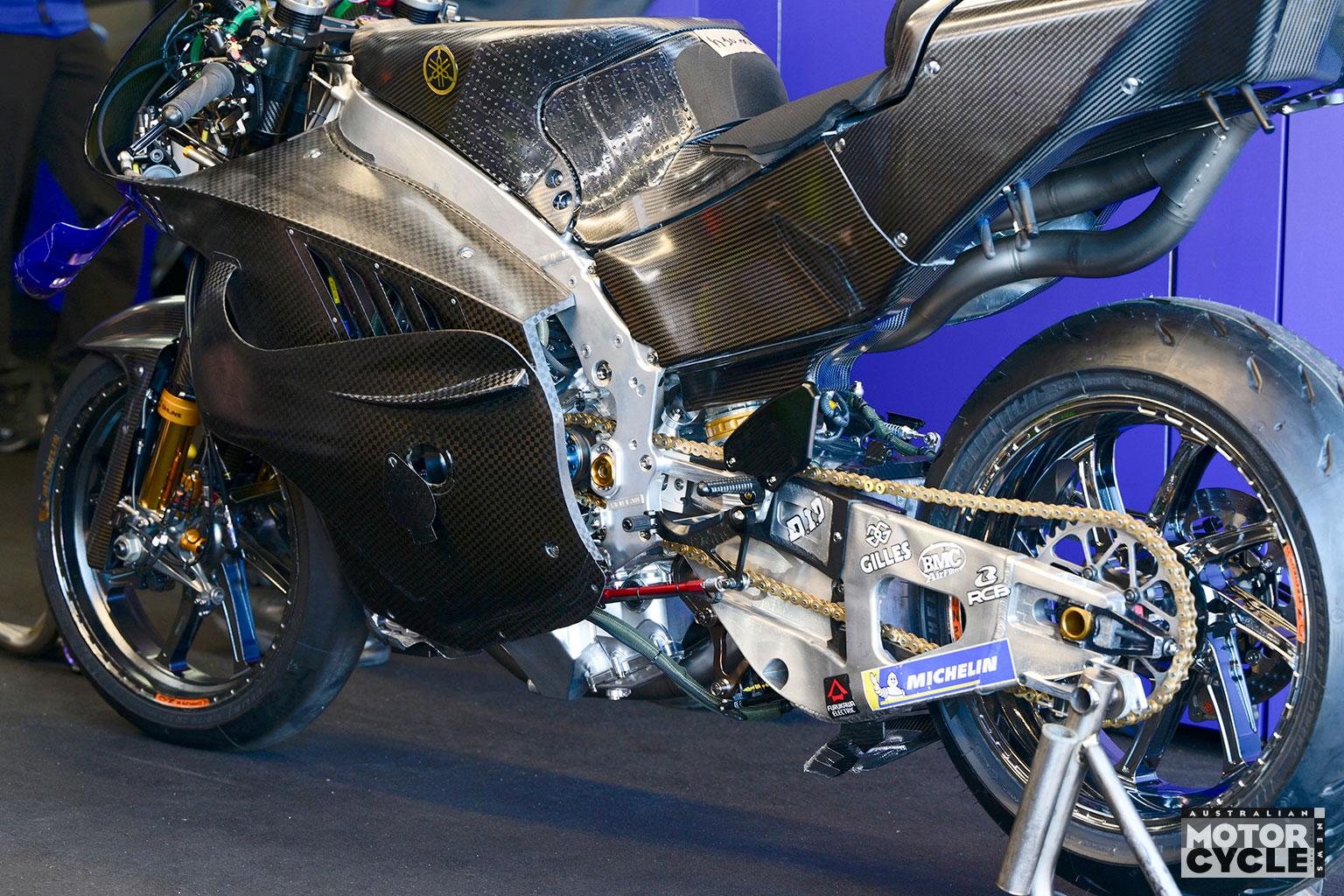
When the heavens open and the mechanics are instructed to prepare the bike for a wet track, they start by opening the front fork and removing the shock mechanism. Softer springs are needed front and rear, because this will help the bike to ‘pitch’ enough to reach the same position under braking, accelerating and cornering as it would on a dry track.
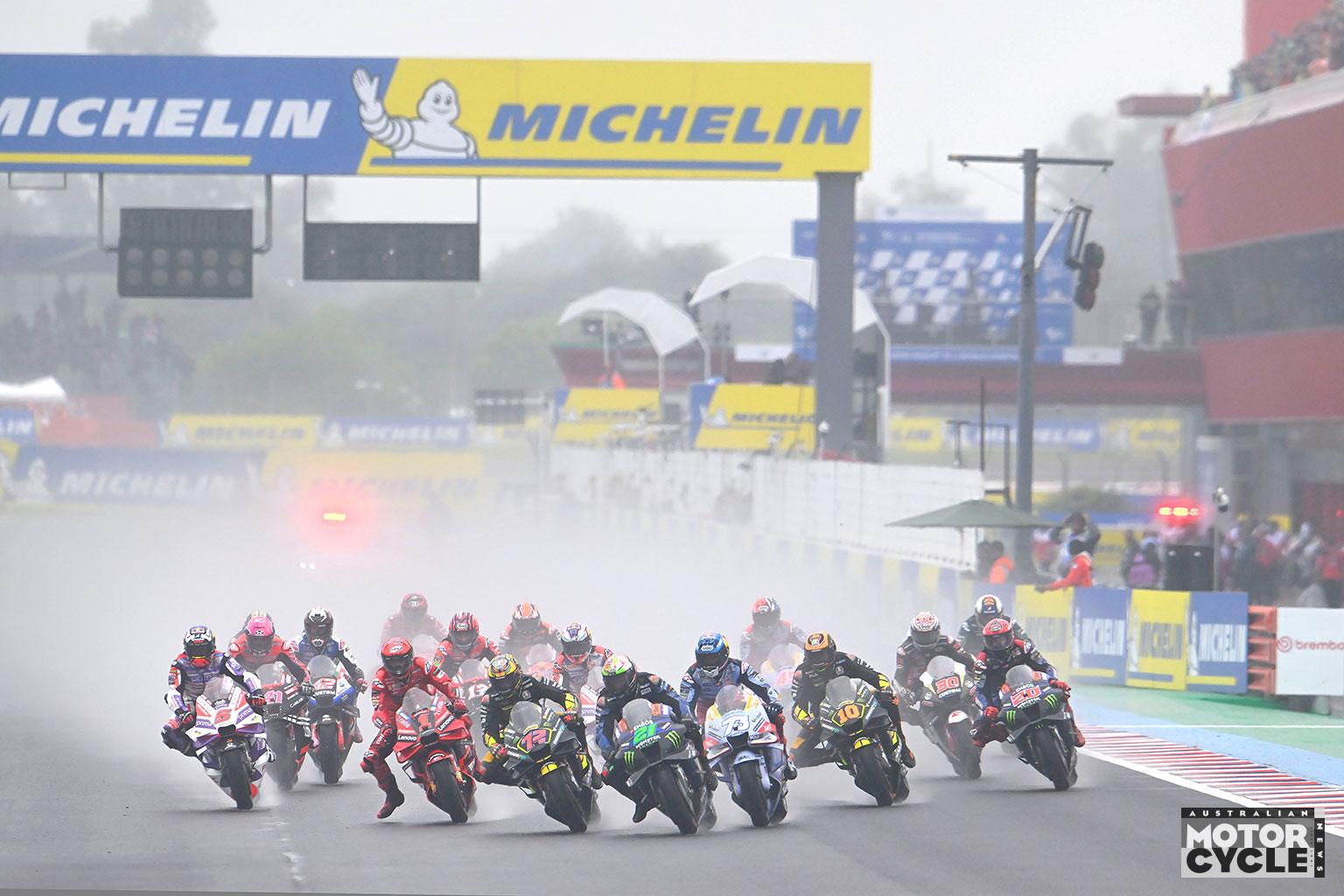
A bike tuned for dry weather won’t pitch forward sufficiently under braking in the rain, and the rear end won’t drop enough when the throttle is opened. On the wet, everything has to happen more smoothly, making the bike’s attitude change less. Without setting the bike for ‘the wet’, it would effectively become too ‘hard’.
The damping of the front and rear suspension is also opened a few clicks, thus setting it softer. This makes sense, because all suspension movements are somewhat smoother on a wet track, and the damping can therefore allow for a bit more movement.
The shock absorber itself is also replaced because its internal settings also need to be different. This includes a softer top-out spring and a softer setting for the shim pack.
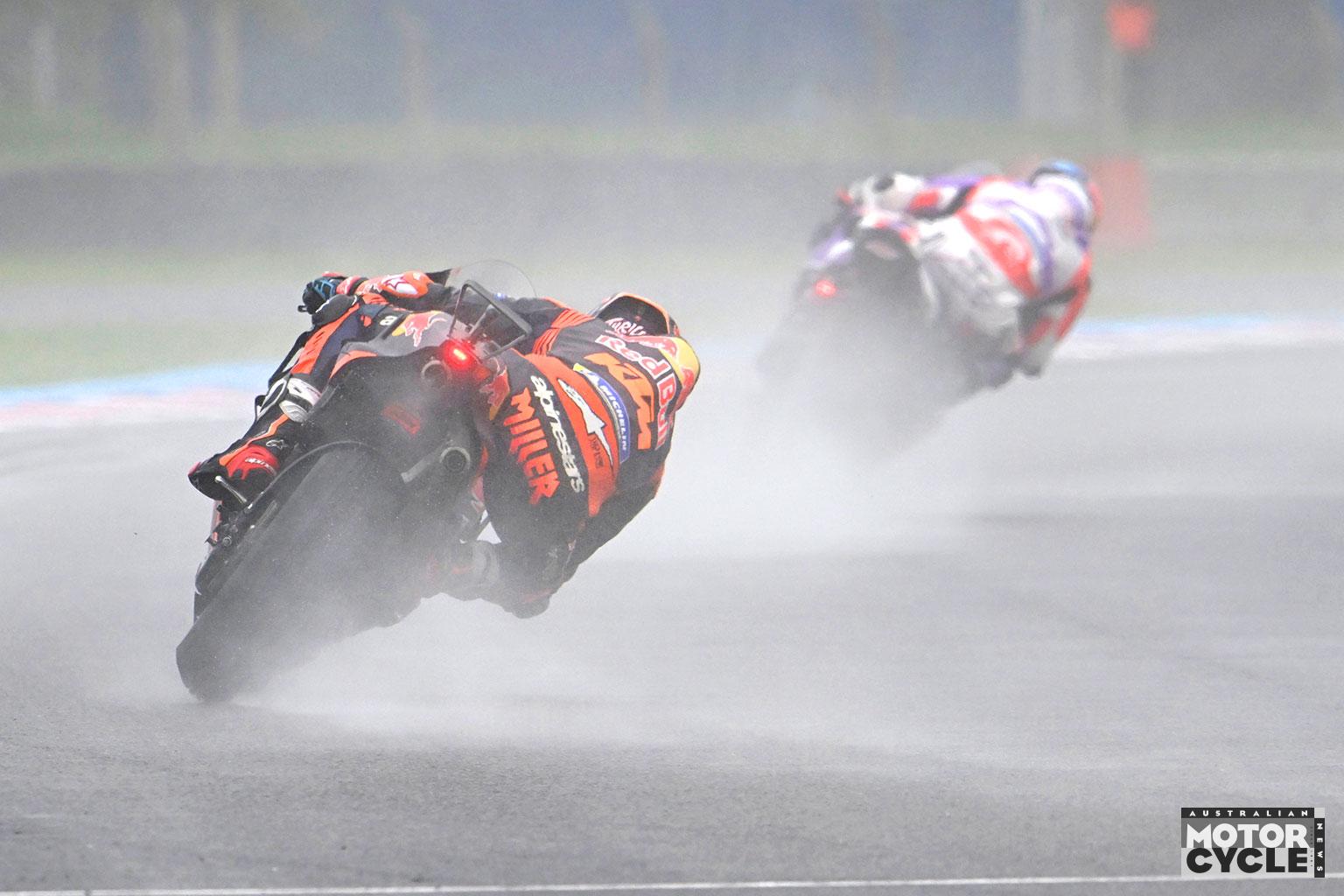
The steering damper is also slightly loosened to achieve a more precise steering response.
To maintain the crucial feel of the front brake, carbon brakes are also being used in the rain. However, because carbon brakes cannot be used below 200°C, only thin brake discs are used, which are also completely hidden behind covers, preventing wind and water from cooling them too much.
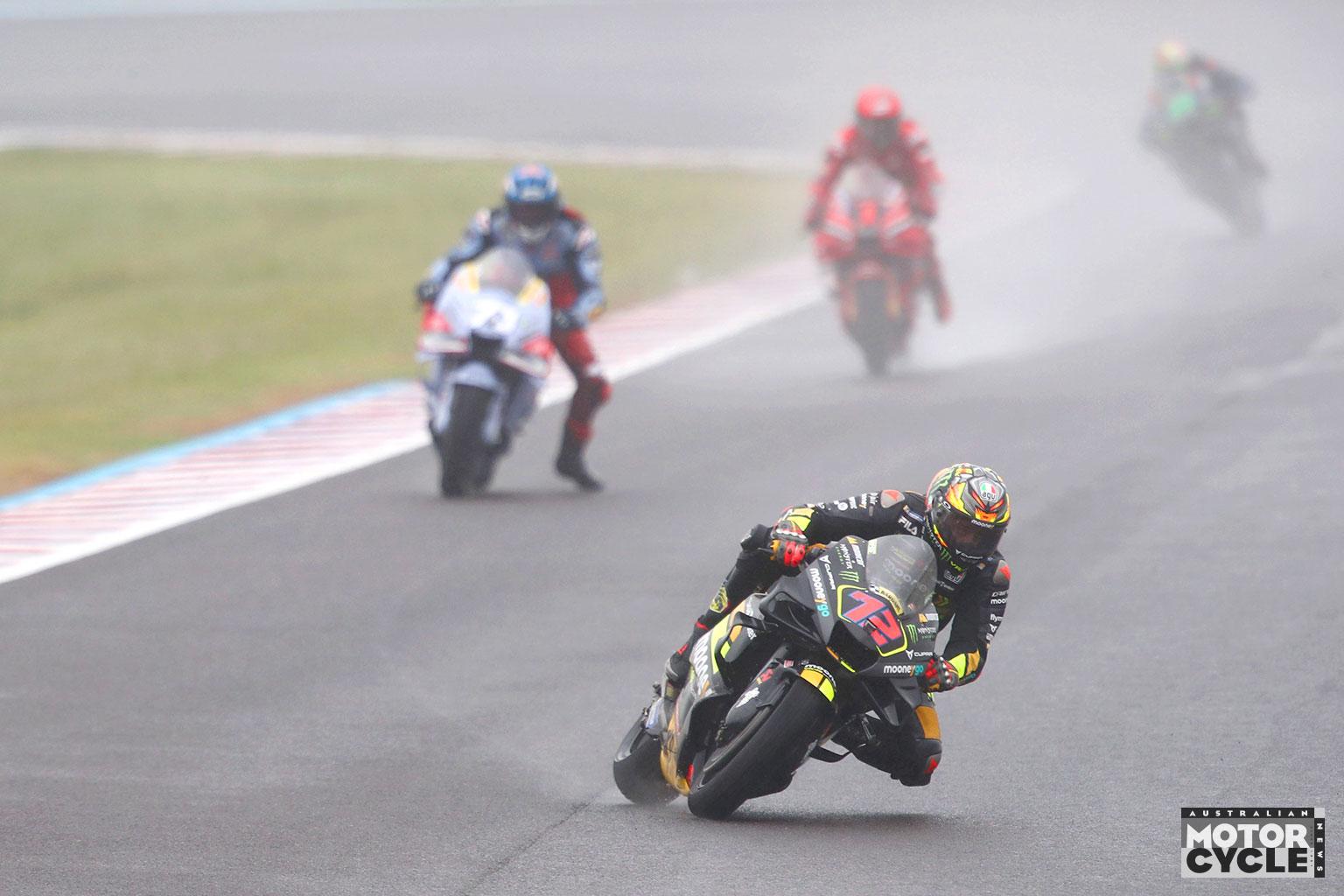
One more step
Sometimes it’s necessary to go a step farther. For example, the swingarm pivot can be positioned a bit lower, which helps the motorcycle drop a little more at the rear when the rider accelerates. Sometimes, instead of replacing the shock absorber, the linkage is replaced. A ‘softer’ link works effectively the same (almost) as a softer spring but is often easier to replace.
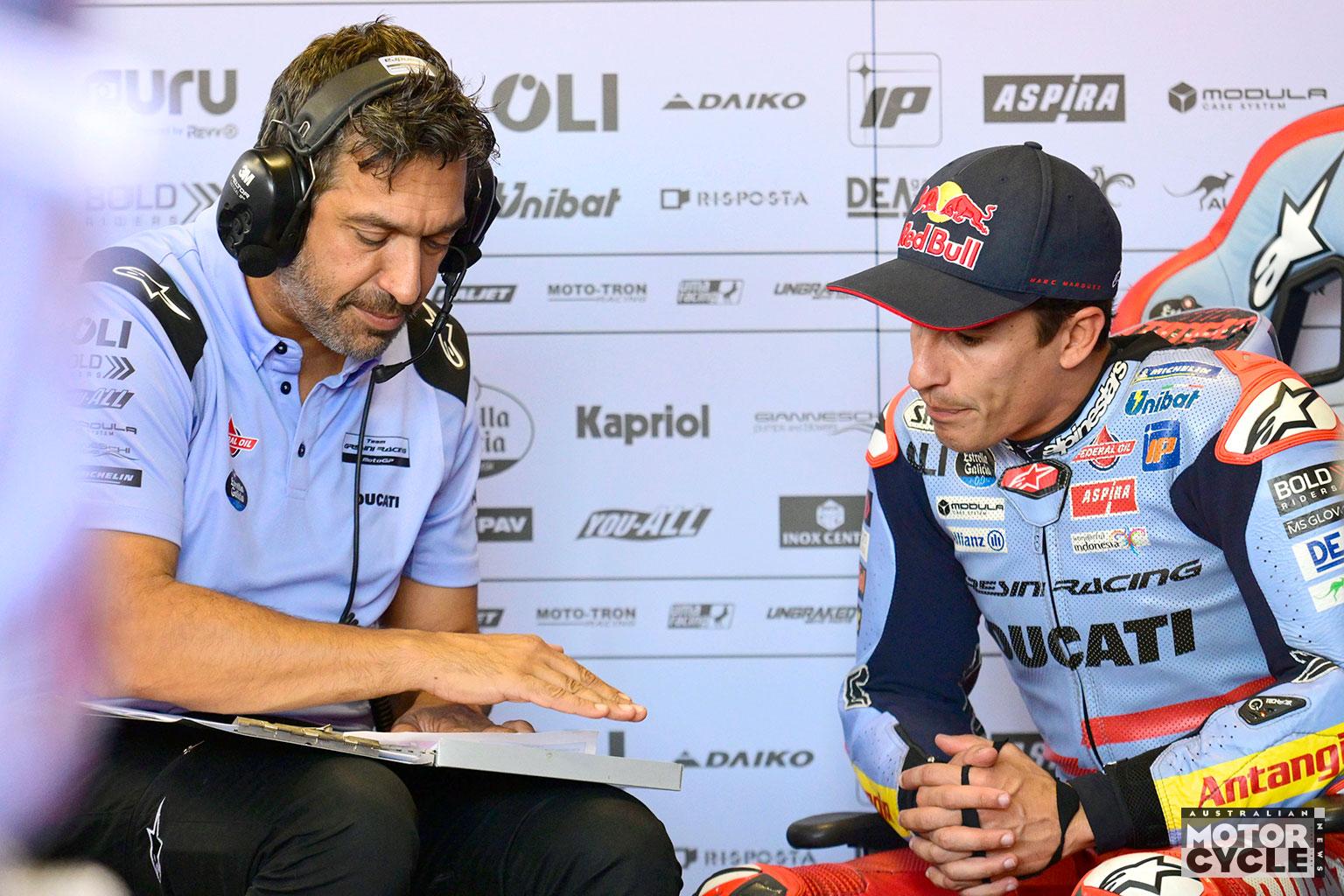
Frankie Carchedi – crew chief for Marc Marquez in 2024 – told me that he once even had the entire swingarm replaced for Marc: “I was probably the first crew chief to have a different, laterally more flexible swingarm installed for the wet conditions, and with success! But that made the conversion from dry to wet very long for the mechanics, at 45 minutes.”
How electronics should work differently on a wet track
While the mechanics are busy with shock absorbers and springs, the electronics engineer has to roll up his sleeves too, as the ECU settings also need significant changes. From traction control to engine braking and from power modus to torque maps, virtually everything needs to be adjusted. And all in the softer direction.
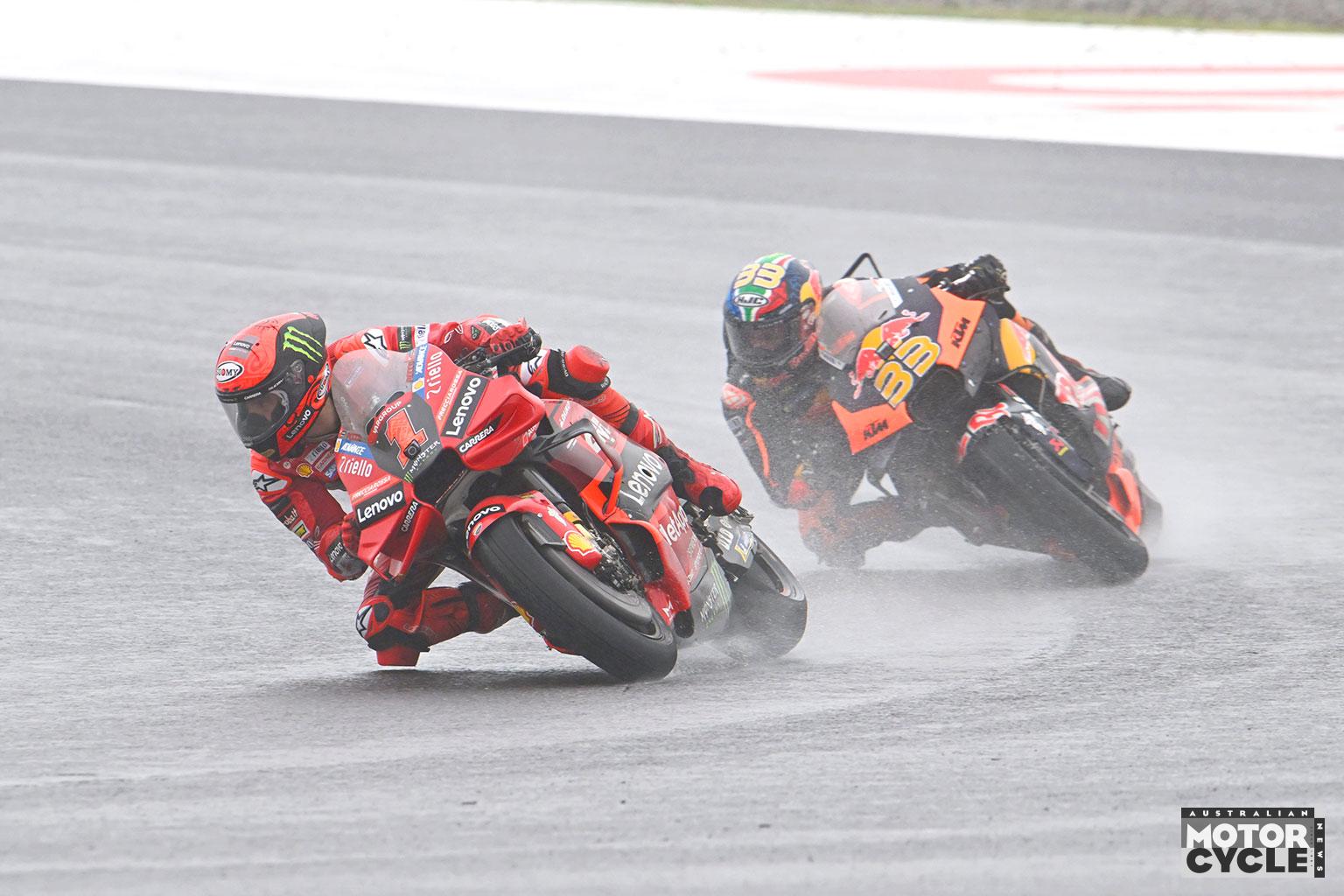
The goal here is to help the rider use as much of the 300-plus horsepower as possible, while at the same time giving him more feel and more room to play with the throttle. Limiting the excess available power is crucial here. This gives the traction control an easier life, and has the engine respond extra smoothly to the rider’s input. Remember that on a wet track, these bikes can still reach lean angles of 45 degrees and more so you really want a predictable and smooth initial throttle pick-up here!
A special rain helmet
Riders themselves also have to adapt to riding in the rain. This isn’t just a mental adjustment but also involves their gear. When it’s wet and cold as well, a kind of rain jacket is used. This thin, flexible, sleeveless jacket connects the front and back at the bottom between the legs to prevent it from rising up while riding.
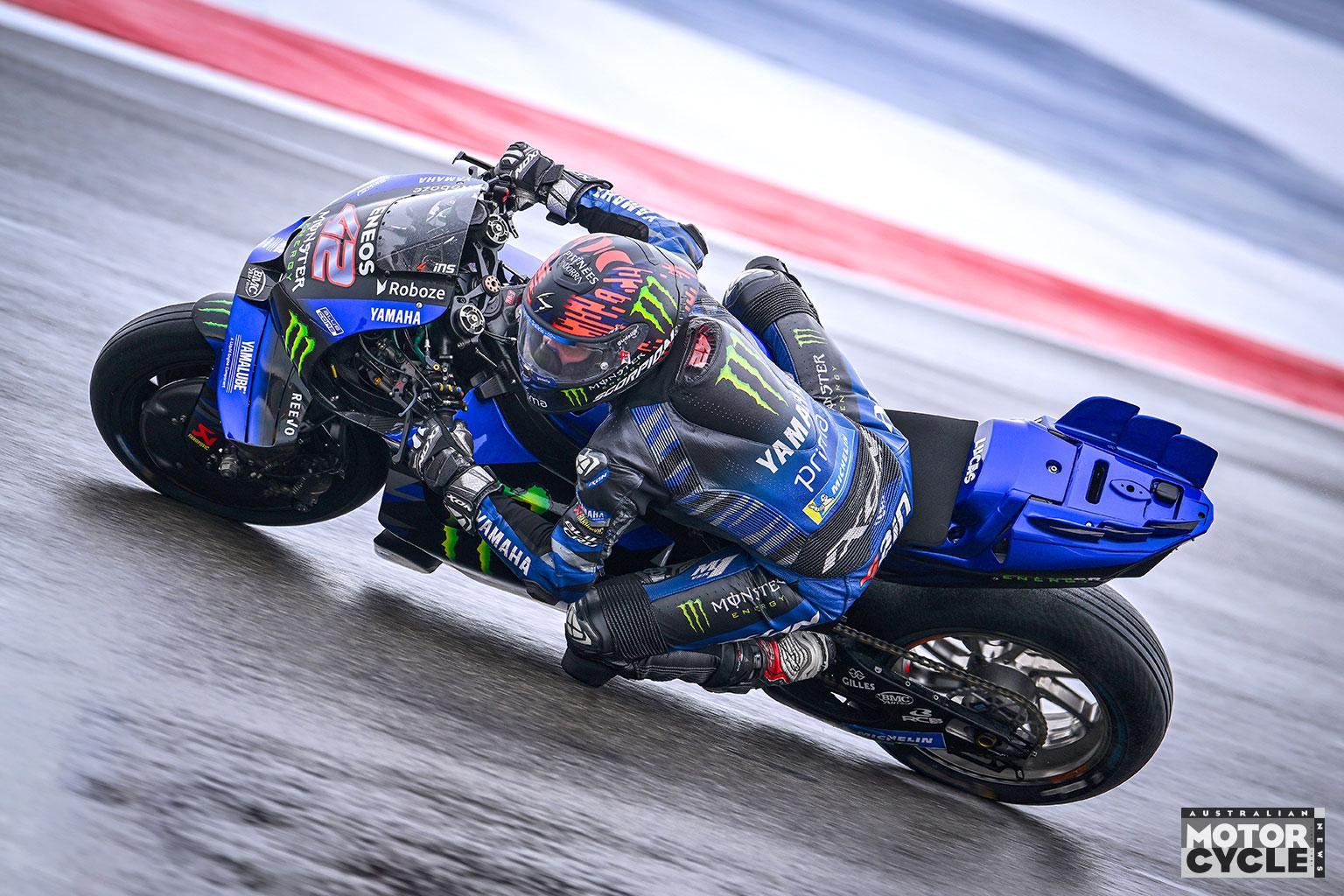
Good visibility is crucial, and even more so when riding in the rain; that visibility is already significantly limited by the spray of water thrown from the bikes. But, unlike riding on a dry track, riders need to be able to ‘scan’ the rapidly appearing wet track extremely well for small colour differences that indicate puddles or slippery patches, white lines, and the eventually slowly drying riding line. It’s therefore crucial to keep the visor clean and clear.
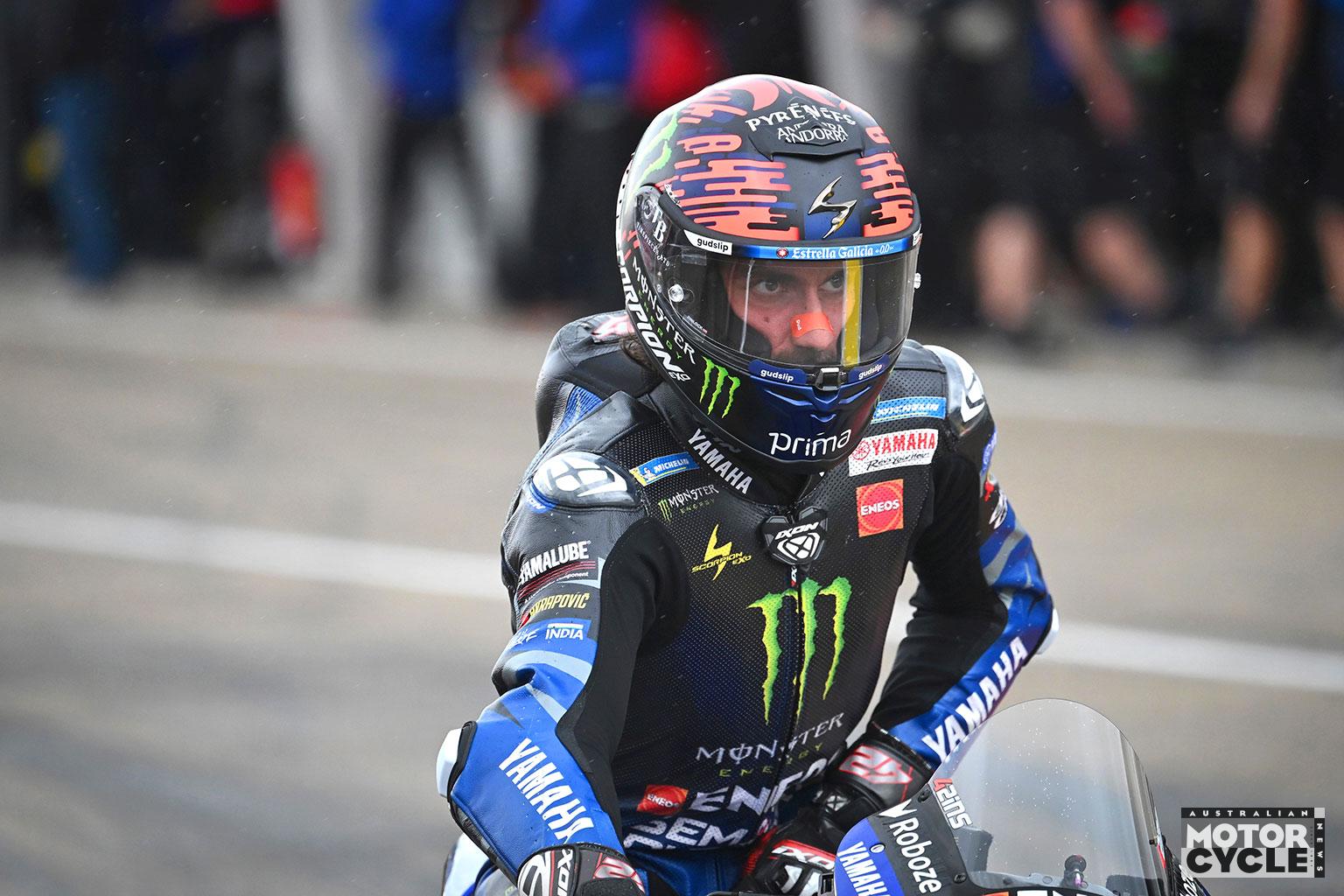
Unfortunately, this has proven to be quite a challenge, especially on a MotoGP bike.
The main enemies are fogging on the inside of the visor and incoming water droplets. The cause? MotoGP engines generate a lot of power, which means they also radiate a lot of heat. And at lower speeds, this rising heat can lead to fog on the inside of the visor. Rain also means a lower outside temperature. Therefore the warm breath of the riders, combined with the warm air rising from the bike, will more quickly cause the visor to fog up. Visibility will be further impaired if incoming water droplets reach the visor.
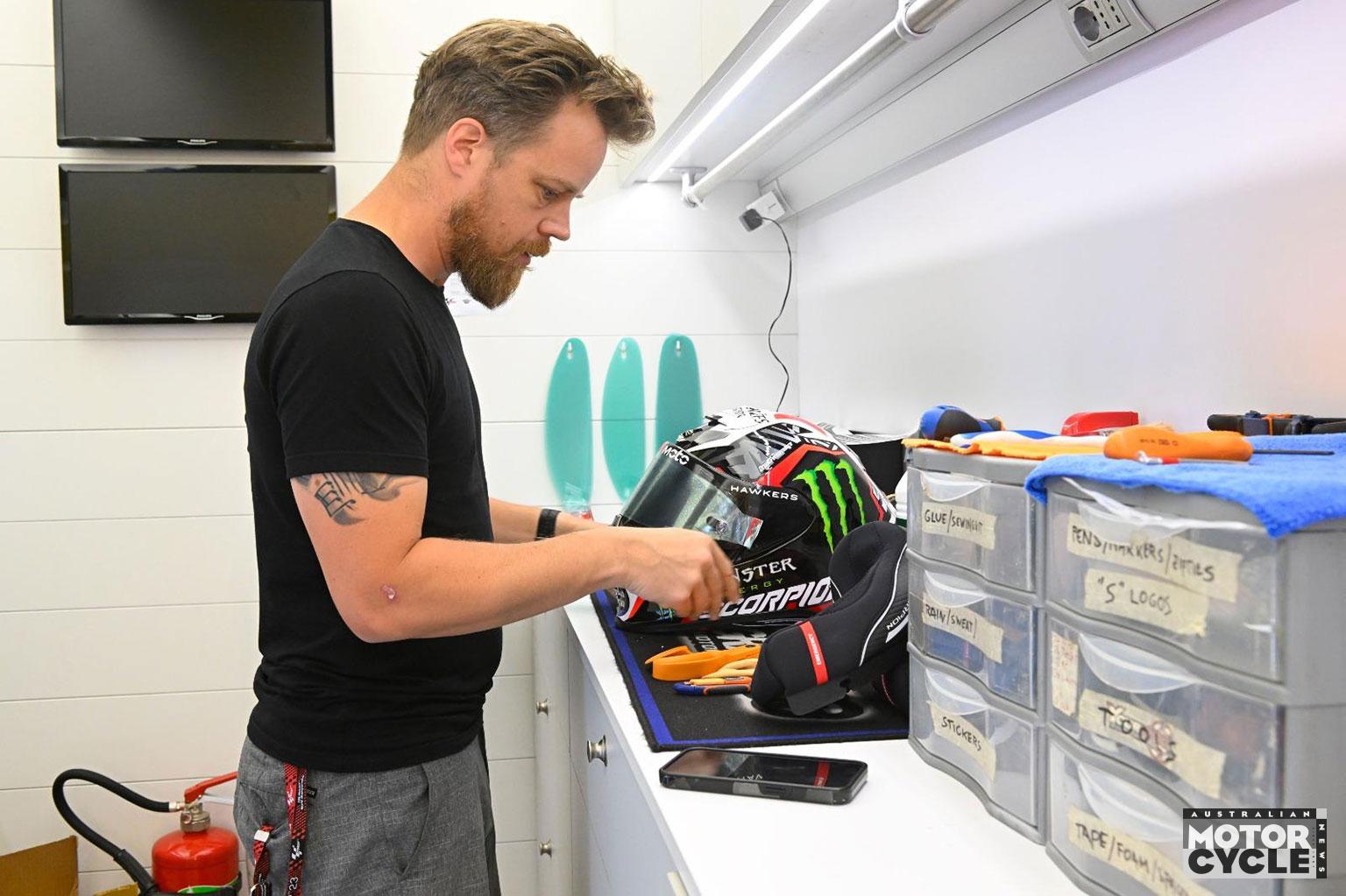
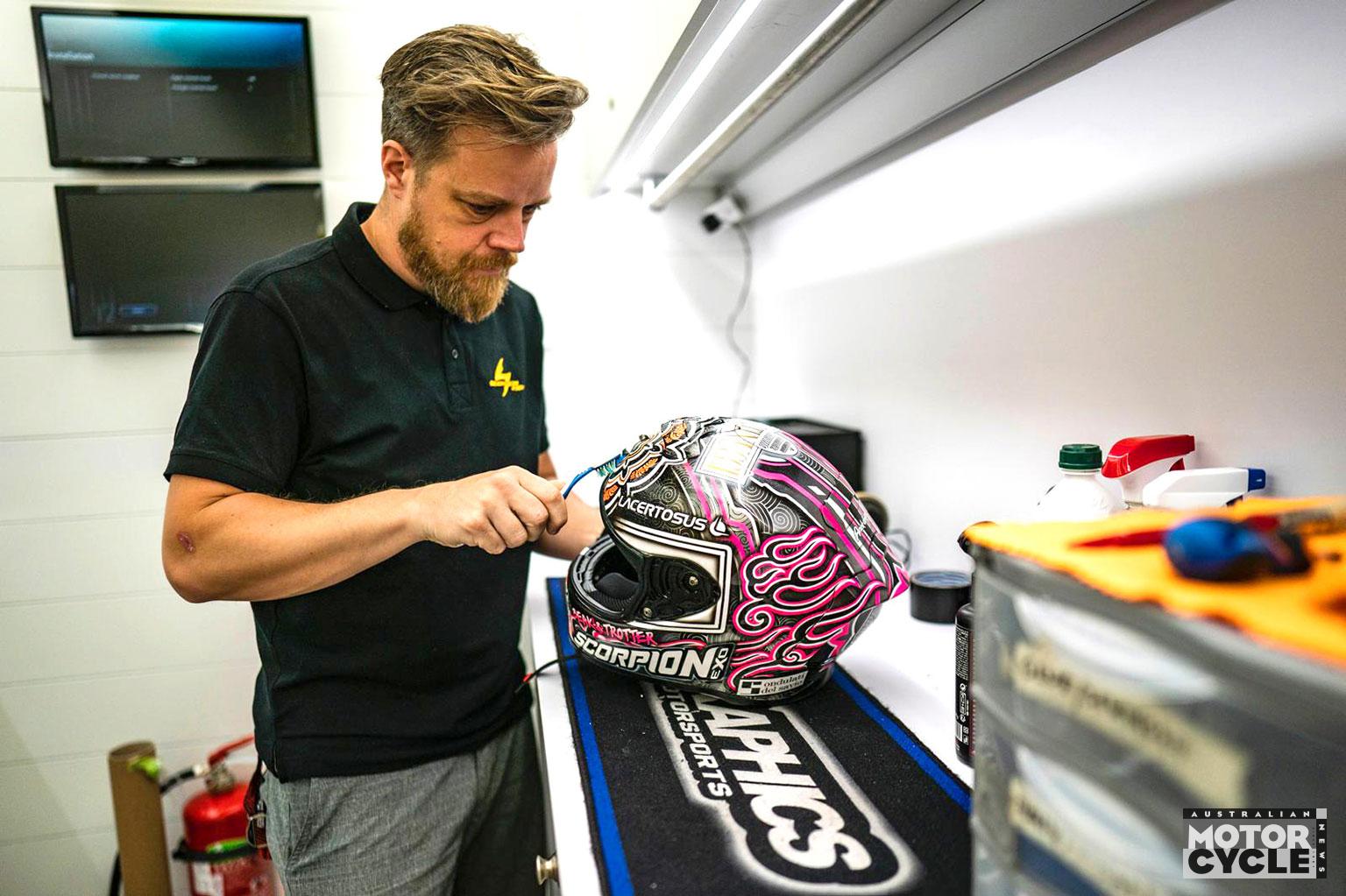
Jarno Bijma knows all about this. He’s responsible for the supply and support of Scorpion helmets (including for Alex Rins) in the MotoGP paddock.
“In bad weather, helmets are always a bit of a balancing act between preventing fogging and keeping water out,” he explains. “If you seal the helmet completely, you have less chance of water getting inside but also less ventilation, which in turn increases the risk of fogging.”
In MotoGP, riders wear a kind of mask under their helmet in the rain. Fitted with a soft rubber edge, it seals the rider’s mouth and nose, with only an opening at the bottom, far from the visor.
A visor equipped with the well-known ‘pinlock’ system (or a variant) is also used. For those unfamiliar with it: this is a kind of ‘double glazing’ applied to the inside of the visor. This insulates and thus prevents the dreaded fogging.
Nyck de Vries is Kabuto’s (Joan Mir, among others) paddock man.
“We always carry a specially prepared rain helmet for each of our riders,” he says. “It has a clear visor with a rubber trim on the top to prevent water from getting inside. We’ve also sealed all the ventilation holes. Kabuto has its own rain visor with special tear-offs on the outside for use in rainy conditions. These can help the rider maintain good visibility, because not only water but also mud and other stains can be easily removed using the tear-offs. These are specially prepared with water-repellent material and special tape to keep water out.”