Motorcycle racing is a technical sport. But machinery isn’t everything. A good rider can potentially get more out of an average bike than an average rider on a good bike.
Talent will out. That’s why it’s a genuine sport, rather than just a mechanical tug-of-war. As Marc Marquez continues to demonstrate.
Yet as technology has advanced, hand in hand with rules that limit that technology, aiming at making the bikes more equal, some differences that should seem to have been ironed out have instead been magnified.
Take the recent Austrian round of MotoGP. The difference between Marquez’s winning Ducati and third-placed Marco Bezzecchi’s Aprilia was less than 3.5 seconds after 28 laps and 121.6km, just over a tenth of a second per lap. (I choose the third finisher for reasons that will become clear.)
Yet the best Yamaha, in a woeful weekend for the beleaguered Japanese factory, was that of Fabio Quartararo – 15th and fourth from last (three other Yamahas behind him), a massive 25.25 seconds down. He’d lost all but a full second every lap.
The Ducati and Yamaha differ mainly in that the former is a V4 and the latter an L4, but might have been in different classes.
It is not the riders making the difference.
Granted, Marc’s on a higher plane at present, but Quartararo isn’t average. He’s overcome the Yamaha’s weaknesses with four poles and two podiums this year. It’s more the stop-and-go track that negates cornering prowess, Yamaha’s strength, in favour of braking and acceleration.
But the point here, and the reason for comparing Marc with the third-place Aprilia, is not to highlight the performance gap between different bikes but similar ones.
In particular, Ducatis.
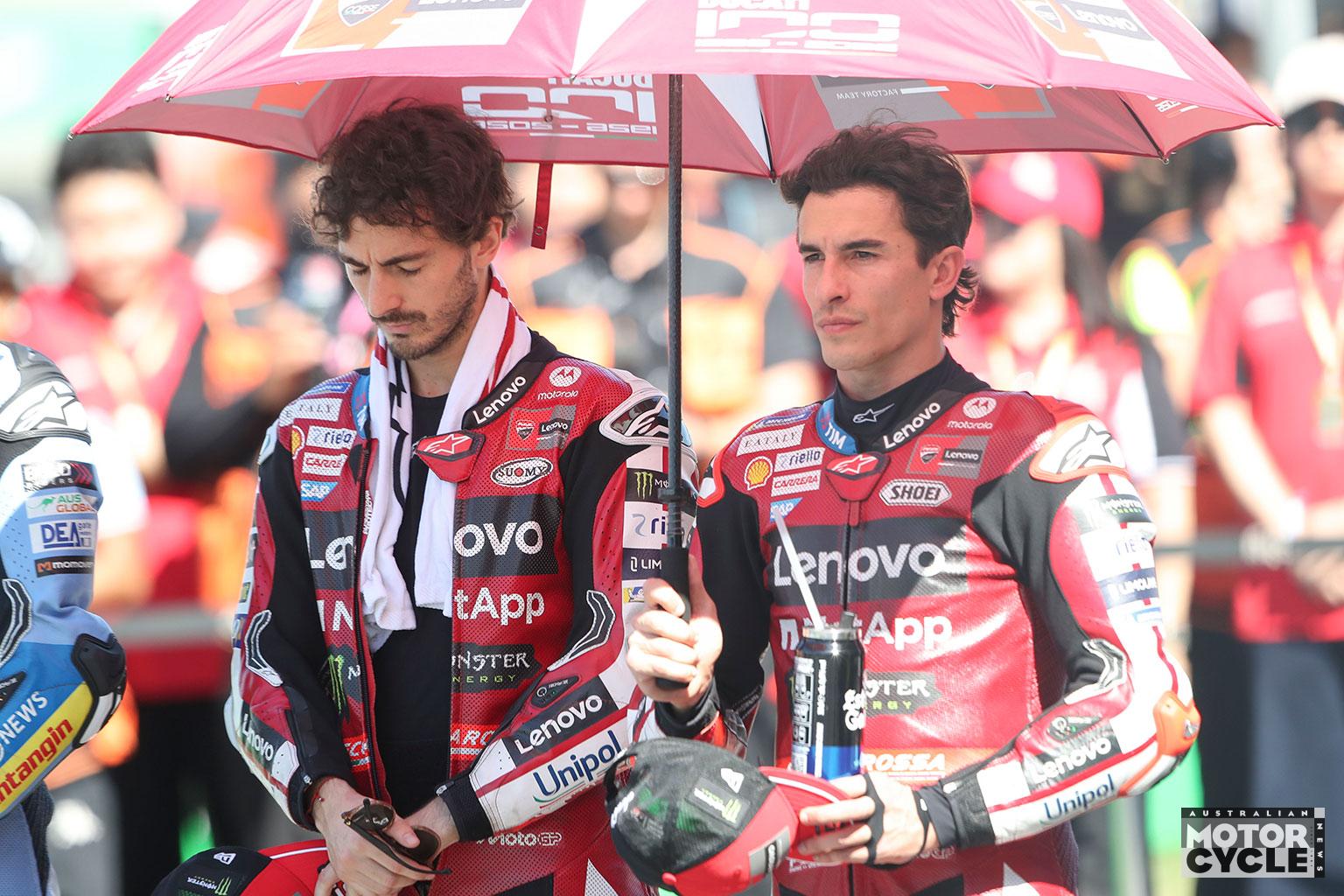
Marc rides the latest Desmosedici, the GP25. Two others have this machine: factory teammate Pecco Bagnaia and satellite rider Fabio Di Giannantonio. Pecco is a triple champion, Diggia a race winner in all three classes – no slouch.
Yet neither have been anywhere near Marc. Bagnaia’s at sea on the new bike… unable to reproduce his race performances from last year. In Austria, his 2024 time would have put him second by less than two-tenths; this year he was a disappointed eighth, 12.4 seconds away.
Marc’s main Ducati opposition, both in Austria and in the championship, has come from satellite-team riders on last year’s GP24. Younger brother Alex is second, and the latest challenge comes from his Gresini teammate, Austria’s second-placed 20-year-old rookie, Fermin Aldeguer.
Both have been somewhat surprising. Alex is a former Moto3 and Moto2 champion but his four MotoGP years had been patchy.
Aldeguer even more so, after four generally disappointing seasons in Moto2. But the bright hope has taken to the big bikes to the manner born.
His strong suit, strong enough to give Marc some worries, is throttle control and tyre management, leading to devastating late-race pace. Three podiums have all come by forging past much more experienced riders in the closing laps.
There is only one conclusion to be drawn. The latest GP25 is not as good a motorcycle as the GP24 it replaced.
It has taken the skill of Marc Marquez to make it a race-winner. A rider who won six world championships over seven years in this class riding an increasingly uncompetitive Honda that nobody else could get anywhere close to him.
The crash-prone Honda eventually hurt Marc so badly he lost five possible championship years, and sent him to Ducati.
Ducati has led technical development in MotoGP for all that time. Engineer Gigi Dall’Igna’s adventures with the rules have changed the sport, introducing aerodynamics and ride-height devices, and leaving rivals scrabbling to keep up.
But it looks like the 2025 bike has been a misstep that only Marc can overcome.
If nothing else, with a whole new 850cc generation coming in 2027, that misstep will give hope to Japan Inc.