25 years after Tamburini’s original stunned the world, MV’s latest Brutale does it all over again
Mind-blowing! That’s the expression the marketing mob at MV Agusta has designated as the one they’d like to pass your lips when you see – and especially ride – the first new model of its born-again corporate existence. That’s the much-anticipated all-new Brutale Serie Oro, powered by a heavily revamped version of the 931cc three-cylinder engine equipping the Enduro Veloce that arrived in showrooms last year.
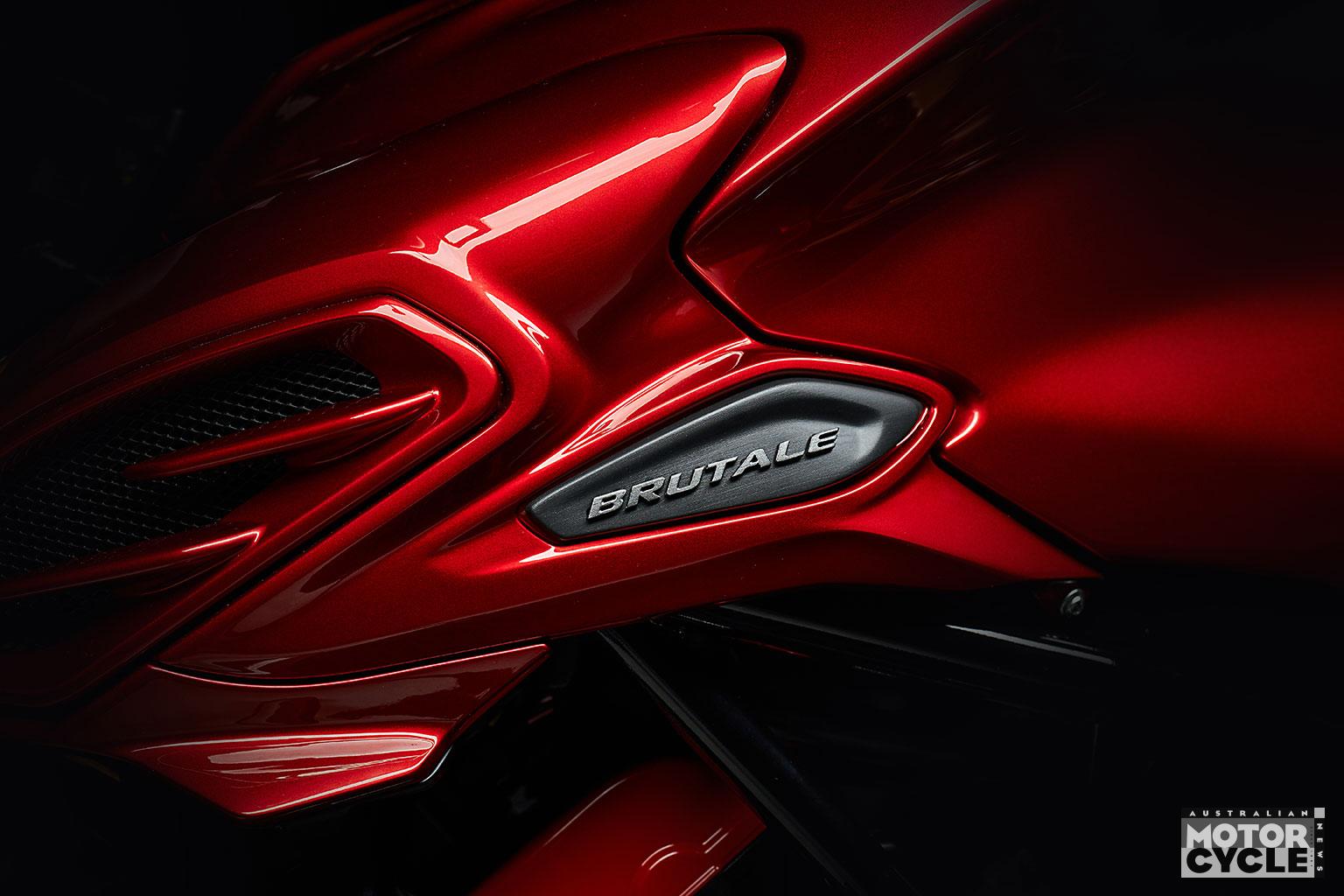
Just 300 examples will be built of this limited-edition model, costing €27k in Italy including 22% tax. That will be followed almost immediately by the volume production version, which MV’s sales team have priced much more competitively than has been the case with any of their products in the recent past at €17,600 in Italy.
The new model is also MV’s way of recording a significant birthday for the Brutale model that’s become synonymous with the brand. For it’s exactly 25 years since design legend Massimo Tamburini’s unique take on the naked sports sector was unveiled to mass acclaim in limited edition 300-off Serie Oro 750cc four-cylinder guise at the September 2000 Intermot Show in Munich. The exact quantity of Brutales made since then isn’t recorded officially – but company insiders say the combined total of all the different variants in terms of capacity and styling is well over 40,000. That makes its latest version worth paying attention to – because once again MV has reinvented one of its core models, and made the best better still.
I can make that judgement after being invited to MV’s Varese factory ahead of three other journalists for an exclusive look at and first ride on the new bike in pre-production prototype form. After being the first person outside the company to ride the Brutale 750 Serie Oro in March 2001, a couple of months before production began, it was a nice way to square the circle 25 years on!
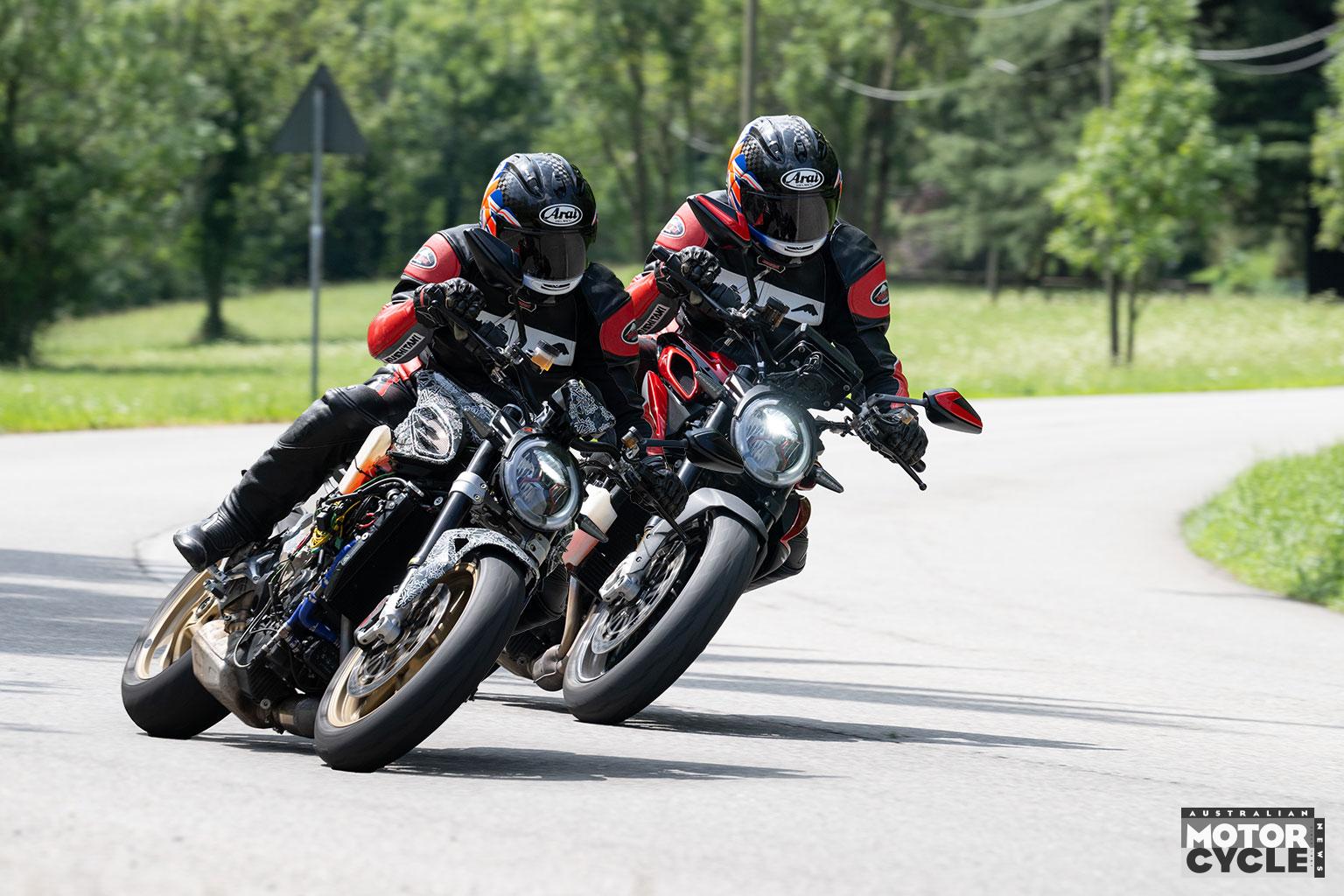
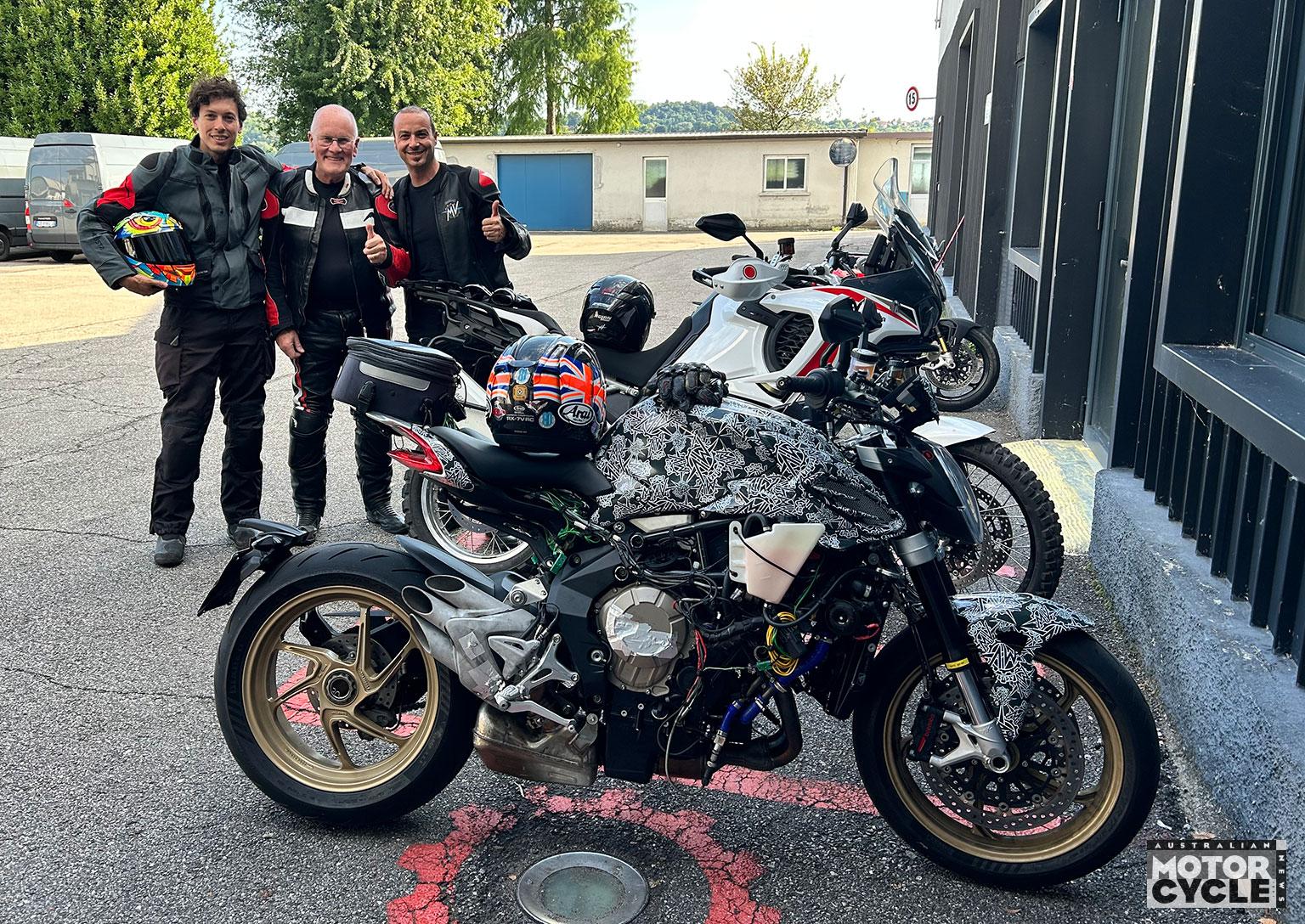
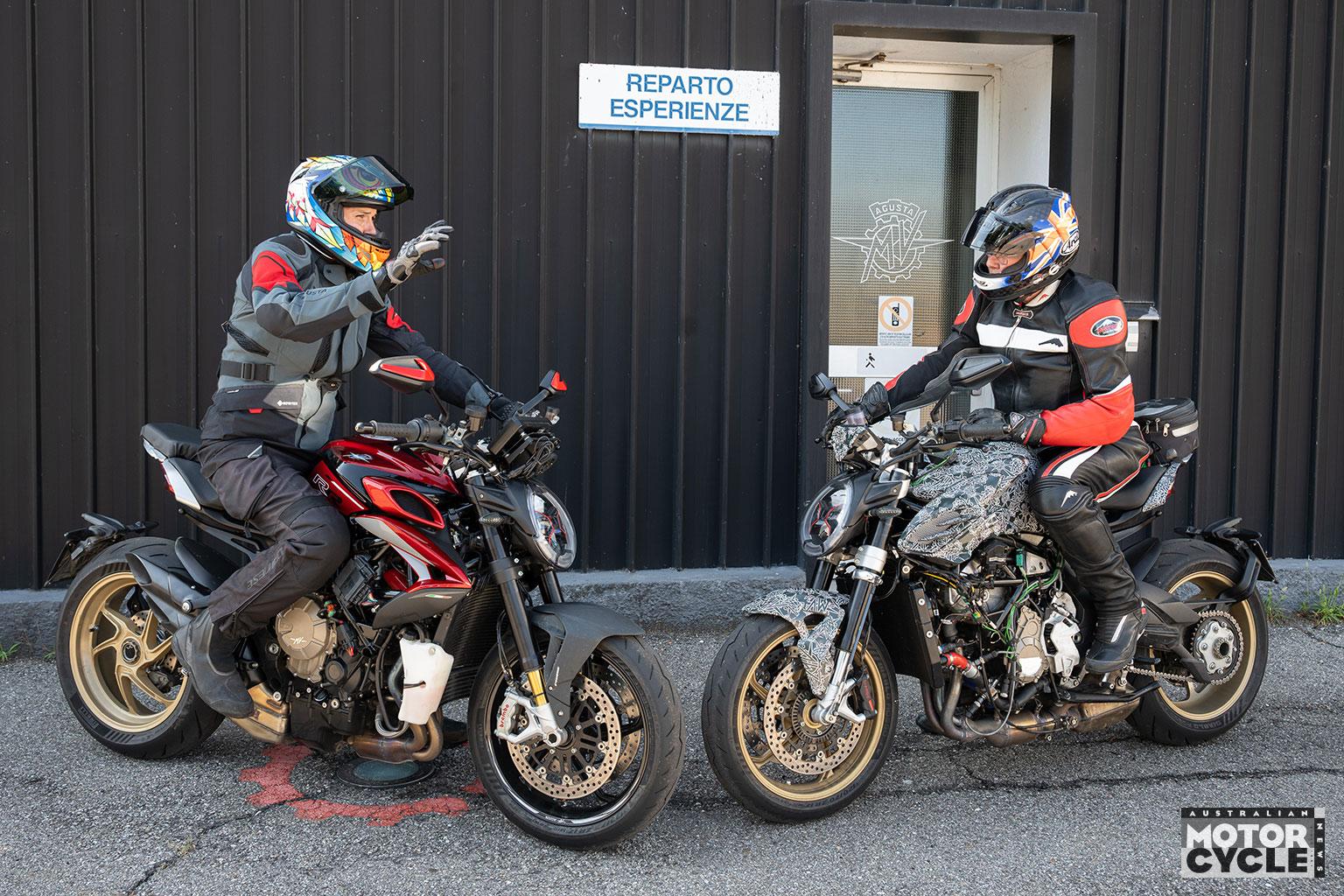
I had company along the way, though, with Federico Macario (see breakout), MV Agusta’s Head of Business Development and essentially the company’s project leader overseeing the new Brutale, riding alongside me all day as we headed out towards the Swiss frontier north of the MV factory, then into the fabulous foothills of the Italian Alps for some serious corner-carving aboard the two different bikes I was being given privileged access to.
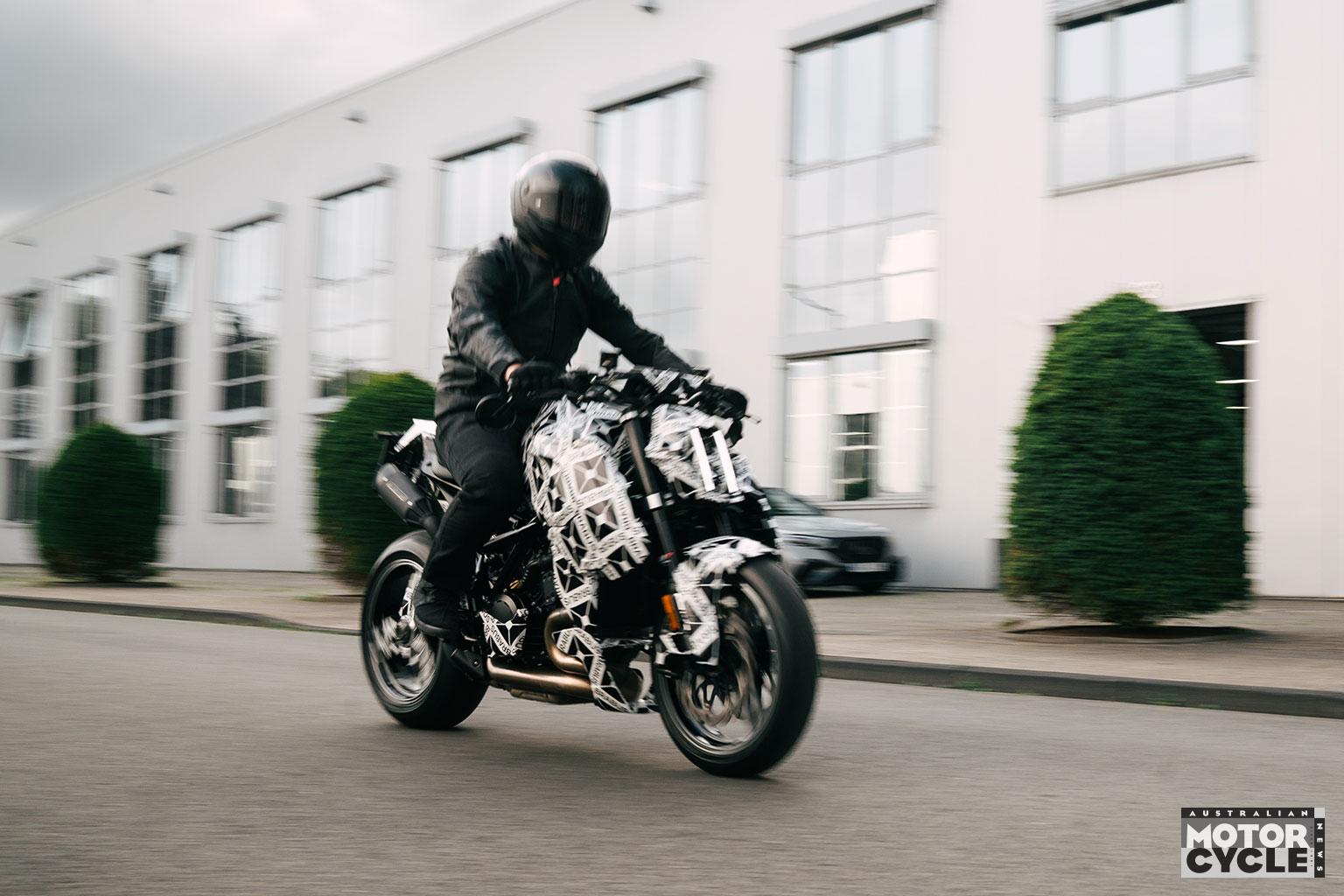
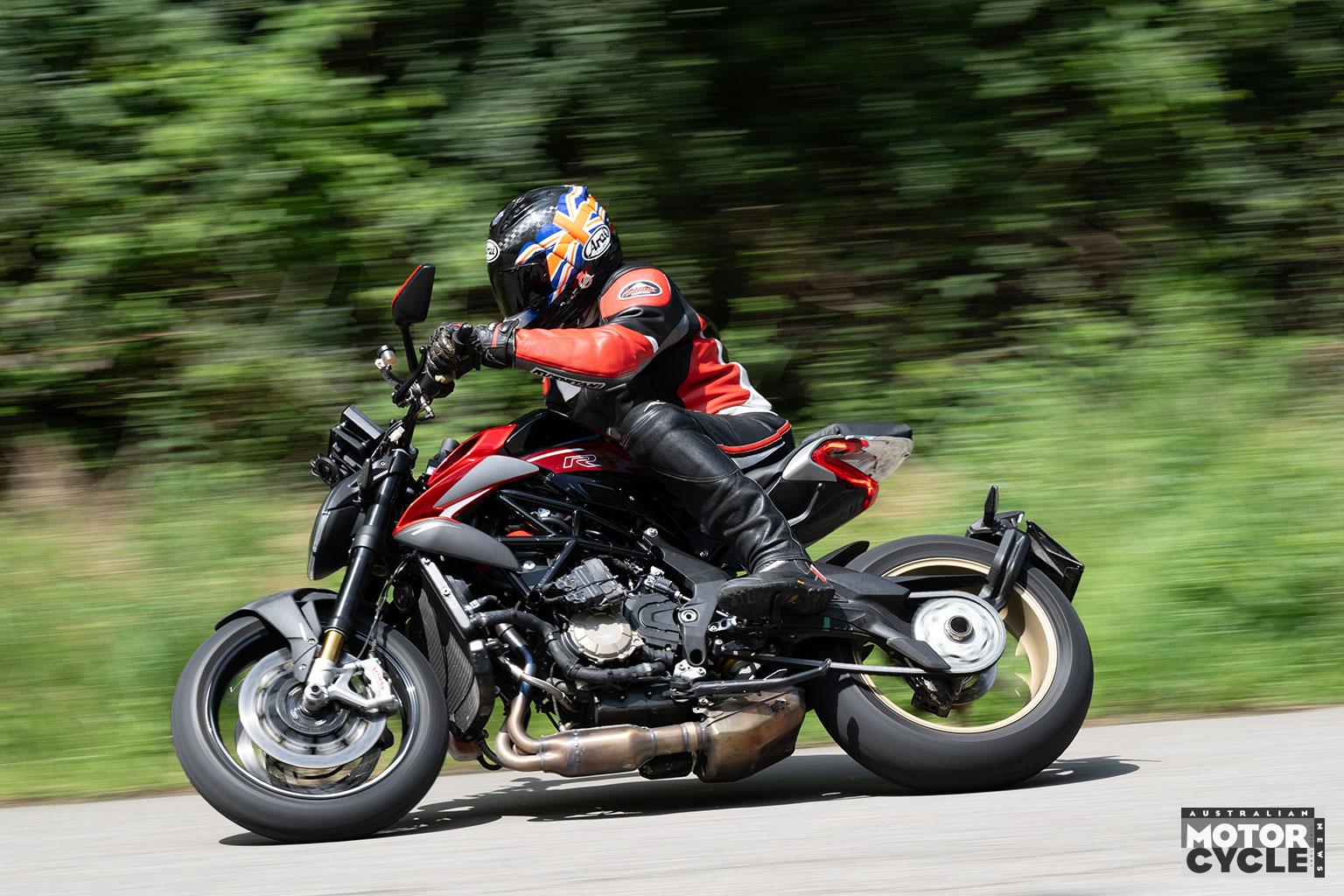
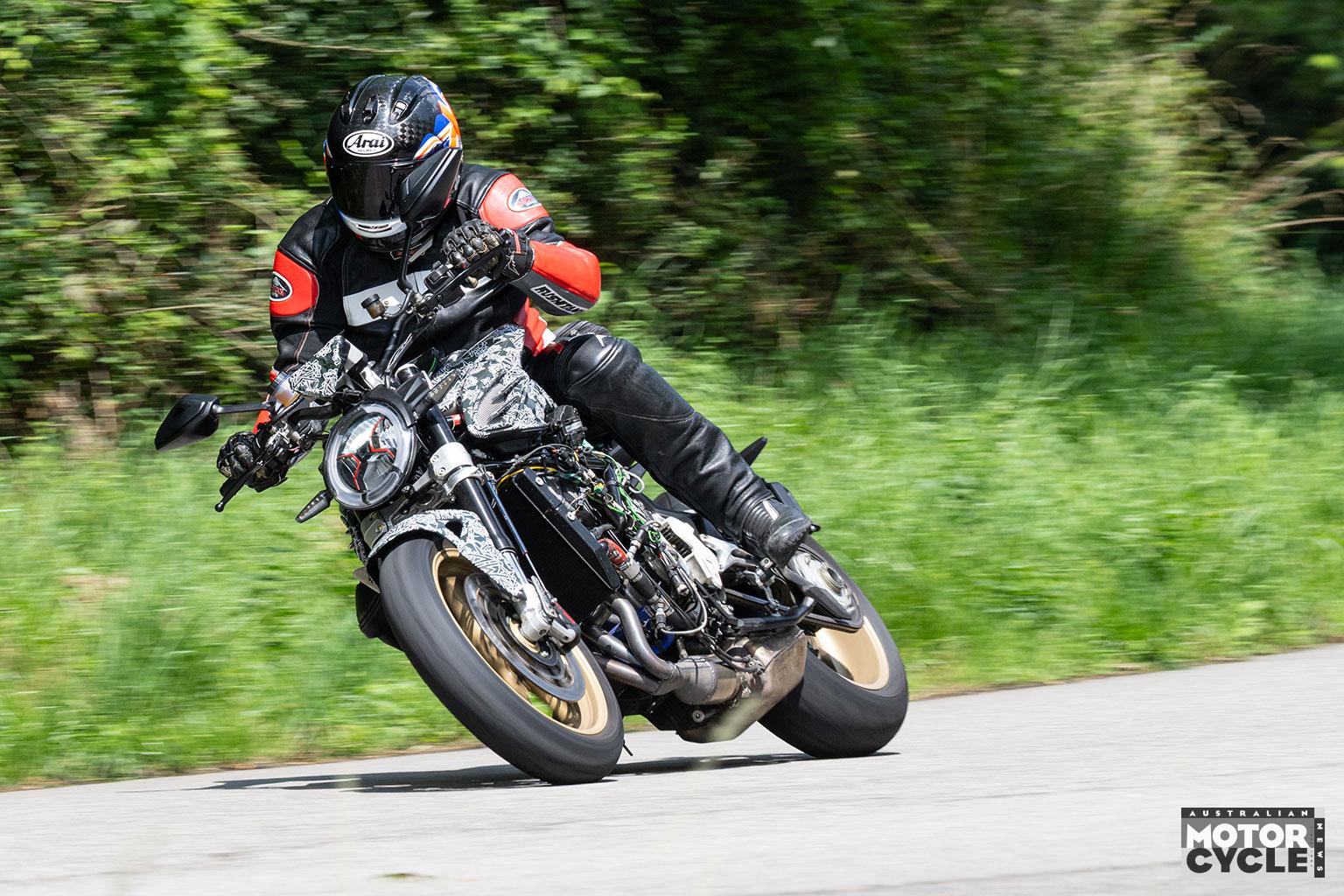
Prototype P-Zero was the seemingly innocuous-looking device wearing well-used current Brutale RR bodywork, which in fact disguised the prototype 950 version’s chassis and running gear, but was powered by an unmodified Enduro Veloce engine. Prototype P2 was a stage farther along the development trail, hence its camouflage paint scheme adorning the 950 Brutale chassis and bodywork, fitted with the latest iteration of the revamped engine. Festooned with diagnostic equipment and assorted wiring, it stood out a mile away as ‘something secret’, despite which I only saw one bloke pull out his smartphone and take a snap of me during the couple of hours I rode it in something very definitely approaching anger, following MV tester Mario through his favourite stretch of ‘racer road’, with Federico Macario doing a good job of keeping up – well, mostly!
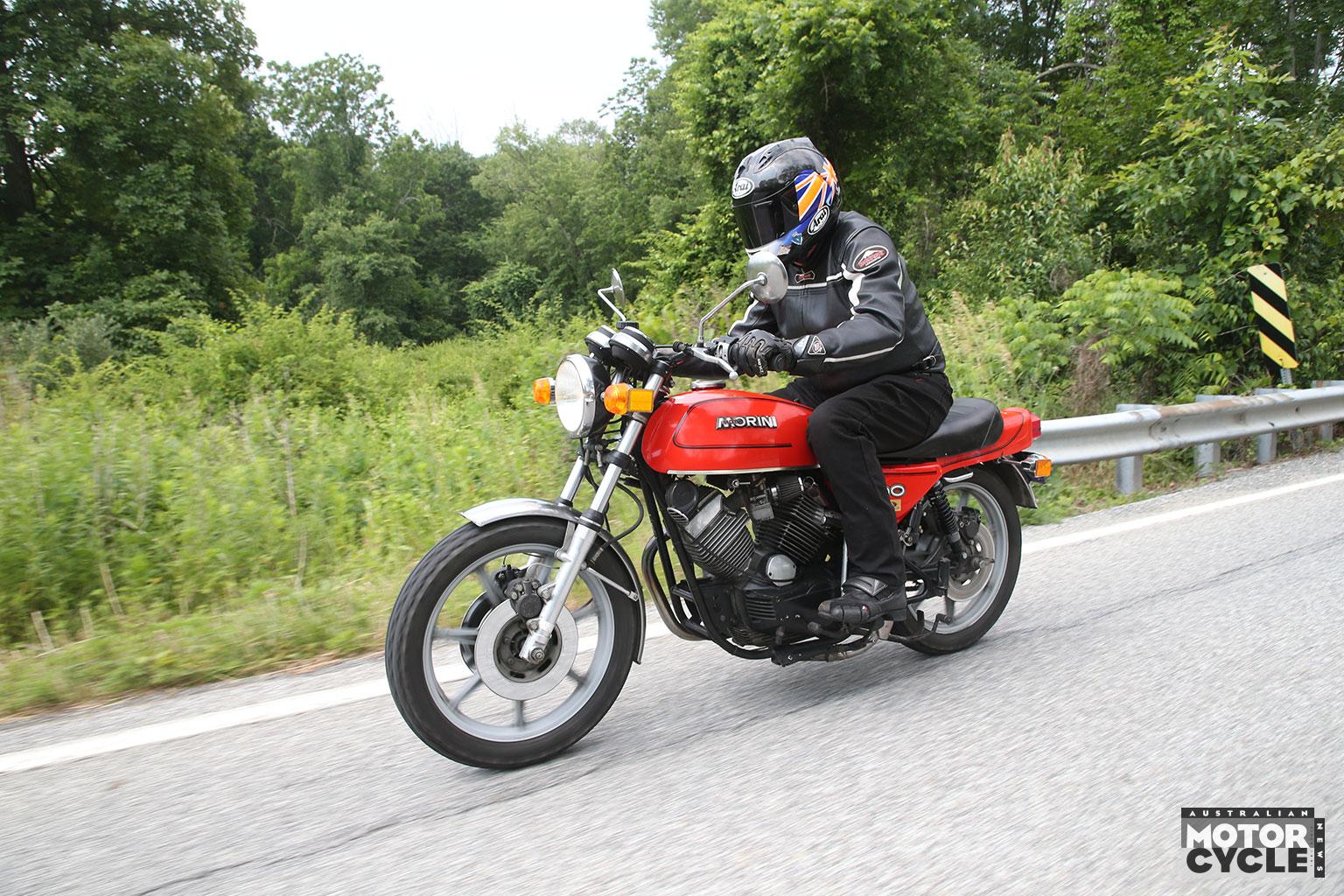
First, though, I started out riding a 2025 Brutale 800RR for an hour to give me some reference points for comparison with the two prototypes, during which I was reminded what a sweet-sounding engine MV’s current midsize triple is. This was constantly brought home to me as I had to work the gearbox pretty hard to keep it on the boil above 7000rpm, in pursuit of maintaining momentum through the twists and turns of the fabulous mountain roads Mario led me along. The tucked-in riding position was surprisingly stretched out for my 178cm stature, though I enjoyed having to work pretty hard in getting the bike to flick from side to side in a series of third-gear bends. But it very definitely felt like a Supersport racer with deleted bodywork – and none the worse for that, just that it was all a bit breathless: you felt committed to ride hard on it.
I switched to Prototype P-Zero, which immediately felt more spacious in terms of the riding position; it didn’t feel as close-coupled and relatively cramped as the RR’s stance had. The suspension settings were softer and more compliant. The engine also immediately felt punchier and more torquey – and this was ‘only’ the Enduro Veloce version, remember. But in retracing my path along which I’d ridden the 800RR, I could consistently use one gear higher in turns – thanks to the gruntier engine – and I also found myself cutting down on gear-changing, too, thanks to the meatier motor. Okay, I was supposed to be evaluating the new chassis, I know – but the way even the detuned EV version of the 931cc engine performed proved again there ain’t no substitute for cubes.
And yes, the handling was definitely improved, too, especially the way the P-Zero steered into corners on the angle: turn-in was almost intuitive and certainly more immediate, but without sacrificing stability, even when trail-braking into the apex as I quickly found myself doing. Despite the longer wheelbase, which presumably helped promote that stability, it didn’t heavy up the steering, and the way the bike seemed to find its own way from side to side in those fast, sweeping turns was very impressive; it was notably less demanding in terms of rider input than the smaller-engined bike had been.
But then it was the turn of P2, and I was able to get a good idea of what the 2026 Brutale Serie Oro – and the volume production version, too – will be like to ride. Despite all the testing paraphernalia, I could properly assess the revised riding position versus the 800RR, and it turned out that the wider handlebar, giving more leverage, had been raised 20mm and moved forward 10mm. The result is a more upright stance that doesn’t place as much weight on your arms and shoulders, and is more comfortable and less stretched out.
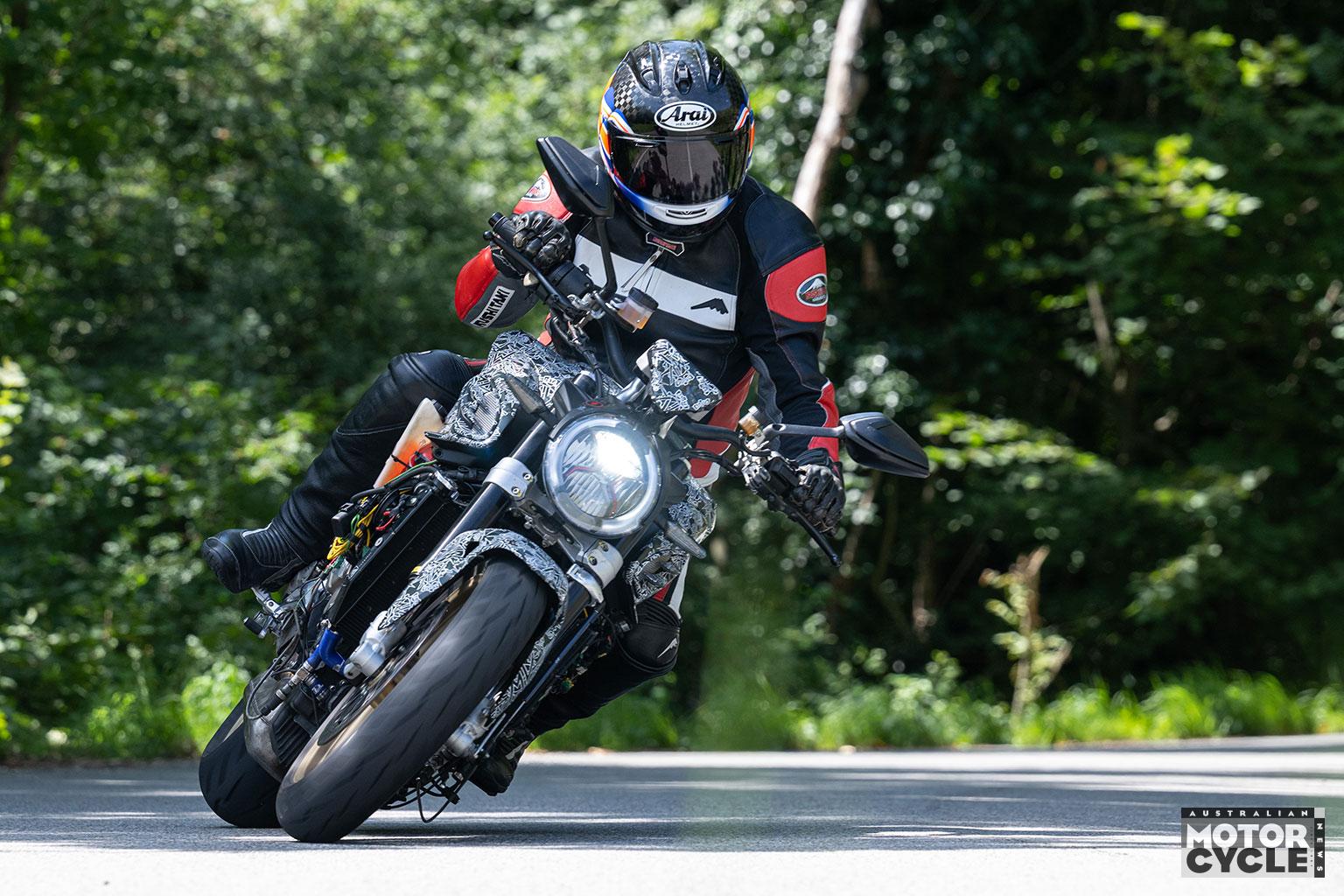
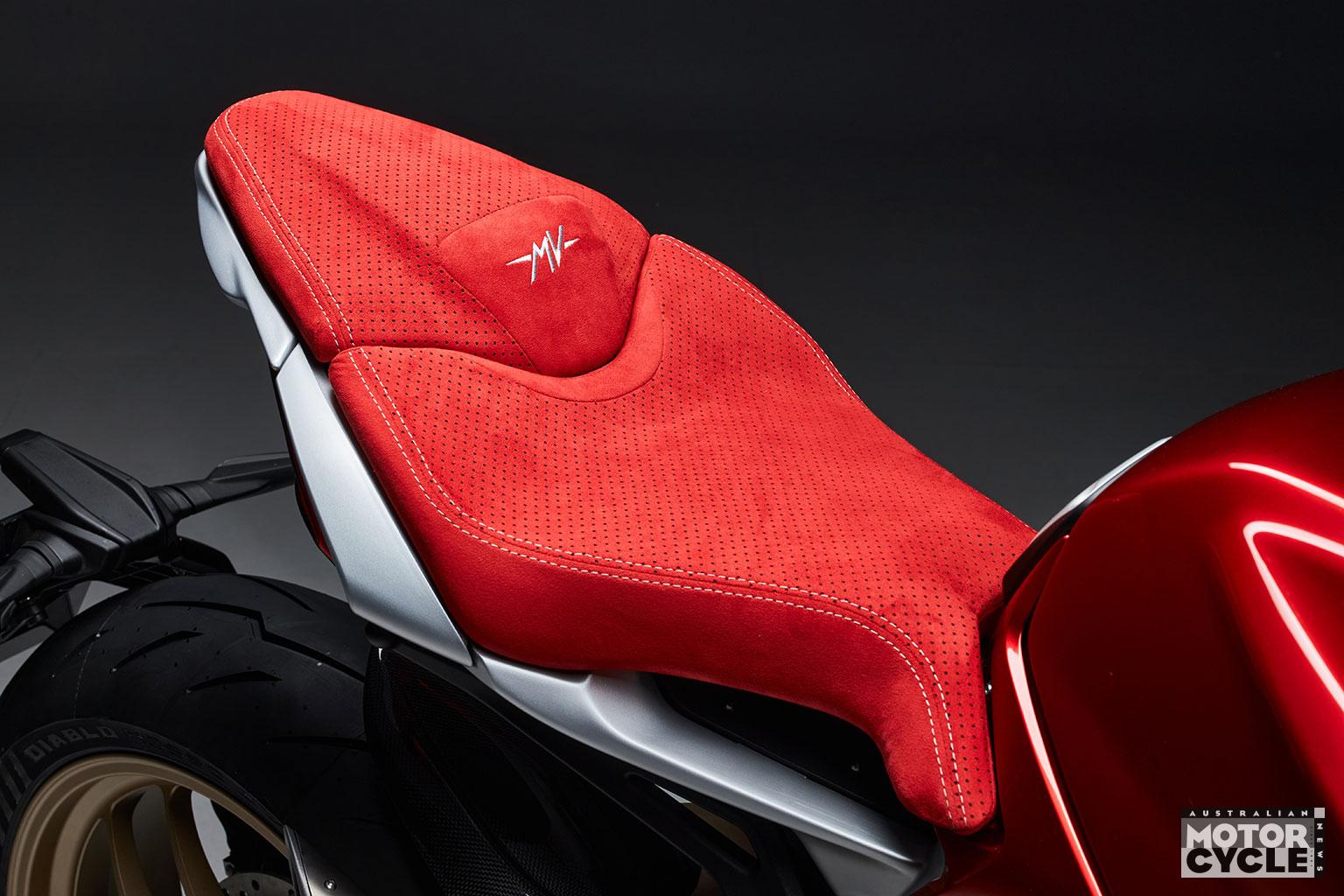
The seat had been completely reshaped versus the smaller bike and was definitely roomier, just as was the P-Zero. Apparently the rider’s seat is now 20mm wider at the front, 40mm wider across the centre and 40mm longer at the rear than the 800RR. The footrests had been lifted 30mm higher, moved rearward 10mm, and widened in spacing, and this was responsible for the more relaxed stance I noticed at once on both bikes. I do think the footrests are too far back, though: I’d like them to be 20mm farther forward to make it easier to lift your body weight from side to side for cornering. And while the 850mm-high seat was nicely shaped, it needed much more padding – though that’s probably a bit cheeky to ask for on this well used prototype! I could get both feet on the ground at rest, so stepover was well judged, and not too wide.
I only had a single riding mode available on the ECU, but fortunately it was the Sport version, so I could get a good idea of whether the tuned Brutale version of the 931cc engine delivered any genuine improvement in performance. It did! Let’s just say that it had a significant appetite for revs, the three-cylinder spinning effortlessly up to my chosen shift point of 9000rpm – and sounding pretty good.
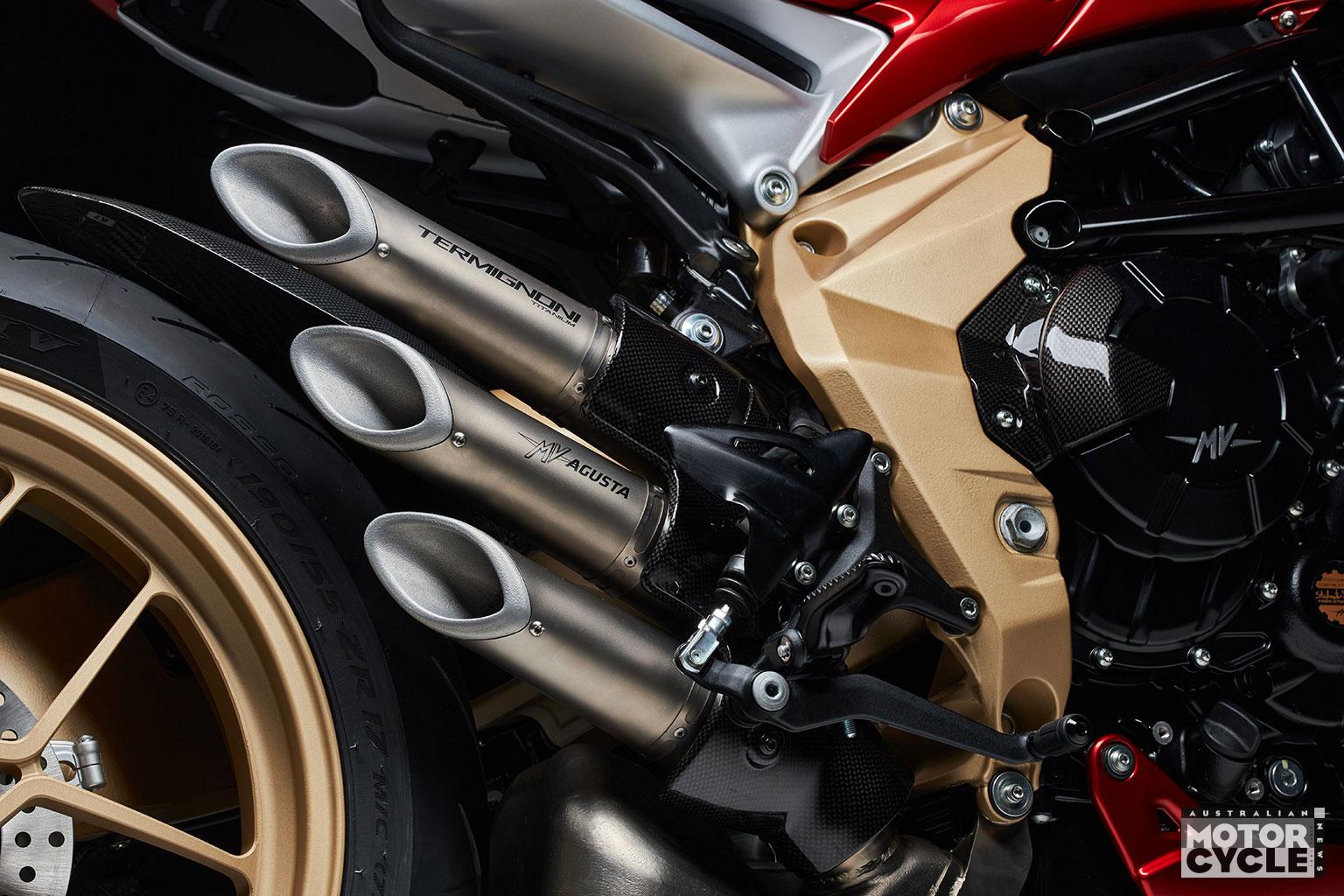
The haunting howl of a three-cylinder aiming for the rev limiter was all present and correct thanks to the Termignoni exhaust, if inevitably muted – but let’s see what MV was allowed to deliver by the noise police when the final homologation took place.
Acceleration is truly thrilling; it feels a bigger bike than I expected, though perhaps that was a spinoff from the more spacious riding position after the 800RR, but it gets off the mark really well. However, pickup from a closed throttle was a little brusque, and occasionally snatchy, although this seemed rpm-related, so was most noticeable at 3-4000revs, not so much either side of that. But you could feel the torque curve was so strong and flat, especially 4000-7000rpm where I found changing gear was almost optional. And the sound from the exhaust as the auto-blipper does its stuff on downshifts is definitely addictive! Using the clutch in traffic was no hardship; it’s not too stiff or heavy a pull on the lever.
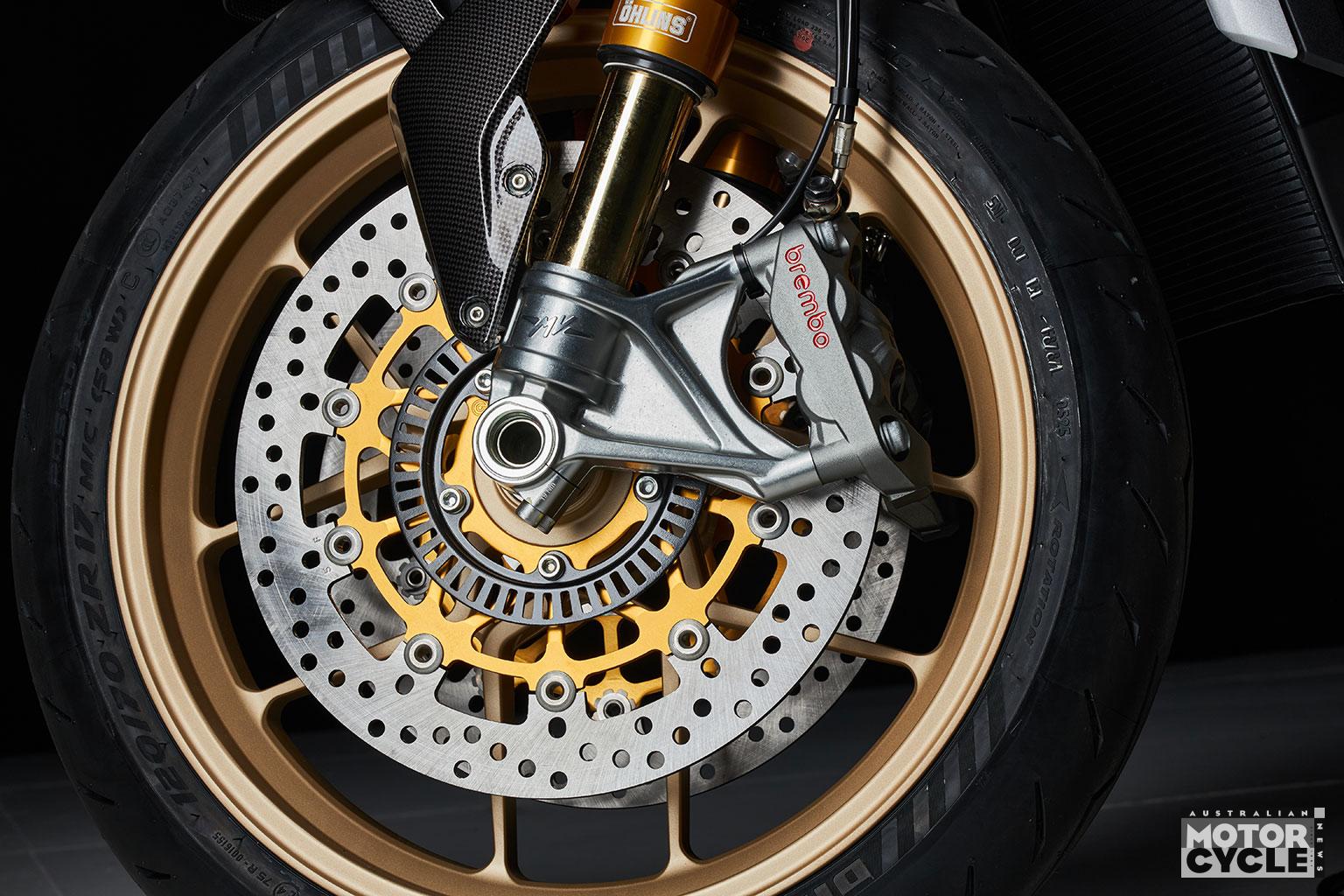
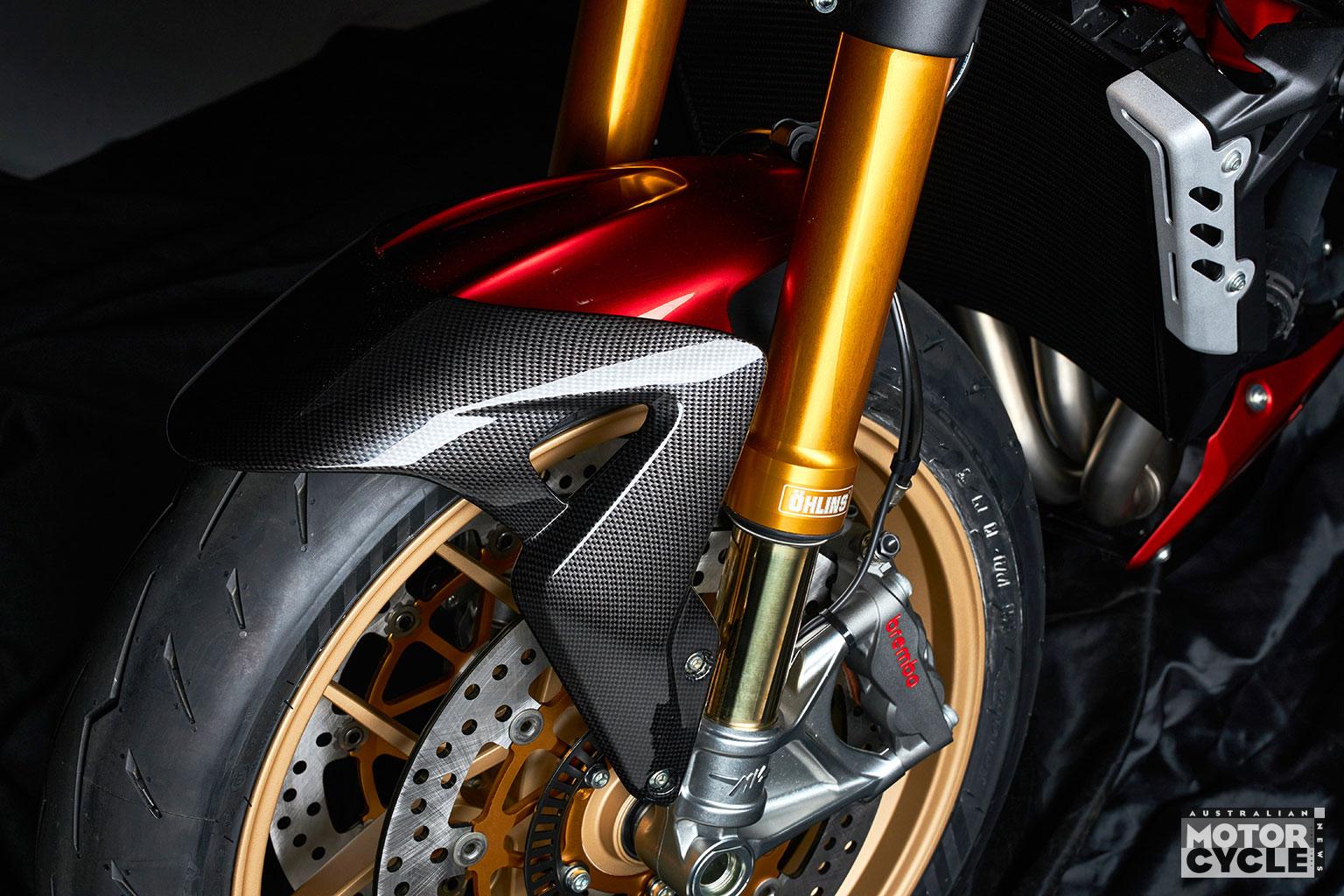
Though the Hypure Monoblock radial brakes are Brembo’s latest top-of-the line kit, and the Brutale is the only midsize model yet be fitted with them, there wasn’t a sense of overkill when I used them hard in the tight, twisting turns in the mountains. But I only used the front discs as I couldn’t find the rear brake pedal! The bike I was riding was fitted with the Marzocchi suspension from the series production variant, and while I can’t say I gave this an intense workout, it felt well sorted. Ride quality was good, although final settings for customer delivery were still under review.
What is certain is that the new Brutale will be accessible to a wider range of customers than anything bearing that name built up to now. Previously, each iteration had been directly derived from the equivalent sportsbike – like the 800RR is a declothed version of the F3 Supersport racer with lights. This new model is much more accessible. More of a roadster than a sportsbike, without sacrificing the inherent sporting allure of an MV Agusta. I’m looking forward to riding the finished version.
The benchmark reborn
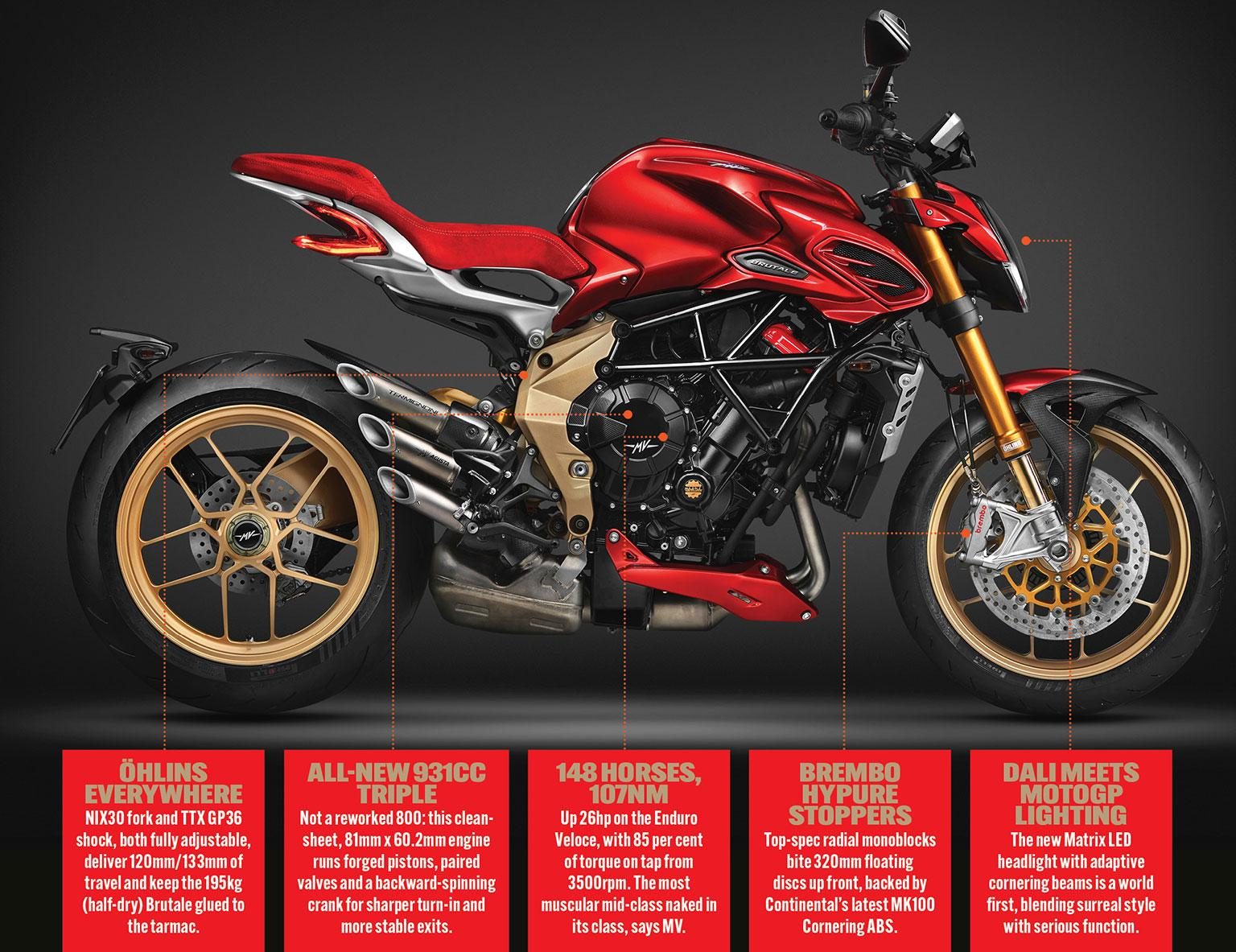
The new 2026 Brutale Serie Oro is powered by the same new-generation 931cc DOHC in-line three-cylinder 12-valve engine which made its debut in 2024 powering MV Agusta’s first dual-purpose motorcycle of the modern era, the Enduro Veloce/EV Adventure tourer. But this has been completely redeveloped by the company’s in-house engineers to produce considerably more power in the Brutale than in ADV mode, to the extent that in many ways it is an all-new engine, as MV’s executives insist.
MV’s R&D aimed to create an all-new 931cc engine that would be physically capable of fitting into MV’s then-existing 800/675 products. So, despite being 50 per cent larger in capacity than the original 675cc triple, it would be compact enough to fit in that bike’s frame. This meant obtaining a considerably greater displacement while maintaining the same exterior wrapping of the old engine, yet using completely new crankcases. MV’s CTO Alessandro Volpini confirms there to be zero carryover from the older three-cylinder engine to this new one. “It is in no way a revamped version of our existing 800cc engine,” he says. “While maintaining MV’s traditional three-cylinder format, it’s a clean sheet design, and the only components the two have in common are the valves and valve caps. Everything else is new.”
MV had the engine first running at the beginning of 2021, and has been working on developing several different versions ever since – first the Enduro Veloce, and now the Brutale. In arriving at its 81mmx60.2mm dimensions for a capacity of 930.63cc (versus 79mmx54.3mm for the existing smaller displacement 798cc triple), the R&D team built seven different configurations in terms of bore and stroke, before settling on the most versatile layout that could give them the biggest envelope of performance in meeting the needs of the high-torque ADV version, and the future more powerful, higher-performance sportsbike variants, starting with the Brutale.
So, in terms of architecture, this bigger engine does share the same overall format as the older engines, with its slant-block cylinders inclined forward 35° atop the horizontally split closed deck crankcase.
As before, the all-new 120° forged steel crankshaft rotates backwards just as on all current MotoGP bikes, a feature which MV claims it was the first to pioneer on roadbikes. This is aimed at improving handling via an easier turn-in to a bend, as well as at holding a tighter line, all by substantially reducing the crankshaft’s gyroscopic influence on the front wheel via rotational inertia. It also permits a safer exit from a bend via the torque reaction of the accelerating crankshaft, which puts extra weight on the front wheel for better grip in countering weight transfer when the throttle is opened.
The Brutale’s cylinder head features fresh porting, larger paired steel valves, DLC-coated finger followers and new cam profiles to deliver 2000rpm more than the Enduro Veloce version, now redlining at 12,000rpm. A full titanium Termignoni exhaust helps it breathe freely while shaving kilos off dry weight.
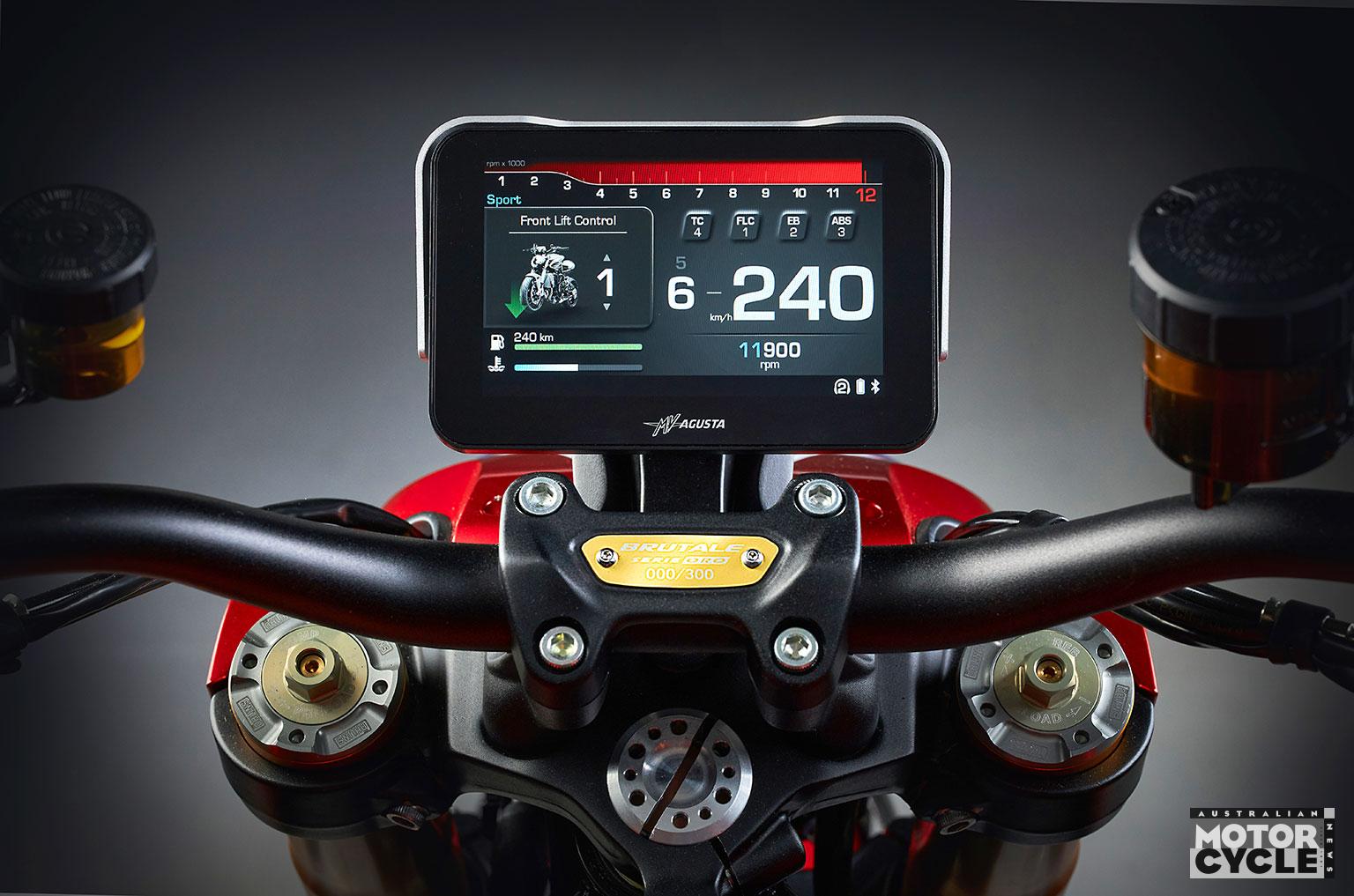
The result? A claimed 109kW (148hp) at 11,200rpm and 107Nm at 8400rpm, with 85 per cent of that torque already available from 3500rpm. Power runs through a six-speed cassette gearbox with MV’s EAS 3.0 two-way quickshifter and a hydraulic slipper clutch. Twin injectors feed each of the 50mm Mikuni throttle bodies, managed by a new Eldor Nemo 2.2 ECU and 6-axis IMU with five riding modes: Rain, Urban, Sport, Race and Custom.
The electronic suite includes adjustable engine braking, eight-level traction control, three-stage Cornering ABS, launch control, wheelie and rear-lift control, cruise control and switchable front-lift (FLC). The 5-inch TFT dash is sharper, brighter, and offers expanded customisation.
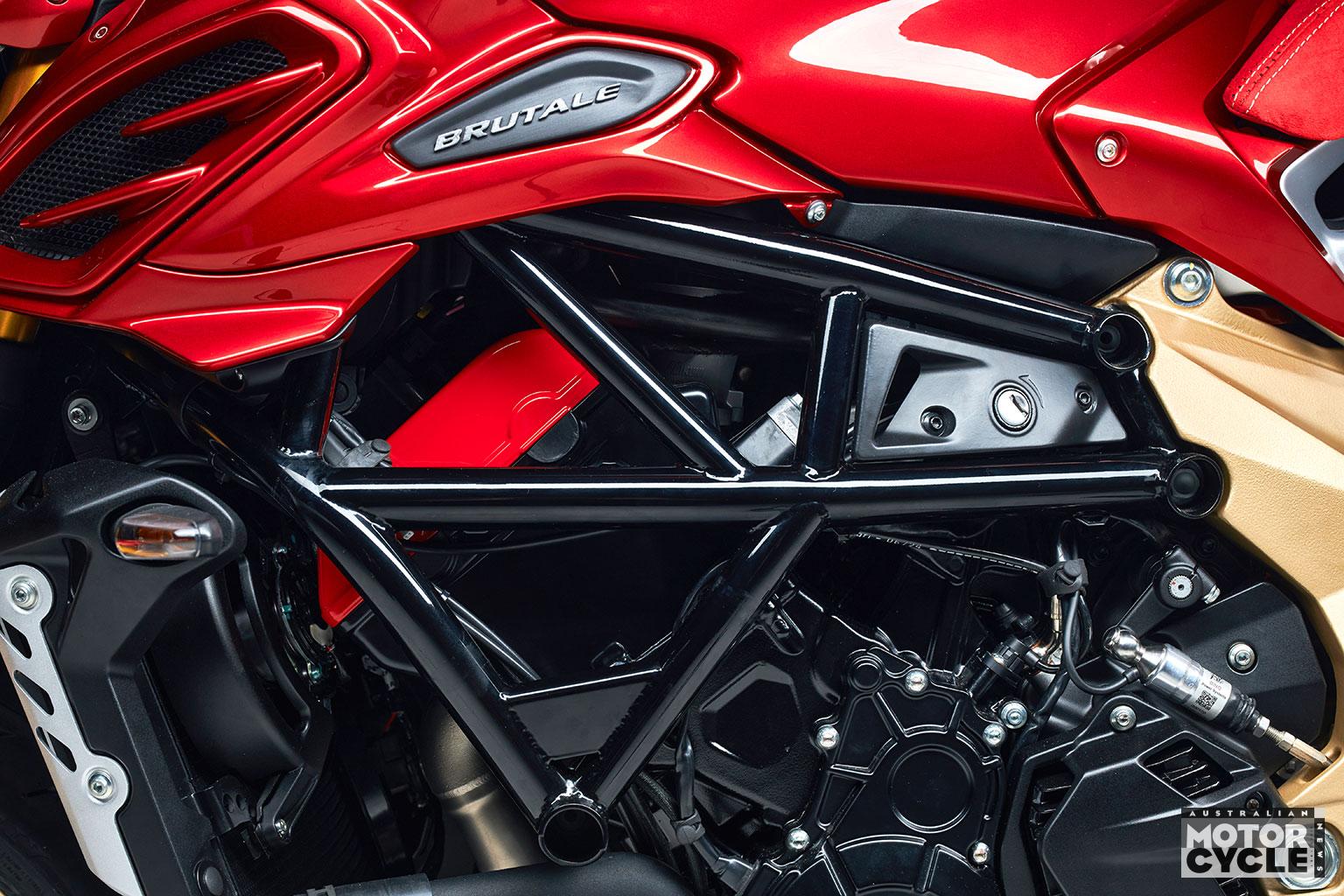
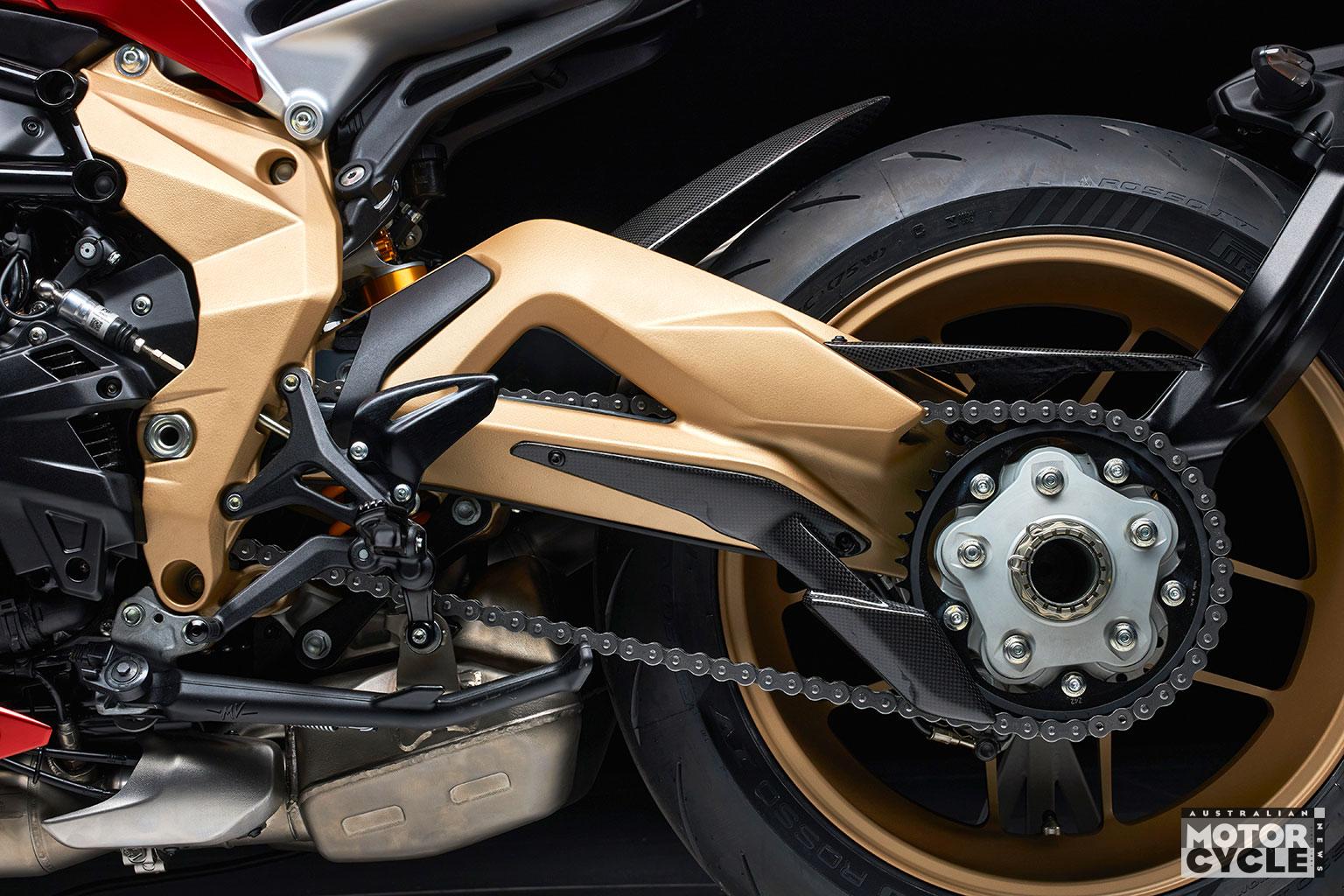
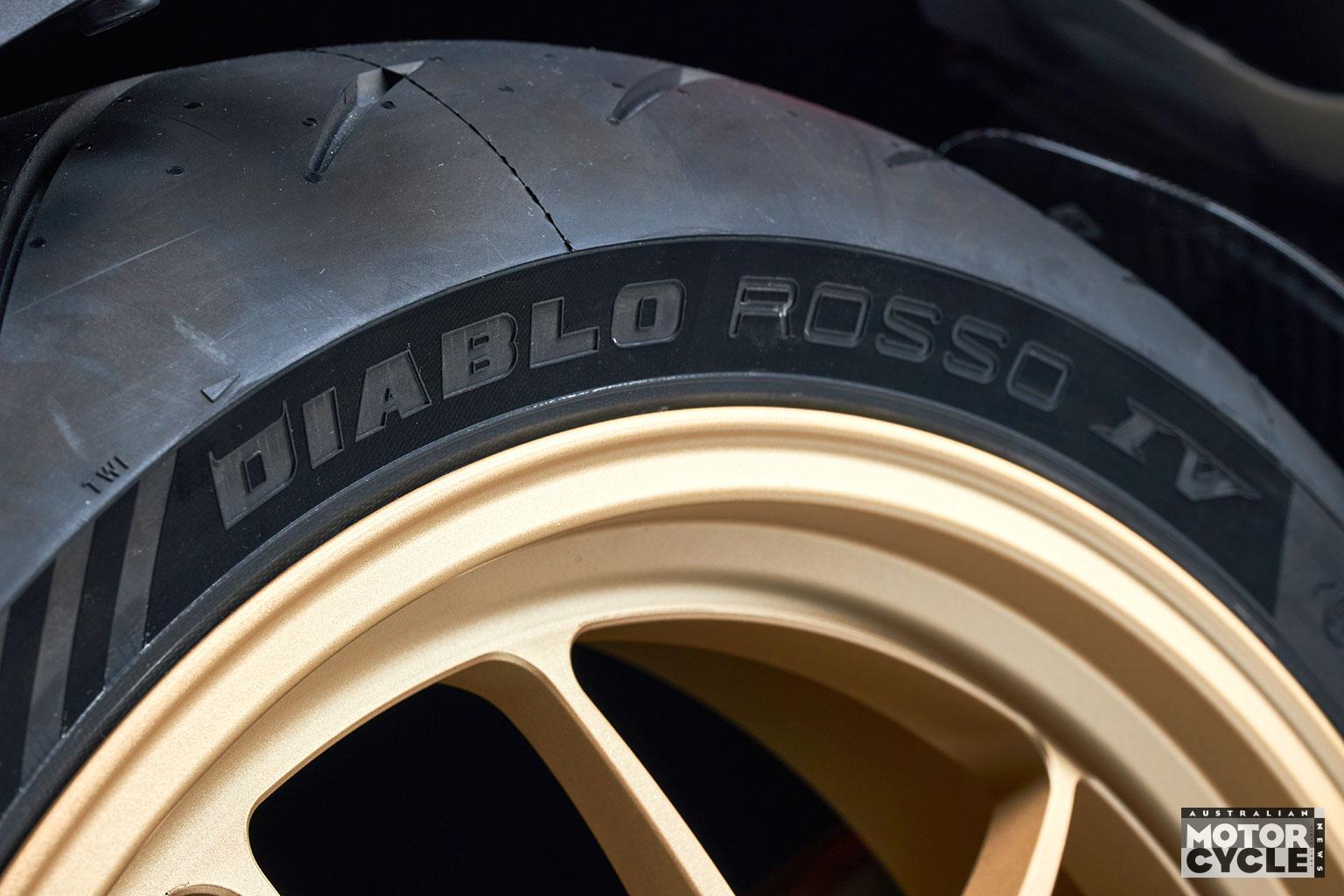
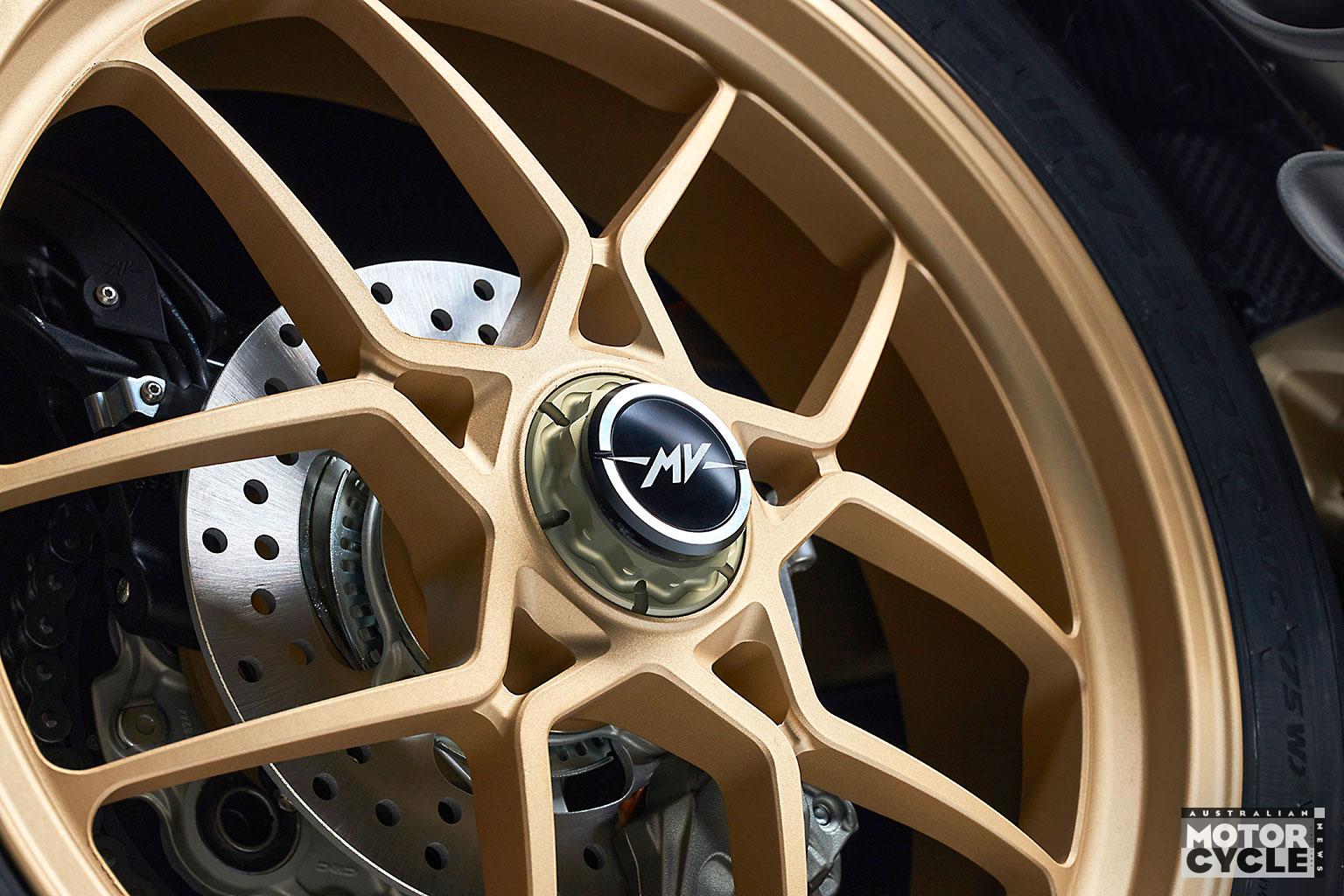
The 931 triple sits in an all-new tubular steel trellis frame built from thin-wall tubing for weight saving, matched to a new cast-alloy single-sided swingarm 30mm longer than the 800RR’s. Wheelbase is up slightly to 1433mm, aiding front-end weight bias and improving turn-in. Forged aluminium 17-inch wheels shed another 2kg over cast versions and wear Pirelli Diablo Rosso IV rubber (120/70-ZR17 front, 190/55-ZR17 rear).
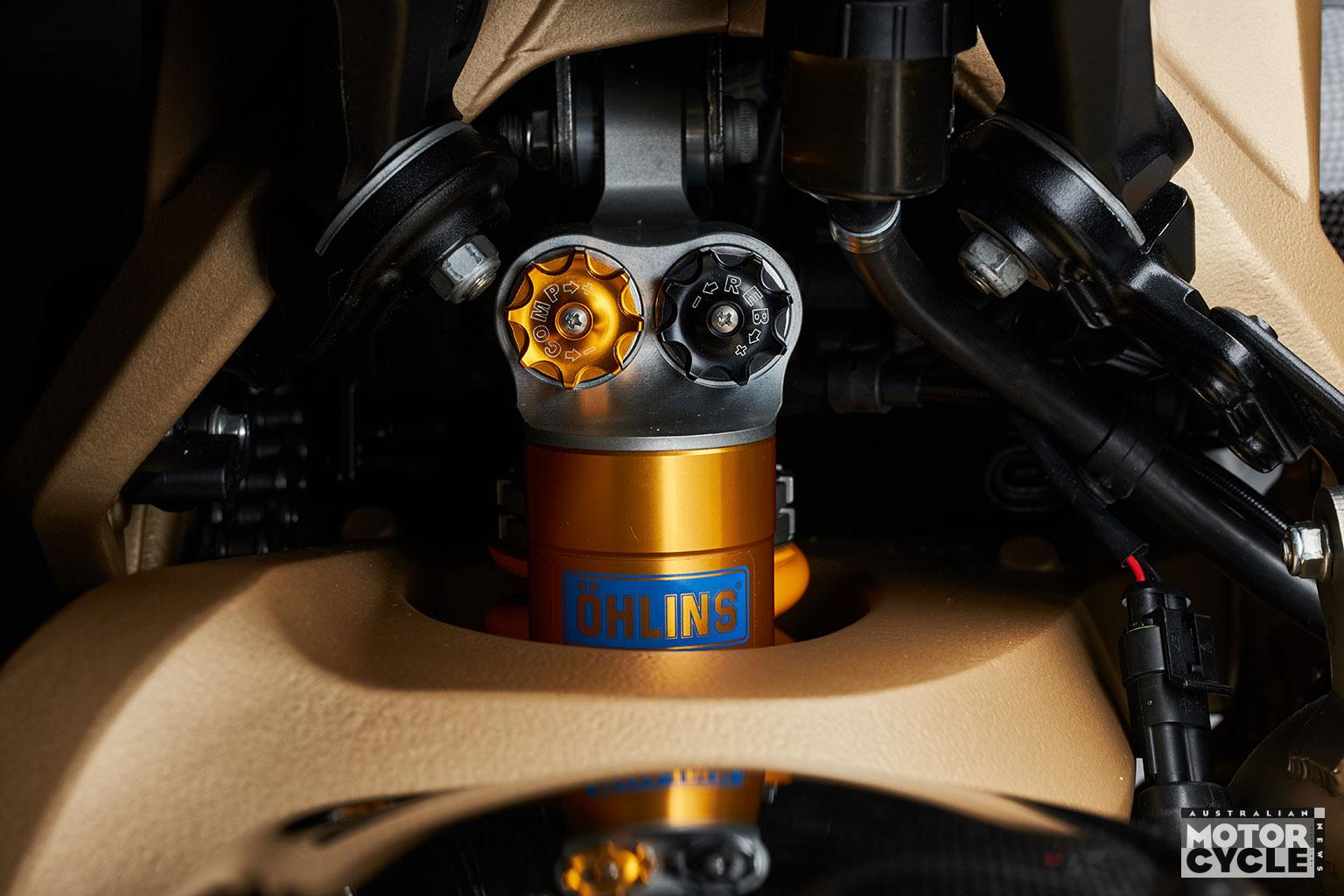
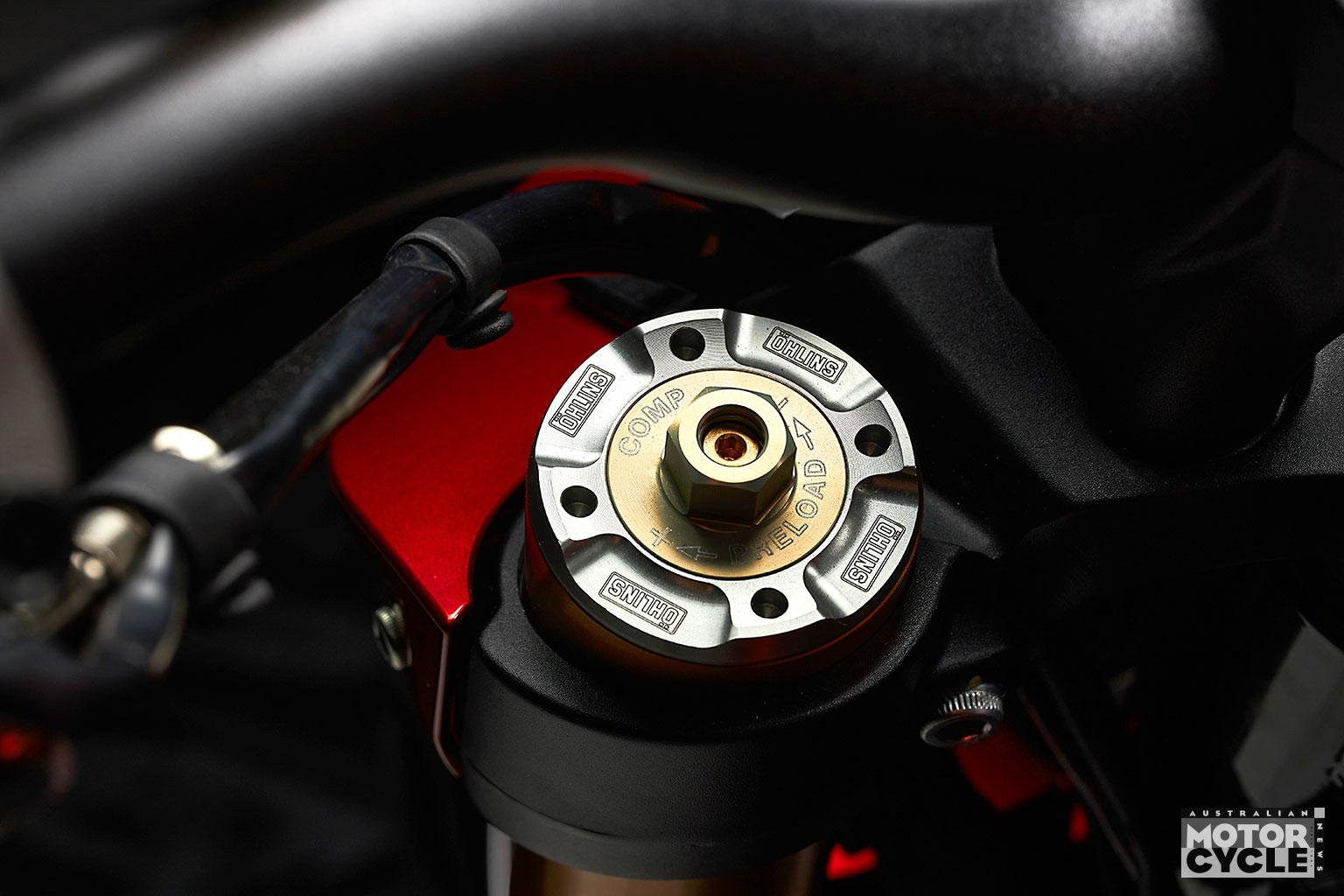
Stopping power is top-shelf: twin 320mm floating front discs gripped by Brembo’s Hypure Monoblock radial calipers, plus a 220mm rear disc, overseen by Continental’s MK100 Cornering ABS system. Suspension is Öhlins – fully adjustable 43mm NIX30 fork and TTX GP36 shock.
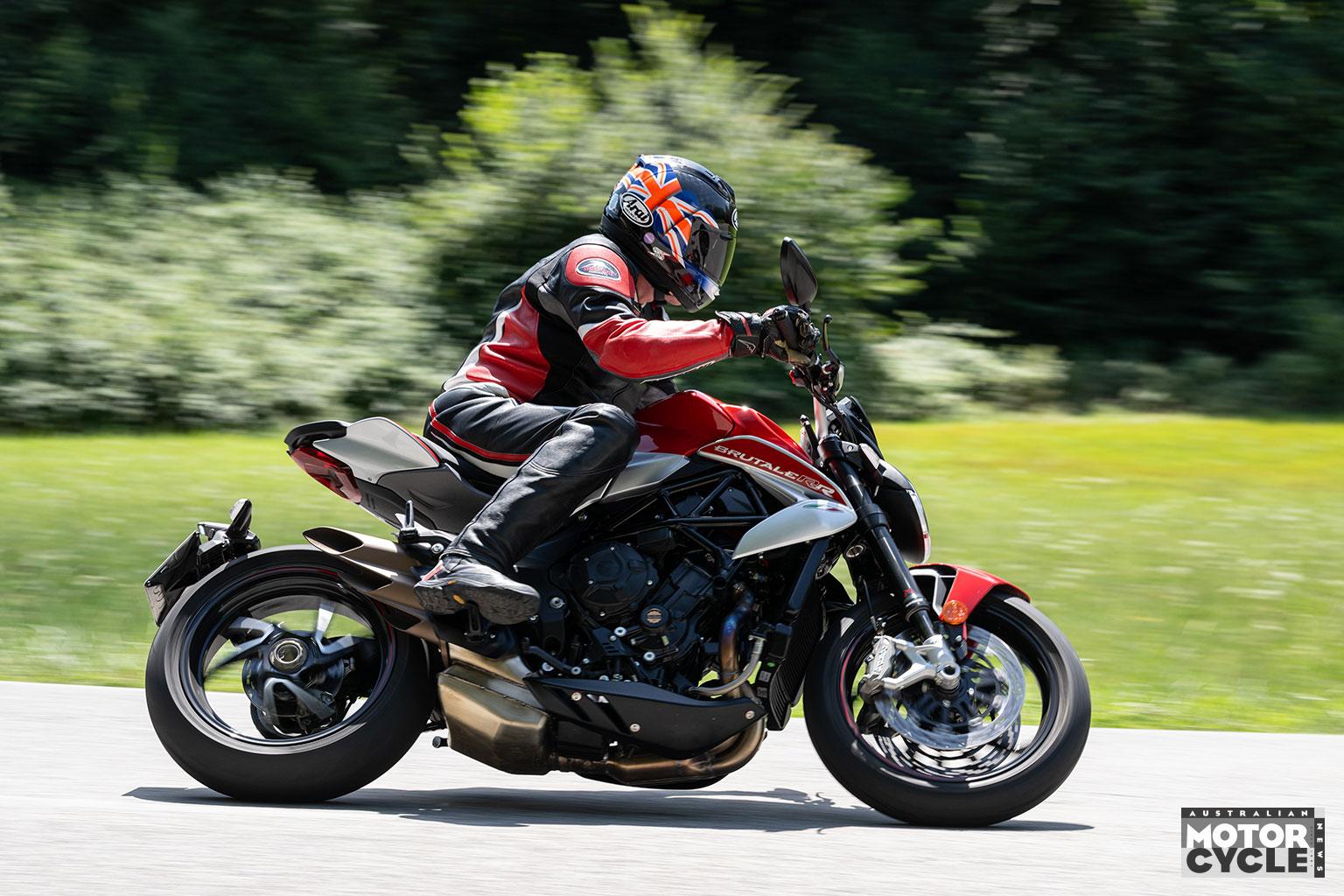
Weight is 195kg (half-dry with fluids, no fuel), and MV quotes a 0-100km/h sprint of just 2.7 seconds with a top speed of 260km/h. The 16.5-litre tank, 850mm seat height and redesigned ergonomic triangle promise improved comfort and control for riders of all sizes.
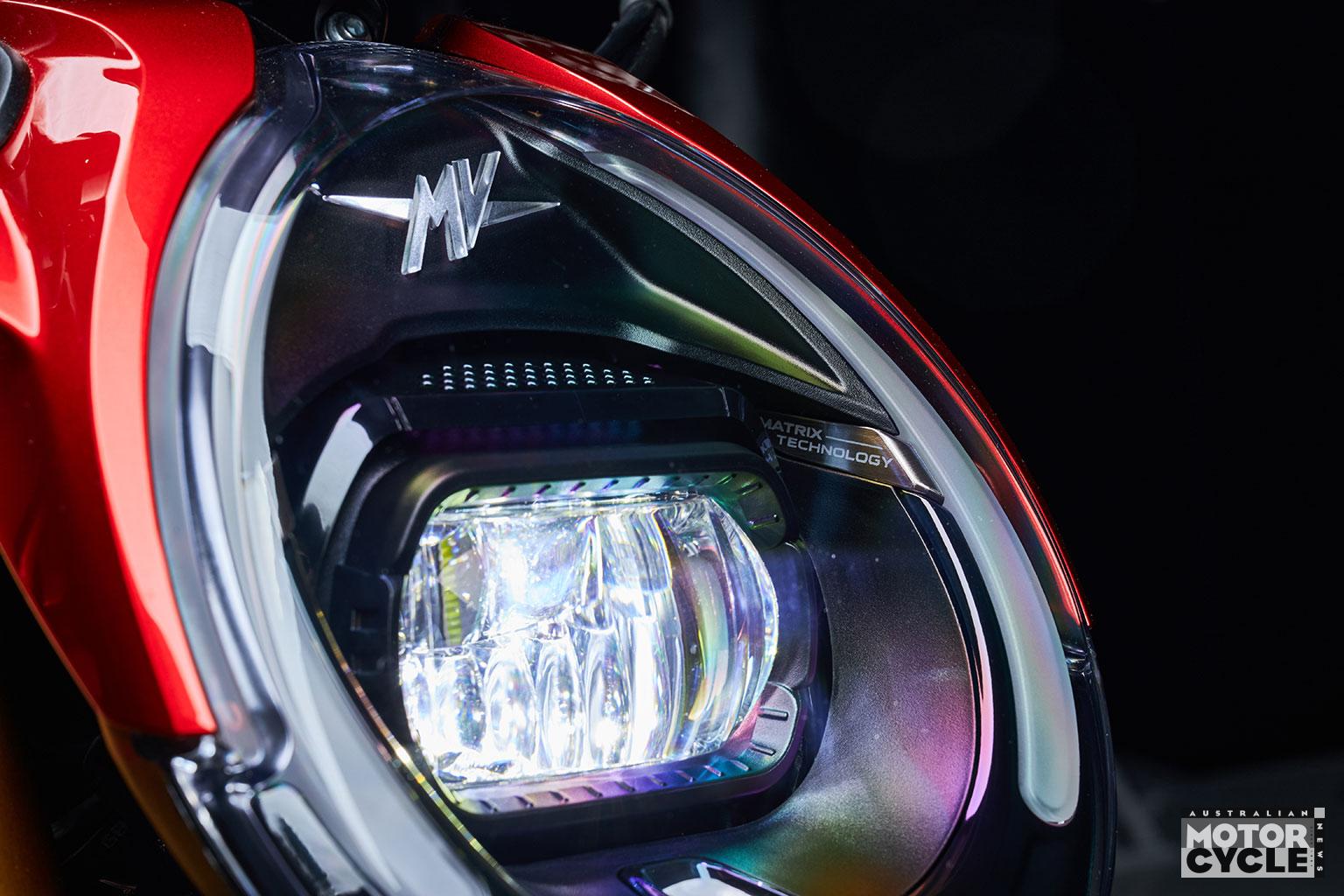
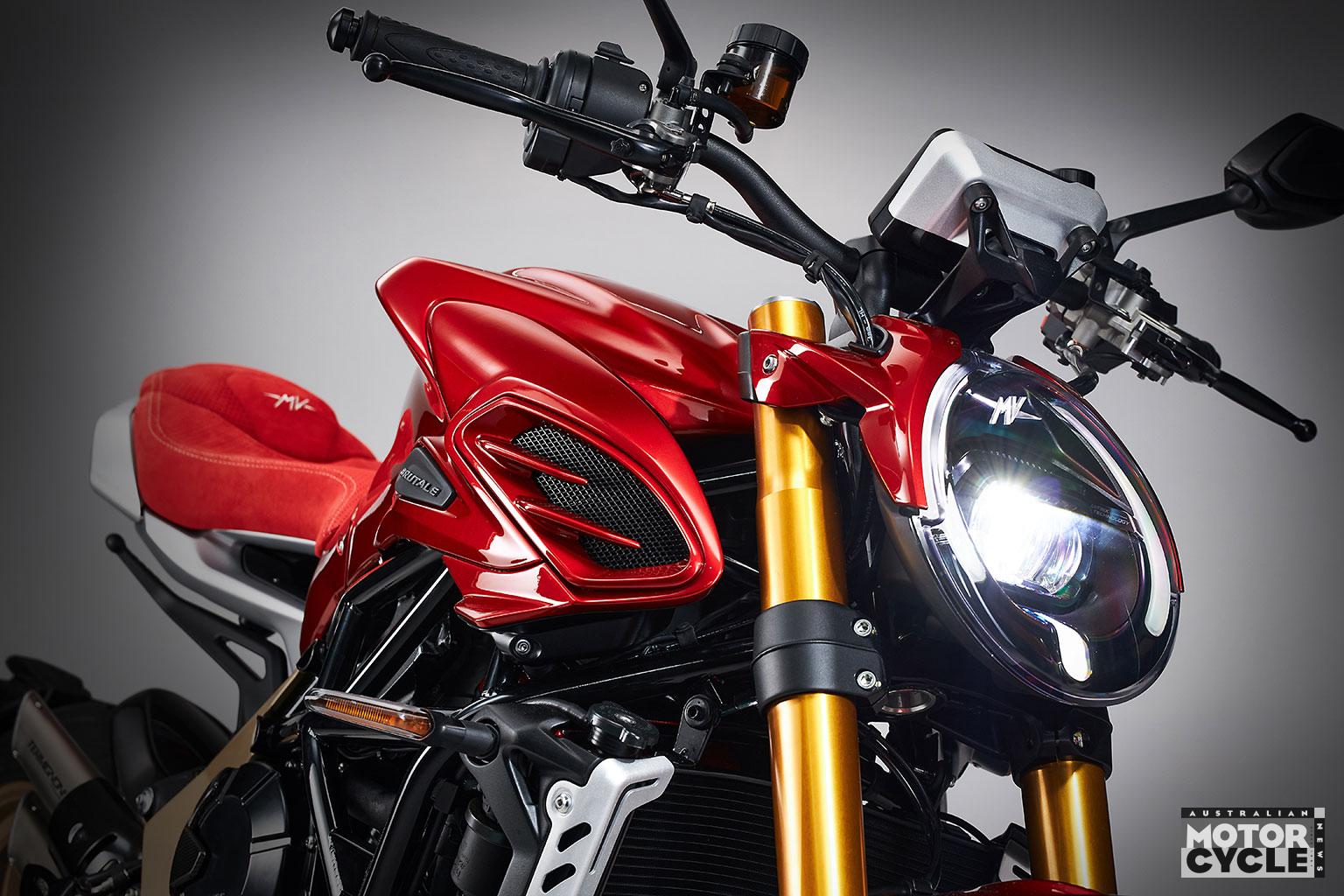
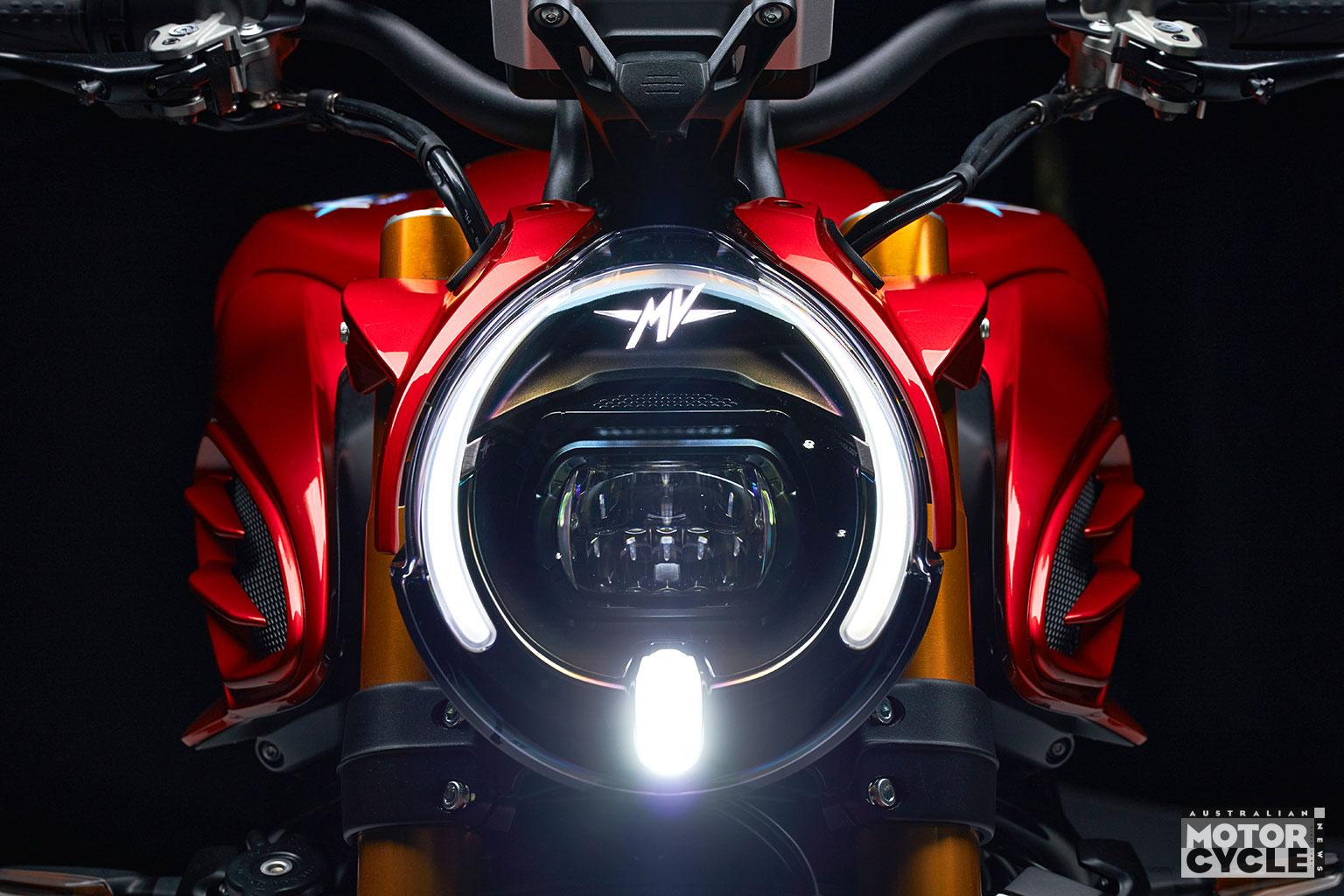
The Brutale family’s most iconic design feature is of course the Salvador Dali-esque headlamp. The latest version features an all-new Matrix LED with progressive cornering functions, a world first on any two-wheeler.
The 2026 MV Agusta Brutale Serie Oro is only available in MV’s trademark Pearl Shock Red/Ago Silver colour scheme, and, like all the company’s models, now comes with a five-year unlimited mileage warranty.
Production is scheduled to commence in Q2 of 2026. Join the queue (if only!).
✅ PROS – A great leap forward in all-round performance without sacrificing the inherent sporting allure of an MV Agusta.
❌ CONS – Not a lot to criticise, considering it is a pre-production prototype. Snatchy throttle issue should be resolved.
Man on a mission
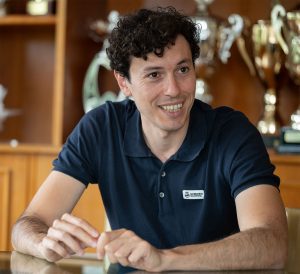
FEDERICO MERCARIO, 35, MV Agusta’s Head of Business Development, is effectively the project leader for the new Brutale. After five years with KTM, he returned to Italy in December 2023 to take up the role, bringing his experience as a development engineer to MV Agusta’s lakeside factory. “Our targets were clear,” Mercario explains. “Design had to be recognisably MV, evolutionary yet modern. Performance needed to set the benchmark in the Super Naked mid-weight sector. Rideability had to make the bike feel fast and confident without compromising comfort. And reliability – backed by a five-year unlimited mileage warranty – had to give our customers complete confidence.”
Rather than repurposing an existing engine, MV Agusta developed a new three-cylinder specifically for the Brutale. “Some might have just put an Enduro Veloce engine in a naked chassis, but we wanted something unique. This engine delivers more power, more torque, and revs roughly 2000rpm higher than the Enduro Veloce, while maintaining paired-valve technology.”
Benchmarking against competitors marked a shift for MV. “In the past, we compared only to ourselves. Now we recognise the strengths of rivals. We tested against the Ducati Streetfighter V2 and KTM 990 Duke. The Brutale outperformed them – stronger across the rev range, higher revs, more usable power and torque.”
Mercario highlights the benefits of moving Centro Stile from San Marino to Varese. “Designers, engineers and project managers now work side-by-side, which accelerates development and fosters teamwork. We focus on collective achievement rather than individual signatures. We may not have a Massimo Tamburini today, but our young, united design team has delivered outstanding work, as seen in the Brutale Serie Oro.”
“Our aim,” Mercario concludes, “is not just to make a better Brutale, but to build the best mid-class naked bike on the market, with unmatched power, torque and rideability.”
SPECIFICATIONS
ENGINE
Capacity 931cc
Type Three-cylinder, 12 valves, DOHC
Transmission 6-speed cassette style, assisted up/down quickshifter, wet assist and slipper clutch.
PERFORMANCE
Power 109kW (148hp) @ 11,200rpm
Torque 107Nm @ 8400rpm
Top speed 260km/h
Acceleration 0-100km/h in 2.7 sec
Fuel consumpion 5.9 L/100km
ELECTRONICS
Full ride-by-wire throttle with 4 torque maps, 8-level traction control, lean-angle sensor, launch and front lift control, cruise control, GPS/Bluetooth-enabled connectivity with MV Ride App. Advanced anti-theft with geolocation and emergency SMS
CHASSIS
Frame ALS steel tubular trellis with aluminium alloy rear swingarm pivot plates.
SUSPENSION
Type Öhlins
Front: Nix 30 USD fork (43mm, 120mm travel), full external adjustment
Rear: Öhlins TTX GP shock (133mm travel), full external adjustment
WHEELS AND BRAKES
Wheels Aluminium alloy, 17in front (3.50 width), 17in rear (5.50 width)
Tyres Front 120/70-ZR17; Rear 190/55-ZR17
Brakes Hypur Brembo front (dual 320mm floating discs, 4-piston calipers), Brembo rear (220mm disc, 2-piston caliper), Continental MK100 ABS with cornering and rear wheel lift mitigation.
DIMENSIONS
Weight 195kg (dry)
Seat height 850mm
Wheelbase 1433mm
Fuel capacity 16.5L.
BUSINESS END
Price: €27k limited edition model, €17,600 volume production model
Colour: Pearl Shock Red/Ago Silver
Contact: mvagusta.com