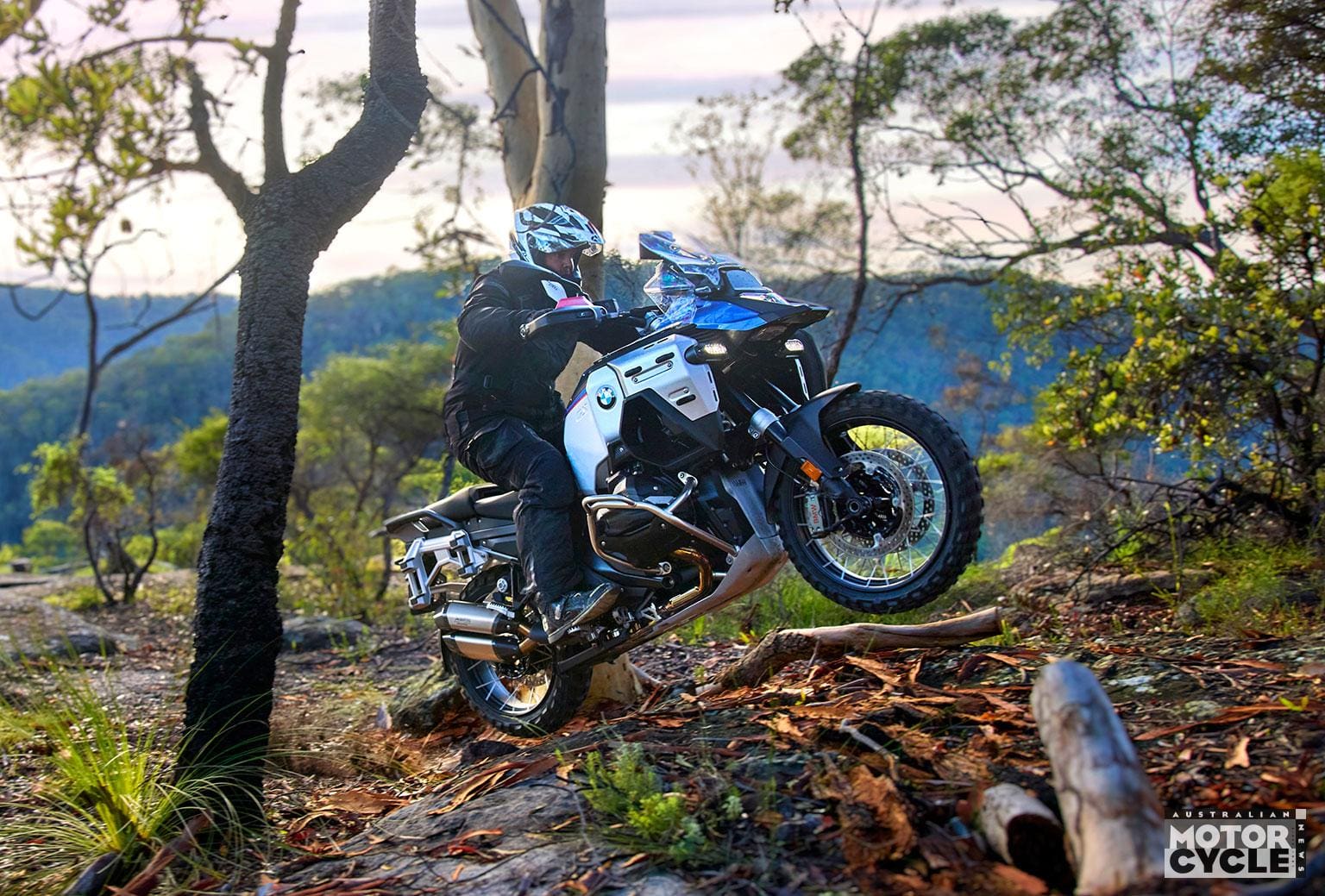
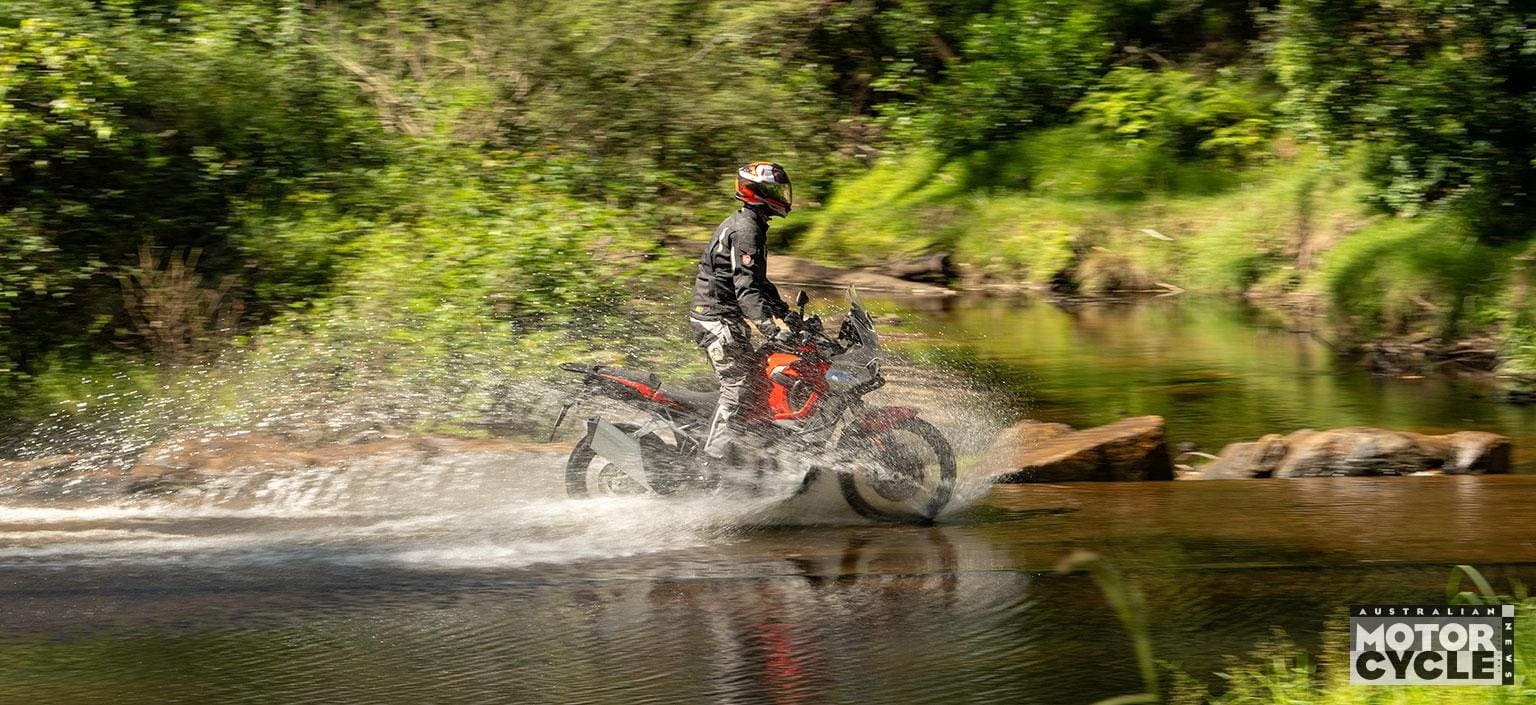
All roads, all weather, all day long. The ultimate all-rounder laughs at poor conditions and begs you to open the throttle
More than a marketing gimmick, the Multistrada name couldn’t be any more fitting to this machine. In my case, however, I’d call it the Multitempo edition as the weather seemed to mock me wherever I went. Brisk spring mornings to 35°C stinkers in the bush to miserable misty damp roads and – adding insult to injury – torrential downpours. Most importantly, I felt safe and confident no matter what was thrown my way.
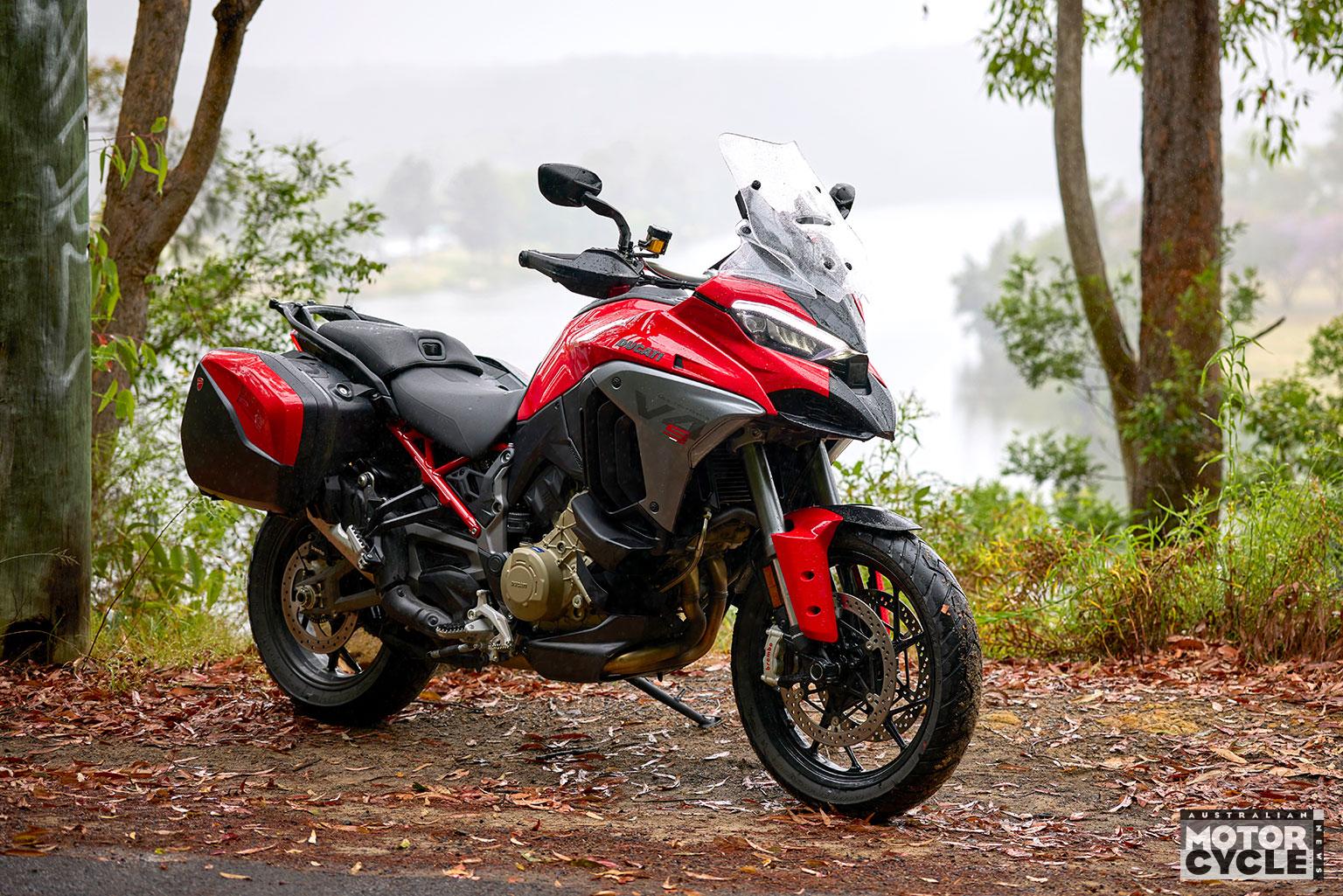
Powered by Ducati’s peachy MotoGP-inspired V4 Granturismo engine, the Multi propels towards the horizon like a over-caffeinated teenager and produces an equally ferocious howl as you click through the gears. I can’t help but think of Gigi Dall’Igna stroking his goatee and nodding in approval as I hold the throttle wide open, letting it scream.
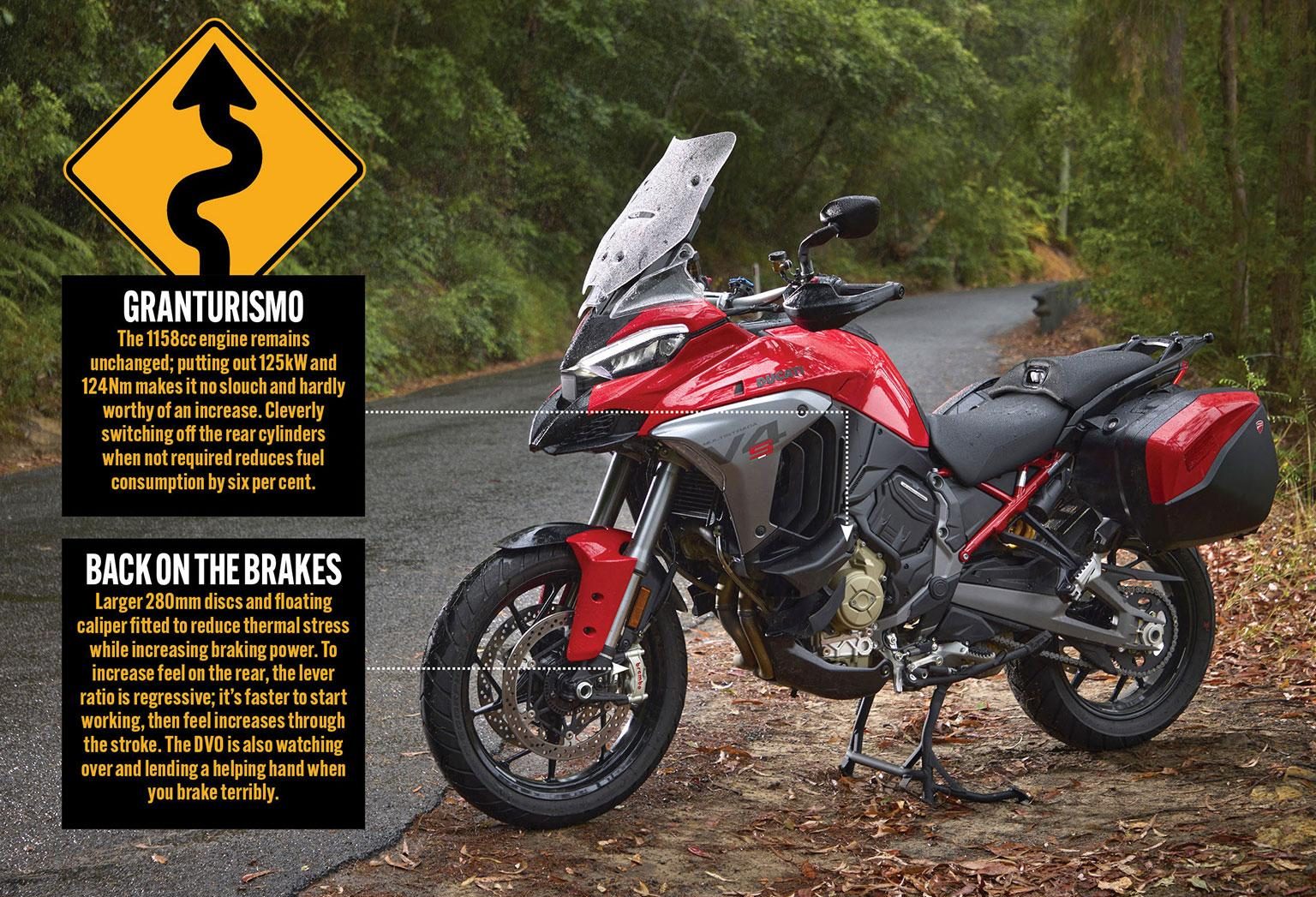
The V4 does its best work in the mid to high rev range, but has enough off-idle torque for low-speed off-road stuff too. The rear cylinders switch off a bit more often now to save fuel and generate less heat. Previously they would only cut out when idling. But now, while rolling along at low-throttle inputs, thanks to the better sounding exhaust you can hear the note change as they drop out. Then burst back into life when you so much as breath on the throttle. Ducati boasts a six per cent fuel consumption reduction as a result.
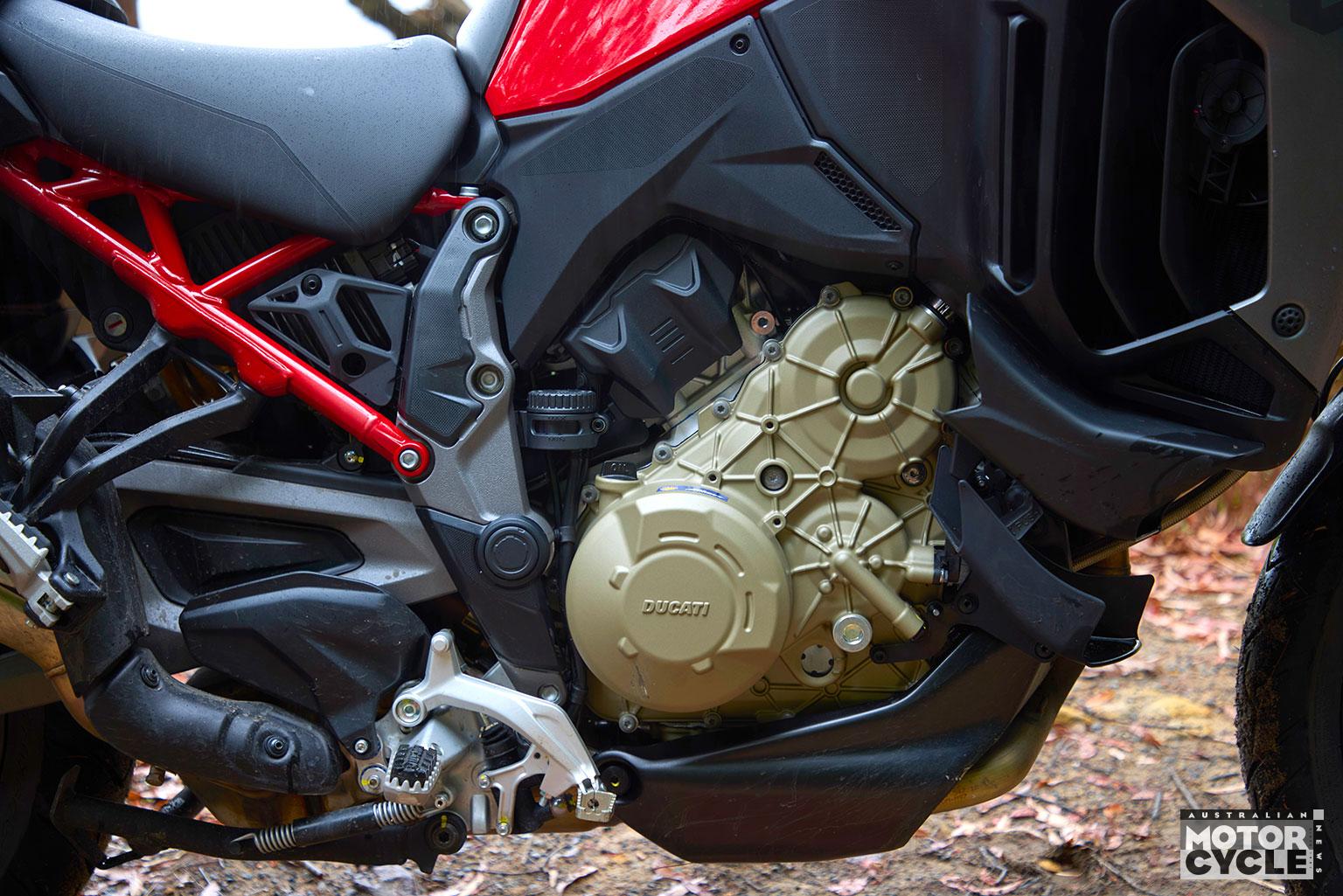
The 1158cc V4 is essentially unchanged since its introduction on the previous model and produces 125kW (170hp) and 124Nm of torque. The spring-actuated valvetrain loses a bit of peak performance over the Desmo valvetrain found in the Multistrada RS – however, it makes for a smoother ride and can go 60,000km between valve clearance checks. Ducati appears to be very happy with the reliability of valve springs too as the new 890cc Panigale V2 engine now also sports valve springs, and that engine has been finding its way into the Hypermotard, Monster and DesertX models.
Twisties beware
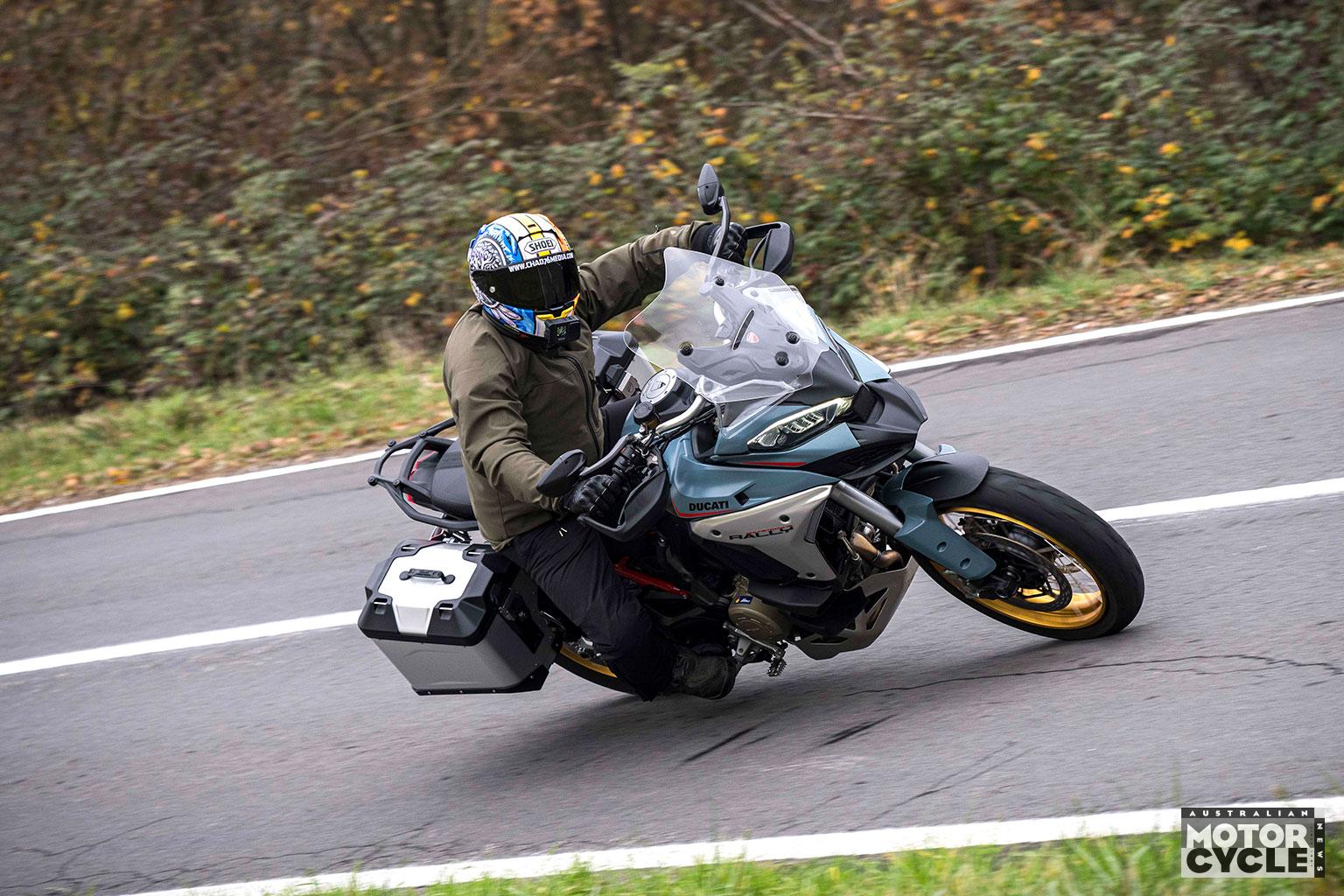
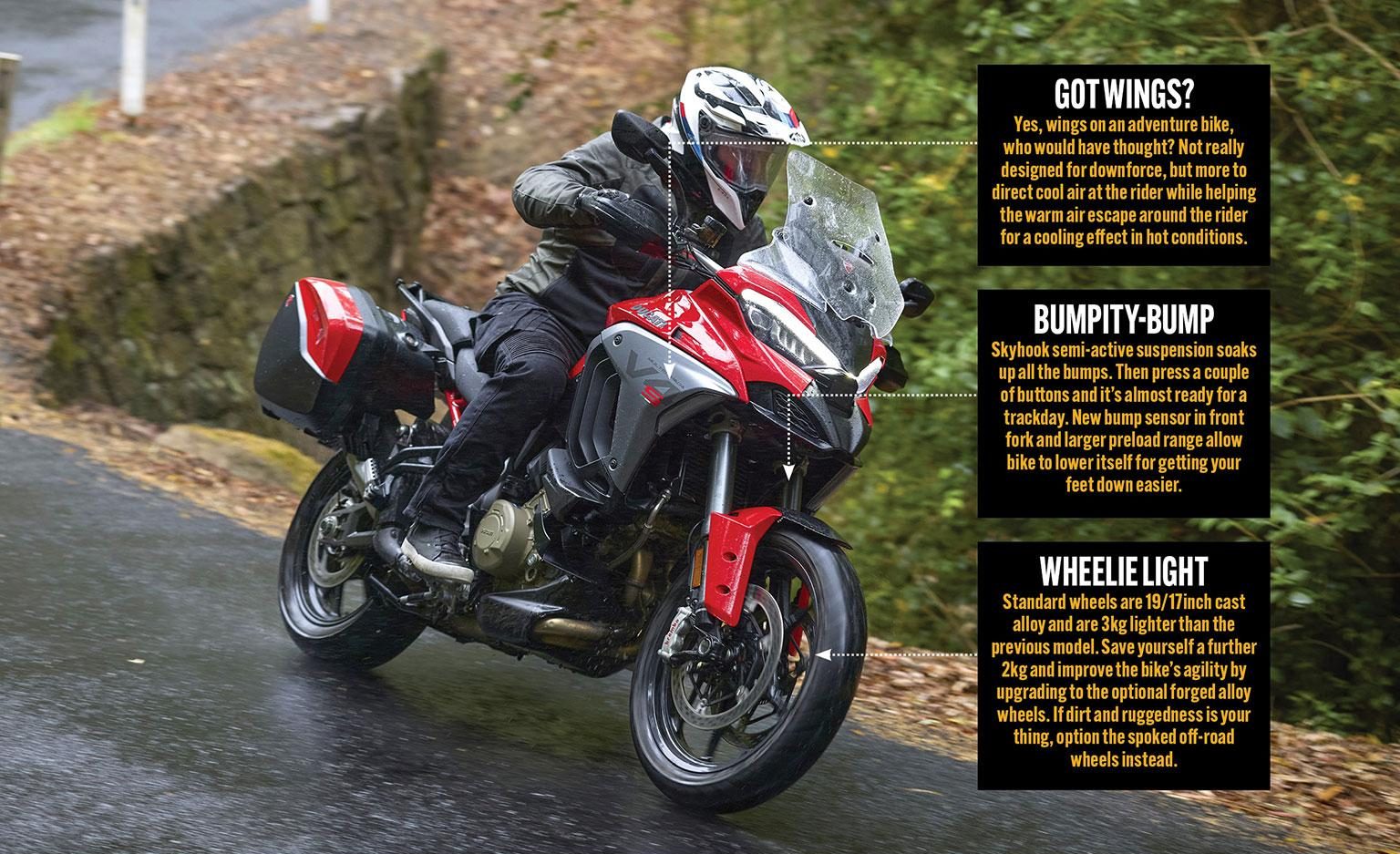
The handling department is where I feel the Multi stands clear of other adventure bikes. Some may excel in off-road conditions more than the Multi, but on the road? The Multi is bonkers. The Skyhook suspension, as the name suggests, aims to make it feel like you’re suspended from above and gliding over the bumps rather than bouncing up and down over the terrain. Obviously that’s physically impossible on a motorcycle, but it’s the thought that counts, right? Either way, the electronic Marzocchi boingers are primo.
The updated rear shock now has more preload range, an automatic lowering device (very MotoGP) and the swingarm pivot has been moved up 1mm to reduce squatting under acceleration. The front fork now has a bump sensor fitted inside; previously this was only fitted to the Rally version and helps the DVO (Ducati Vehicle Observer) make adjustments faster than an IMU alone.
When cruising around the countryside, I opt for Touring mode with automatic suspension adjustment as an all-round setting. I also set the preload algorithm to rider-plus-luggage for some extra support for my 95kg. In this mode, the suspension is compliant and comfortable but you can still ride spiritedly without feeling too mushy.
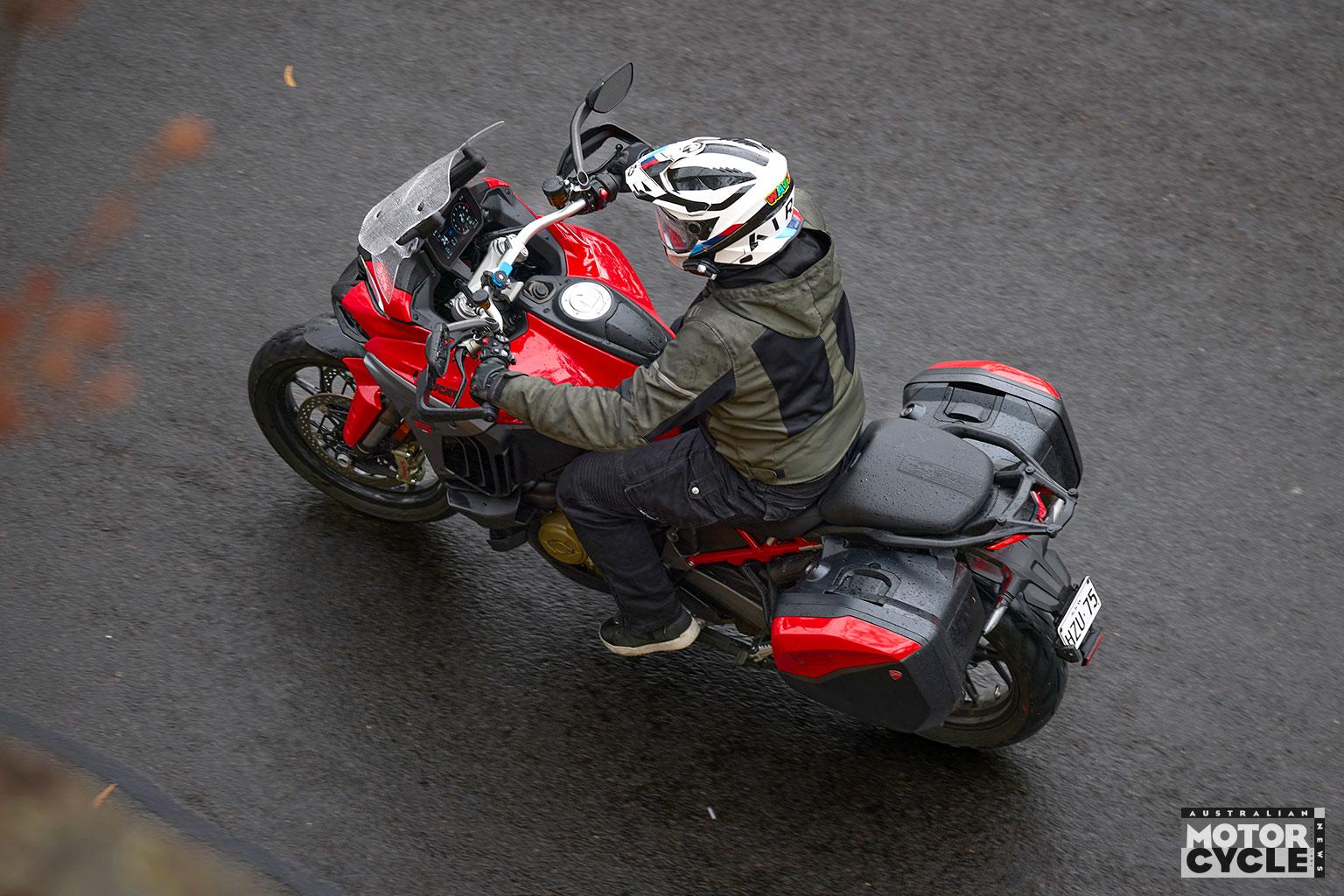
When the road turns twisty, I dial up Sport mode, which winds the preload up and changes the damping to dynamic mode, ready for more aggressive riding. It disables the front and rear radars, sharpens the throttle and allows a bit more rowdiness. In this mode the Multi really shines. It’s a twisty back-road weapon with its wide ’bars and commanding riding position.
There is ample grip available from the Pirelli Scorpion Trail tyres; you can scrape footpegs and dive into corners while trail braking without feeling loose.
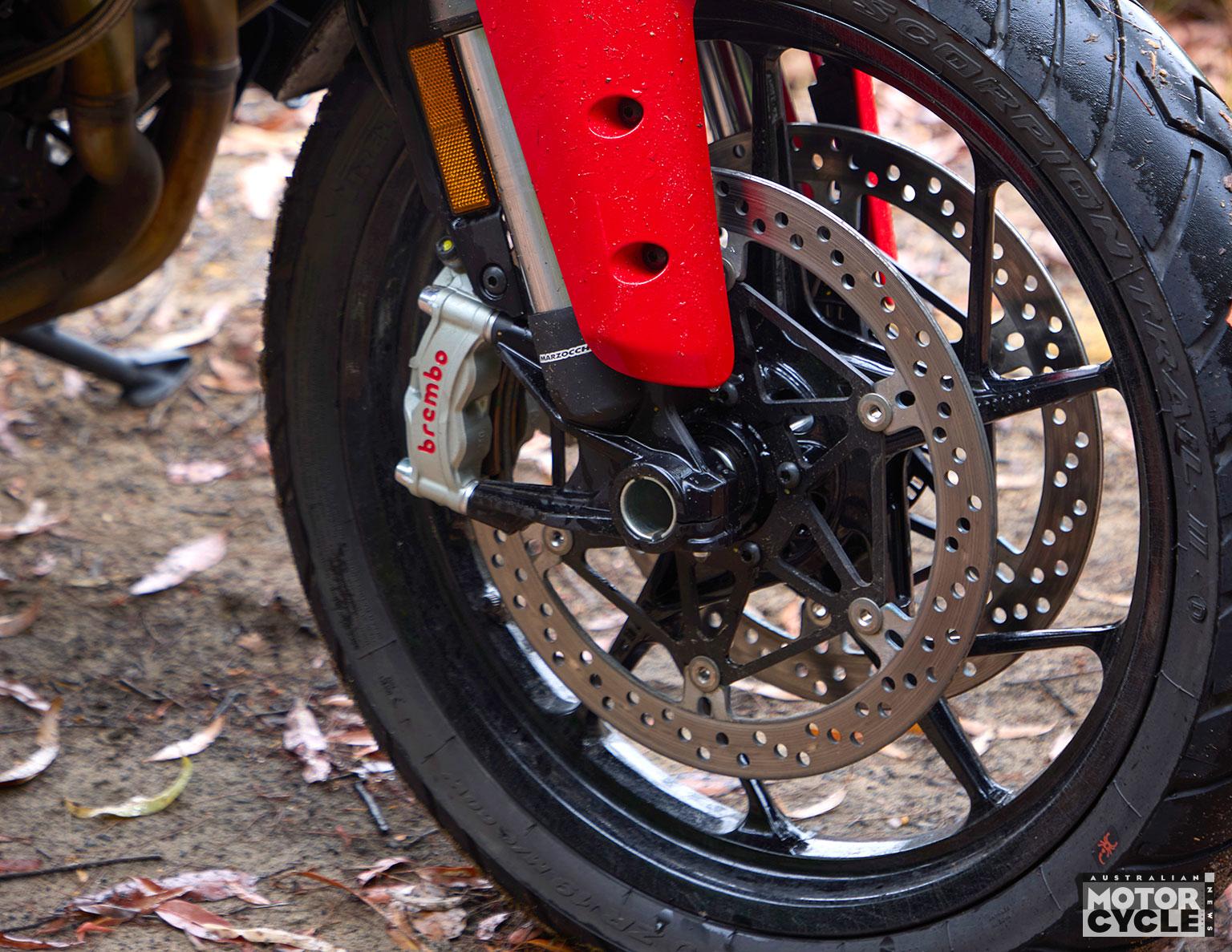
The Brembo brakes are amazing. The front is super-powerful and an updated larger rear disc and master cylinder give more feel. You can feel the DVO correcting bad habits or simply inefficient braking. If you give it too much rear brake it will squeeze the front for you too when required, and the same from front to rear. It feels natural enough, but I’d hate to think of the algorithm running it. Braking bumps and crappy road surfaces? The Skyhook suspension eats it for breakfast and delivers maximum smiles per mile in less-than-perfect conditions.
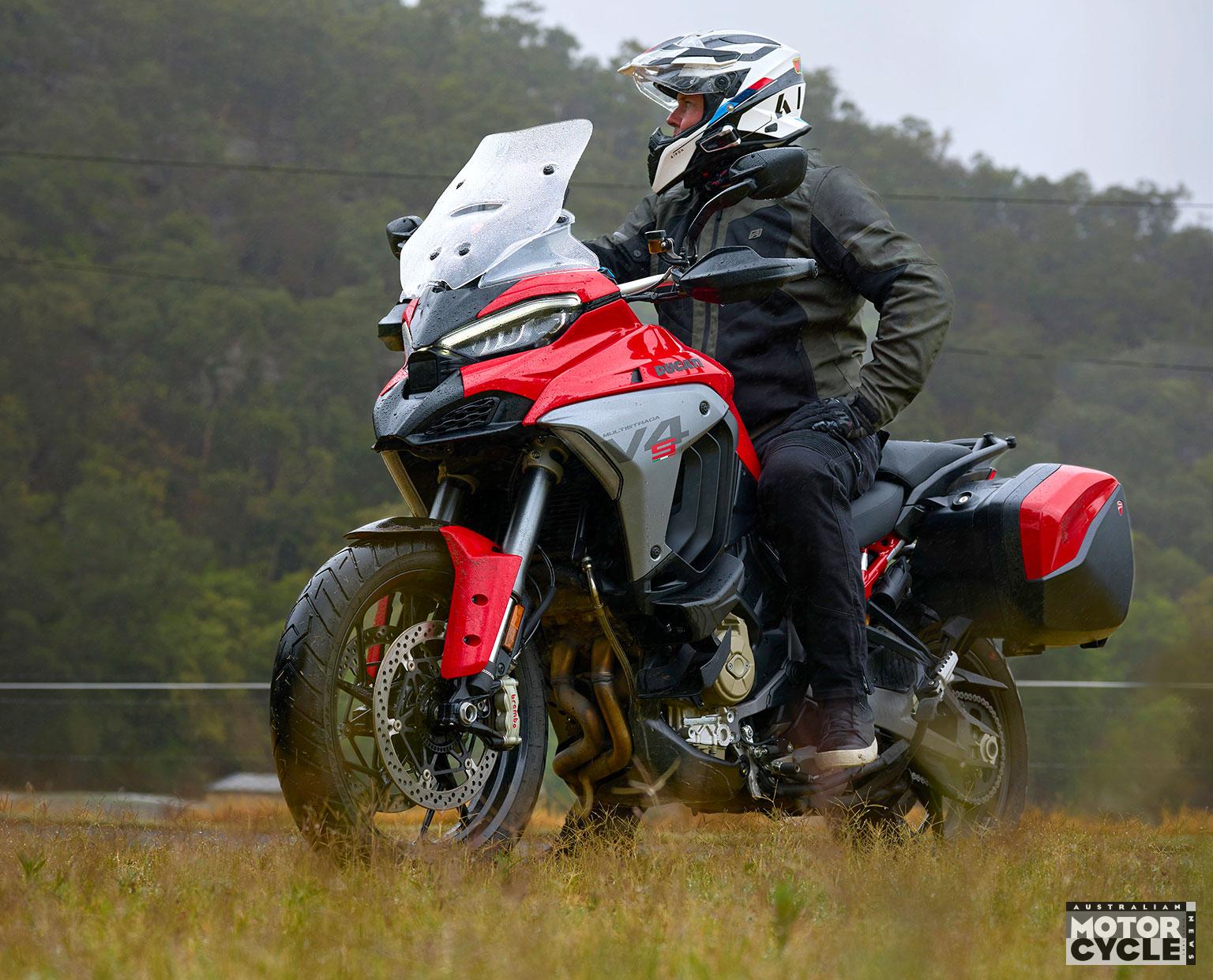
Rain? No problem
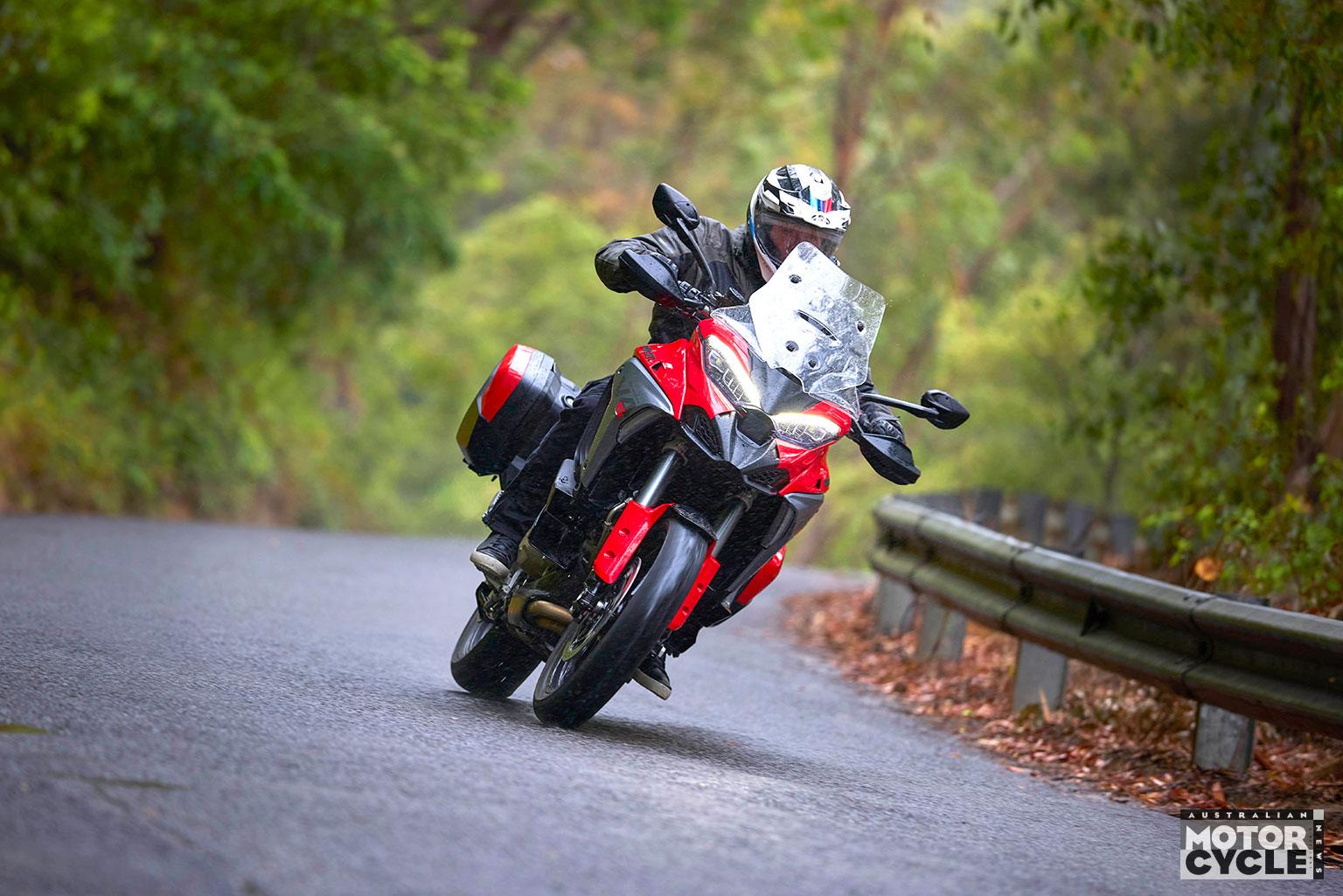
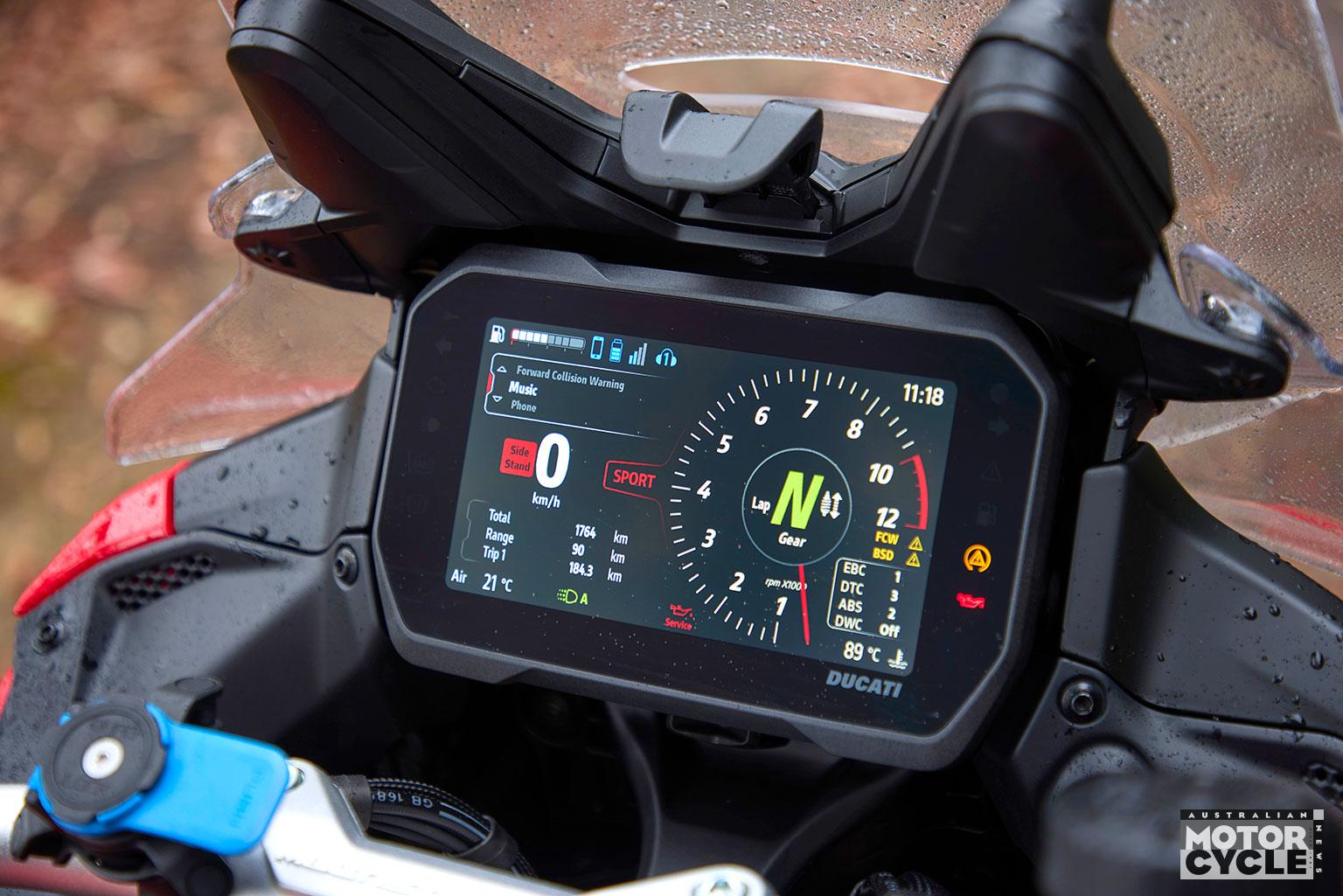
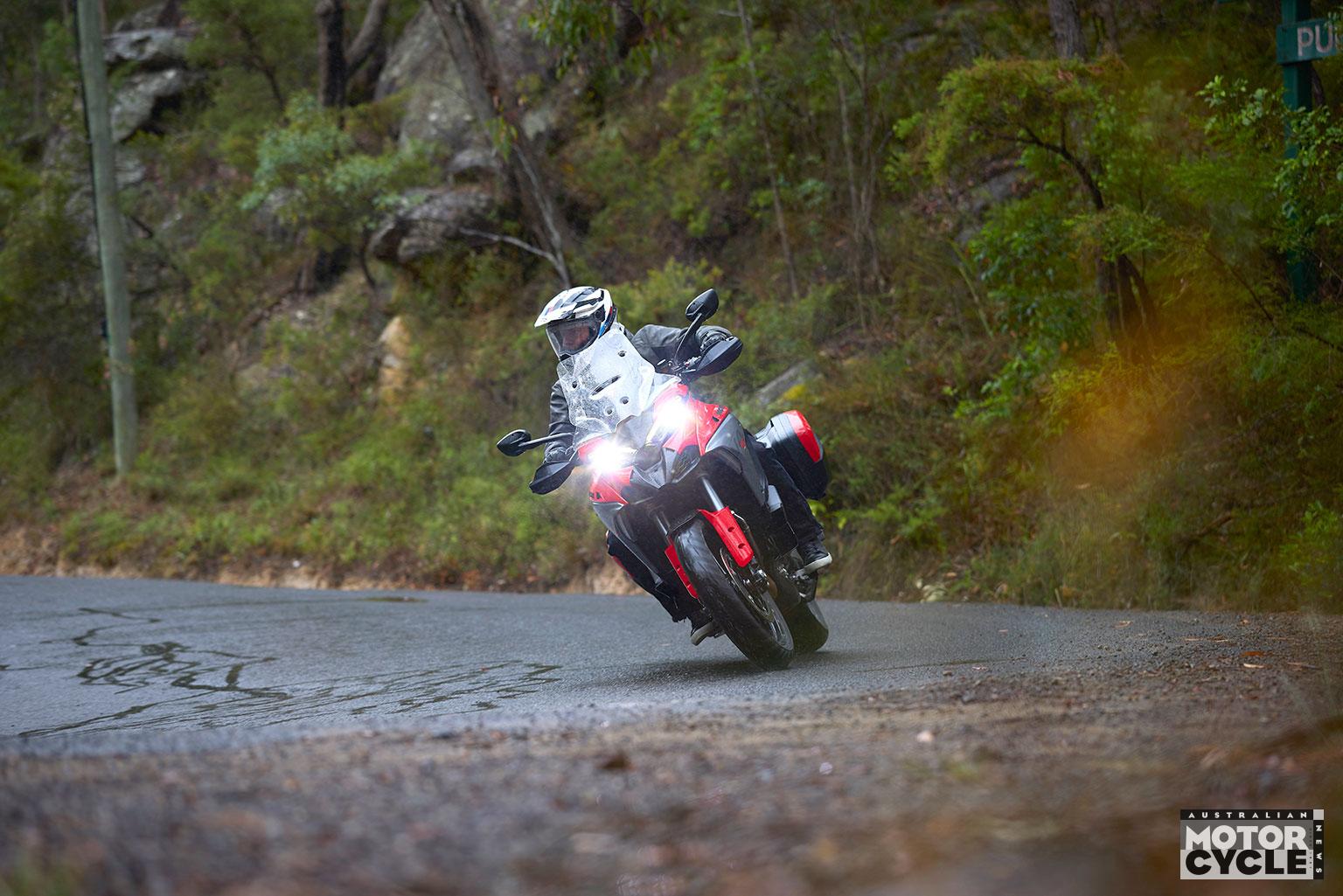
As usual, rain made an appearance during my stint on the Multistrada. No worries, mate. Dial up Wet mode on the dash and power drops from 125kW to a more manageable 84kW. Sounds dramatic, but the Multistrada V2 only puts out 88kW in total, so there’s still enough grunt on tap. Wet mode also softens the suspension in what it calls a ‘low grip’ setting and increases the electronic aids to maximum. All of this allows you to concentrate on the task at hand, like not riding into a river or under a bus while still being able to enjoy the ride.
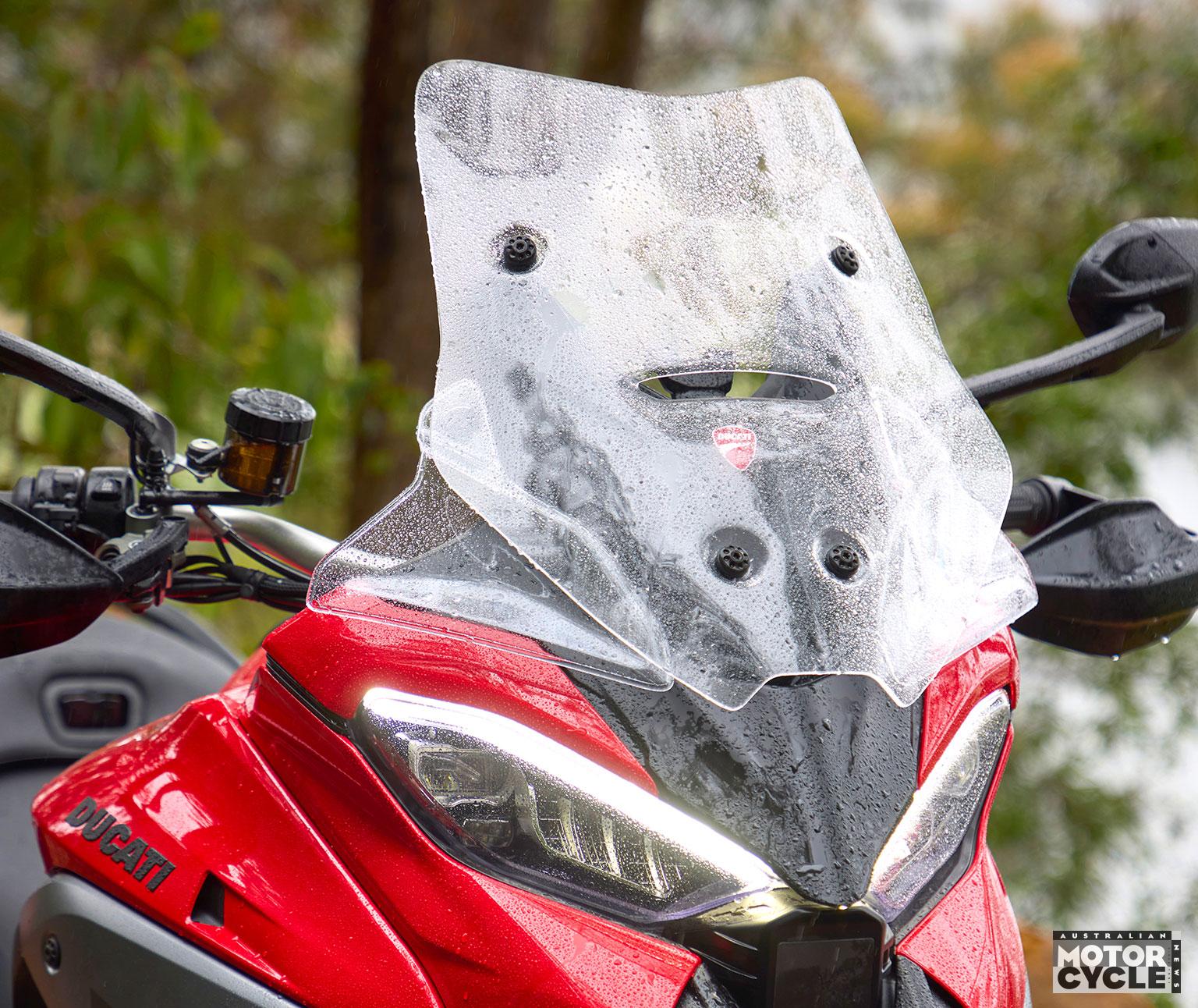
One advantage of running trail tyres is that the deep grooves make them very good at dispersing water, increasing available grip.
The windscreen is manually adjustable on the fly, so I yoink it up and enjoy the protection from the weather. When the ambient temps drop, as well as heated seats and grips, there are a pair of flaps located inside the wings on the side fairings. Flick these shut and the cool air is diverted around your legs by some aero wizardry. This same wizardry also sends the hot air from the radiators out and around the rider to stop you getting blasted with hot air in summer.
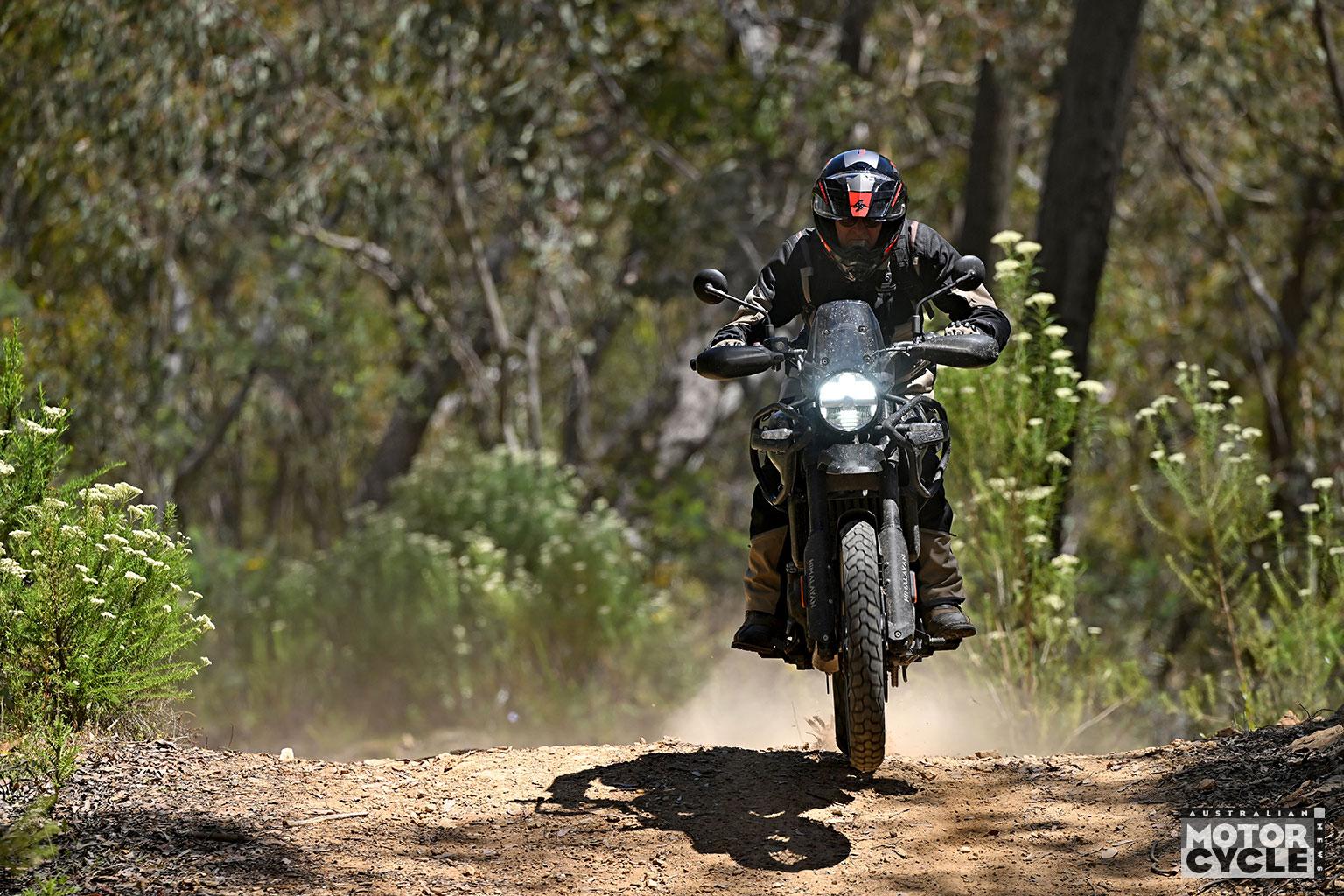
While the V4S with cast wheels wouldn’t be my first choice of Multistrada to take offroad, the dash has Enduro mode and the tyres say ‘trail’, so onto trails I go.
I’ve ridden the older V-twin Multistrada offroad with knobby tyres and found it to be more than capable. But they were a bit more rugged back then and their road prowess wasn’t at the level of the V4, so I ease in gently on a nice dirt road.
Of course as roads progress further from civilisation, so do the trails. The Multi doesn’t disappoint. The V4 chugs along at low revs and puts the power down gently and smoothy. The Enduro ride mode makes use of the low-power engine map, but a more aggressive throttle.
I feel I can modulate the throttle well in all situations. It certainly doesn’t feel like a corner-slaying 170hp sports tourer while doing small jumps over erosion mounds and climbing rocky sections of trail. I spend the hot (35°C) part of the day cruising along in second and third gear and hardly feel any heat being thrown at me from the engine. Something that anyone who has ridden a Panigale in traffic would find hard to comprehend.
I reduce the TC from the standard setting to get a few slides happening and the bike is predictable and drives as well as can be expected from trail tyres. The front end does tend to wander and follow ruts, but this is expected from the tyres also. Without side knobs to steer it out of a rut, you’re essentially along for the ride. This is a sacrifice I’m willing to make in exchange for on-road performance and wet-weather safety. After all, there is a Multistrada V4 Rally if you need more offroad performance.
Creature comforts
Comfort on the Multi is on point. To deliver the performance in all areas and still be super comfortable is an absolute delight. Weather protection is great without being intrusive. I did a 500-plus kilometre day of road and some dirt in total comfort. The seat is soft and shaped well. In usual Multistrada style, I find the ’bars to be wide and close to me for maximum control; if you were going to ride offroad and stand up more, I would turn them forward for some extra height and angle to the levers.
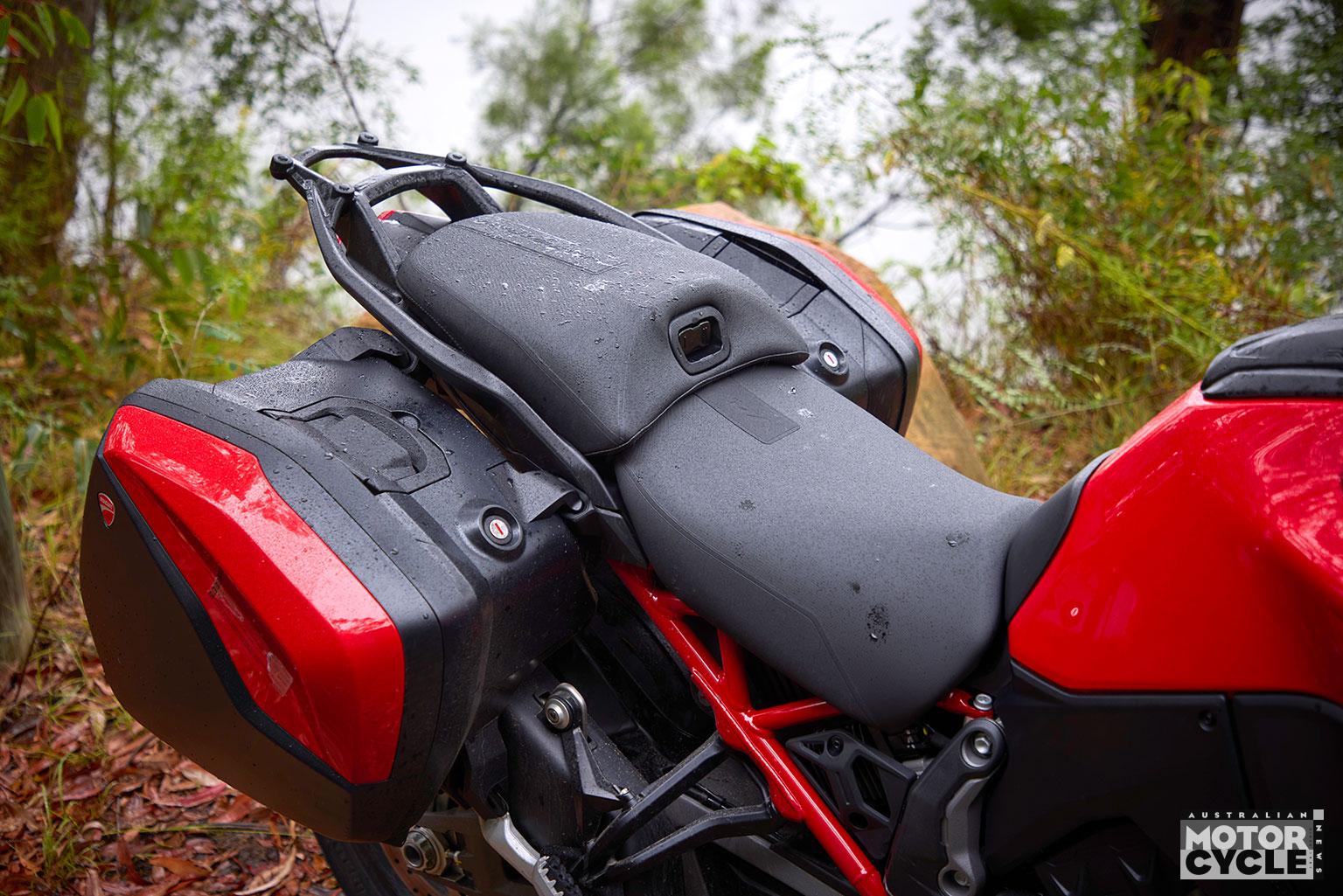
The seat height is very reasonable at 840mm in the low position, then up to 30mm lower when the automatic lowering device does its thing as you come to a halt. When offroad or with a pillion, this gives an extra level of stability.
The pillion comfort wasn’t overlooked in the small updates either. The luggage rack has been moved back 12mm and the panniers 25mm rearwards to give your pillion extra space. My wife was happy with the seat, grab rails and general feel of the Multi. There were mutterings about corner speeds and necessity, but the Multi was not at fault.
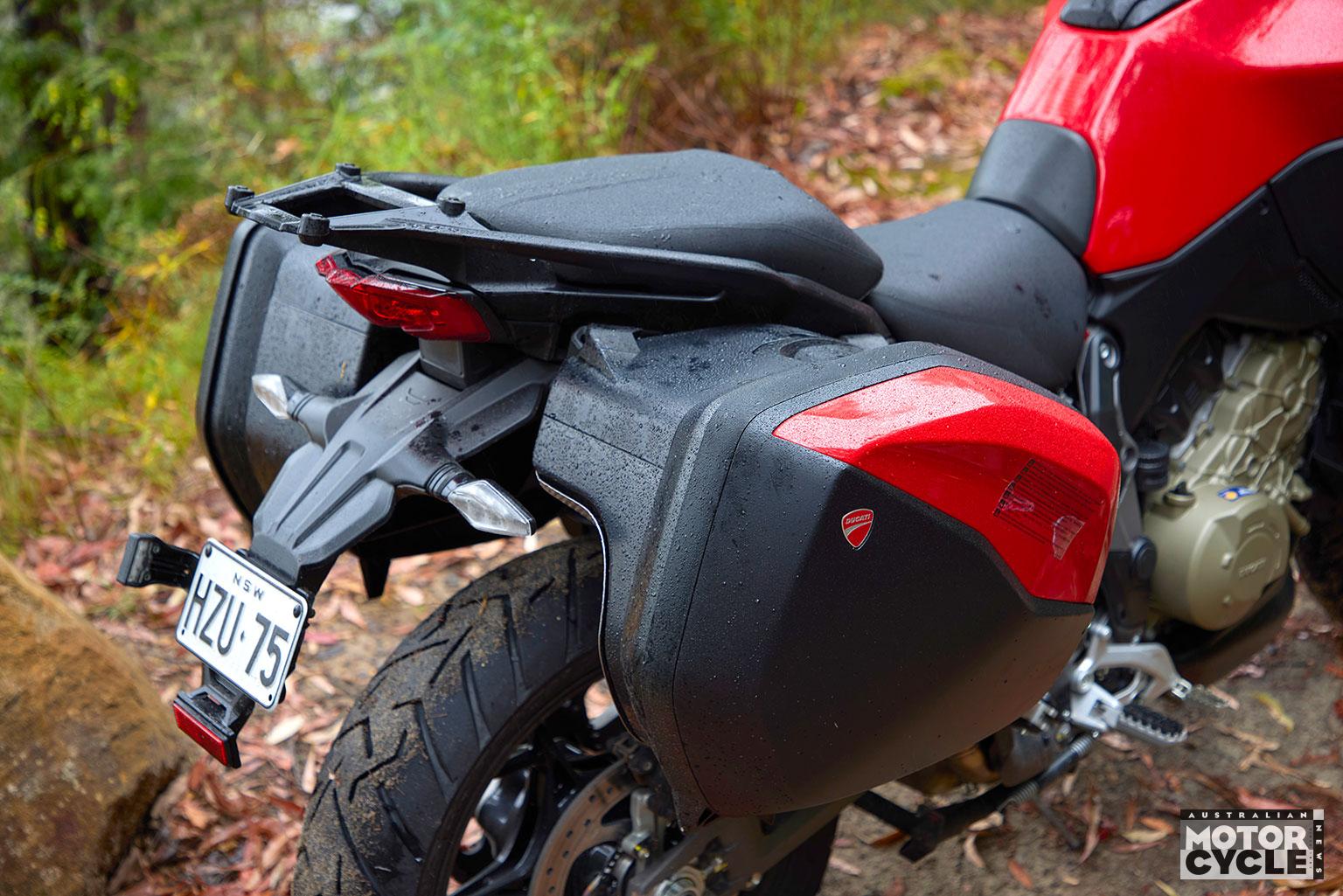
The hard panniers fitted to this test rig are pretty easy to fit; they need the bike key to open them or lock them to the bike. As previously, they are fitted on shock-absorbing mounts, so they might seem loose but they stay where they are. Central locking might be a nice update in the future, so the bike is fully keyless. A topbox would also be a good option for two-up touring with a little pillion backrest.
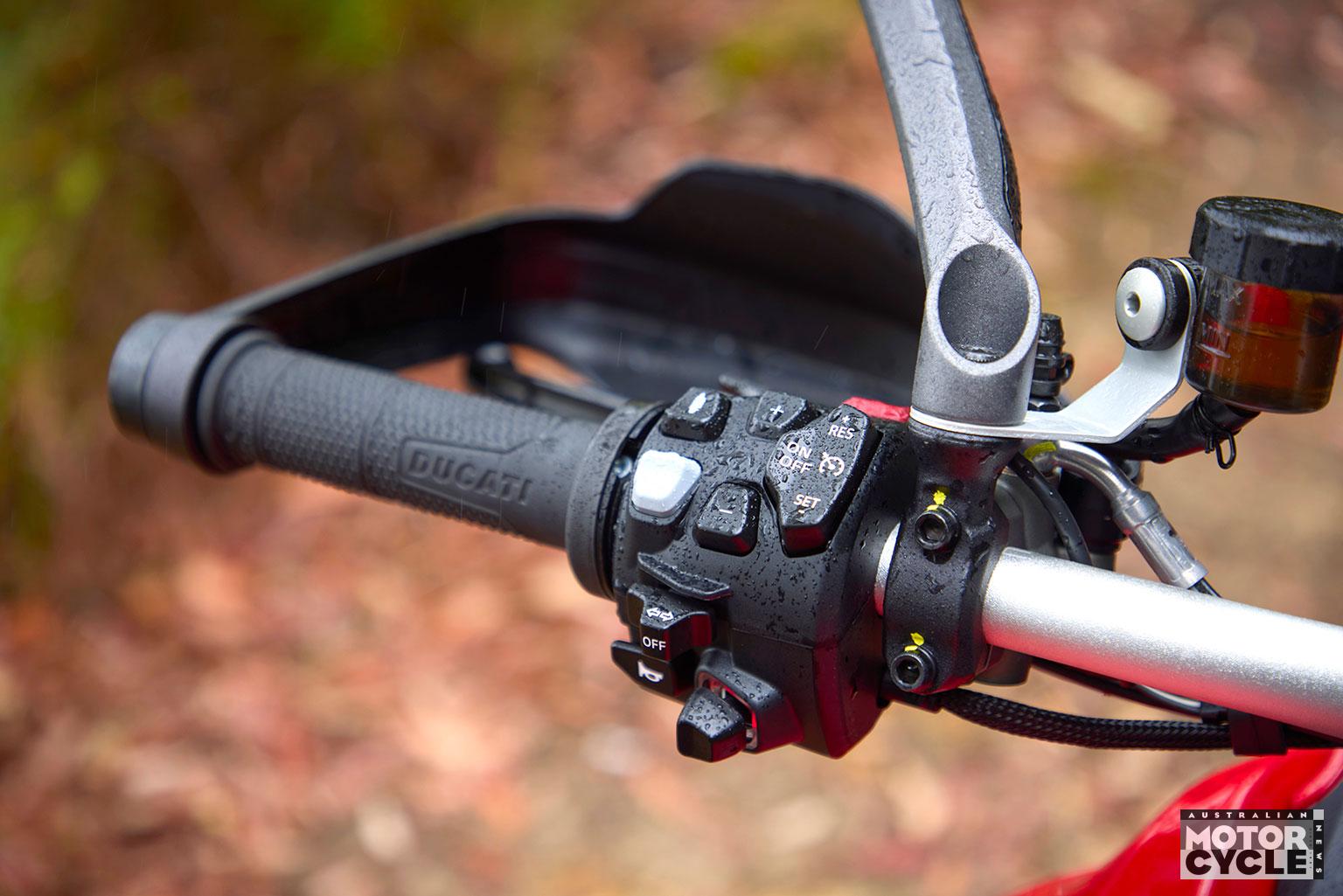
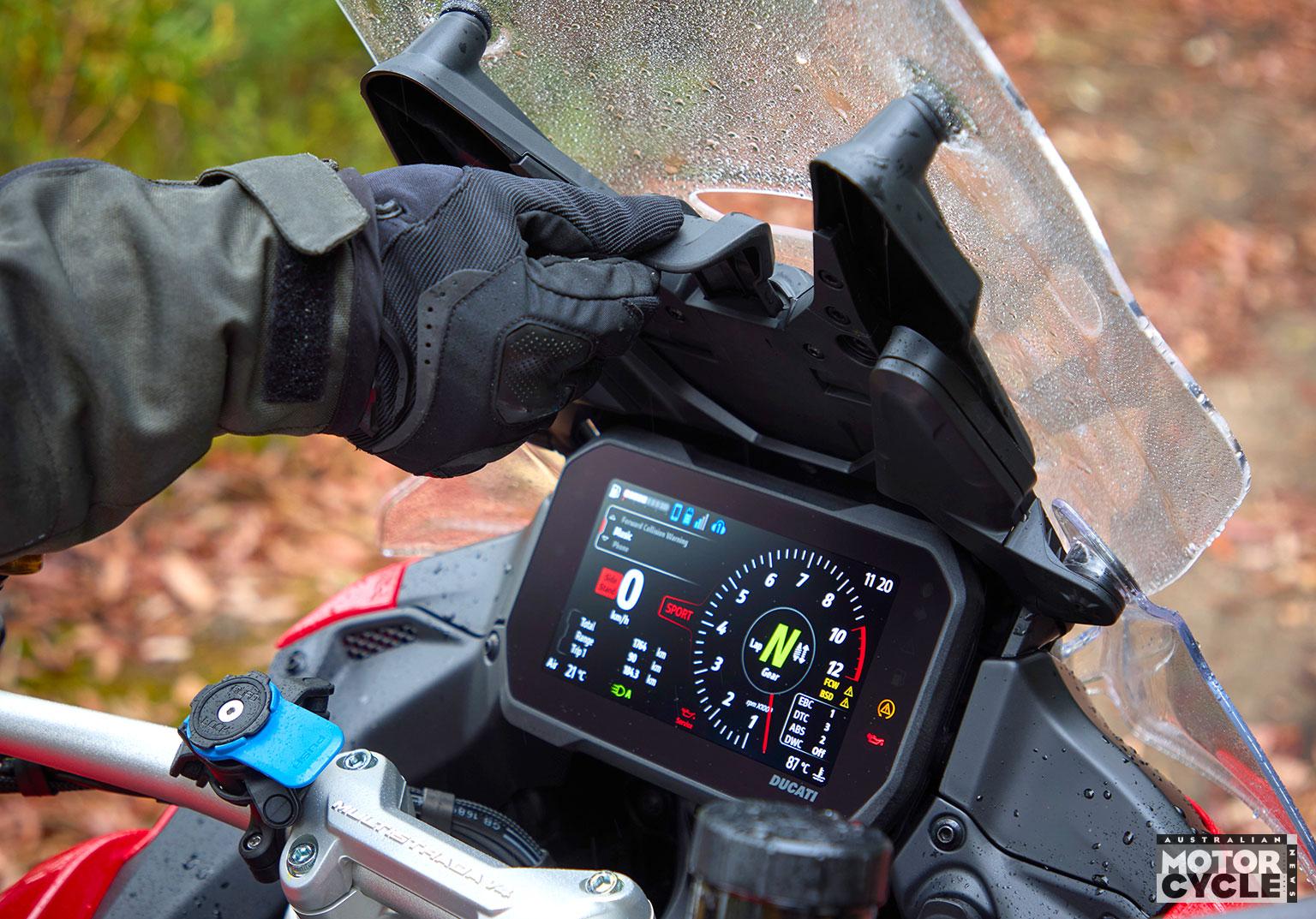
Creature comforts are now easier to access through the dash display, which makes bike adjustments super easy. When you hit the heating button, a new menu pops up that shows rider grips and rider seat and you can scroll through with the joystick control with your left thumb. The dedicated suspension button takes you straight to the menu to choose your preload setting and damping settings. A long press of the same button enables and disables the auto-lowering suspension. Then the mode button takes you directly to selecting the ride mode, and if you’re stopped and in neutral you can then also access the individual settings of each mode.
The new menu is super easy, with dedicated buttons for different functions (BMW should take note).
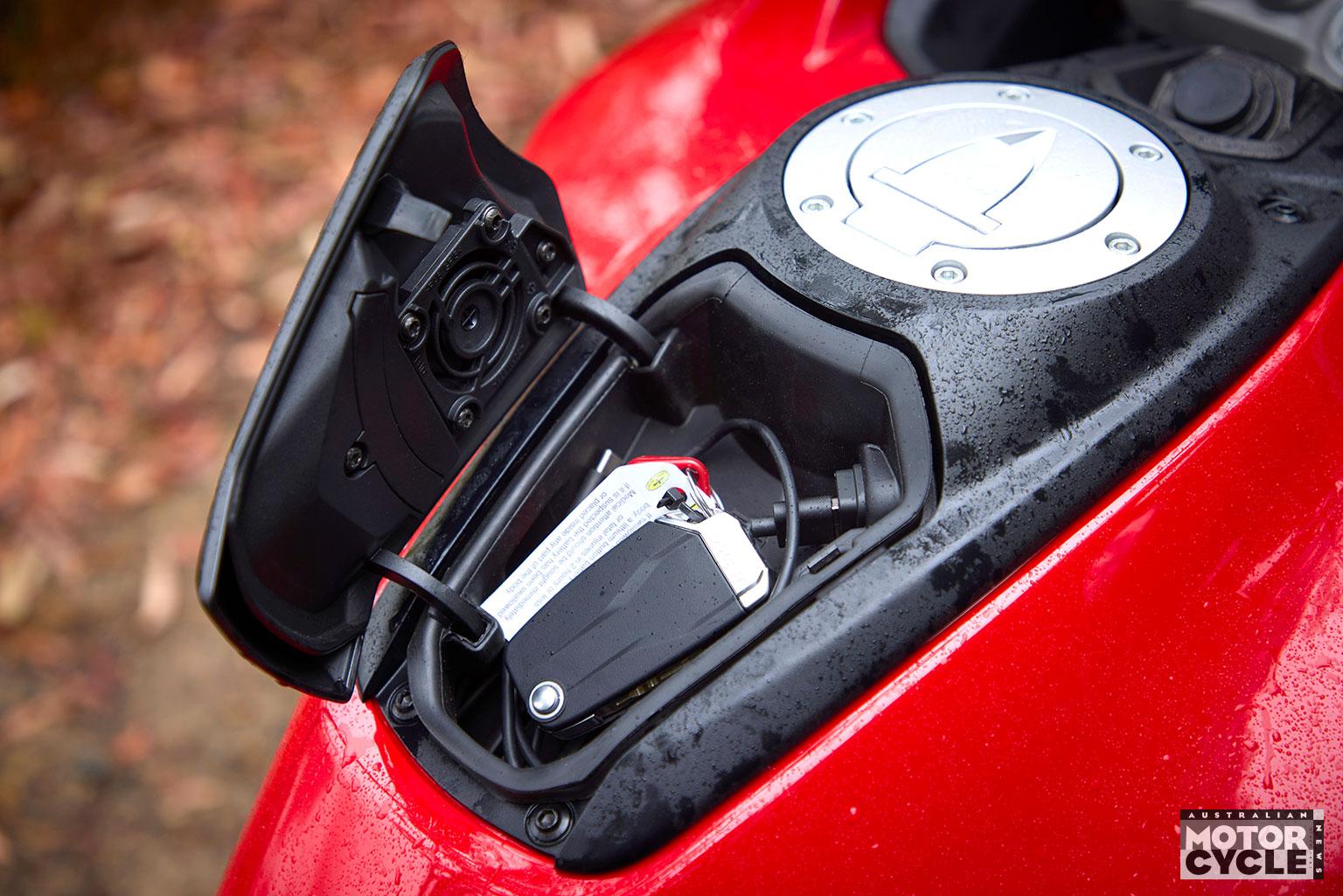
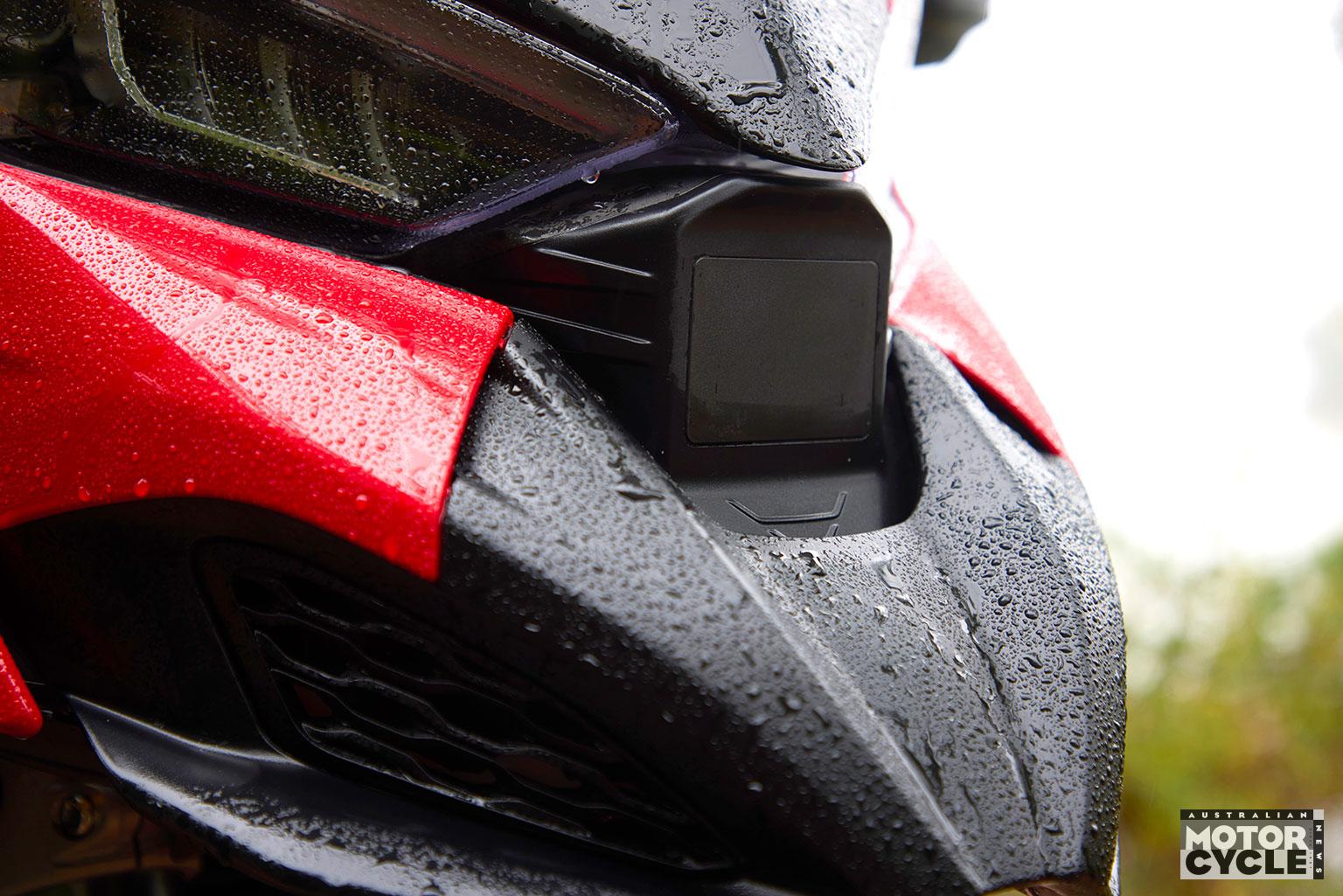
You need to be an electrical engineer with a lot of spare time to work your way through all the tech as this bike has everything. I especially like the radar cruise control. It works well on the boring bits of road and will trundle along at the same speed as the traffic; it is a bit erratic in corners, so best leave those to the right hand. The forward-collision warning does what it says, I guess, although I only managed to get it to flash once while changing lanes to filter through traffic. Blind-spot warning works okay. The full suite of navigation and phone connectivity is available with the Ducati apps. There’s a fan-cooled phone pocket and USB outlet on the fuel tank, but only smaller phones fit.
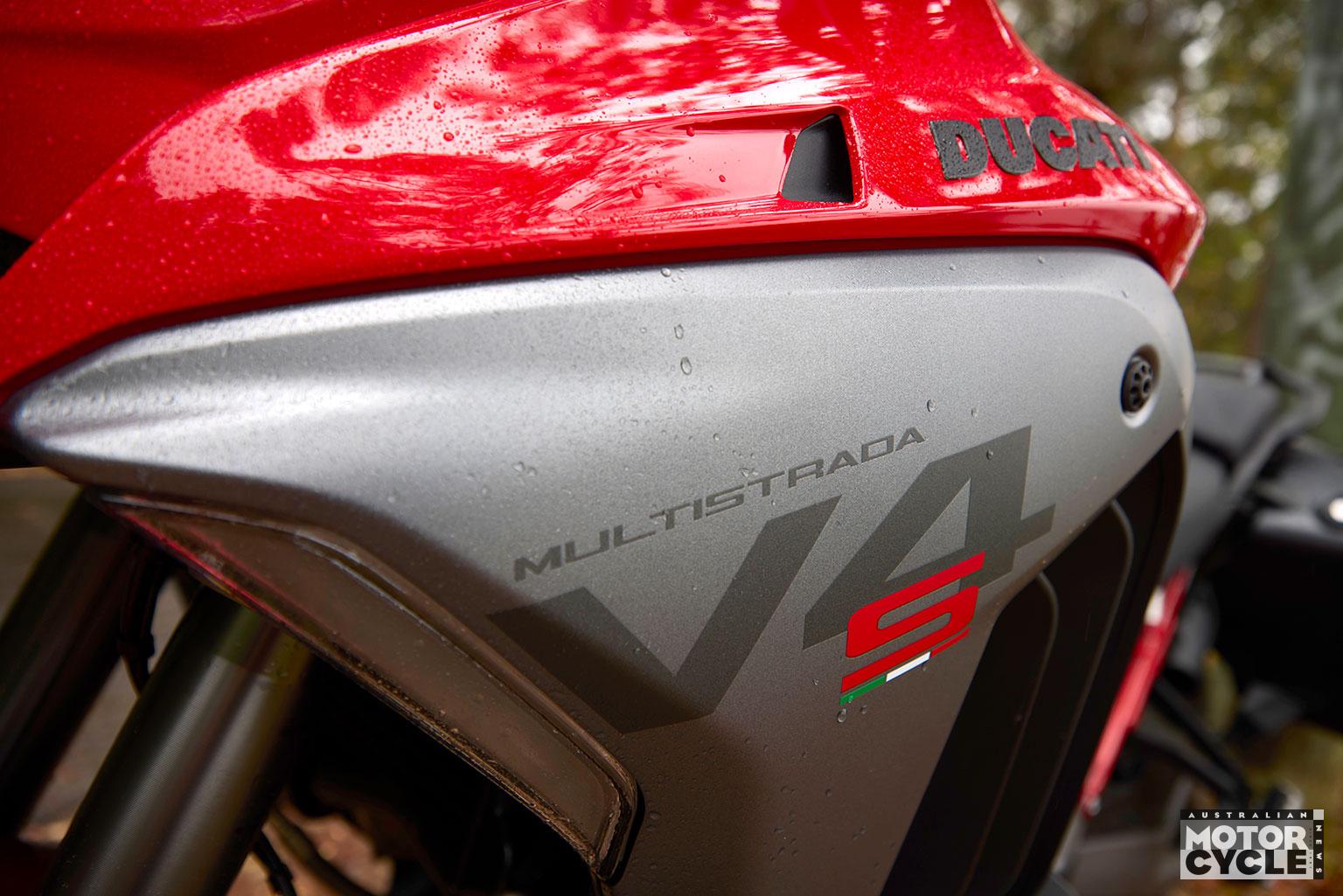
The 22-litre fuel tank will take you over 300km – which is plenty, but with some other adventure bikes squeezing out almost 500km per tank, it looks a little light on fuel capacity for some far-flung adventures. It passes the tank-of-fuel comfort test, but I can easily last longer on the bike than a tank of fuel. The Multi will take you 15,000km before needing an oil change, 60,000km before needing a valve inspection, and there is now a four-year warranty. Ducati is walking the talk when it comes to reliability, that’s for sure.
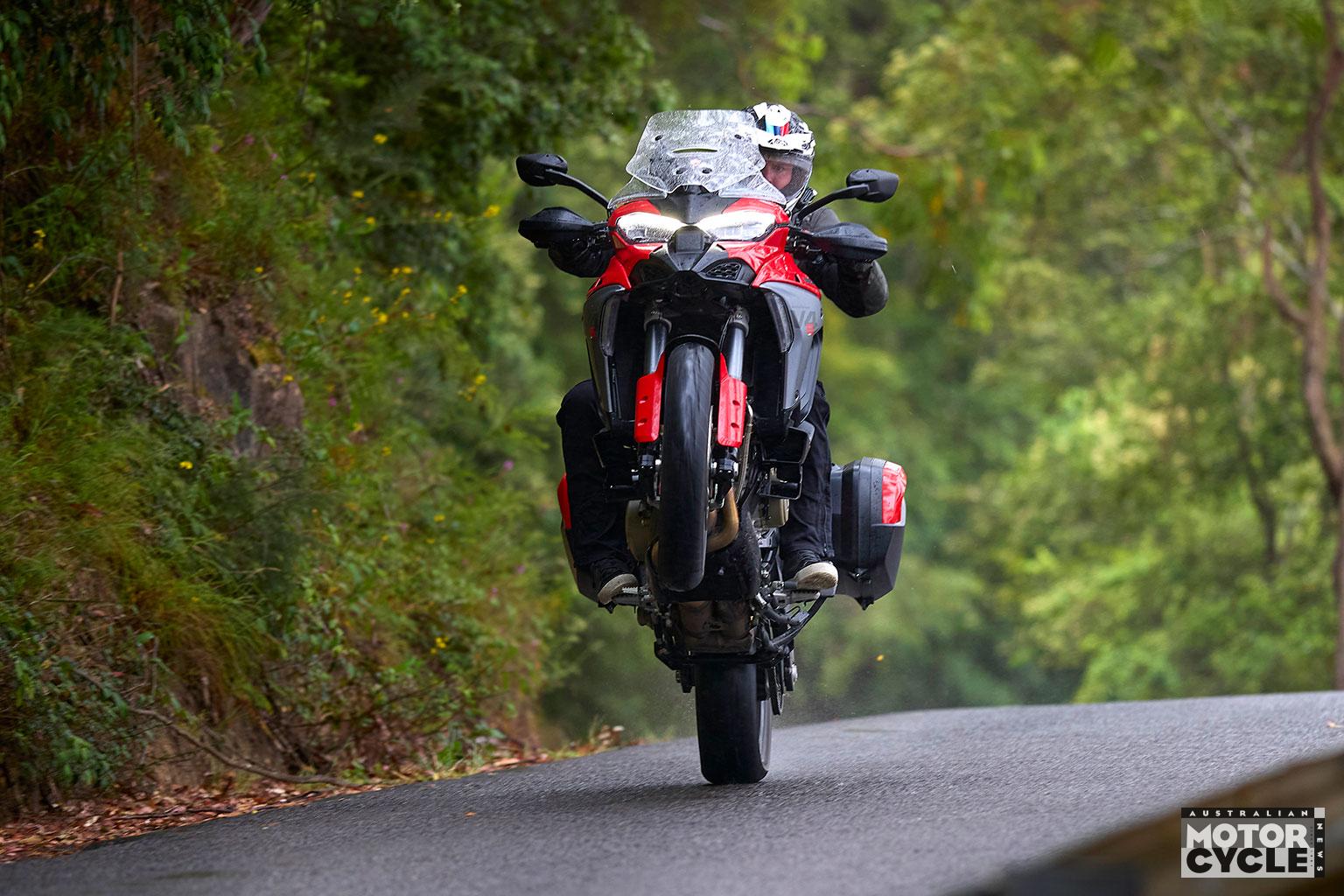
Do I love it? I absolutely do. Yes, there are faster road bikes out there and yes, there are more capable offroad bikes out there – but the Multi is like a top-of-market SUV. Fast enough to get funky, super comfortable and surefooted in almost every condition besides serious off-road.
✅ PROS – Blistering power, superb handling, all-day comfort in any road or weather conditions.
❌ CONS – Too nice to take on dirt, enduro boots scratch the clutch cover, central locking would make it entirely keyless.
the rivals
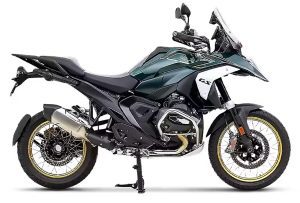
BMW R 1300 GS Option 719 – $41,780 ride away
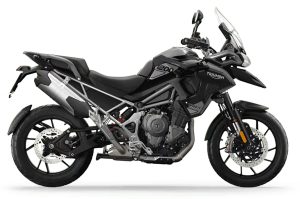
Triumph Tiger 1200 GT Pro – $30,590 ride away
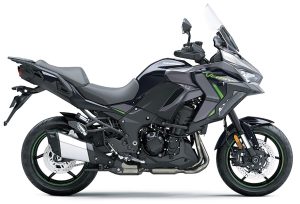
Kawasaki Versys 1100 S – $24,292 ride away
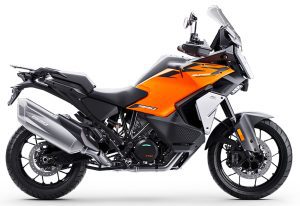
KTM 1390 Super Adventure S Evo – $36,495 ride away
Multi Choice
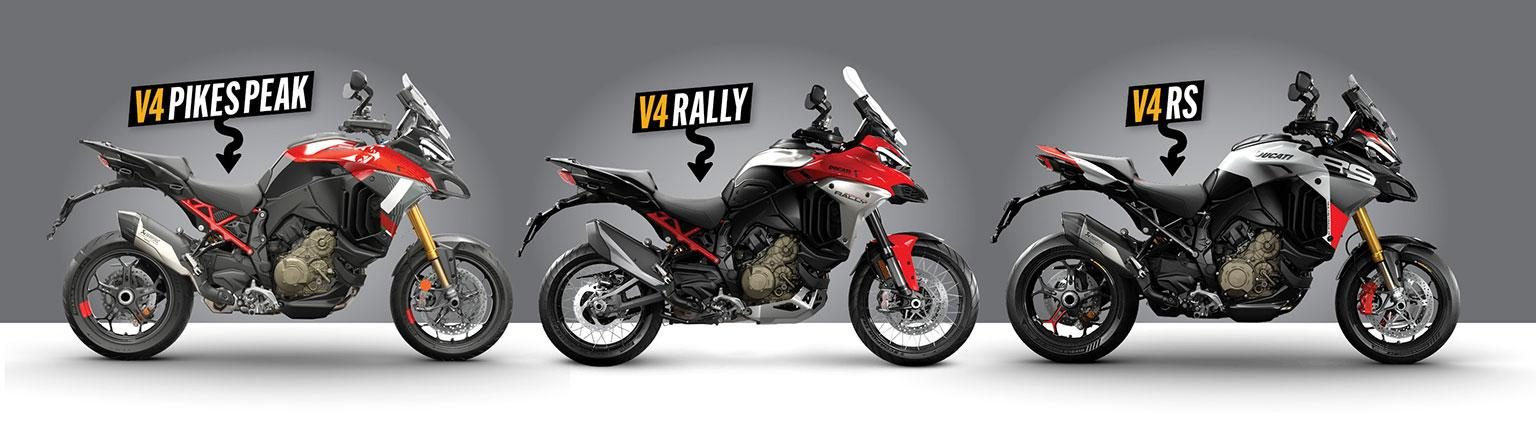 With five models and five trim levels to choose from, there’s a Multi V4 for every road and every taste.
• The V4 comes with cast alloy 19/17in wheels, in Red only and costs $32,700.
• The V4 S comes in Red, Black or White with a choice of cast alloy, forged alloy or spoked off-road 19/17in wheels, from $37,900.
• The V4 Pikes Peak comes with forged 17/17in wheels, single-sided swingarm and Pikes Peak livery, from $48,800.
• The V4 Rally comes in Red, Jade Green and Brushed Aluminium, spoked off-road 19/17in wheels, from $43,800.
• The V4 RS comes in RS livery with forged alloy 17/17in wheels, is dripping in carbon, single-sided swingarm and desmo valves, from $58,200.
SPECIFICATIONS
ENGINE
Type V4 90-degree, 16 Valve, DOHC
Bore & stroke 83mm x 63.3mm
Capacity 1158cc
Compression ratio 14:1
Cooling Liquid
Fuelling EFI 46mm Eliptical throttle bodies, ride by wire
Transmission Six-speed
Clutch Wet, multi-plate, slip and assist
Final drive Chain
PERFORMANCE
Power 125kW (170hp) at 10,750rpm (claimed)
Torque 124Nm at 9000rpm (claimed)
Top speed 250km/h (estimated)
Fuel consumption 5.1L/100km (measured)
ELECTRONICS
Type Ducati Skyhook, Continental ABS, ride-by-wire
Rider aids Cornering ABS, Traction Control, wheelie control, radar cruise control, semi active suspension, quickshifter, blind spot assist, forward collision assist, hill hold assist
Rider modes Sport, Touring, Urban, Enduro, Wet
CHASSIS
Frame material Aluminium
Frame type Monocoque
Rake 24.2°
Trail 100.6mm
Wheelbase 1566mm
SUSPENSION
Type Ducati Skyhook, Marzocchi
Front: 50mm telescopic,170mm travel
Rear: Monoshock,180mm travel
WHEELS & BRAKES
Wheels Cast aluminium tubeless
Front: 19 x 3in Rear: 17 x 4.5in
Tyres Pirelli Scorpion Trail II
Front: 120/70- ZR19 (M/C 60W)
Rear: 170/60- ZR17 (M/C 72W)
Brakes Brembo, ABS
Front: Twin 330mm semi-floating discs, Brembo Stylema monoblock calipers
Rear: Single 280mm disc, Brembo twin piston floating caliper.
DIMENSIONS
Weight 232g (wet, no fuel, claimed)
Seat height 840-860mm (adjustable)
Width Not given
Height Not given
Length Not given
Ground clearance 200mm
Fuel capacity 22L
SERVICING & WARRANTY
Servicing First: 1000km
Minor: 15,000km
Major: 60,000km
Warranty Four years
BUSINESS END
Price $42,600 (as tested, ride away)
Colour options Ducati Red, Thrilling Black, Arctic White
Contact Ducati.com/au/en